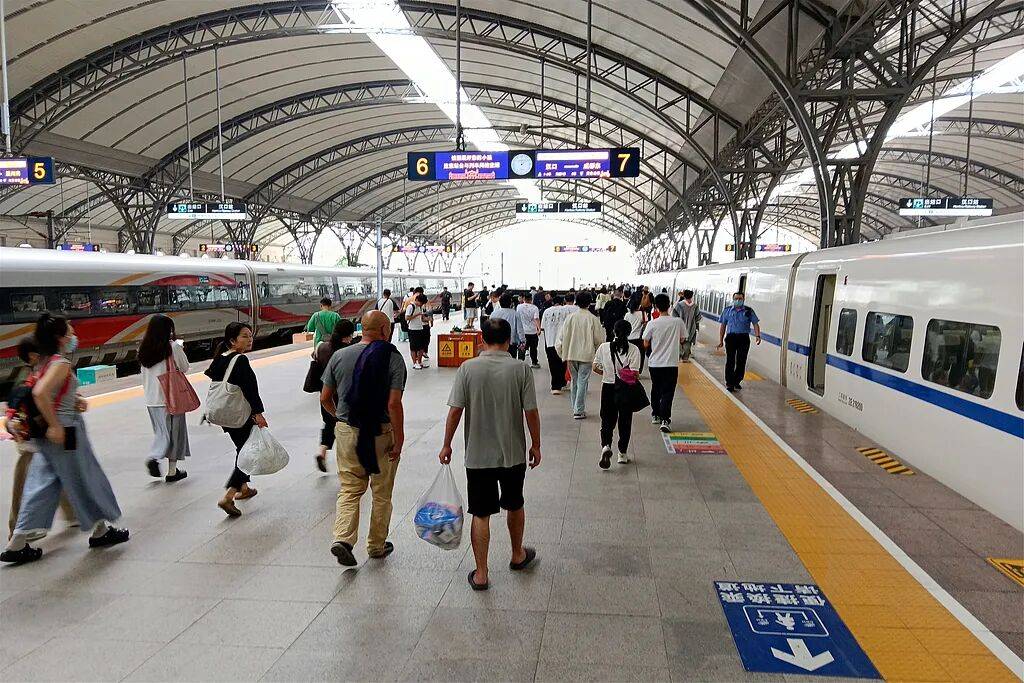
The advantage boundary of high-speed rail has expanded from the traditional “800 kilometers” to the “4-hour direct circle”, and civil aviation has shifted to medium and long-distance routes. But the real way out for both parties is not to compete for passengers from each other, but to jointly expand the travel market through air-rail transport.
Text | Caijing reporter Wang Jingyi
Editor|Wang Yanchun
To travel from Beijing to Shanghai, should I take a 4-hour high-speed train or a 2-hour flight?
Different people have different answers. Some people are afraid of flying and prefer high-speed rail; others are high-level airline members and prefer civil aviation services; some like high-speed rail to run smoothly and the network is basically not dropped throughout the entire process, making it suitable for study and office work; some people find that flights are not more expensive than high-speed rail after discounts, so they decisively buy air tickets.
The Beijing-Shanghai line is about 1,100 kilometers long. It is China’s most profitable transportation “golden line” and is also a key battlefield for fierce competition between high-speed rail and civil aviation.
For a long time, academia and industry have generally regarded 800 kilometers as the boundary between civil aviation and high-speed rail competition. That is, within 800 kilometers, high-speed rail occupies absolute dominance, and beyond 800 kilometers, civil aviation dominates.
However, this traditional distinction is being rewritten by the increasingly perfect high-speed rail network. The latest research released by aviation manufacturing giant Airbus in September pointed out that the operating time of high-speed rail exceeds the distance and has become a decisive factor in passenger travel. In areas that can be reached directly by high-speed rail in four hours, the market share of civil aviation has declined significantly. Overall, high-speed rail diverts 10% of passenger traffic from civil aviation.
While short and medium-distance routes are being diverted by high-speed rail, long-distance routes and cross-border routes have become an unbreakable moat for civil aviation.
Data provided to Caijing reporters by the third-party civil aviation data platform Flight Manager shows that the average distance of domestic civil aviation routes will reach 1,262 kilometers in 2025, compared with 1,163 kilometers in 2019; the proportion of flights on routes below 800 kilometers has been decreasing year by year. , dropped from 25.3% in 2019 to 18.1% in 2025; during the same period, the proportion of flights on routes over 1,200 kilometers increased from 42.4% to 49.2%, reflecting the structural adjustment of the civil aviation industry’s “focus on long distances”.
High-speed rail diverts 10% of passenger flow from civil aviation
For a long time, academia and industry have been accustomed to using “800 kilometers” to draw a line – high-speed rail is within the line, and civil aviation is outside the line. This judgment is being revised simultaneously by intensive research and rapidly changing market realities.
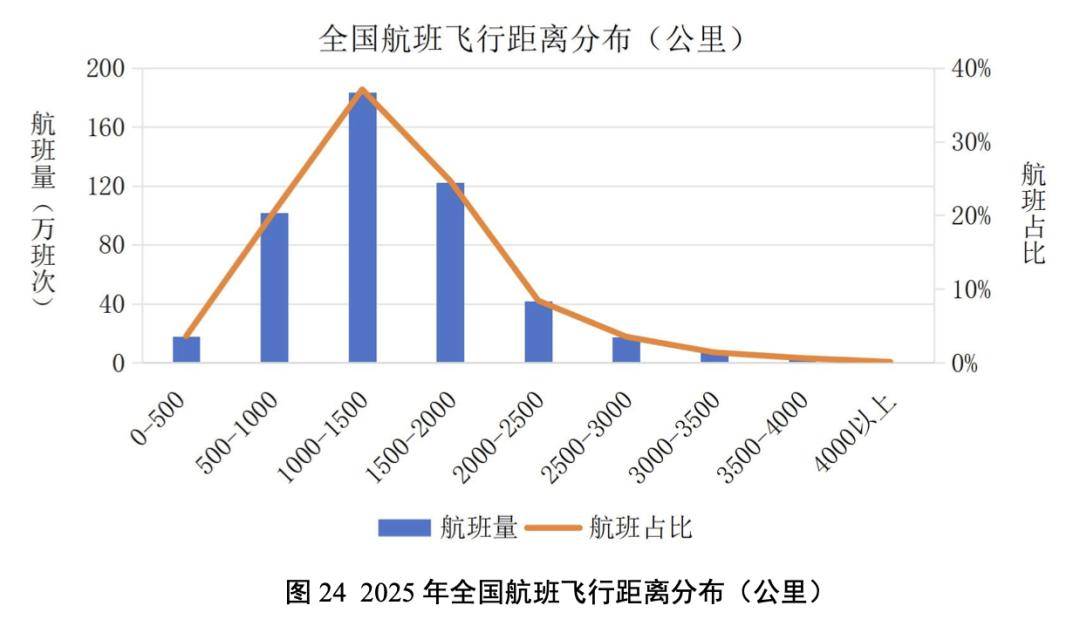
(Data source: Civil Aviation Administration of China’s “2025 National Civil Aviation Flight Operation Efficiency Report”)
According to statistics from the Civil Aviation Administration of China, among all flights in China in 2025, flights between 1,000 kilometers and 1,500 kilometers account for the highest proportion, accounting for 37.09%, followed by 1,500 kilometers and 2,000 kilometers, accounting for more than 20%, indicating that there are more medium and long-distance flights nationwide.
The latest research released by Airbus in September 2026 also reveals the pattern of longer and longer civil aviation distances: in short-haul segments of 600 to 700 kilometers and below, the growth rate of air passenger transport only remains at 1% to 3%; while in the medium and long-distance market of 900 to 1,000 kilometers or more, aviation is still Maintain a high growth rate of 7% to 11.3%; in markets with flight distances of 1,200 kilometers, 1,300 kilometers, 1,400 kilometers and 1,500 kilometers, the growth rates of air passenger traffic reached 9.2%, 9.1%, 10% and 11.3% respectively – the longer the flight distance, the higher the growth rate.
Based on this, Francois Cabaret, head of global aviation market forecasting at Airbus, told Caijing reporters that about 10% of air passenger traffic will be diverted by high-speed rail in the next 20 years, and the aviation industry’s demand for new aircraft will decline. Airbus has fine-tuned its forecast for new single-aisle passenger aircraft deliveries in China over the next 20 years, from 7,950 last year to 7,480, a net decrease of 470 aircraft.
In Central China and East China, which have dense high-speed rail networks, route cancellations are nothing new. Take the latest case: in June 2026, the West 10 high-speed railway will be opened, and the shortest high-speed railway time from Wuhan to Xi’an will be shortened to 2 hours and 41 minutes. In the first month of operation, in the passenger transportation structure of Wuhan and Xi’an, the proportion of railways increased from 74.4% to 80.2%, while the proportion of civil aviation dropped from 15.8% to 7.2%. Ma Ming, general manager of the marketing department of China Eastern Airlines Wuhan Company, said frankly that the ticket price of the company’s Wuhan-Xi’an flight has dropped by 20%, the flight volume has dropped by 47.4% compared with the same period last year, and the capacity and passenger volume have dropped by 55.9% and 55.6% respectively.
As the high-speed rail network is still accelerating its expansion, from 48,000 kilometers in 2025 to the target of 60,000 kilometers in 2030, a new situation in recent years is that provinces that did not have high-speed rail in the past have also opened high-speed rail, directly impacting the civil aviation market. Yunnan is a typical case.
Due to the rugged terrain, the construction cost of roads and railways in Yunnan and other southwestern provinces was extremely high in the past, and they were highly dependent on civil aviation development. The medium and short-distance markets in Kunming-Dali and other provinces are quite prosperous. However, with the continuous expansion of newly built high-speed rail networks such as the Kunming-Dali Line and the Chengdu-Kunming Double Line, the operating time of high-speed rail has been shortened to less than 2 hours. The passenger flow of the civil aviation Kunming-Dali Line, which once had more than 20 flights per day, has gradually reduced to one flight per day, and the Kunming-Guiyang route has been suspended.
A senior executive of a Hong Kong airline company revealed to a reporter from Caijing that the company has operated a route from Hong Kong to Guiyang in recent years. The high-speed rail journey between the two places takes five hours, but there is no direct route. The passenger flow was originally expected to be good, but after the launch, it was found that the passenger flow for tourism and business trips could not support the operation. In the end, the route was canceled less than a year after its opening.
The impact is not limited to the route level. Data show that the passenger flow of Kunming Changshui Airport has been affected by the systematic contraction of the short and medium-haul aviation market, and the national ranking has slipped from 6th in 2019 to 10th in 2025. Although the passenger flow of Changshui Airport is still growing, reaching 49.706 million passengers at a growth rate of 5.4% in 2025, the growth rate continues to be lower than the national average.
The expansion of high-speed rail does not mean the shrinkage of civil aviation
It should be pointed out that the expansion of high-speed rail is not simply equivalent to the shrinkage of civil aviation – during the 2026 summer travel period, the railway carried a total of 954 million passengers, and the passenger volume of civil aviation reached 151 million. The total number of trips exceeded 1.1 billion, both hitting a record high for the same period in history, indicating that the “cake” of China’s travel market continues to grow.
Airbus also predicts that despite the 10% diversion by high-speed rail, China’s air passenger turnover will continue to rise at a compound annual growth rate of 5.2%, requiring more than 8,800 new passenger aircraft in the next 20 years. The number of annual flights per capita in China will increase from 0.5 in 2025 to 1.4 in 2045.
“High-speed rail is actually a good thing for civil aviation.” Li Cunmei, general manager of Airbus China’s marketing department, gave two reasons to Caijing reporters: First, high-speed rail cultivates people’s travel habits. First-time passengers may first take the high-speed rail, but later become civil aviation passengers; second, the high-speed rail network gathers passengers from small and medium-sized cities to hub airports, and for airlines, its ability to attract passengers is stronger.
A latest study also debunks the general statement that “high-speed rail diverts civil aviation.” Yin Hongpan and Cui Yuchen from the School of Economics and Management of Southwest University summarized the data of 35 central cities across the country from 2002 to 2023, and regarded the opening of long-distance high-speed rail in the six major economic zones as a natural experiment. They concluded that the impact of high-speed rail on civil aviation varies from region to region – air passenger flow was significantly suppressed in the central region, while high-speed rail in the Chengdu-Chongqing region promoted aviation growth, while there was no significant change in the three major coastal economic zones and the northeastern region.
The study pointed out that the root cause of the difference lies in location: the closer a city is to the central node of the high-speed rail network and the denser the surrounding central cities, the easier it is for high-speed rail to form network coverage, and the deeper the degree of air passenger flow is intercepted; conversely, it is difficult for high-speed rail to form effective radiation, and aviation is able to maintain its advantage.
Under this logic, four air-rail patterns have been formed across the country: In coastal economic zones such as Beijing-Tianjin-Hebei, the Yangtze River Delta, and Guangdong, Hong Kong, and Macao, high-speed rail and aviation each cover travel needs at different distances, forming a “rail-air parallel” that does not squeeze each other; in the Chengdu-Chongqing region, high-speed rail brings passenger flow from surrounding small and medium-sized cities to the hubs of Chengdu and Chongqing. The market shows that high-speed rail assists aviation. Affected by the dense high-speed rail network, air passenger flow has been significantly diverted in the central region, which is manifested as “rail is strong but air is weak”; in the northeastern region, due to limited regional travel demand, high-speed rail and aviation replace each other in the same passenger source pool, forming a “rail-air transposition” in which roles are reversed.
Both modes of transportation each have unique advantages. Just like the busiest Beijing-Shanghai line, high-speed rail and civil aviation run in parallel. High-speed rail departs every four minutes at the fastest, and flights also fly between the four major airports at intervals of minutes.
Overall, the advantage of civil aviation lies in long distances. When the travel distance exceeds 1,200 kilometers (such as Beijing to Urumqi, Guangzhou to Beijing), the efficiency advantage of civil aviation becomes overwhelming. Air transportation plays an irreplaceable role in cross-border travel such as outbound and overseas travel.
In order to compete for high-quality business customers, the railway sector has frequently “learned” from civil aviation in recent years. From the introduction of high-speed rail “silent carriages” and frequent flyer programs that redeem points for tickets, to business class seats offering meals comparable to first-class flights, exclusive waiting rooms and luggage check-in “light travel” services, high-speed rail is encroaching on civil aviation’s business travel base through refined services.
Subtle changes are also taking place in the fare landscape. In May 2026, the Beijing-Shanghai high-speed railway announced that fares would increase by up to 20%. The highest second-class ticket price from Shanghai Station to Beijing South Railway Station increased from 669 yuan to 802.8 yuan, exceeding 800 yuan for the first time. At the same time, the tax-included fare for the economy class on the Beijing-Shanghai route was as low as just over 400 yuan during the off-peak travel season. After adding the engine fuel cost, the total price is basically the same as that of the high-speed rail second-class seat.
High-speed rail price increases and air ticket discounts go hand in hand, making price competition in the short- and medium-distance markets more complicated. Passengers’ choices depend more on a comprehensive trade-off between time, price, and convenience.
Air-rail combined transport is the way out
Early research focused heavily on substitution effects and competition for market share, but in recent years the research trend is shifting towards cooperation mechanisms and intermodal transport efficiency. The industry is gradually forming a consensus that air-rail intermodal transport is the way out.
Francois Cabaret’s core logic is to introduce hinterland passenger flow in areas covered by high-speed rail into aviation hubs and convert short-distance high-speed rail passenger flow into long-distance air passenger flow, thereby creating incremental demand rather than competing for existing passenger flow. He took Nanjing as an example: Passengers take the high-speed rail to the Shanghai Hongqiao hub, and then transfer to a flight to Urumqi. This is the most efficient solution.
Internationally, air-rail combined transportation around large hubs is becoming more and more popular. There is a high-speed rail station in the terminal building of Paris Charles de Gaulle Airport in France, and more and more passengers are choosing domestic high-speed rail to connect to long-distance international flights. Frankfurt Airport in Germany is also one of the largest aviation hubs in Europe. Its train stations connecting all parts of Germany are also set up in the airport terminal to facilitate the collection and distribution of passengers.
The concept of air-rail combined transport is accelerating in China. In 2025, the Civil Aviation Administration of China and China Railway Group jointly issued the “List of Key Tasks to Promote the High-Quality Development of “Air-Rail Combined Transport” (2025-2027)”, clarifying the construction of comprehensive transfer centers and promoting intermodal transport models such as “one ticket purchase, one pass”. Railway 12306 App has realized system connection with 6 airlines including Air China, China Eastern Airlines, and China Southern Airlines, allowing passengers to “buy tickets once and pay once.”
However, the current pain points of air-rail combined transportation are still prominent. Wang Yu, chairman of Spring Airlines, found that “high-speed rail stations and hub airports are often far apart and cannot be directly accessed. Even if there is an express connection between the two, multiple transfers are required, which is extremely inconvenient.” He suggested that strengthening the “integration of the two networks” of air and rail should be included in the national “15th Five-Year Plan” development plan, promote the “integration of multiple stations into one” in hub cities, and establish railway “airport stations” on main railway lines as much as possible.
Most of the newly built large-scale transportation hubs in recent years have taken air-rail combined transport into consideration. For example, the Wuhan Tianhe Station air-rail combined transport main and passenger station will start construction in 2026 and is expected to be put into use in the second half of 2028; air-rail combined transport hubs in Shenzhen, Shanghai, Nanchang and other places are also under planning and construction, and generally aim to achieve air-rail transfers within 5 minutes.
In addition to the objective limitations of location, inconsistent service standards also pose obstacles. “Caijing” reporters learned that high-speed rail and civil aviation belong to different operating entities. The popularity of integrated services such as “one ticket, direct baggage check, and mutual protection for delays” at the national level is still limited, and the in-depth integration of informatization and ticketing systems still needs to be solved.
Looking at Shanghai, which is doing well in air-rail combined transport, China Eastern Airlines’ air-rail combined transport transfer center at Shanghai Hongqiao Station will serve more than 32,000 passengers and complete more than 20,000 pieces of luggage in 2025. However, there is still room for expansion of the service: currently, only China Eastern Airlines passengers can check in their luggage in advance at Hongqiao High-speed Railway Station. Passengers taking other airlines’ flights still need to carry their checked luggage with them to Pudong Airport before checking it in.
Related Reading
- Original: 4 teachers guard 9 primary school students, they can’t just calculate economic accounts2026-09-25
- The first provincial capital in the north is not “strong” enough?2026-09-25
- At more than 71 yuan per kilogram, beef prices have risen to a new high in more than two years2026-09-25
- The pit of the 10 trillion world copper king is deeper than Evergrande2026-09-24
- From the start of a business to sailing overseas, the “two-way rush” between China Minsheng Bank and specialized new enterprises2026-09-24