At the end of 2025, Merriam-Webster Dictionary awarded the word of the year to the new meaning of an old word: slop. Its original meaning is swill for feeding pigs, but nowadays it is more often used for low-quality content generated in batches by AI. When a word is included in a dictionary, it means that it is no longer an isolated phenomenon, but has become people’s daily life.
In fact, low-quality content has attracted the attention and cleanup of major channels. Spotify removed more than 75 million AI-generated songs; in the nine days after the X platform launched Grok’s photos, users generated 4.4 million pictures, of which about 1.8 million were requests to “change her clothes into a bikini.” This resulted in nearly 10 lawsuits, with model companies, platforms and third-party applications sitting in the dock.
But using swill to describe this matter actually underestimates it. AI content is pouring out day and night, production costs are approaching zero, and supply no longer relies on human creation. What the Internet is facing is not a tank of swill, but a rising water level, or even a flood.
Will we be flooded by cyber floods in the near future? We can choose not to watch just low quality, but the ensuing infringement on “reality” may be more worthy of reflection.
Today “Tiger Sniff” tries to dismantle this complex problem and see if all parties have a solution.
cyber flood
In the past year, a number of new “getting rich tips” have been circulated on various platforms: “Use Agent to collect and rewrite 100 popular articles with one click”, “All-digital live broadcast factory, no human anchor is needed”, “Leave all copywriting and illustrations to AI, quickly spread the account matrix”. It doesn’t matter whether the tutorial is true or not, the accounts inside are true: the cost of a single piece of content is zero, a hundred pieces are generated in batches, and if you win one of the bets, you make money. Invulnerable individually, but together they are a disaster.
The official information at the skit level is even more shocking. In the third quarter of this year, Wang Xiaoliang, director of the Online Audiovisual Program Management Department of the State Administration of Radio, Film and Television, gave data at a press conference of the State Council Information Office: in the first eight months, 430,000 micro-short dramas were launched nationwide, 13 times the number in the whole of last year, of which more than 90% were AI dramas. According to reports, the production cost of high-quality AI simulator short dramas has been reduced to less than 200,000 yuan, which is about one-tenth of the high-quality real-life short dramas. Even short plays, which require the coordination of crews, actors, and types of work, were 90% AI-enabled within a year.
The flooding scene is not difficult to imagine. In the masterpiece modified by AI, Lin Daiyu is uprooting a weeping willow; a digital host is looping the same set of words in the live broadcast room; under the “hand-made video” generated by AI, the most popular comment is asking for a link. The audience cannot tell the truth from the false, and they don’t feel the need to do so. These were the first to be dealt with: the Cyberspace Administration of China’s “Clear Clarity and Censorship of AI Application Chaos” special campaign has disposed of more than 14,000 illegal AI products and cleared more than 5.61 million pieces of relevant illegal information.

when authenticity is violated
Going deeper, it is reality itself that begins to loosen, and this is the most far-reaching impact.
In August last year, a snack brand promoted its product as “selected high-quality peanuts”, but the peanuts in the picture were growing on branches. It is common knowledge in agriculture that flowers grow underground. What’s more important than false propaganda is the kind of future it demonstrates: claims no longer need to be supported by real-world evidence, pictures can be generated, and so can “experience.”
For example, if you check parenting guide late at night and think you are reading a mother’s real record, it is actually a piece of code that has never experienced any life, imitating this tone. You talk to a “net friend”, and the person comforting you may be a program in a certain account matrix. AI generation does not mean fake, real people can also fake, and AI can also help people tell the truth better; the new problem is that experience, identity, relationships, and responsibilities can now be packaged and faked, without a responsible person behind it.
The court has decided this matter. In the country’s first unfair competition case involving AI ghostwritten “grass planting notes”, two apps that provided “one-click generation of popular planting notes” were brought to court by Xiaohongshu, and the court determined that they constituted unfair competition. This is the first time that my country’s judiciary has confirmed that the true content ecology and user trust are protected by law.
Build embankments to divert floodwaters
The question comes back again, will the cyber flood created by AI recede? The answer from all parties is – no. So the question becomes, how to control water?
The “Interim Measures for the Management of Artificial Intelligence Anthropomorphic Interactive Services” implemented in July this year stipulates that AI content must be explicitly labeled, and machine-readable implicit labels must be embedded in metadata. “Excessively catering to users, inducing emotional dependence or addiction, and damaging users’ real interpersonal relationships” is included in the prohibition clause. The law began to protect the very thing “between people.”
In May this year, the National Anti-Fraud Center APP launched the “AI content identification” function. Pictures, videos, texts, and audios can be uploaded for detection, and each person can use it 10 times a day for free.
The platform takes action earlier. WeChat, Douyin, Xiaohongshu and other platforms have upgraded their AI content labeling, requiring creators to proactively declare that AI content will be automatically tagged when the platform detects it. In August this year, Xiaohongshu also expanded the labeling obligation from content to accounts, and AI virtual people must reveal their identities, with an average of more than 300,000 items tagged per day.
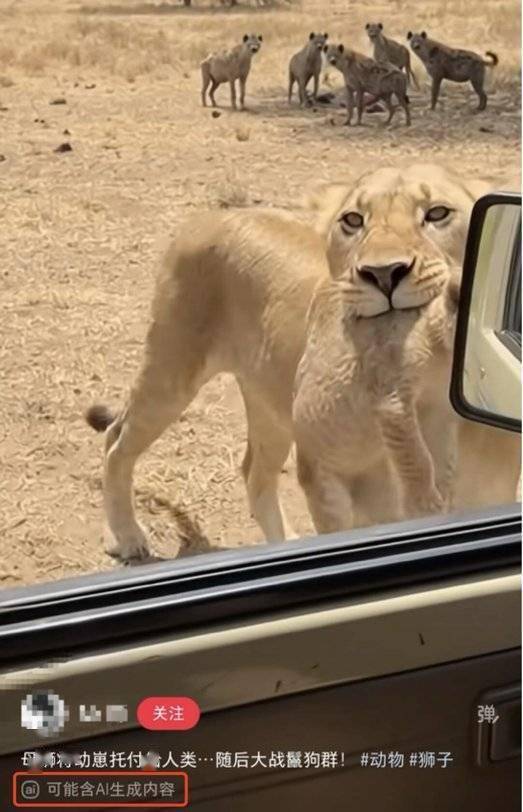
Regarding AI-hosted content, Xiaohongshu has a more determined attitude than other platforms. Xiaohongshu is the first platform to clearly express its crackdown on “AI managed accounts”. Xiaohongshu has announced that it has comprehensively intercepted and accurately identified approximately 3.02 million automated abnormal accounts involving script operations. In response to the recent new trend of “using AI tools to piece together and automatically publish illegal notes in batches” that damages the content ecology, the platform has carried out key crackdowns and accurately targeted approximately 130,000 “AI managed release” accounts. For such illegal accounts that attempt to use automated tools to mechanically operate, batch piece together AI content, and simulate real-person interactions, the platform has severely punished them with account closures or bans, and will resolutely normalize systematic crackdowns.
Carbon-based humanity’s last line of defense
If low quality and custody are already being dealt with, what about AI “faking” with more serious consequences?
Low quality is a matter of volume and aesthetics. Active identification and platform identification allow AI content to enter its own channel and keep swill out of sight.
But fraud is a matter of bottom line and trust: forged experiences, fake identities, changed faces, and fabricated chat records are all added to the mix, and the truth becomes less real.
“True and fake, this is the line between silicon-based AI and carbon-based humans, and it is also the line of defense we should guard.” A scholar who has long observed the AI industry said that some people would think that social platforms would turn a blind eye to AI fraud. After all, traffic is traffic. But in fact, it’s just the opposite—the platform wants the boundary between true and false to be blurred by AI more than anyone else. “Especially for a community like Xiaohongshu that focuses on the sense of living people. Real communication between real people is almost the cornerstone of the community. Such platforms have a stricter attitude towards falsehoods.”
“Huxiu” has also seen that various platforms are also aware of the seriousness of the issue of authenticity. Many platforms have begun to vigorously crack down on AI false content. Xiaohongshu is also vigorously cleaning up and cracking down on “fake notes”. Previously, Xiaohongshu officially stated that it has incorporated the production and release of false content with AI into normal management, especially the identification of high-risk scenarios with AI-generated pictures to forge real scenes, AI batch-generated homogeneous experience notes, and fictitious personal experiences. Categories such as cultural and tourism accommodation, medical beauty, education, and real estate are prioritized for coverage. From June to August this year, the platform cleaned up and disposed of nearly 120,000 false notes produced and published by AI.
Dayu controlled floods for decades. His method was not to block the water, but to find a way out for it. To deal with cyber floods, it seems that the same principle as the ancient Chinese can be followed: leaving river channels for AI and guarding dams for reality.
Related Reading
- More people are sending AI to fight their customer service battles2026-09-25
- Why “exclusive franchise” is the choice of the times2026-09-25
- Who needs a pair of AI glasses during Golden Week?2026-09-25
- Original Muxi shares staged a tens of billions of hands changing drama2026-09-25
- Original AI short drama’s myth of getting rich, the fever subsided in half a year2026-09-24