Can AI escort glasses be a good travel companion?
撰文/ 李覲麟
編輯/ 李 季
排版/ Annalee
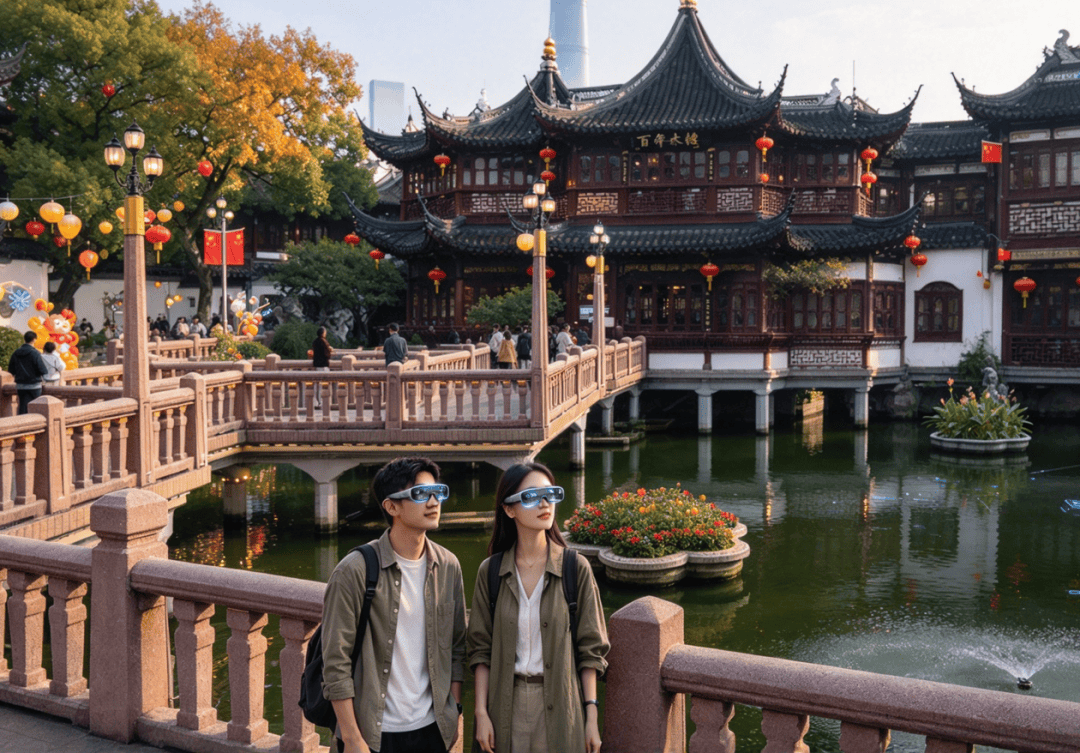
Recently, there has been a group of “weird” tourists in Shanghai.
Wearing the same AI glasses, they stopped at the Jiuqu Bridge. Without even taking out their mobile phones, they heard the story of the century-old Huxinting Tea House. Passing by the entrance of Nanxiang Steamed Bun Shop, they muttered something, then walked straight into the shop and took away the Xiaolong they had just ordered.
Prior to this, iFlytek’s AI glasses had become popular in the outbound travel circle with its real-time translation function for cross-border travel. Many outbound travelers regarded it as a necessary piece of hardware for overseas travel.
On the one hand, there are real-life cultural tourism pilots in domestic city blocks, and on the other hand, the consumption of cross-border tourism scenes is booming. The two phenomena are superimposed, and a proposition of great industrial discussion value is thrown out: Will AI glasses break out of the geek circle and become a universal travel companion for ordinary tourists?
For a long time, AI glasses have always been in an awkward industry position. Travel is likely to be the first killer scenario for AI glasses to break through. But being usable does not mean that it is popular. Is the story of travel companions a beautiful marketing narrative by hardware manufacturers or a real turning point in the commercialization of wearable devices? The upcoming prime time is a window for investigation.
From explanation, translation to consumption, what kind of AI glasses do users need?
Most tourists know the pain of holiday travel. When walking in a scenic spot, you have to hold your mobile phone in one hand to read the navigation and read the guide in the other hand; when you see an ancient building and want to understand the history, you need to hold up your mobile phone to take a photo to identify and switch to search software; when traveling abroad, you cannot understand the menus and street signs, and you have to repeatedly click on the translation software to communicate; when you encounter the details of the attractions you are interested in, the mobile phone screen is small, and you have to look down at the screen while walking, which not only fragments the tour experience, but also poses safety risks.
Smartphones solve the problem of information acquisition, but their hands are occupied and their eyes are forced to switch back and forth between the screen and the real scenery. This is an unavoidable pain point with existing travel tools.
The Shanghai Yuyuan pilot program shows us another tourism paradigm. When tourists put on Qianwen AI glasses and walk in front of Huabao Tower, the glasses will introduce the architectural features; when they walk to the Maritime Pear Garden, the content turns to opera culture; when they pass by the Huxin Pavilion, the history of this century-old tea house rings in their ears.
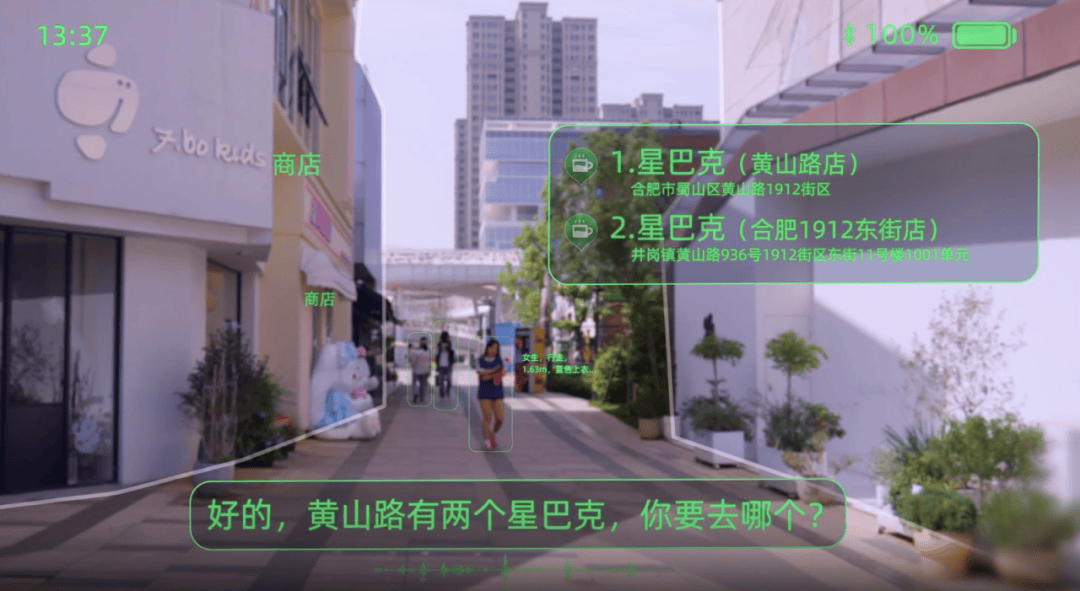
AI glasses usage scenarios Source: AIUI official website
The biggest difference between this interactive logic of “talking wherever you go” and traditional audio tours is the initiative. Traditional tours require users to scan codes, enter numbers, and click play. In essence, people are still looking for services. andNow after continuous iterations, AI glasses have begun to complete the experience of finding people for services. The device knows where you are standing, what direction you are facing, and what you were asking just now, and then proactively sends the corresponding information.。
Not only that, tourists can also place orders directly through their glasses and pick up their meals at the store. From seeing the store to completing the purchase, there are no steps to switch apps, search for prices, or jump to payment. This link requires at least four or five steps in the traditional mobile phone scenario, but is compressed into a password in the glasses scenario.
The technical base that supports this experience is the GPASS framework developed by Ant Group. This framework was first released at the Bund Conference in 2025. It was previously integrated with the summit’s intelligent “Tong Xiaowu” to provide services such as route navigation, voice explanations, information push, convenient payment, real-time translation and intelligent consultation through AI glasses. In May this year, the city escort function was launched in Hangzhou. Later, the integration of GPASS and the intelligent “Fu Xiaocuo” also realized functions such as voice question and answer, building recognition, route planning and story telling.
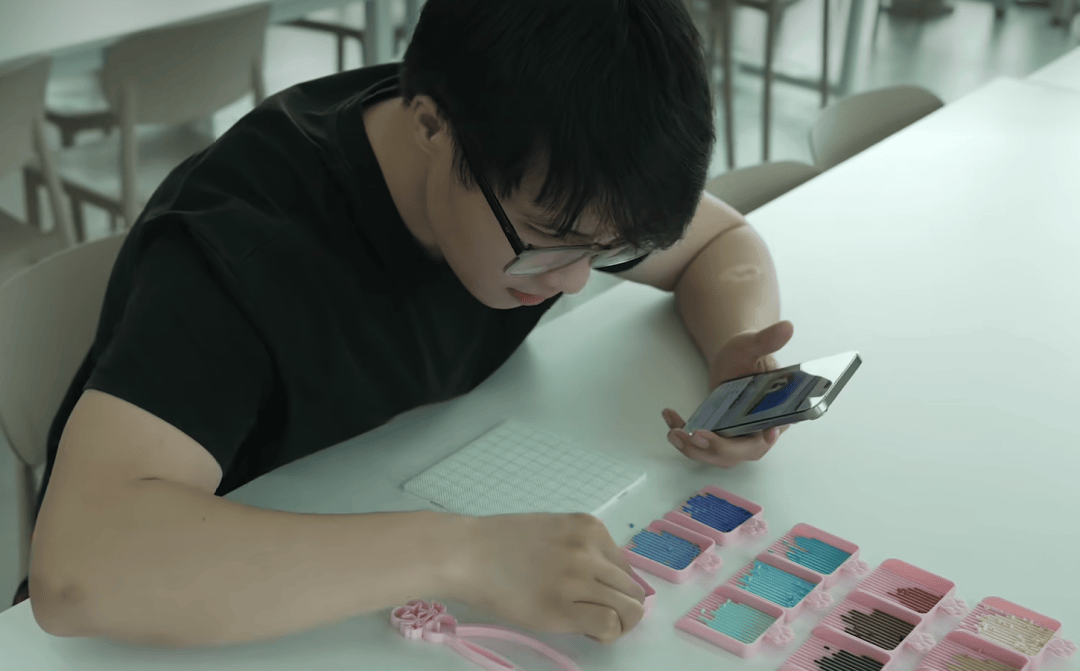
Color-deficient blogger “Ti Ke” transforms AI glasses to complete Doudou
On the outbound travel track, the popularity of iFlytek AI glasses also hits the pain points of real users. Many outbound travel consumers shared that in the past, when traveling to many European countries, restaurant menus, subway signs, and museum exhibit descriptions had to be lifted up to take photos and translate with their mobile phones, which was very inconvenient to operate while walking. The AI glasses can directly recognize the text in front of you, the translation is displayed on the lenses, you can have face-to-face conversations, real-time subtitles are displayed simultaneously, and rely on multi-microphone arrays to complete sound pickup and noise reduction in noisy environments. They support hundreds of language translations, and can also complete basic translation work in offline mode.
Behind the two types of scenes, two types of models for AI glasses to enter the tourism scene emerge. The first category is domestic in-depth tourists, mainly young groups and family tourists, who pursue immersive tours, are tired of checking in and clocking in, and hope to receive flexible and personalized explanation services. The second category is outbound travelers, people on business trips and outbound tourism. Their core demand is cross-language barrier-free communication.
Triple bottlenecks restrict the popularization of “travel partners”
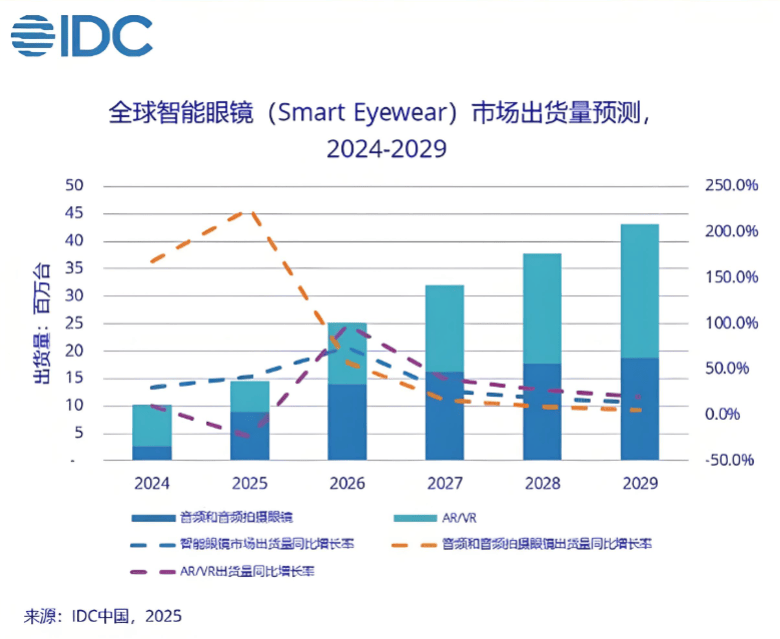
The market and consumers are full of expectations and imaginations for AI glasses. Omdia data shows that in the first half of 2026, mainland China’s AI glasses shipments surged 306% year-on-year, and domestic manufacturers accelerated their breakthrough; Morgan Stanley predicts that global AI glasses shipments are expected to hit 35 million pairs by 2028, and the industry’s year-on-year growth rate remains high.
However, behind the rapid growth, the base is still very small. Compared with the annual shipment of more than one billion smartphones, AI glasses are still in the introduction stage. Even if the needs of the tourism scene are clear, if the product wants to enter the backpacks of millions of ordinary tourists, it still faces three practical bottlenecks of hardware, content ecology, and business model.
The first bottleneck is the hardware “impossible triangle” that has been difficult to crack in the industry for a long time.: Weight, battery life, and display performance compete with each other and directly determine the quality of the travel experience.
For travel, wearing comfort is the first threshold. When going out to visit scenic spots, if the glasses weigh heavily on the bridge of the nose, the experience of wearing them for a long time will deteriorate sharply. Although domestic AI glasses have achieved breakthroughs in lightweighting, with many products weighing around 40g and weighing close to ordinary frame glasses, as long as they are equipped with optical waveguide display screens, the weight of the entire machine will increase significantly.
Battery life is the fatal shortcoming of outdoor travel. For consumer-grade AI glasses with display screens, most current mainstream products can last for 25 hours with a single continuous use. A complete city tour and a full-day sightseeing tour can easily take 68 hours, and the battery life is not enough to support a full-day trip.
At the same time, interaction reliability in noisy environments is also a hard test in travel scenarios. “I have tried that the translation effect is really good in quiet scenes such as homes and conference rooms before, but if I go to places with loud environmental noise such as outdoors, shopping malls, and scenic spots, the recognition accuracy will drop significantly.” Vicky, who often travels abroad and travels on business, told Zinc Scale, “The deterioration of network information will also lead to increased delays and lags in responses. This is often the case when traveling abroad.”
The second bottleneck is the insufficient ecological supply of cultural and tourism content. Now that the hardware is available, there is a huge gap in high-quality localized service content.。
The smooth operation of the Yuyuan pilot project does not rely solely on a pair of hardware glasses. It is supported by multiple sets of services such as the GPASS intelligent body frame, the geographical location, and the local historical database. The hardware is just an output terminal. If you switch to other ordinary urban scenic spots, most places have not completed the construction of this set of digital content.
In the current market situation, hardware products are emerging one after another, but the construction cost of cultural and tourism vertical content is high. If you want AI glasses to travel normally in an ancient city or neighborhood, you can’t just tell a story casually. You need to input a lot of information and do a lot of localized manual verification. General large models can easily output wrong historical knowledge points and mislead tourists. However, every time a new cultural tourism location is added, the content team needs to do refined processing, which costs a lot of labor.
In comparison, traditional mobile phone applets and public account smart tours have low deployment costs, can be used by tourists just by scanning the QR code, and do not require hardware modifications. As for AI glasses city escorts, the hardware, content, and technical framework are coordinated by multiple parties, and the entire implementation cost is higher.
Hardware is the skeleton, and cultural tourism content is the flesh and blood. If the content ecology cannot keep up, no matter how advanced the hardware is, it is just an empty shell.
The third bottleneck is the dilemma of the business model. Individual purchase costs are high, and the public rental model is difficult to replicate profitably on a large scale.。
At present, the retail price of mainstream consumer-grade AI glasses with screens ranges from 2,000 yuan to more than 10,000 yuan. In order for most ordinary tourists to purchase additional equipment for the few trips a year, the threshold for consumer decision-making is actually very high.
However, the rental models piloted in various scenic spots also face business difficulties. Rental operations in scenic spots require the purchase of a large amount of hardware equipment, as well as ongoing costs such as equipment maintenance and personnel management. During holidays, the passenger flow is overcrowded, and the supply of equipment exceeds the demand. During the non-tourist season, a large number of glasses are idle, and the asset utilization rate is low.
However, despite the current shortcomings, the huge imagination space presented by AI glasses in the cultural and tourism industry also brings hope to the entire industry.
Looking back at smartphones, they were not originally designed for travel. They are frequently used in communication, social networking, entertainment, and payment, and travel is only one of the application scenarios. In the same way, travel can be a stepping stone for AI glasses to break through the industry, but it cannot be the whole story. If the industry only defines AI glasses as “travel artifacts”, the ceiling will be obvious.
Related Reading
- More people are sending AI to fight their customer service battles2026-09-25
- Why “exclusive franchise” is the choice of the times2026-09-25
- Who will stop the cyber flood from flooding the world?2026-09-25
- Original Muxi shares staged a tens of billions of hands changing drama2026-09-25
- Original AI short drama’s myth of getting rich, the fever subsided in half a year2026-09-24