Introduction: During this National Day holiday, robots appeared in official consumption data for the first time in a way that is closer to “consumer goods”.
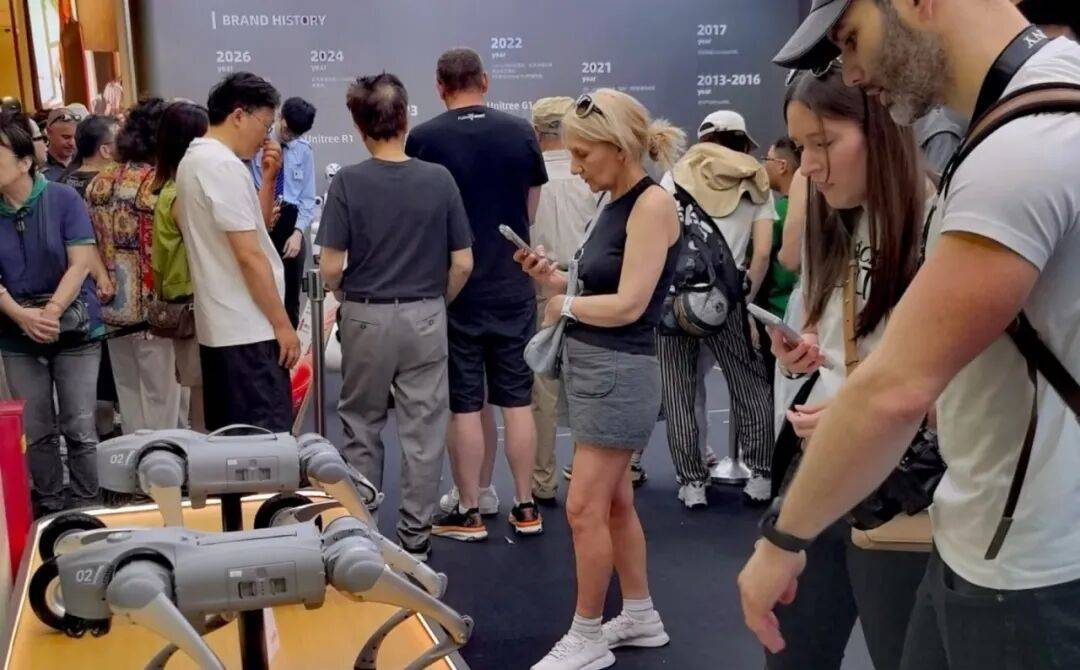
On October 7, business big data released by the Ministry of Commerce showed that from October 1 to 6, sales of embodied intelligent robots on key platforms increased 1.3 times year-on-year. As a reference, during the same period, sales of smart glasses doubled, exoskeleton boosters increased by 12.8%, and outdoor sports equipment increased by 10.4%.
If you only look at the 130% growth rate, this can easily be understood as another beautiful story about robots.
But what really deserves the attention of the capital market is not that robots are selling better, but the most difficult question surrounding this industry in the past two years—whether there is real demand for robots.
Judging from this National Day holiday, this issue has been verified with data from the consumer side for the first time.
Moreover, this is not an isolated National Day phenomenon.
The Ministry of Commerce previously disclosed that in July this year, sales of embodied intelligent robots on key platforms increased by 95.1% year-on-year. In other words, before the National Day holiday, robot consumption has shown signs of continuous growth.
This makes the humanoid robot market in 2026 different from before.
In the past, investors discussed when Tesla would mass-produce, which company would enter the supply chain, how much the lead screw was worth, and how many reducers a robot would use.
Now, a more realistic question is put on the table – if people really start buying robots, where will the first batch of money go?
01 Sample from Yizhuang, Beijing
In the past few years, the most indispensable thing for the humanoid robot industry is demonstration.
Robots can run, do somersaults, dance, and punch, and are increasingly attracting crowds at exhibitions.
China has become one of the most intensive markets for humanoid robot products in the world. The Ministry of Industry and Information Technology disclosed in July this year that in the first half of the year, my country’s complete humanoid robot products have reached more than 400 models, more than half of the world’s total.
The number is growing rapidly.
But “making it” and “selling it” are never the same thing.
For a new hardware industry, the really hard part usually happens after the lab.
Technicians need to solve reliability, factories need to solve yield, suppliers need to reduce costs, and end users need to answer a simpler question: Why do I need it?
This is also the valuation paradox that humanoid robots have faced for a long time in the past.
The capital market can price the robot industry chain based on the market space in a few years or even more than ten years, but it is difficult for companies to immediately provide income that matches this valuation in today’s financial statements.
Just because a robot can run a marathon doesn’t mean someone is willing to pay hundreds of thousands of dollars for it.
The fact that a robot can sort clothes does not mean that it is already more economical than a traditional robotic arm or a worker.
Therefore, the most important change in the robot industry this year may not be how much progress has been made in motion control, but that more and more robots are beginning to enter a place they were not familiar with before: the checkout counter.
Beijing Yizhuang is a good microcosm.
During the first E-Town Robot Consumption Festival in 2025, more than 190,000 robots and related products were sold, with overall sales exceeding 330 million yuan; robot consumption coupons directly drove sales of more than 70 million yuan. Relevant disclosure data also shows that within 16 days of operation of the embodied intelligent robot 4S store, there were multiple million-level orders, and the proportion of orders above 1 million yuan reached 25%.
This year, we will continue to expand.
In 2026, E-Town’s special funds for robot consumption promotion will be increased from 15 million yuan to 18 million yuan, a new 9,600 square meters of robot consumption blocks will be added, and more than 50 types of robot experience equipment covering education, elderly care and home scenarios will be launched.
Behind this is actually a very typical logic for cultivating new consumer products: let consumers see it first, then let them experience it, and finally buy it.
New energy vehicles have gone through a similar process, and so have smartphones.
But for robots, the process is much more difficult.
Because today, a large number of people who buy robots are still from enterprises, schools, scientific research institutions, scenic spots, shopping malls and government scenes, rather than ordinary families.
Even though the so-called “robot consumption” is growing rapidly, we must pay attention to an easily overlooked caliber issue: the Ministry of Commerce disclosed that the sales of “embodied intelligent robots” increased by 1.3 times. This is not equivalent to “the sales of humanoid robots increased by 130%”, nor does it mean that humanoid robots worth hundreds of thousands of dollars have begun to enter households on a large scale like mobile phones and cars.
In fact, the robots that currently run really fast are still those robots with clear tasks and relatively standardized scenarios.
For example, Xinhua News Agency reported during the National Day that a wheeled humanoid robot store in a cultural and creative park in Hefei can independently complete product identification, grabbing and delivery. The average daily orders during the holiday are about 100, and the single-day turnover is about 1,500 yuan.
That’s not a huge number, but it’s probably more important than a single robot backflip, because it means the robot is starting to move from being a “technology showcase” to being a “production tool,” and it’s starting to generate revenue.
For the robotics industry, what lies between the two is the real commercialization gap.
02 Humanoid robot “disenchantment”
When a new hardware industry begins to increase its volume, the most common mistake the capital market makes is to treat all industry chain companies as the same story.
In fact, from smartphones to new energy vehicles, the companies that make money stably in the early stages of industry development are often not necessarily the terminal brands that attract the most attention.
Sometimes it’s a chip company, sometimes it’s a battery company, sometimes it’s a connector, optics or precision manufacturer.
The same may well be true for robots.
The reason is not complicated.
Today’s humanoid robots are still in the rapid iteration stage.
The shape is changing, the number of joints is changing, the transmission scheme is changing, the dexterous hand scheme is also changing, and even “whether it must be made into a human form” itself has not yet formed a final answer.
At this stage, it is difficult to judge the winner of the complete machine brand.
But some needs are relatively certain.
If robots need to move, they need actuators; if they need high-precision control, they need reducers, screws, and motors; if they need to interact with the real world, they need vision, force, and tactile sensors; if they want to truly enter the factory, they must solve lifespan, cost, and reliability.
This is why the robot market has reached today. What is increasingly worth watching is not whether a certain company announces its “deployment of humanoid robots”, but three more specific questions: Has it entered the supply chain? Are there any bulk deliveries? How much did the robotics business contribute?
Green Harmonics is a sample of this change.
The company has achieved batch delivery of head robots to international customers, and its overseas revenue in the first half of the year increased by 78% year-on-year.
This is a different stage than simply getting a “sample delivery” or “fixed location” or signing a strategic cooperation agreement.
Because after batch delivery, the logic of a robot parts company truly shifts from theme investment to production investment: every more complete machine produced means more demand for reducers, motors, sensors or actuators.
The more robots are sold, the more obvious this scale effect becomes.
Cobos provides another worthy reference.
Although sweeping robots and service robots are not the same as the most popular humanoid robots at the moment, they at least prove one thing – only after product definition, cost control, and channel laying are completed, robots can become real consumer electronics products.
According to Ecovacs’ 2026 semi-annual report, global shipments of Ecovacs-branded service robots increased by 44% year-on-year, and overseas revenue accounted for more than 50% for the first time in the second quarter.
The difference between these numbers and “robots can dance” is the business model.
When a product truly reaches the market, what ultimately needs to be answered is not the technical parameters, but: How many people will buy it? How much does it cost? What is the gross profit margin? How often should it be replaced? Will consumers use it after buying it?
It is here that more and more obvious differentiation will appear within humanoid robot concept stocks.
Hongxin Technology is a typical negative observation sample.
The company has signed a parts procurement framework agreement with a domestic head-embodied intelligent robot company and received a small-batch purchase order for humanoid robot structural parts.
If you just look at this sentence, it has almost all the elements that make robot concept stocks most popular in the market: head customers, embodied intelligence, humanoid robots, and orders.
But keep looking down at the financials and the story cools down quickly.
The company disclosed that related businesses will only begin to generate sales revenue in June 2026. In the first half of the year, revenue from robot parts was only 164,000 yuan, accounting for 0.03% of operating revenue in the same period. The company itself has also made it clear that the business is still in its infancy, and there is great uncertainty about customer fixation and the pace of mass production.
164,000 yuan, this number may be one of the most valuable data for understanding the current robot market.
It tells investors one thing: there is still a long way between entering the robot supply chain and robots truly becoming a source of profit.
And this distance is likely to become the biggest valuation watershed in the next stage of the robotics sector.
Previously, the market was willing to give a high premium to “0 to 1”.
As long as a company has robotics technology reserves or gets customer verification, the market will begin to trade in future large-scale mass production.
But when the entire industry truly begins to reach the scale of 10,000 units or more, the evaluation criteria will change: “Is there any” will gradually become “how much”; samples will become orders; orders will become deliveries; and deliveries must eventually turn into revenue and profits.
At that time, a company’s robotics business accounts for 0.03% of revenue, or 3%, or 30%, and the valuation system is completely different.
03 Countdown to the launch of “10,000 units”
In June this year, the Ministry of Industry and Information Technology and the State-owned Assets Supervision and Administration Commission of the State Council jointly launched a special action for real-life training of humanoid robots and embodied intelligence.
The document states that by the end of 2026, key products such as humanoid robots will have completed application verification and normal deployment in a number of representative scenarios, and condensed into more than 100 high-value application scenarios, leading to the formation of a 10,000-unit scale implementation capability.
“Ten thousand units level” is a very important word.
Because from the perspective of the capital market, the truly dangerous stage for the robot industry may not be the end of mass production, but the beginning of mass production.
When there is no mass production, each company can talk about its own technical route.
Once in volume production, price, cost, yield, reliability and delivery capabilities start to speak.
This is a test that all manufacturing industries ultimately cannot escape.
CCTV News quoted the “2026 Humanoid Robot Industry Development Report” as saying that in the first half of this year, China’s humanoid robot shipments have exceeded 40,000 units, and the global share has increased to 97% (the statistical caliber of the industry report includes products such as wheeled humanoids, and the statistical scope of different institutions varies). In 2025, according to market research data released by the China Electronics Society and others, my country’s humanoid robot shipments will be approximately 14,400 units.
No matter how different the product calibers of different statistical agencies are, one direction is quite clear: the number of robots is increasing rapidly.
The real question then is where to send these robots.
If most robots still stay in laboratories, schools, exhibition halls and data collection fields, then the industry will still mainly solve the problem of “how much to produce”.
Only when robots continue to enter automobile factories, 3C production lines, warehouses, shopping malls, elderly care institutions and even homes will the industry truly enter the “value creation” stage.
This is why the Ministry of Industry and Information Technology has focused on real-life scenarios such as production and manufacturing, testing and analysis, repair and maintenance, warehousing and logistics, catering and retail, medical and health care, production safety and emergency rescue in its latest special action.
The policy objectives have actually undergone a subtle but important change.
In the past, the emphasis was on what robots could do; now the emphasis is on whether robots can do it for a long time.
This means that the robotics industry is moving from an engineering problem to an economics problem.
Assuming that a robot costs hundreds of thousands of yuan and can work continuously for several years, is it cheaper than human labor? How often are repairs performed? How often does the battery need to be replaced? Will a failure in a complex scenario cause the entire production line to be suspended? For the same action, is the success rate 99% or 99.99%?
These questions, which may not seem as eye-catching as somersaults, ultimately determine whether the robot has a real order.
It also determines the next round of reshuffle of the A-share robot industry chain.
In the past two years, the two most valuable words in the robotics sector have been “enter”.
Enter the Tesla supply chain; enter the head robot manufacturer; enter sample delivery; enter verification.
But in the next few years, the two most valuable words may become: “increasing volume.”
Because only by increasing the volume can the profit assumptions behind the market value of billions or tens of billions of yuan be realized.
This is why the significance of “sales of embodied intelligent robots increased by 1.3 times” during the National Day cannot be understood as just a holiday consumption data, it is more like a signal for the switching of the entire industry valuation system.
In the past, the market bought technical possibilities; next, the market will start to buy business results.
In this process, the robot sector will not become easier to invest in due to increased sales, but may become more difficult.
Complete machine companies must prove that their products are continuously used by people, not just purchased for display; component companies must prove that their orders can grow from hundreds of sets to tens of thousands; traditional manufacturing companies must prove that robots are not a new story accounting for 0.03% of revenue in annual reports.
The company that ultimately remains may not be the one that has released the most robots, nor may it have the sexiest story in the capital market.
It’s about companies that can do three things: the robots really sell; customers really buy them again and again; and the company really makes money every time it sells one more robot.
During the National Day holiday in 2026, robots seemed to have finally taken the first step—people began to buy robots.
But for capital markets, the real story is just beginning now.
Related Reading
- This year’s Nobel Prize, both AI and experts guessed wrong2026-10-09
- Original AI game, Game of Thrones2026-10-09
- A hand-made variety show with a local flavor is earning 500,000 yuan a month.2026-10-09
- How hard should you press the brake pedal of a million-dollar luxury car to be considered “overstepping”?2026-10-09
- Where is the “last mile” of enterprise AI implementation stuck?2026-10-08