Integrating AI into games is not a new topic.
As early as 2005’s “Extreme Panic”, Monolith Productions introduced AI technology to give the enemies in the game a certain degree of thinking ability.
Not only will they communicate with each other through simple instructions, they can also judge threats based on the player’s behavior, and even use maps and weapons to perform tactical operations such as outflanking.
But have you ever thought that one day, we won’t even need a game engine and can automatically generate games just by relying on large AI models?
No need to think about it, because it has become a reality.
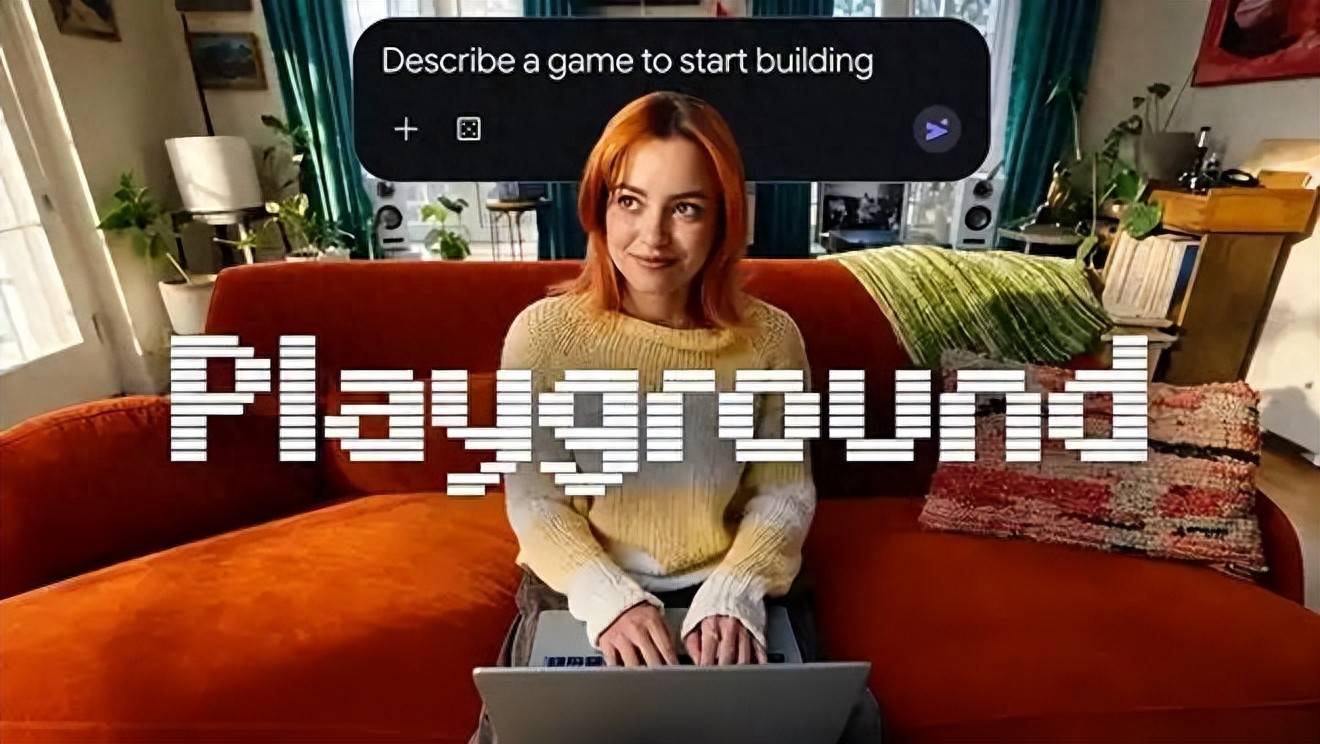
On the 7th, according to media reports, Google and the game engine company Unity announced a strategic cooperation and will jointly launch an AI game platform for the next generation of interactive entertainment.
The announcement shows that Playground, an experimental platform launched by Google, has been launched. Users can generate and customize playable games through natural language prompts without writing code.
The two parties also plan to launch Unity Spark, a creation product based on the expansion of the platform later this year, providing creators with richer 3D development capabilities and professional-level game production tools.
Overseas giants have joined forces to enter the game, once again pushing the AI game platform into the spotlight.
However, the issue of infringement of AI games has also surfaced.
Recently, the free browser game “Fallout: New York” developed by AI was officially offline.

The game is a browser game built entirely on code generated by Claude Opus 5.5.
Producer Chris First said the entire development process took only five days, and everything was generated by code.
On September 28, Chris Furst released the “Fallout: New York” project demonstration video on the X platform. The video subsequently received approximately 3.5 million views and was quite popular.
Subsequently, on October 1, Chris Foster posted a screenshot of a suspected infringement suspension notice on the X platform and officially announced the termination of the “Fallout: New York” project.
In China, a race around AI gaming platforms has already quietly begun.
Recently, domestic game companies have made intensive moves in the field of AI game platforms. From leading manufacturers to start-up companies, they have launched self-developed platforms, covering game creation, R&D efficiency improvement, UGC ecology and other directions.
Tencent’s layout is the most systematic. Its AI game creation platform “Codename Craft” was officially named “Youdianling” in September, and many zero-based developers completed playable game prototypes within two days.
Xindong Company, which owns the well-known gaming community TapTap, also produced impressive data. After launching the AI game creation agent TapTap Maker invitation test in January 2026, users have released more than 6,000 games through this tool.

Earlier, MiHoYo’s large model Glossa also completed the domestic generative artificial intelligence service registration in 2024, positioning itself to serve the entire process of game production.
In addition, there is still controversy in the industry as to whether AI games will become native games (completely AI-driven plot) or AI will participate in production (talent is the director).
The launch of various AI game platforms has made how far AI games can go become a new gold-mining topic.
What problems remain to be solved in the business model of AI-native games?
How does the AI game platform lower the threshold for creation while taking into account content quality and creator ecology?
How do you view the future development trend of AI game platforms?
In this regard, Dahe Cai Cube reporters Wang Yu and Shu Le had some exchanges. I think:
AI games are definitely a future trend, but they are games from big companies.
There is not much time left for ordinary creators to advance to the big companies and be included.
Let’s first take a look at AI-native games to see if they can become a gold mine. Here’s what I think:
There are three commercial difficulties in AI-native games:
One is that the completion of the script is questionable.
The original plot is most likely not as good as the screenwriter. It seems that there are thousands of people with different faces, but the “storytelling AI” may only be able to tell a good story occasionally, and the gaming experience of the vast majority of players cannot be guaranteed.
The second is that the AI’s reading comprehension ability is questionable.
Artificial intelligence’s ability to understand long texts is prone to fragments, making it difficult to achieve a complete story.
The third is that the computing power supply capacity is questionable.
AI-native games require real-time computing power to provide calculations to ensure real-time game experience. Even if the reading comprehension ability is passed and the screenwriting level is excellent, under the premise of tight computing power and high price, the cost of supporting the game may become a “money-burning game.”
At the same time, AI game platforms are actually leading AI to participate in the production of games, rather than AI native games. This is the general trend of the industry.
The AI game platform currently lacks the ability to truly achieve AI-native games and is basically just an AI companion chat.
But AI technology is making it possible for AI to fully produce games, that is, through limited pictures, videos and long enough text narratives, it is possible to achieve an AI-generated stand-alone game.
If the AI game platform wants to make breakthroughs and ensure creative enthusiasm, it needs to achieve the following three points:
The first is to iterate tools in real time so that creators can make games without programming.
The third is to guide some creators to create a hundred flowers blooming on popular themes or vertical themes through themed AI game competitions.
In addition, AI games are bound to be a future trend.
However, games are full-chain digital media and are the best training ground for AI to participate in the entire chain. However, most of them are only used as plug-ins for game development and operation.
The entire industry has yet to see the implementation of disruptive innovative AI.
The AI game platform is actually the same as previous independent game platforms. It mainly provides release scenarios and convenient production tools (similar to game engines) to reduce the difficulty of game creation.
This requires strong technical support, rather than just relying on calling external large models or deriving intelligent agents from large models.
It can be seen that the future of AI game platforms will still be “games from big manufacturers”.
Related Reading
- A hand-made variety show with a local flavor is earning 500,000 yuan a month.2026-10-09
- How hard should you press the brake pedal of a million-dollar luxury car to be considered “overstepping”?2026-10-09
- Where is the “last mile” of enterprise AI implementation stuck?2026-10-08
- Original Xiaomi lost 970 billion, is Lei Jun the last card left?2026-10-08
- The second generation bean bag mobile phone has not solved the old problem2026-10-08