Looking back on the timeline, the progress of enterprise AI upgrades is not slow.
In 2023, the first year of large models, a war of hundreds of models has begun in China, and companies have begun to think about what large models can do. In 2024, large model capabilities will be rapidly iterated, and enterprises will begin to try to access AI capabilities, with intelligent question and answer, document assistant and other applications being launched internally. In 2025, the concept of intelligent agents will explode. Since September last year, companies have begun to explore the integration of AI into core production processes.
By 2026, Huo Jia, vice president of Alibaba Cloud Intelligence Group, judged, “This is the first year that Agentic AI applications will truly explode. The core task of enterprises is to promote the implementation of AI applications.”
But the reality is that most companies are stuck in the last mile of AI implementation.: From “available” to “entering production”.
The reason behind this is that enterprises implementing AI have to face their internal systems, permissions, data, equipment and business rules that have been running for many years. This means that if AI wants to truly enter the production process, it is not a matter of adding another entrance, but it must enter this complex system.
Let intelligence enter business
The digitalization of enterprises in the past two decades has mainly solved the problems of process onlineization, data accumulation and system collaboration. But the situation faced by AI today is different. The enterprise is not a blank sheet of paper. ERP, MES, DCS, and OA have already taken root within the enterprise. When AI enters the interior, it cannot overthrow it and start over, but it must also find a suitable incision, making it more difficult to land.
From digitalization to intelligence, the most prominent change is the role of systems in business. Digitization is centered on data connection and business reconstruction. Data is the basis for analysis, and decision-making subjects are people, relying on information systems and networks;Intelligence takes algorithmic reasoning and automatic decision-making as its core. Data becomes the raw material for decision-making, and the decision-making subject becomes machine-assisted or autonomous decision-making, thereby completing the digital base and AI algorithm.

However, most of the existing digital architecture of enterprises is designed for process solidification and system control. ERP manages resources, MES manages production, DCS manages control, and OA manages processes. Each system operates efficiently in its own field. The system is accustomed to converting known rules into standard actions, but it is not necessarily good at dealing with complex scenarios with fuzzy rules, cross-system reasoning, and reliance on expert experience. This is exactly the problem that AI must face when it enters the production process.
More importantly, these systems themselves do not proactively prompt AI on what data should be retrieved at the business site, which systems should be switched, who should be responsible for decision-making, and what it means if an exception occurs. The above-mentioned problems have little to do with whether large models are smart and cheap.
In addition to system-level obstacles, the construction model itself also poses resistance. Huo Jia told Photon Planet that traditional AI project construction is to plan the process first and then start construction. But today, model-related technologies are changing with each passing day. From context engineering at the beginning of the year to Harness engineering to self-evolution engineering, four versions were updated in just nine months. Under the inherent digital construction model, it is difficult to keep up with such fast technology iterations and scene implementation requirements.
The combination of system solidification and construction inertia has jointly created the current dilemma of enterprise AI implementation. AI cannot enter the existing system, and the traditional construction model cannot keep up with technological iterations.
What has been accomplished in the digital era is to let business enter the system; what needs to be accomplished in the intelligent era is to let intelligence enter the business.What enterprises really lack is a methodology that allows AI to understand business, call existing digital systems, accept verification, and participate in business processes.
Choose a scene, do a demo, say no
This methodology cannot raise a tall building from the ground, nor can it be completed by product design far away from the site. It requires manufacturers to enter the business site to connect problems, systems and engineering implementation.
But in the past three years, most of the paths companies have tried are away from the site. Some start from large model APIs and make a batch of question and answer assistants; some start from a certain business pain point and make a single point POC; some set up an AI special group and try to promote it from the top down. These attempts are not necessarily in the wrong direction, but the common problem is that the design is at the remote end, verification relies on reporting, and delivery ends. There are still few cases where AI has truly entered the production process and formed a closed loop.
In the process of serving large state-owned enterprises and leading industry customers, Alibaba Cloud has gradually developed a methodology for the implementation of enterprise AI. This methodology does not require companies to build a new system from scratch. The core is to use the company’s existing digital base to transform general AI capabilities into business capabilities that can truly enter the production process.
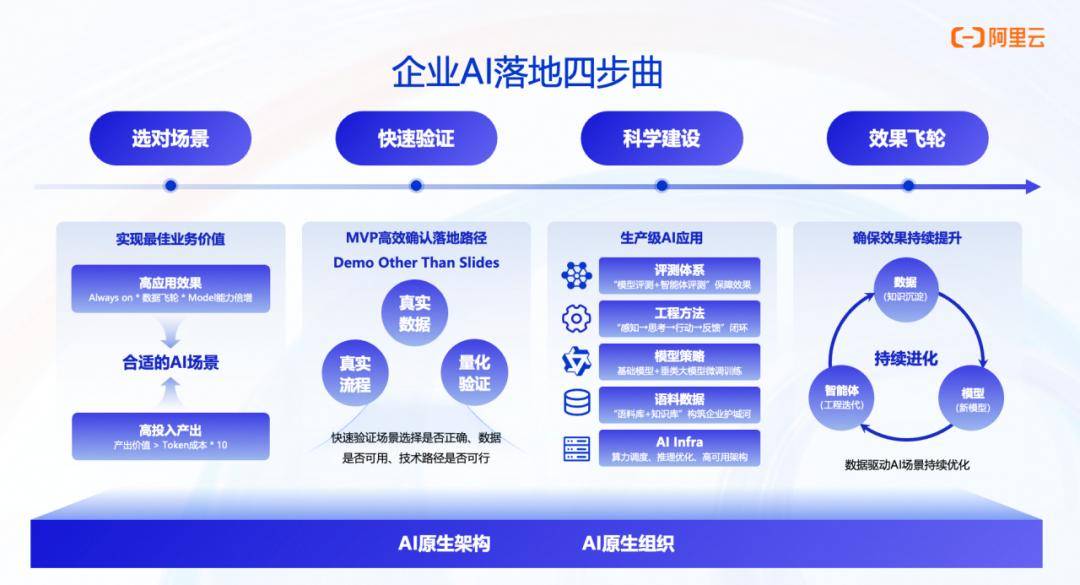
This also represents a new working model.Huo Jia summarized it into four steps: choosing the right scene, rapid verification, scientific construction, and effect flywheel.
Choosing the right scene is the starting point.Determining whether a scene is worth using large model technology is still the primary reason for the success of most projects. With the development of AI, there are more and more scenarios. In practice, it is found that many scenarios may not be suitable for large models, and if you try to do it forcefully, you will fail. What really deserves priority are those core links that are high-frequency, high-value, and highly dependent on experts. That is, the closer to the core of production, the more measurable the value of AI and the harder it is to be replaced.
PetroChina Lanzhou Petrochemical is one of Alibaba Cloud’s key customers. In the scene selection process, the Alibaba Cloud team used a three-level funnel-type survey to refine the scenarios. The headquarters strategic survey covered 6 functional departments and 4 industrial joint innovation centers, and then focused on the four joint innovation centers to focus on exploration and development, water injection and oil production, refining and chemical equipment, and equipment inspection and maintenance. Finally, they went to the site to work with equipment managers, process experts, and internal operators to work on the process, and finally set the abnormal alarm diagnosis of refining atmospheric and vacuum equipment as a pilot.
Quickly verify whether the decision direction holds.Don’t talk about PPT, just watch the DEMO. Run it again with real data and real processes, let business experts directly comment on the results, and advance the discussion from “should we do it” to “how to do it better”. In the Lanzhou petrochemical project, the team completed the design demonstration plan 23 days after entering the site, spent another 13 days on-site for end-to-end adjustment, and produced an operational business demo in 36 days. When the operational system is put on the table first, business experts directly look at the diagnosis results, evidence chain and disposal suggestions to determine how to proceed to the next step.
This idea of rapid verification also runs through the rhythm of project advancement. Huo Jia has a clear requirement for project advancement: shorten the cycle. A central enterprise project team initially reported that it would take three months to go online. Huo Jia directly said not to do it, and changed the release rhythm to once a month, and later to once a week. In addition, he also insists on the premise of building a true “One Team” relationship with customers, rather than the traditional Party A and Party B model.
Scientific construction covers corpus data, model strategies, evaluation systems and engineering methods.Production-level systems are fundamentally different from experimental environments and require a complete technical path to support them.
Still taking the Lanzhou Petrochemical Project as an example, the Alibaba Cloud team first built an ontology knowledge base for atmospheric and vacuum devices based on knowledge graph technology, translating the business language of the physical world into the language of the ontological world; then used large models to clean data from operating manuals and various IT systems into Agentic data, and poured it into the ontology knowledge base; finally, they built a global inference engine to train a large vertical domain time series model based on the Qianwen Max model and the atmospheric and vacuum devices. When an abnormality occurs, the model can simulate the human thinking process, assist the intelligent agent in capturing abnormal signals, and provide root cause judgment. The system has been running continuously since it was launched in May. The overall effect has reached 90% accuracy and the processing efficiency has increased by 80%.
The effect flywheel allows the first three steps to continue to increase in value.New data generated after the system goes online, new feedback from business personnel, and new experience accumulated by experts should all be fed back into the corpus, evaluation set, and engineering rules to drive continuous optimization of the model and system. With each cycle, the system has a deeper understanding of the business, the value of the output is higher, and the unit cost decreases accordingly. When the output value far exceeds the input cost, intelligent construction enters a self-reinforcing positive cycle.
Computing power, models, and agents are all indispensable
The implementation of this methodology is inseparable from the support of a complete set of full-stack AI infrastructure.
Overall, this support system is divided into three layers: the bottom layer is AI Infra, the middle is MaaS, and the top is Agent.The underlying computing power supports reasoning efficiency, the MaaS layer provides model scheduling and privatized deployment, the Agent layer completes agent orchestration and engineering constraints, and the security and observability system ensures production-level operations.
Alibaba Cloud is a better observation sample. At the AI Infra layer, Alibaba Cloud has Pingtouge chip. The PPU1.5 currently on sale is the first chip in China to support native FP4. It is also the first chip to achieve 144G HBM3E video memory and 800G video memory bandwidth, ensuring that the MOE large-size model inference efficiency is high enough.
At the MaaS layer, Alibaba Cloud provides Qianwen series models, including a large model with 2.4T parameters, and a 27B small model of Qwen3.8. It also provides five types of exclusive closed-source models, from large language to multi-modal to speech recognition, speech generation, video generation, image generation and editing, all of which can be deployed privately.
At the Agent layer, Alibaba Cloud provides the AgentScope agent framework, Qoder AI native programming tool, Harness engineering platform, industrial ontology platform, etc.
The Lanzhou Petrochemical Project has verified the support capabilities of this full-stack system. The ontology knowledge base allows the intelligent agent to understand the device, the Harness layer makes every step of reasoning auditable and credible, 13 professional AI assistants are embedded in the daily life of the team, and the industrial software is uniformly scheduled by the large model through the MCP protocol.
This set of full-stack capabilities also builds a flywheel for forward circulation. Cloud vendors use AI-native products to solve problems at customer sites, and customers’ use generates real data and feedback. This feedback flows back to the product team, driving product feature iteration and architecture evolution. After the product capabilities are enhanced, the scene value and work efficiency will be further improved.
Huo Jia told us that in the process of serving customers, Alibaba Cloud has gradually expanded from using only basic models and cloud products to more AI-native products such as Bailian Platform, Qoder, and Qianwen Office. The requirements obtained in real scenarios can become a source of feedback for future iterations of the product, continuously maintaining the advancement of the product.
For cloud vendors, when the usage and product flywheel is turned, it can drive the underlying model and data flywheel, thereby improving overall commercialization; for customers, it solves the three pain points of not being able to find scenarios, verifying technical feasibility and ROI, and production-level launch at once. Once a positive ROI is generated, the implementation of enterprise AI will naturally have value returns.
Technology is not a barrier, but transforming technology into enterprise-specific intelligence is
As the implementation of enterprise AI gradually moves into deep waters, more fundamental issues are emerging. General large models are getting stronger and stronger, but the core competitiveness of an enterprise has never been having extremely smart models.
The general large model is a technical base that can be used by any enterprise, and its capabilities tend to be homogeneous. What really widens the gap is the company’s own data, knowledge and processes, as well as the process parameters, expert experience, institutional rules and business logic embedded in the production process.
Huo Jia repeatedly emphasized a judgment:No matter what the technology is, for an enterprise, its value ultimately means “increasing revenue, improving quality, reducing costs, and increasing efficiency”.The essence of business operations is to create value and earn profits. Technology itself does not constitute a barrier, but transforming technology into exclusive capabilities does.
Exclusive intelligence is not bought, but grown bit by bit in the production process. There are no shortcuts in this process. Which data is available, which knowledge is credible, which rules must be rigidly constrained, and which judgments can be left to the model, all need to be confirmed one by one in real verification. Once settled, these exclusive assets constitute the most difficult barrier to copy in the enterprise’s intelligent transformation.
When model capabilities are homogenized, what really sells at a premium is not the model, but the ability to use proprietary intelligence to solve specific business problems.The stronger the model, the higher the ceiling of exclusive intelligence; but the thickness of exclusive intelligence depends on how much the company has accumulated in its business scenarios.
To implement exclusive intelligence, specific product carriers are also needed. Take Qianwen Office as an example. In addition to large-scale personal office scenarios, it has also launched a privatized version for enterprises, which can be deployed in the enterprise’s own environment and complete permissions, data isolation and audit adaptation around security and trustworthiness requirements.
What Qianwen Office brings into the enterprise is not just an AI assistant, but digital employees who understand the position, can collaborate, and are traceable, and undertake specific tasks in enterprise services, operation management, and industry collaboration. When digital employees are actually on the job, the thickness of exclusive intelligence will have a measurable impact, and there will be room for continuous growth.
Related Reading
- Original Xiaomi lost 970 billion, is Lei Jun the last card left?2026-10-08
- The second generation bean bag mobile phone has not solved the old problem2026-10-08
- Tencent secretly tests “AI beauty companionship” internally, will real-person companionship be collectively unemployed?2026-10-08
- The circle of AI bloggers is being crowded by “China Theater and Nortel”2026-10-08
- Original: Xiaomi is in big trouble again in India. How much meat will India cut off Xiaomi this time?2026-10-08