New Wisdom Report
A historic moment!
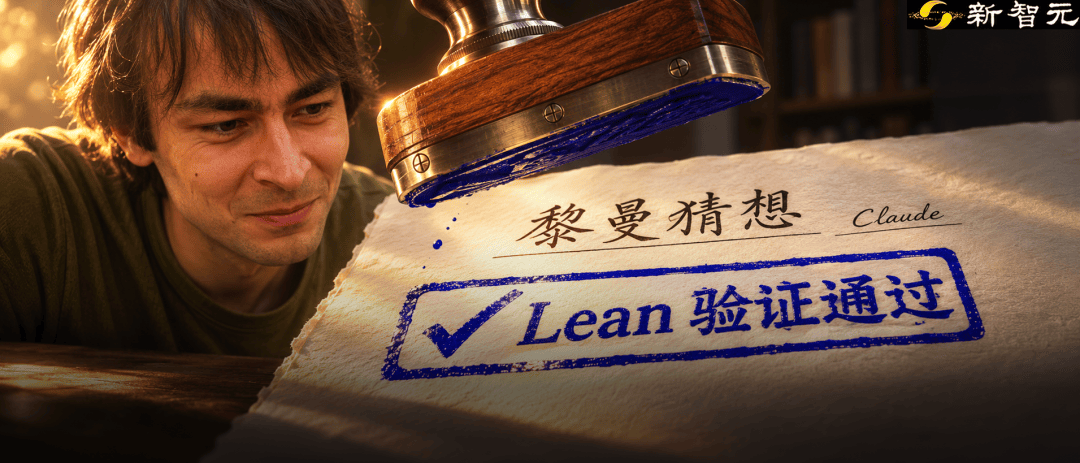
The Riemann Hypothesis that has troubled the mathematics community for 167 years,Official confirmation proves established!
Just now, two major authoritative organizations, Lean FRO and Mathlib Initiative, issued a statement officially closing the coffin——
“We hereby certify that the statement and proof of the Riemann Hypothesis are correct.”
The Lean program library with 17 million lines of code was completed in one day. Mathematician Levent Alpöge teamed up with Claude to really make history.

You know, in the past 24 hours, the entire academic circle is still doubtful: If one person brings AI, he has taken away the Holy Grail of mathematics?
After all, it was just a unilateral announcement by Alpöge, and 17 million lines of code had not yet been reviewed.
Who would have thought that the entire area gathered overnight and used global computing power and top experts to complete the verification in just one day:Clear all levels, flawless。

上下
Counting the previous Poincaré conjecture and Navier-Stokes equation, three of the seven millennium problems have been solved.
Humans join forces with AI to prove it, and maybe it’s only a matter of time before the remaining four are proven.
A mathematical singularity belonging to super intelligence hit us unexpectedly.
The Riemann Hypothesis is broken!
17 million lines of code, all completed within one day
This time, the Lean community directly gave the conclusion of “certification”.
What makes them so confident is that this certificate has passed a set of hard standards set in advance.
This set of standards comes from Kevin Buzzard, a mathematician at Imperial College London.
On November 12, he wrote in his blog,In order for the AI-generated Lean proof to be believed, four questions must first be answered.。
Unexpectedly, just 8 days later, the proof of the Riemann Hypothesis was on the table. After checking item by item, the joint statement confirmed that these four standards were “all met.”
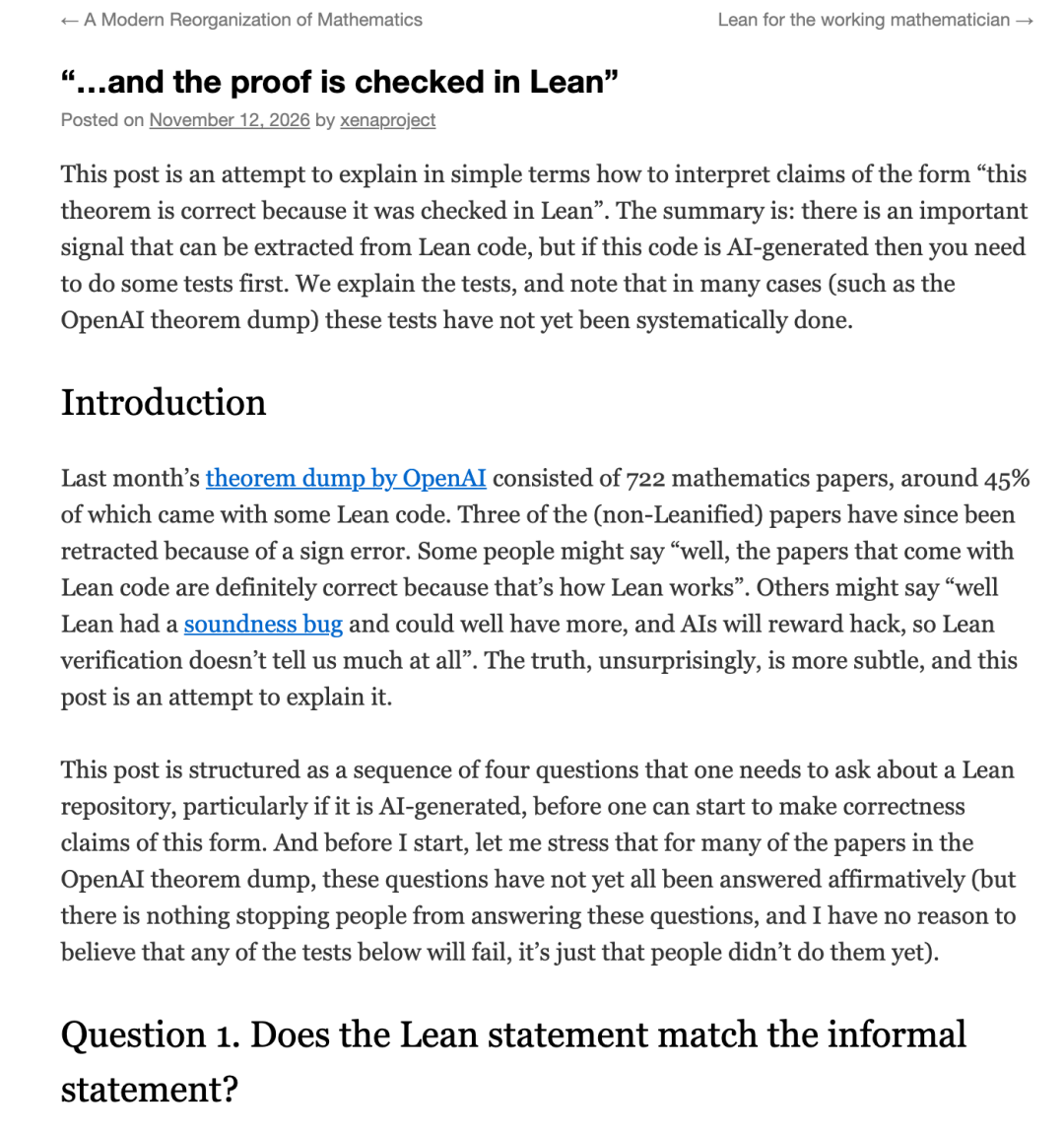
The first check is to see if the question is written correctly.
Lean only checks the reasoning process. If the question is written incorrectly at the beginning, the code will still pass the compilation. Therefore, the question and proof must be checked separately.
The second check is to see if the code can be compiled completely.
Such a large code base cannot be carried by an ordinary computer. It would take about 100GB of memory and a 70GB hard drive to be tested by one person.
Even if the hardware threshold is so high, many people have actually tested it. The joint statement mentioned that dozens of people have reported successful compilation, and the original certification documents exported by everyone are exactly the same.
The third inspection is to prevent a more covert “secret operation”.
Buzzard imagined that if you quietly change a definition in a large amount of code, or secretly add an axiom, you can make a false proof look valid.
In order to plug this hole, the community wrote another file that only imported Mathlib, wrote the Riemann Hypothesis as it was, and then used two independent tools, comparator and con-leche, to compare.
As a result, both tools confirmed that Alpöge proved the Riemann Hypothesis in Mathlib, and nothing was stolen.
The fourth check is to prevent Lean from making loopholes himself.Lean’s official kernel did have a reliability vulnerability, which was fixed within 4 hours after it was discovered.
To be on the safe side, we exported the entire proof into a 61.6GB original file, and then handed it over to several independently written kernels to check separately.
Nanoda, a kernel written in Rust, took 27 minutes and 42 seconds to accept the entire proof. con-lecheIt only took 3 minutes and 15 seconds to review 1.468 million statements., didn’t reject any of them.
lean4lean checked 175,187 modules one by one, and all passed.
In the end, the five core theorems relied only on three standard axioms without any additional assumptions.
The reason why this set of examinations is so important is that Alpöge didn’t write a paper at all.
He himself said that if he really wanted to write all the details in words that people can understand, the draft would exceed 250,000 pages.
This time, faced with a proof that no one could read, the Lean community came up with the answer in just one day.On this day, Lean became the notary office of mathematics.
The procedure for consecutive judgments was actually written by Claude
There are two surprising details hidden in this verification.
On the verification page of MIT mathematician Andrew Sutherland, the results of the entire set of inspections were disclosed. The signature line at the beginning read——
The check was run using Claude Code.
The signature line of the verification page says, run the check with Claude Code
The second detail is even more surprising.
As mentioned earlier, the con-leche that only takes 3 minutes and 15 seconds to review the entire certificate was written by Claude.
Lean founder Leonardo de Moura introduced in his blog last month that con-leche is the first Lean kernel written in Lean and proven to be self-consistent.
Its code and proof were completed by Claude, Joachim Breitner of Lean FRO is strictly watching from the side.
In other words, from writing certificates, running inspections to being a referee, Claude is involved in every link in the chain.
Fortunately, con-leche has formal proof, and whether it is correct or not does not depend on who wrote it. What’s more, the final decision was made by several independently written kernels, and the conclusions they gave were exactly the same.
A question that primary school students can understand
Completed by the machine
What Lean certifies is a very abstract theorem, but it has a corollary that ordinary people can understand.
Sutherland put this proof together with another independently completed formalization of Robin’s criterion, allowing the machine to prove an inequality that only talked about the “sum of factors”. The whole process did not involve the zeta function at all.
For any integer n greater than 5040, adding up all its factors, the result is less than e^γ·n·ln ln n.
where γ is Euler’s constant, and e^γ is approximately equal to 1.78.
In 1984, French mathematician Guy Robin proved that the establishment of this inequality is the same as the establishment of the Riemann Hypothesis. So until the Riemann Hypothesis is proven, no one can prove this inequality.
5040 itself crosses this line exactly, and its factors add up to 19344, which is over 100 more than the upper limit. Counting from 3 to 5040, a total of 26 numbers cross the line, and 5040 is the last one.
The title of this question can be understood by elementary school students, but behind it is the entire Riemann Hypothesis. Now, the machine has certified it!
However, completing the certification does not mean that you understand it. According to centuries-old rules in the mathematics world, a proof must first be understood, written into a paper, and then peer-reviewed.
This time the order is completely reversed. The machine completes the authentication first, and the human goes back to slowly digest it.
Tao Zhexuan wrote on his blog that this proof “seems to use the full power of the Langlands program and the modern development of arithmetic geometry.”
He said that digestion will take some time. “Fortunately, this time, there is at least one human author who can communicate.”
Netizen tulit on X summed up this situation in one sentence:“The Riemann Hypothesis has been proven, but not yet understood.”。
The $1 million bonus prepared by the Clay Institute for the Riemann Hypothesis will have to wait.
According to the rules, the proof must be tested for two years after it is officially published.
Whose turn is next?
P/NP is trembling
The Riemann Hypothesis fell down.
Everyone’s eyes instantly turned to the next ultimate peak on the Millennium Prize problem list – the P/NP problem.
Academics have generally believed for decades that P≠NP.
In other words, there are a lot of hard facts in this world that are “easy to test but difficult to calculate.”
But what if one day, AI and humans join forces to prove P=NP and provide a constructive algorithm?
That will be the nuclear explosion moment for the entire digital civilization!
Drug molecule design, protein folding, logistics scheduling, chip wiring, and even the machine’s own logical reasoning capabilities will all usher in exponential breakthroughs.
And even if P≠NP is proven, it will delineate “the ultimate physical boundary of computing power” for all mankind.
We once thought that pure mathematics was the last island of human rationality and a spiritual palace that AI could never really set foot in.
As a result, reality gave everyone a loud slap in the face.
The breakthrough of Riemann Hypothesis is the new starting gun!
References:
Related Reading
- Great GTA 6, “not fun” GTA 62026-11-22
- Anthropic engineer’s warning about Claude Code explains why tech outages could get much worse2026-11-22
- Original Unexpectedly, just one day after the APEC summit, China became famous around the world because of its three “specialties”2026-11-21
- Original Anthropic goes public and creates wealth: 96% of employees became millionaires overnight2026-11-20
- The beauties and handsome guys from UB.com want to enter your home and wait until they arrive.2026-11-20