Produced by Huxiu Technology Group
Author|Huang Tianyuan
Editor|Miao Zhengqing
Header image|Reflection AI official website
Two years after its establishment, Reflection AI, which wanted to be the “American version of DeepSeek”, finally handed in its application.
On October 5, US time, Reflection AI announced its first open weight model, Beam, which focuses on programming, reasoning and agent tasks. (Huxiu’s note: The open weight model refers to the publicly trained model parameters. Users can download and deploy them themselves. Whether they can be modified and commercialized depends on the license)
Many people in the American media and technology industry regard Beam as the United States’ response to China’s openness to AI.
This is how their company benchmarks itself.
According to the company’s official website, Beam’s performance in programming and agent tasks is competitive with GLM 5.2 and close to Alibaba’s Qwen 3.8-Max, but it still lags behind leading models such as Kimi K3 in terms of absolute capabilities.
But its significance is not limited to Benchmark.
Reflection has a very clear positioning: serving enterprise and government customers who are unwilling or unable to use Chinese models, but at the same time want to own and control their own AI capabilities.
There are not many companies like this in the United States. Reflection also has billions of dollars in financing, top-tier GPU resources, Nvidia support, and U.S. government and sovereign AI project resources.
This is why a product that has not yet reached the forefront of the open model will still receive such high attention.
What kind of company is Reflection? What exactly has Beam done?
Beam’s transcript
The founder of Reflection disclosed in a podcast interview that Beam uses a MoE architecture with a total of about 500 billion parameters, but only about 23 billion parameters are activated during inference.
For comparison, DeepSeek-V3 has a total parameter of 671 billion and activation of 37 billion; Dark Side of the Moon Kimi K2 has a total parameter of 1 trillion and activation of 32 billion; GLM-4.5 has a total parameter of 355 billion and activation of 32 billion.
At the same time, Reflection also emphasized that Beam is completely autonomous from the pre-training stage (without distillation), and focuses on training for coding, reasoning and agent tasks.
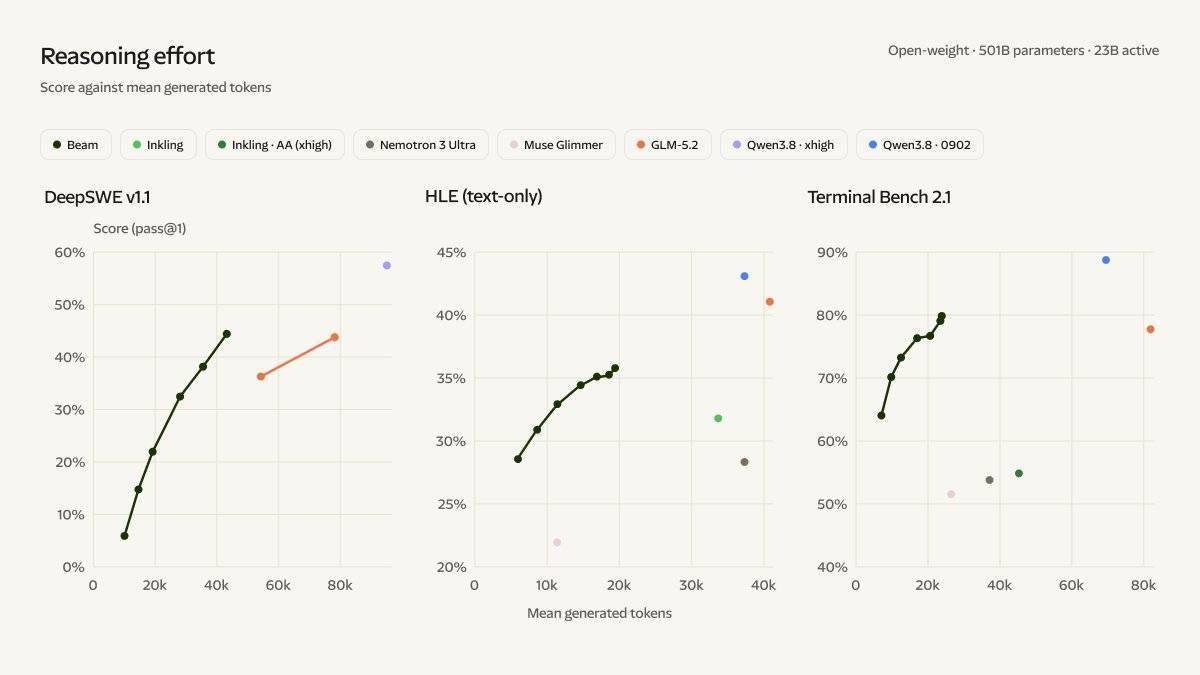
Reflection also particularly emphasizes Beam’s reasoning efficiency.
The company said that relying on large-scale reinforcement learning, Beam can consume approximately 1/3 to 1/4 of the amount of tokens and inference calculations required to complete inference tasks of similar difficulty, such as GLM 5.3 and GPT-6 Luna.
According to official disclosures, Beam’s pre-training data has reached 23.8 trillion Tokens. For comparison, DeepSeek-V3 uses 14.8 trillion Tokens for pre-training; Kimi K2 uses about 15.5 trillion Tokens. Beam then conducted a round of high-intensity RL training. They used 10,500 Nvidia GB300 GPUs to run continuously for 4 weeks, generating a total of more than 100 million Rollouts.
Reflection’s judgment is that Scaling of cutting-edge models is changing.
In the past few years, the industry has been most familiar with expanding the number of parameters and training data and improving pre-training computing power. However, as pre-training gradually becomes a more mature project, more and more important variables for improving model capabilities in the next stage will come from continuing to scale reinforcement learning itself.
Therefore, Beam is like a technical verification of Reflection.
Can a new company rely on large-scale RL to push a model with fewer activation parameters to a level close to China’s head-opening model?
It has proven itself on the poker table.
American “DeepSeek”, why Reflection?
Reflection is not a model company that just popped up out of nowhere.
It was founded in 2024 by two former Google DeepMind researchers, Misha Laskin and Ioannis Antonoglou. Laskin and Antonoglou participated in Gemini 1 and Gemini 1.5 related work during their time at DeepMind. Antonoglou joined the company in the early days of DeepMind and is one of the core team members of AlphaGo.
But what’s interesting is that when Reflection started its business, it didn’t actually prepare to train the basic model from scratch.
Laskin recently recalled in a podcast that when the two founded Reflection, they mainly bet on two judgments: The first judgment is that reinforcement learning will allow large models to move from chatting to coding and agents; the second judgment is that strong enough open models will continue to appear in the West. Reflection does not need to repeatedly train basic models, as long as it continues to do reinforcement learning and agent research on these models.
Looking back today, the first judgment has become the mainstream direction, but the second one has failed.
After the emergence of DeepSeek V3, the gap between Western open models and Chinese open models began to widen rapidly. Reflection waited for a few more months, hoping that a strong enough open model would emerge in the United States, but it never came. So, it decided to end itself.
Beam is the first answer after this strategic shift.
In the past year, the world’s strongest closed-source models were still mainly in the hands of American companies, but the focus of open models has increasingly tilted toward China.
Chinese models such as DeepSeek, Qwen, Zhipu, and Kimi continue to enter the model list of global developers. The OpenRouter ranking shows that in the open model, a large number of top-ranking products come from Chinese companies such as DeepSeek, Zhipu, Xiaomi, and Tencent.
What both Reflection and the US government want is to regain this market.
Reflection is currently valued at approximately US$25 billion and has raised more than US$4 billion in total, of which Nvidia invested approximately US$800 million.
In July this year, Reuters reported that Reflection signed an agreement of more than $1 billion with cloud computing company Nebius to obtain computing resources including Nvidia’s latest chips.
Previously, Reflection had signed a computing power agreement with SpaceX. According to Axios reports, after an initial ramp-up phase, the company will pay US$150 million per month starting in July this year, and the agreement will last until 2029.
Reflection’s official website also states that the company will participate in the U.S. Department of Energy’s Genesis Mission scientific research program and provide open models for U.S. national laboratories.
A company that has been established for more than two years and has just released its first basic model has already obtained resources of this level, which itself shows that investors are not just betting on Beam.
Their bet is that the United States will regain an open model system.
According to Reflection’s official website, the company not only plans to open up the model weights, but is also developing supporting open source software and supporting API calls or deployment in corporate private clouds, local servers, and environments that are physically isolated from external networks.
Open weighting is just the first layer. What Reflection really plans to sell is model + inference + software stack + infrastructure + enterprise deployment.
Its main customers are not ordinary consumers either. According to the founder’s description, large enterprises, government agencies, public sectors and “sovereign AI” customers will be the biggest buyers of the open model in the future.
A real-life case has appeared in South Korea.
In March this year, Reflection and South Korea’s Shinsegae Group announced the signing of a memorandum of cooperation to build a 250MW AI data center to provide sovereign AI services to Korean companies and government agencies. The project will use Reflection’s open weight model and NVIDIA GPUs. The US Secretary of Commerce also attended the signing event and expressed support.
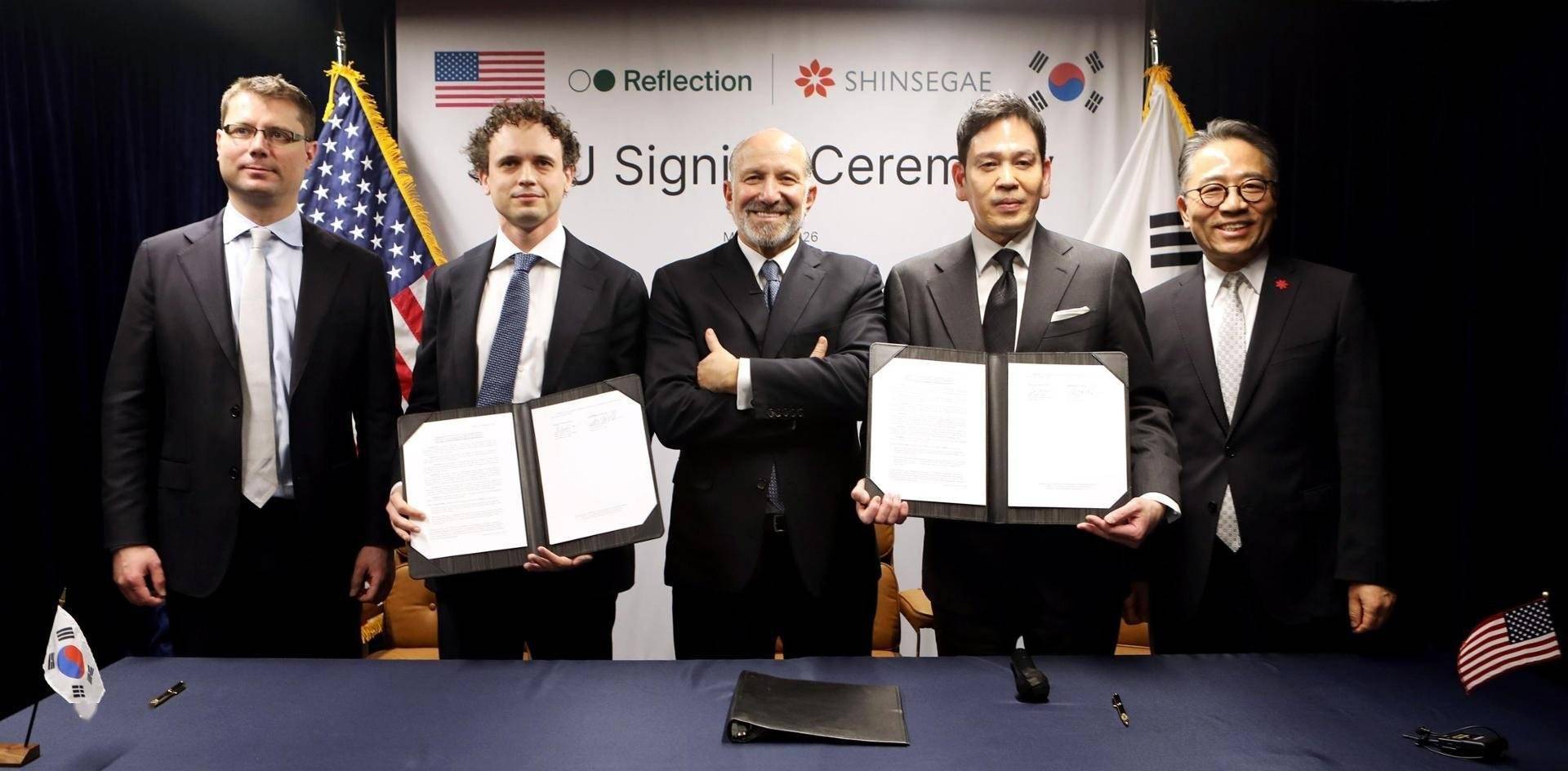
Reflection has obtained the resources to train large models, and has also found corporate and government customers willing to discuss cooperation. Next, Beam has to pass the ecological application level and capability improvement level.
These answers, the amount of financing and the list of partners cannot be given.
Related Reading
- The circle of AI bloggers is being crowded by “China Theater and Nortel”2026-10-08
- Original: Xiaomi is in big trouble again in India. How much meat will India cut off Xiaomi this time?2026-10-08
- Under the deep ice of Antarctica, waiting for a letter from the universe –2026-10-07
- The sudden emergence of Chinese-language groups has brought countless old games to light again.2026-10-07
- Original Terminator comes true! 1500℃ molten steel, robots line up for “cremation”2026-10-07