Xinhua News Agency, Stockholm, October 6 (Reporters Guo Shuang, Zhu Haochen, Zhang Xinwen) Passing through our bodies, and even through the entire earth, neutrinos, “the shyest particles in the universe”, usually leave no trace. However, under the deep Antarctic ice, high-energy neutrinos from the distant universe occasionally stir up a faint light due to collisions with atomic nuclei. These glimmers of light are recorded by detectors buried in the ice, and we may be able to read “letters from the universe.”
In order to receive such “letters”, Francis Halzen, the 2026 Nobel Prize winner in physics, and his colleagues turned 1 cubic kilometer of Antarctic deep ice into a special “mailbox” – the IceCube Neutrino Observatory.
This is the announcement scene of the 2026 Nobel Prize in Physics taken in Stockholm, Sweden on October 6. Photo by Xinhua News Agency reporter Lu You
“Silent” unique “messenger”
About 65 billion neutrinos from the sun pass through your little fingernail every second, making them undetectable to you and difficult for scientists to detect.
There are also some neutrinos that may come from the distant universe. Some of these neutrinos are far more energetic than solar neutrinos, but much rarer in number, and may bring news about where they were born.
Searching for them is to ask a puzzle: Where and through what process do some particles in the universe obtain energy that far exceeds what ground accelerators can give them? How do these natural particle accelerators work?
It is not easy to track these particles directly. Many particles in cosmic rays are charged and will be redirected by magnetic fields. When they reach the earth, their origin is difficult to identify. Neutrinos provide another clue. This uncharged “messenger” will not be deflected by magnetic fields and is rarely blocked by matter. It has the opportunity to bring messages from places where light cannot penetrate.
Mark Pierce, chairman of the Nobel Committee for Physics, explained that this means that observing the universe does not necessarily have to rely only on light, but can also rely on the information brought by neutrinos.
But how can we capture evidence of such a “silent” visitor?
At a conference held in Poland in 1988, Halzen and his colleagues first proposed the idea of building a neutrino observatory in the Antarctic ice, hoping to use a large enough detection volume to capture the signals generated by the interaction of a very small number of neutrinos with atomic nuclei.
However, “This is an adventure with no guarantee of success.” Halzen recalled after winning the award on the 6th.
Special “mailbox” buried deep in the ice
“Our biggest risk is that no one knows whether a 1 cubic kilometer detector is large enough to detect neutrinos from outside the Earth’s atmosphere and from the universe,” Halzen said.
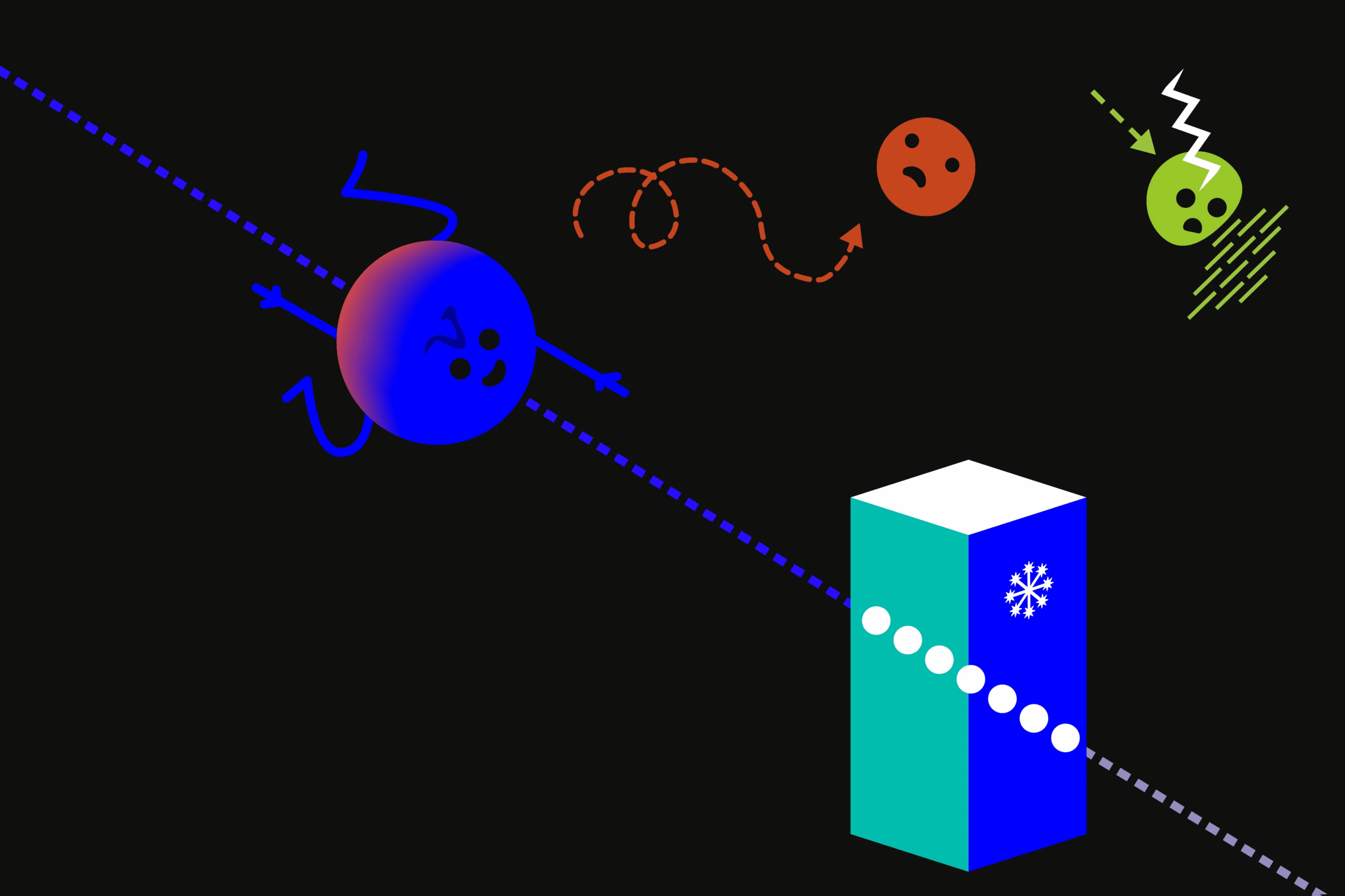
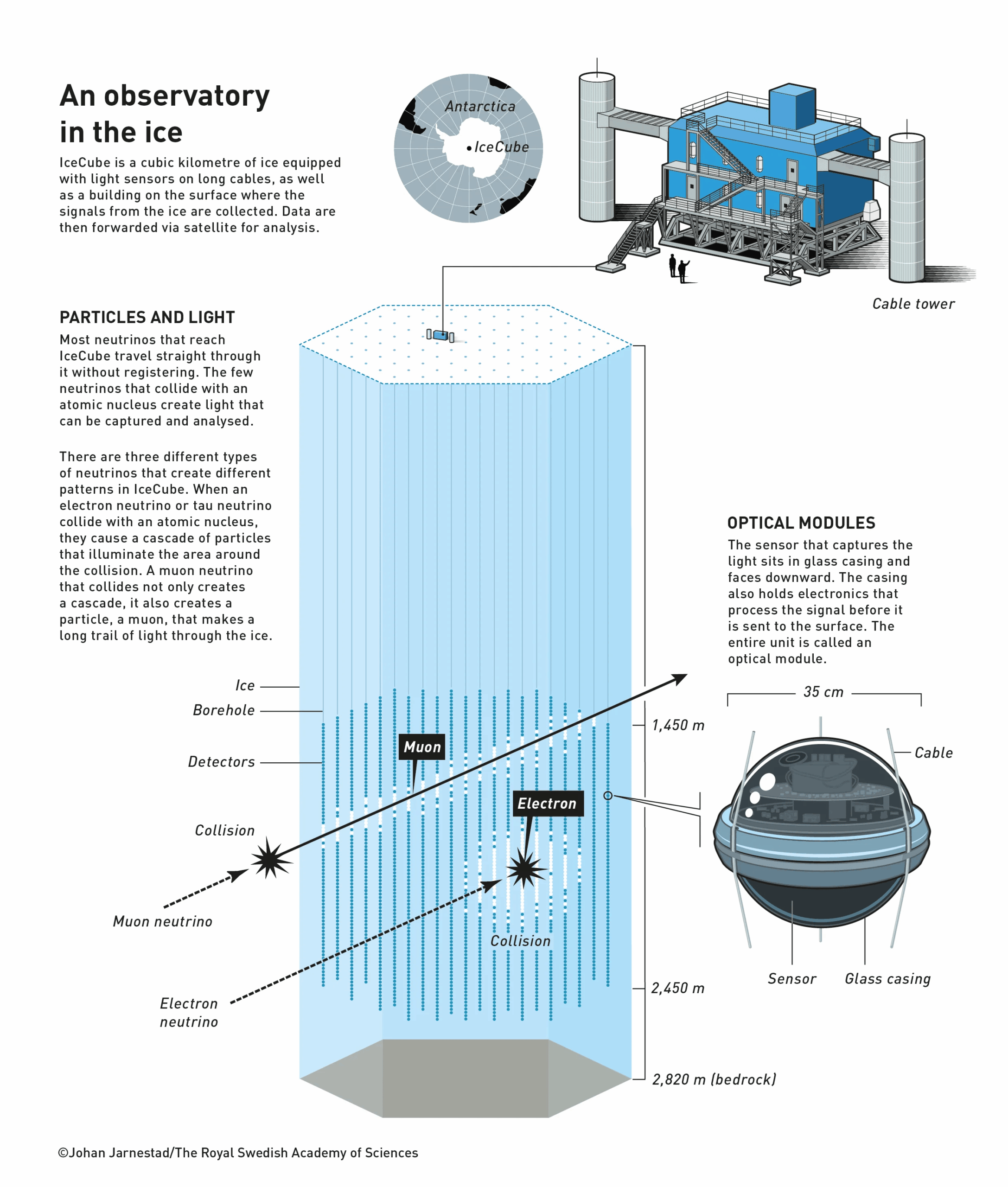
Neutrinos themselves do not emit light. But when it occasionally hits the nuclei of atoms in the ice, it can produce some charged particles. As these particles move at high speeds through the ice, they emit faint light.
To capture this shimmering light, light sensors need to be placed in the ice. Halzen likens these sensors to “reverse light bulbs”: Instead of a light bulb, they receive light and turn it into an electrical signal. Based on the amount of light received, researchers can estimate how much energy the particles have left in the ice; and then use the time difference between the light reaching different sensors to deduce the direction of the neutrino.
How to get these sensors into deep ice? The researchers learned from glaciologists and used high-pressure hot water to melt deep holes in the ice, and then slowly put long cables strung with light sensors into them.
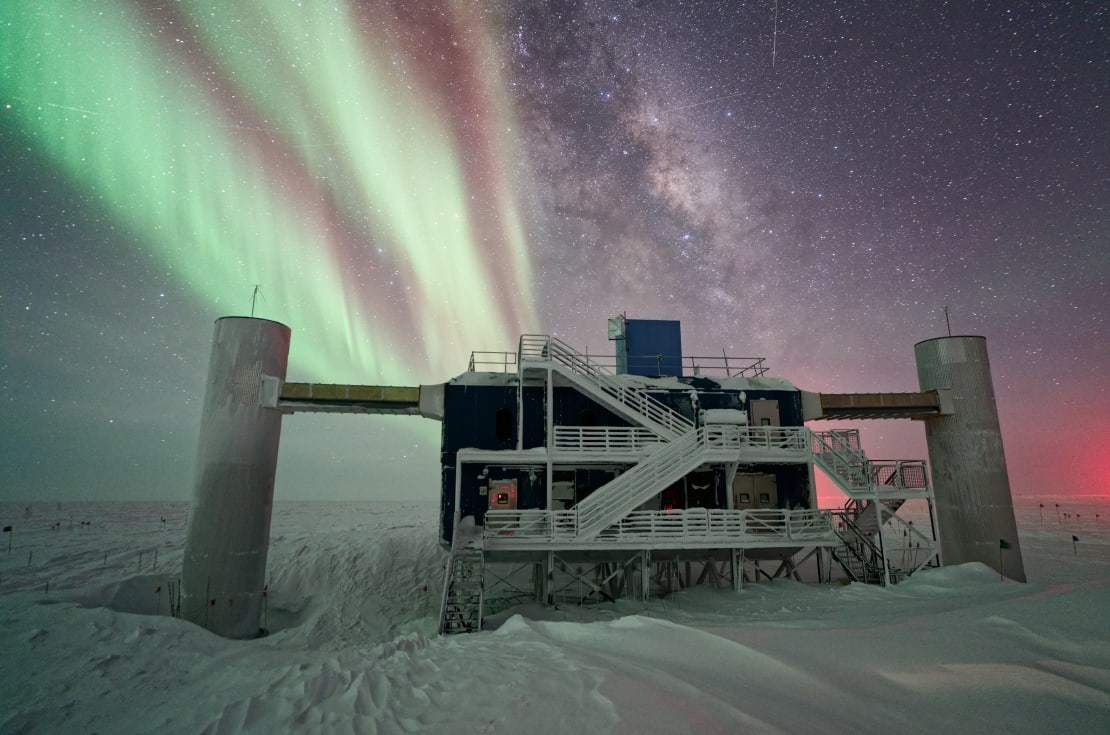
Preliminary experiments gradually proved that this path is feasible. The IceCube Neutrino Observatory built on this basis reached full scale in 2011: 5160 optical sensors are distributed on 86 long cables. The main array is located 1450 meters to 2450 meters below the ice surface, covering about 1 cubic kilometer of ice.
“Letter” from afar yet to be interpreted
After the instrument is built, it is necessary to identify the signal: cosmic rays will also produce neutrinos in the atmosphere. To search for neutrinos from the distant universe, scientists need to screen the detected events, analyze the energy, direction and other characteristics of the particles, and determine whether the data exceeds the range that can be explained by the atmospheric background.
In 2013, the research team reported two extremely high-energy neutrino events, obtaining the first evidence of high-energy neutrinos with astrophysical origins. The team later identified more high-energy events and confirmed high-energy neutrinos coming from outside Earth’s atmosphere.
However, the “sender” information is still vague. The galaxy NGC 1068 is one of the candidate sources that has received attention, but the relevant evidence is not enough to make a determination; IceCube has also discovered high-energy neutrino signals from the Milky Way, but has not yet been able to pinpoint the specific source.
Although the exact origin of these cosmic “letters” remains to be discovered, the boundaries of neutrino detection have been broadened. Humans have previously detected neutrinos from the sun and supernovae, and IceCube has extended the detection to higher energy ranges. As Eva Olsson, a member of the Nobel Committee for Physics, said at the press conference, it has brought neutrino astronomy “to a new level.”
Ole Eriksson, a member of the Nobel Committee for Physics and a professor at Uppsala University in Sweden, said in an interview with Xinhua News Agency that the high-energy neutrinos detected by IceCube bring information about events in the distant universe and help mankind gain a deeper understanding of the world we live in. It’s not just esoteric science, many times, these kinds of scientific achievements end up having practical applications.
What can we learn about the universe through the new window of neutrino astronomy? Halzen’s answer was surprising: “What’s really exciting is that I can’t answer that question yet.”
Related Reading
- The sudden emergence of Chinese-language groups has brought countless old games to light again.2026-10-07
- Original Terminator comes true! 1500℃ molten steel, robots line up for “cremation”2026-10-07
- National Day mountain climbing has evolved to include plug-ins. Exoskeleton robots have entered the scenic spot and can be worn for 3 hours for 59 yuan.2026-10-07
- Altman fires! Musk is a “bully”: you have to punch him in the nose occasionally to respect you2026-10-06
- An AI movie without actors won the Dragon Award first2026-10-06