 Making money is not as fast as spending money.
作者 I 薛星星
編輯 I 何簡
封面 I 盜夢空間
Tencent, which is accustomed to making money on its own, must now learn to pay for the future.
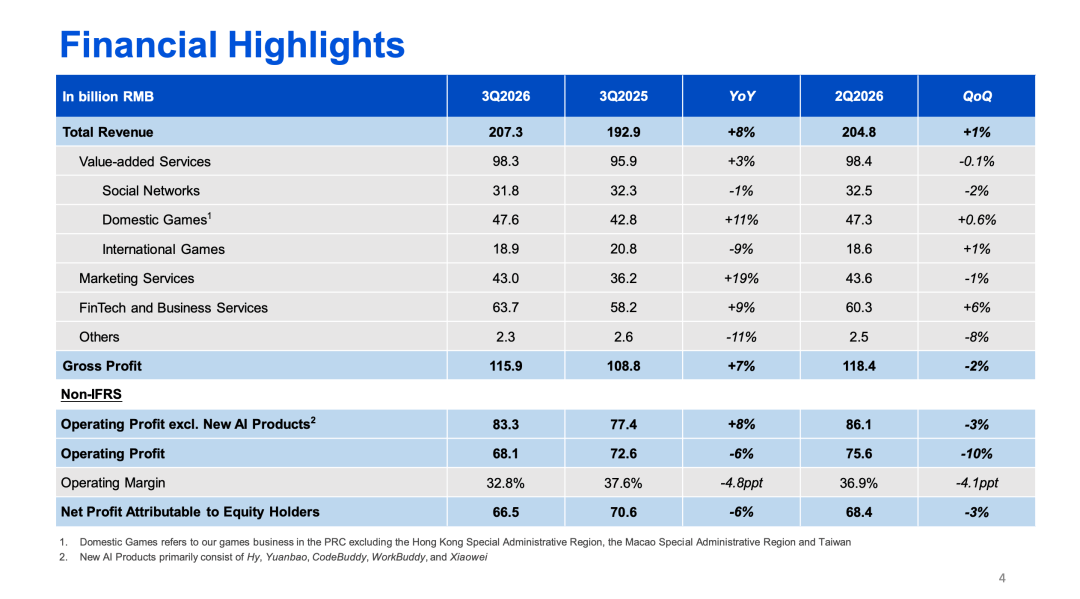
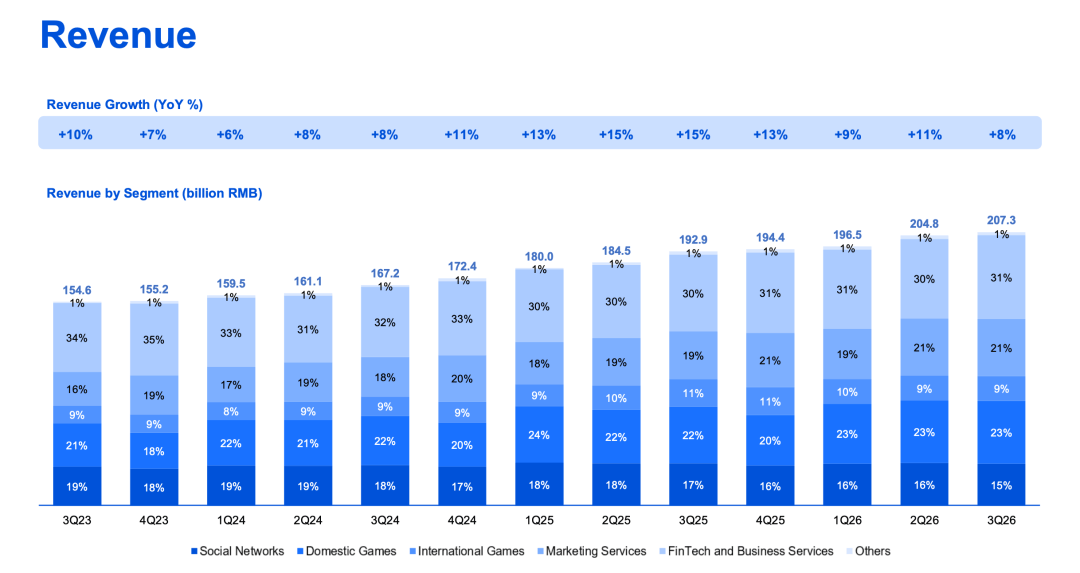
On November 18, Tencent released its third quarter financial report for 2026. Revenue growth slowed down and operating profits turned from increase to decrease. Tencent’s revenue in the quarter was 207.3 billion yuan, a year-on-year increase of 8%, and the growth rate was 3 percentage points lower than the previous quarter; operating profit was 59.1 billion yuan, a year-on-year decrease of 7%, while it still increased by 12% in the previous quarter; net profit attributable to the parent company was 63.6 billion yuan, a year-on-year increase of only 0.8%.
騰訊財報
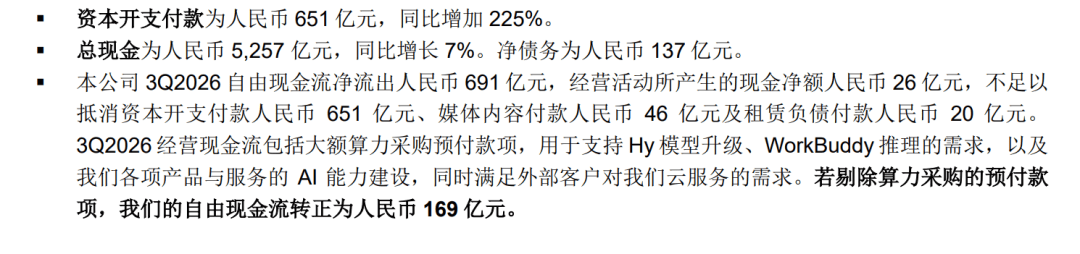
Tencent can no longer make money as fast as it spends money. Tencent’s free cash flow turned from positive to negative last quarter, and this quarter saw a net outflow of 69.1 billion yuan. Net cash generated from operating activities plummeted to 2.6 billion yuan from 85.3 billion yuan in the same period last year, a year-on-year decrease of 97%. At the end of last quarter, Tencent still had net cash on hand of 58.2 billion yuan, which has now turned into net debt of 13.7 billion yuan.
Or the investment in AI is too crazy. In the third quarter, Tencent’s capital expenditures reached 81.4 billion yuan, a year-on-year increase of 527%, exceeding last year’s full year. In the first three quarters of this year, Tencent’s cumulative capital expenditures reached 166.2 billion yuan, close to the total investment in the past three years. Even compared with Alibaba, which claims 380 billion in three years, it is still uncompromising.
It seems that as Xiao Ma said, the current AI competition has reached the level of “life and death”. If you don’t invest or embrace it, you will be subverted. According to Tencent, it is the accumulation over the past 28 years that gives Tencent the opportunity to participate in this technology competition. “It’s an honor to be able to invest,” and it’s even more important to throw coins at an epic level, bet big and special, and be in line with AI in everything.
During the earnings call, Tencent management stated that capital expenditures in the remainder of 2026 and in each quarter of 2027 will fluctuate around the current peak level, and may not improve until 2028.
Tencent’s shareholders can only suffer a little longer. At the closing of Hong Kong stocks today, Tencent fell more than 6%, with its share price falling below HK$350, a new low in two years. Since the beginning of this year, Tencent’s share price has fallen by more than 40%, and the scale of buybacks has been reduced by nearly half compared with last year.
It’s an honor to invest
In the past, Tencent’s elephants were slow to turn around, but now Penguin is investing heavily in computing power.
In the first quarter of this year, Tencent’s capital expenditures were 31.9 billion yuan, which increased to 52.8 billion yuan in the second quarter, and further surged to 81.4 billion yuan in the third quarter. In just six months, investment scale increased by nearly 50 billion yuan in a single quarter. In the third quarter of last year, Tencent’s capital expenditure was only 13 billion yuan.
Tencent CFO Luo Shuohan said at the earnings call that the company is accelerating investment in AI infrastructure to support upgrading the hybrid model, meet WorkBuddy’s reasoning needs, and provide computing power to cloud service customers.
The purchase of large amounts of computing power allowed Tencent to pay huge amounts of money in advance. In the third quarter, Tencent had a net free cash flow outflow of 69.1 billion yuan, but if prepayments for computing power purchases are excluded, it was a positive 16.9 billion yuan. Free cash flow in the second quarter was also affected by prepayments, and was positive 37.6 billion yuan after excluding prepayments.
騰訊財報
During the earnings call, analysts were particularly concerned about Tencent’s high capital expenditures and computing power investment for two consecutive quarters, and they almost directly asked management how much computing power they still need to buy. “How far has this round of large-scale procurement of computing power progressed? According to your standards, how far is it from sufficient computing power?”
Tencent Chief Strategy Officer James Michel said that the long-term computing power contract the company hopes to sign has basically been signed, and future prepayment expenditures will gradually decrease. He also revealed that Tencent is withdrawing from some contracts for which it has previously paid advance payments, and may even receive returned advance payments in some quarters in the future.
Michel said that based on actual capital expenditure payments of approximately 65 billion yuan in the third quarter, Tencent’s current investment level has roughly reached its peak. Quarterly capex payments are likely to continue around this level through 2027 before tapering off.
Perhaps to appease investors, Tencent President Martin Lau tried to justify this huge round of capital spending. He compared this round of investment to building a factory. After it is built, the next generation model can be trained and tokens can be continuously produced. In short, it will not be a one-time investment and can be used continuously in the future.
Moreover, as hardware prices fall in the future and computing power efficiency improves, the same equipment can produce more Tokens, and new investment requirements are expected to decrease. “We think the situation will be much better in 2028 and beyond,” Liu Chiping said.
Facing the wave of AI, Tencent is not investing without brains. For example, Yuanbao, which once participated in the red envelope war at the beginning of the year, no longer blindly pursues user scale. During the earnings call, Chiping Lau rarely admitted, “Yuanbao did not meet our expectations.” They have significantly reduced related expenditures and shifted their focus from acquiring users to improving product capabilities.
At the same time, Tencent has begun to tighten cash returns to shareholders. In the third quarter, the company spent approximately HK$7 billion to repurchase shares, a year-on-year decrease of 67% and a month-on-month decrease of approximately 58%. The cumulative repurchases in the first three quarters of this year were approximately HK$31.4 billion, a decrease of nearly half compared to the same period last year.
As early as March this year, Tencent stated that in order to increase investment in AI, the amount of share repurchases in 2026 may be lower than last year. Liu Chiping believes that their investment in the field of AI will definitely create huge value returns for shareholders in the future.
Making money is not as fast as before
While investing heavily in AI, Tencent’s own business growth is also slowing down. In the third quarter, Tencent’s revenue increased by 8% year-on-year, but its adjusted operating profit fell by 6% year-on-year. Adjusted operating profit rose 9% year over year in each of the previous two quarters.
Although Tencent’s net profit attributable to its parent company increased by 0.8% year-on-year in the quarter, most of it came from investment income. In the third quarter, Tencent’s net income from investment income and other projects reached 10.1 billion yuan, compared with only 2.8 billion yuan in the same period last year. After excluding some investment income and other adjustment items, Tencent’s adjusted net profit attributable to the parent company was 66.5 billion yuan, a year-on-year decrease of 6%.
It’s AI that’s dragging down profits again. Tencent disclosed in its financial report that if new AI products such as Hunyuan, Yuanbao, WorkBuddy, and Xiaowei are excluded, the adjusted operating profit in the third quarter was 83.3 billion yuan, a year-on-year increase of 8%.
But even excluding new AI products, profit growth in Tencent’s original business is slowing. In the first and second quarters of this year, Tencent’s operating profit after excluding new AI products increased by 17% and 19% year-on-year respectively, with growth rates far exceeding those in the third quarter.
Games, advertising and even finance, businesses that Tencent used to make money in the past, are now facing various problems.
騰訊財報
In the third quarter, Tencent’s domestic game revenue increased 11% year-on-year to 47.6 billion yuan, but international game revenue fell 9% year-on-year (or 4% year-on-year at constant exchange rates). Tencent said it was mainly affected by the high base last year. Analysts were once worried that GTA6 would affect Tencent’s international game market, and Michelle had to admit that their growth slowed down earlier than the warm-up of GTA6.
Although the advertising business still maintained a year-on-year growth of 19%, the gross profit margin fell by 4 percentage points to 52%, partly affected by the increase in AI operation and short drama content costs. Michelle said that the performance of the WeChat Green Bubble short drama entrance exceeded expectations and significantly boosted advertising revenue. Without the contribution of the short drama business, Tencent’s advertising growth this quarter would have been even slower.
The financial technology business was dragged down by weak consumption and only achieved low-single-digit growth in the quarter. The number of commercial payment transactions increased, but the average transaction amount decreased.
Another pressure comes from rising hardware prices. Michel revealed during the earnings call that DRAM prices rose by about 400% year-on-year at the beginning of this year, and some of the costs have begun to be passed on to Tencent’s core business. They expect pressure from weak consumption and rising hardware costs to continue for several more quarters.
Tencent is looking for ways to turn AI investment into revenue as soon as possible. In the third quarter, Tencent Cloud service revenue increased 35% year-on-year, up from 21% in the second quarter. Among them, WorkBuddy revenue increased by more than five times month-on-month, model-as-a-service revenue increased by more than twice, and computing power rental revenue increased by more than 30%.
騰訊財報
WorkBuddy is one of the most successful products of Tencent’s AI business. Martin Lau revealed during the earnings call that WorkBuddy has more than 10 million daily active users and consumes more than 100 trillion Tokens every day. Based on the most recent week’s revenue, WorkBuddy’s annualized revenue exceeds $500 million, more than twice that of Tencent Meetings.
But these are still not enough to solve the current drag on main business profits caused by AI products. During the earnings call, analysts were concerned about when the impact of new AI products on group profits would diminish. Liu Chiping did not give an exact time. He believes that AI-native businesses need to attract users first, then gain revenue, and finally achieve profits.
Related Reading
- Anthropic engineer’s warning about Claude Code explains why tech outages could get much worse2026-11-22
- Original Unexpectedly, just one day after the APEC summit, China became famous around the world because of its three “specialties”2026-11-21
- Original Anthropic goes public and creates wealth: 96% of employees became millionaires overnight2026-11-20
- The beauties and handsome guys from UB.com want to enter your home and wait until they arrive.2026-11-20
- Huang Renxun, there is no way he can go back!2026-11-20