It is estimated that 2.13 billion people will move across regions, with an average of about 300 million people on the road every day, and a single-day peak of 340 million. Railways carried more than 24.4 million passengers in a single day, a record high, and high-speed traffic flowed 71 million vehicles on the first day… This year’s National Day, the holiday economy once again showed a booming picture.
People are indeed going out in large numbers.
But if you only focus on this number, you will miss the biggest change during this year’s National Day.
The real highlight of this year’s National Day is not the passenger flow itself, but where each consumer voucher goes after it is spent.
The first important flow of money is Xiaotuan.
Platform monitoring data shows that the search popularity of small group tours for short-term destinations has increased by more than 110% year-on-year, and the booking volume of related travel products has increased simultaneously. In the summer of 2026, traditional large group bookings of more than 20 people will decrease by 18%, while small family group bookings of 2-6 people will increase by 132%.
“Special Forces”-style tourism is gradually becoming a thing of the past. Most tourists this time arrive at one place, choose 2 or 3 cities on the way as “bases” for accommodation, and then go on self-driving tours in surrounding cities. I stayed in each city longer and played more deeply. Qunar travel data shows that on October 1, 20% of tourists had checked into hotels in the second city or even the third city.
Behind category segmentation is consumers voting with their wallets. Consumers no longer want to be packed into a 50-passenger bus and transported from one attraction to another.
The second important flow of money is craftsmanship.
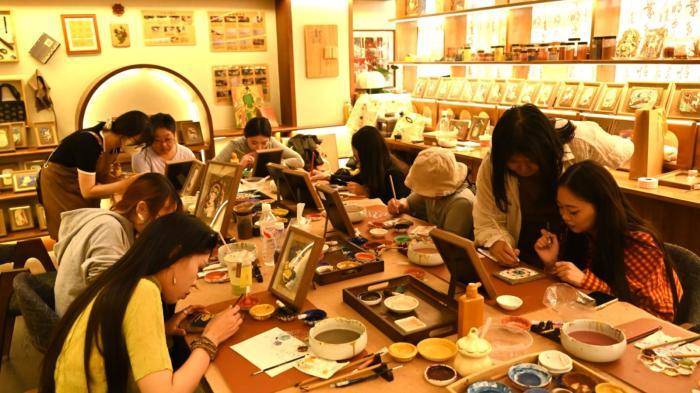
The most intriguing consumption trend during this year’s National Day is that “learning crafts” has replaced “taking photos” and has become the new hard currency for cultural and tourism consumption. On the first day of National Day, searches for tickets to scenic spots with tags such as “immersive performances,” “fireworks shows,” and “night tours” increased by more than 50% year-on-year.
For example, the Hetou Old Street Scenic Area in Tangshan, Hebei Province, relies on water night tours and live performances to allow tourists to “travel” into the painting, and is also among the top 5 in popularity; the “New Art Gallery” themed exhibition at Beijing’s Indigo Winter Garden integrates nature, art and urban life, and outlines the future of waterfront life. The diverse scenes continue to release consumer vitality. During the National Day peak period in the ancient city of Luoyang, there were about 5,000 makeup workers on duty, with an average of 7 to 9 hairpins inserted into each set, and more than 200,000 hairpins were consumed a day.
This cannot be summed up by the simple label “experience economy”. When a post-00 generation is willing to live in a small town and spend half a day learning to tie lanterns and make purple pottery with a representative inheritor of intangible cultural heritage, the way he connects with the city changes.
Cultural tourism consumption is shifting from a ticket economy to a stay economy, and from a one-time check-in to an immersive experience.
The third important flow of money is to the county.
Tongcheng Travel data shows that the popularity of county tourism bookings increased by 42% year-on-year, and the average number of days tourists spent in counties increased by 3.2 days. On the first day of National Day, platform users will stay in hotels in more than a thousand counties across the country. Jiuzhaigou County, Yangshuo in Guangxi, Antu County in Jilin, Pingtan in Fujian, Burqin in Xinjiang, Wuyuan in Jiangxi, and Xiaojin County in Sichuan are still the top choices for accommodation in popular counties.
The place names that used to be swept by the accelerator of the highway are now destinations worth buying a ticket to stay for a few days.
These three money flows point to the same thing, that is, money has been spent in a different way.
In the first eight months of 2026, retail sales of services increased by 4.9% year-on-year, while retail sales of goods increased by only 1.0%. Extending the time dimension, from 2020 to 2025, my country’s residents’ per capita service consumption expenditure increased at an average annual rate of 8.5%, and its proportion in per capita consumption expenditure increased by 3.5 percentage points, reaching 46.1% in 2025.
The changes in consumption during the National Day holiday are just a microcosm. Behind this is a bottom-level switching of consumption logic, from “fighting for customer flow” to “fighting for experience”, and from “selling location” to “selling content.”
For the supply side, this means that past barriers to competition are breaking down. Tickets for scenic spots are no longer a moat, because what tourists want is not to visit here, but to make the trip worthwhile. A handicraft workshop in a county town may be more attractive than a standard sightseeing route in a 5A-level scenic spot.
The real competitiveness of the holiday economy lies not in how many people you can attract, but in what you can do to get people to stay. Whoever can turn local culture into content that can be perceived, participated in, and disseminated will win the next vacation.
|Chief Planner: Yu Lan
|Planner: Zhou Rui
|Coordinator: Wang Qingkai
|Written by: Zha Zhiyuan Wang Jiahua
|Editor: Cheng Chunyu
Related Reading
- Video丨What to do with the new power grid during the “15th Five-Year Plan” period? Promote from six aspects2026-10-08
- The beacon is carried on paper and the string song lasts forever—2026-10-08
- Customs reminds: Don’t take these “souvenirs” back home2026-10-08
- Solve the century-old chemical mystery of “how homochirality occurs spontaneously”! Official explanation of why this year’s Nobel Prize in Chemistry was awarded to these two scientists2026-10-08
- Chinese scientists successfully develop nuclear optical clock2026-10-08