On October 7, the Royal Swedish Academy of Sciences announced that the 2026 Nobel Prize in Chemistry will be awarded to Henri B. Kagan of the University of Paris Sud in France and Kenso Soai of Tokyo University of Science in Japan for their “discovery of nonlinear effects and autocatalysis in asymmetric organic synthesis.”
Some chemical reactions produce two different molecules that are mirror images of each other. For decades, researchers have known that it was theoretically possible to engineer reactions that produced only one of these mirror image molecules, but how to do this in practice has always been a mystery.
Kagan discovered a new way to regulate chemical reactions so that one of the mirror-image molecules can be in excess more than previously thought possible. The discovery is revolutionary for chemists developing reactions to create drugs, flavors, fragrances and new materials. Xia Hexiansan devised the first chemical reaction that produces only one possible mirror image. No one has ever achieved this feat before, except for the living beings themselves.
Heiner Linke, chairman of the Nobel Committee for Chemistry, said: “How homochirality can arise spontaneously is a chemical puzzle that has been around for more than a hundred years, and Henry Kagan and Kip Hexian San provided the answer. The chemical reaction they developed is amazing.”
Starting with tartaric acid: Why does life favor a mirror image molecule?
The molecules of life pose problems for chemists. Imagine you are a locksmith who makes keys to customer specifications. The problem is that every time you make a key, you always end up with two versions that are mirror images of each other, but only one of them can open the lock. The customer may even damage the lock if they try to open it with another type of key. Unfortunately, the two types of keys are difficult to distinguish, so customers always get a mix of the two.
Chemists face similar challenges when developing new drugs. Many drug molecules exist in two mirror-image but not entirely overlapping forms: one that has a therapeutic effect and the other that can produce unwanted and sometimes harmful side effects. The reason behind this has to do with the most basic chemical characteristic of life: life has what chemists call “homochiral”, a word derived from the Greek words for “same” and “hand.”
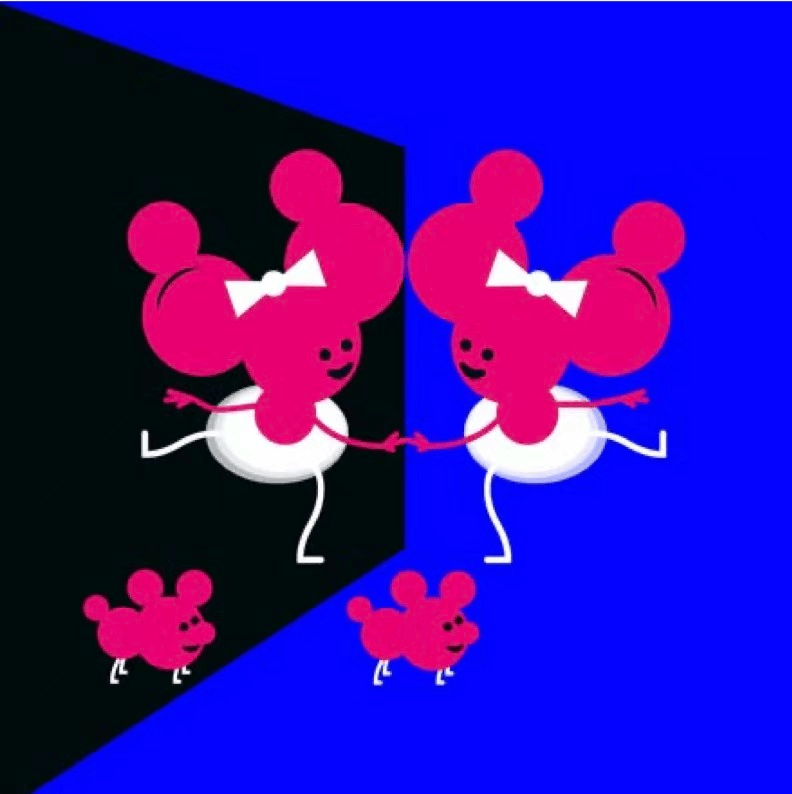
The results of the 2026 Nobel Prize in Chemistry stem from a long chain of ideas, the first link of which was formed in the mid-19th century. It all started with Louis Pasteur’s research on tartaric acid, a substance that is very important in wine production.
Louis Pasteur’s colleagues suggested that tartaric acid could sometimes deflect polarized light to the right, but sometimes it had no effect on the polarized light at all, which aroused Pasteur’s curiosity. He cultivated tartaric acid crystals and observed them under a microscope. He found that the crystals had two mirror images of each other. He used tweezers to separate the two crystals and dissolve them separately. When polarized light is passed through two solutions, one solution deflects the light to the right and the other deflects the light to the left. If the two solutions are mixed together, the polarized light will not be deflected. This experiment led chemists to realize that certain substances exist in two mirror-image forms. Later, these substances were called chiral substances, and the two molecules that were mirror images of each other were called “enantiomers.”
In 1857, Pasteur made his next important observation. He studied what happens when bacteria ferment different enantiomers of tartaric acid. It was found that the bacteria readily fermented the enantiomer present in grapes that rotates polarized light to the right, but had no interest in its mirror image molecule, which was left intact. From this, the idea that the chemical processes of life are chiral in some sense appeared for the first time.
Realizing that living molecules adopt only one of two enantiomers leads to the next question: What happened at the beginning of life to create this single handedness in the chemistry of life? When chemists conduct experiments to generate chiral molecules, what they get in the test tube is always an equal mixture of two enantiomers. So why do living organisms only use one of the mirror image molecules of amino acids? How does homochirality arise?
Some chemists believe that chiral chemistry is a phenomenon unique to life. However, in the early 20th century, the German chemist Willy Markwald was the first to successfully achieve an asymmetric reaction. This means that the reaction produces more of one enantiomer than the other. Crucially, Markwald used a catalyst—a substance that promotes a chemical reaction without being consumed itself. In this reaction, the catalyst is chiral, so it favors one mirror image form over another.
The next important link in the ideological chain leading to the 2026 Nobel Prize in Chemistry was formed in 1953. This time, it comes from a purely theoretical deduction presented in a scientific paper. The author is Charles Frank, a theoretical physicist at the University of Bristol. Frank proposed a model of a chemical reaction in which three conditions must be met: the presence of a chiral catalyst and an asymmetric reaction. The generation of one mirrored form is somehow facilitated, while the generation of the other is inhibited. The chemical reaction can produce the catalyst itself. This is called “autocatalysis” and produces a self-reinforcing effect, causing the amount of a certain enantiomer in the reaction to increase exponentially.
Chemical reactions that satisfy all of the above conditions can produce homochirality. As mentioned earlier, Markwald successfully fulfilled the first condition in the early 20th century, but researchers did not engineer chemical reactions with significant asymmetry until later. Pioneers in this field received the Nobel Prize in Chemistry in 2001 and 2021 respectively. The 2026 Nobel Prize in Chemistry will recognize the realization of the remaining two conditions.
Kagan’s breakthrough: Small deviations can be magnified
In the early 1980s, Kagan, then working at the University of Paris 11, was one of many chemists working on improving asymmetric reactions. The goal is to make the purest possible enantiomers for pharmaceutical production etc. The importance of doing this was demonstrated by the thalidomide scandal in the early 1960s, when thousands of children suffered birth defects from the sedative thalidomide. When the researchers analyzed what was happening, they realized that it was the mirror image of the active substance that was causing the damage.
Because researchers want the pure enantiomer in the product, they usually also use the purest possible one in the catalyst. However, they believe that if you mix two enantiomers that are mirror images of each other in a catalyst, the corresponding proportions will appear in the product. In other words, they believe that the chirality of the catalyst is transferred to the product, and there is a linear relationship between the two.
Kagan began to question this assumption. Metal atoms often interact with multiple molecules at the same time. Therefore, Kagan hypothesized that in a chemical reaction, the metal in the catalyst would bind at least two chiral molecules. If you mix the right- and left-handed enantiomers, three catalyst forms appear as shown in Figure 4: right-right, left-right, and left-left. Right-right and left-right catalysts produce products that are mirror images of each other, but how do left-right catalysts participate in the reaction?
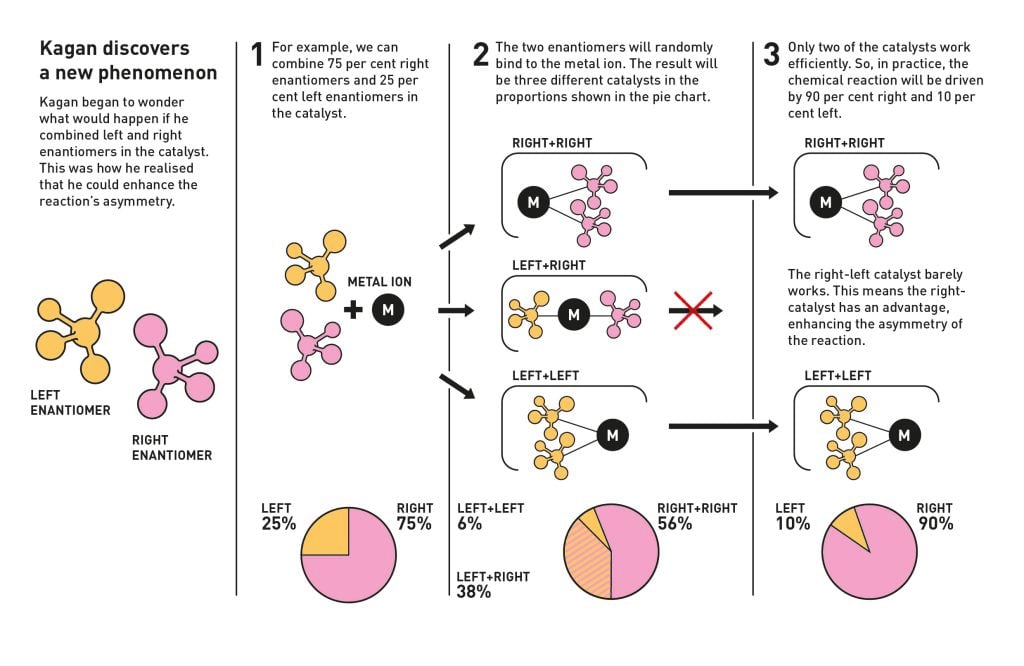
Kagan began to wonder what would happen if he mixed left- and right-handed enantiomers in a catalyst. It was from this that he realized he could enhance the asymmetry of his responses.
This reasoning led Kagan to an unexpected key factor: the left-right catalyst behaved differently from the other two. When he tried to drive reactions using catalysts composed of different combinations of enantiomers, he found that the ratio of enantiomers in the catalyst and the ratio of enantiomers in the product were not linearly related as other chemists had assumed. Instead, when Kagan plotted the results of his experiment, what he got was a curve. The reason is that left-right catalysts drive chemical reactions much slower than right-right or left-left catalysts.
In practice, this means he found a way to promote the formation of one of the enantiomers in the product. Thus, he satisfies the second condition of Frank’s model. In 1986, he introduced as many as three different asymmetric reactions, all of which exhibited what chemists call “nonlinear effects.” This was a historic breakthrough, and many chemists began to explore this new phenomenon. One of them is Kenzo Kipai of Tokyo University of Science.
The exploration of Xia He Xian III: Let the product promote its own generation
Xia Hexiansan studied an asymmetric chemical reaction with significant nonlinear effects. When he carefully examined the structure of the reaction catalyst and the resulting product, he found that there were great similarities between the two. This inspired him: Maybe he could design a reaction in which the catalyst generates itself through an autocatalytic process?
By experimenting with many different molecules, Kia Hexiansan succeeded in finding a chiral substance that could catalyze the production of itself – 5-pyrimidinyl alkanol. In a paper published in 1995, he introduced this revolutionary experiment. Initially, the enantiomeric excess of one enantiomer of 5-pyrimidinyl alkanol was 2%, and by the end of the reaction, this value reached 87%. This reaction is self-reinforcing and meets all of Frank’s conditions, but it has not yet reached the 100% enantiomeric purity required for life.
Eight more years later, Kia Hexianzo continued to search for the ideal autocatalytic process. In 2003, he finally demonstrated a chemical reaction that produced a slight excess of one enantiomer, which then contributed to the creation of more copies of itself. This is the first time since the birth of life that humans have successfully created chirality from achiral molecular combinations.
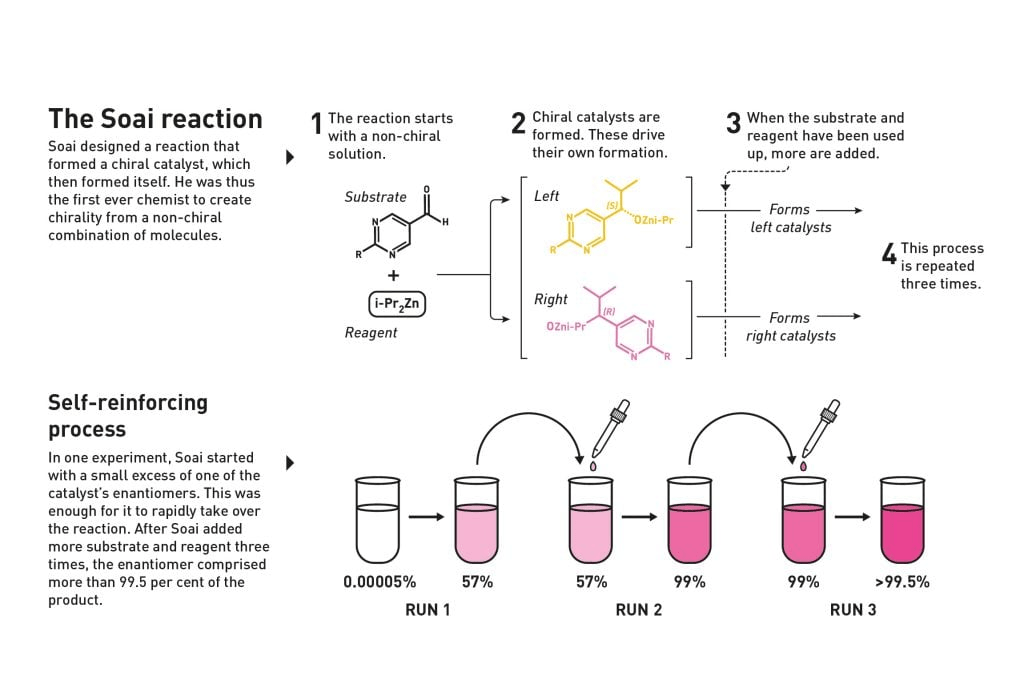
Kip Hexian-san devised a reaction that produced a chiral catalyst, which then produced itself. With this, he became the first chemist ever to create chirality from achiral molecular combinations.
When Kip Hexian San initiates the catalytic process, both enantiomers are formed, but slightly more of one is produced because the process is governed by randomness. This tiny excess is enough for this enantiomer to dominate the entire chemical reaction. Ultimately, it can account for 99.99% of the product. When Xia Hexiansan repeats this reaction, it is also possible that another enantiomer will dominate; which enantiomer you end up with depends on what happened randomly at the beginning of the reaction.
The Kip reaction is an artificially designed reaction that is distinct from the chemical processes of life, but it has reignited enthusiasm among chemists who hope to understand the origins of life. Now, researchers around the world are trying to repeat Kip’s achievement, but their goal is to generate homochiral amino acids and sugars.
The nonlinear effects discovered by Kagan have become an important tool for chemists when designing new reactions. The fact that a reaction is nonlinear can provide chemists with information about how the reaction proceeds. They can use this information to optimize reactions to obtain products with the highest enantiopurity possible. This is critical for all companies that manufacture substances that interact with living organisms, such as pharmaceuticals, flavorings, fragrances and agricultural chemicals. In some cases, it is also important for the production of new materials.
Related Reading
- Customs reminds: Don’t take these “souvenirs” back home2026-10-08
- Chinese scientists successfully develop nuclear optical clock2026-10-08
- Democrats cry foul as U.S. lifts sanctions on Serb nationalist, MAGA-linked firm gets huge Bosnia energy contract2026-10-08
- Weeks before Election Day, the nation’s campaign finance regulator can’t enforce the law2026-10-08
- “Insufficient balance” during vacation and “boiling” on the way home! Various places usher in peak return passenger flow during the holidays2026-10-07