The nuclear optical clock is a timing device that uses laser to accurately drive a special radioactive isotope “thorium-229” to achieve an energy level transition inside the atomic nucleus, and uses the frequency of this nuclear transition as a benchmark. Chinese scientists used the independently developed 148-nanometer continuous-wave vacuum ultraviolet laser and thorium-229-doped calcium fluoride crystal to take the lead in the world in developing a nuclear optical clock and achieving its stable operation, extending quantum precision measurement from electronic transitions to atomic nuclear transitions. The results were published online in Nature on the evening of October 7.
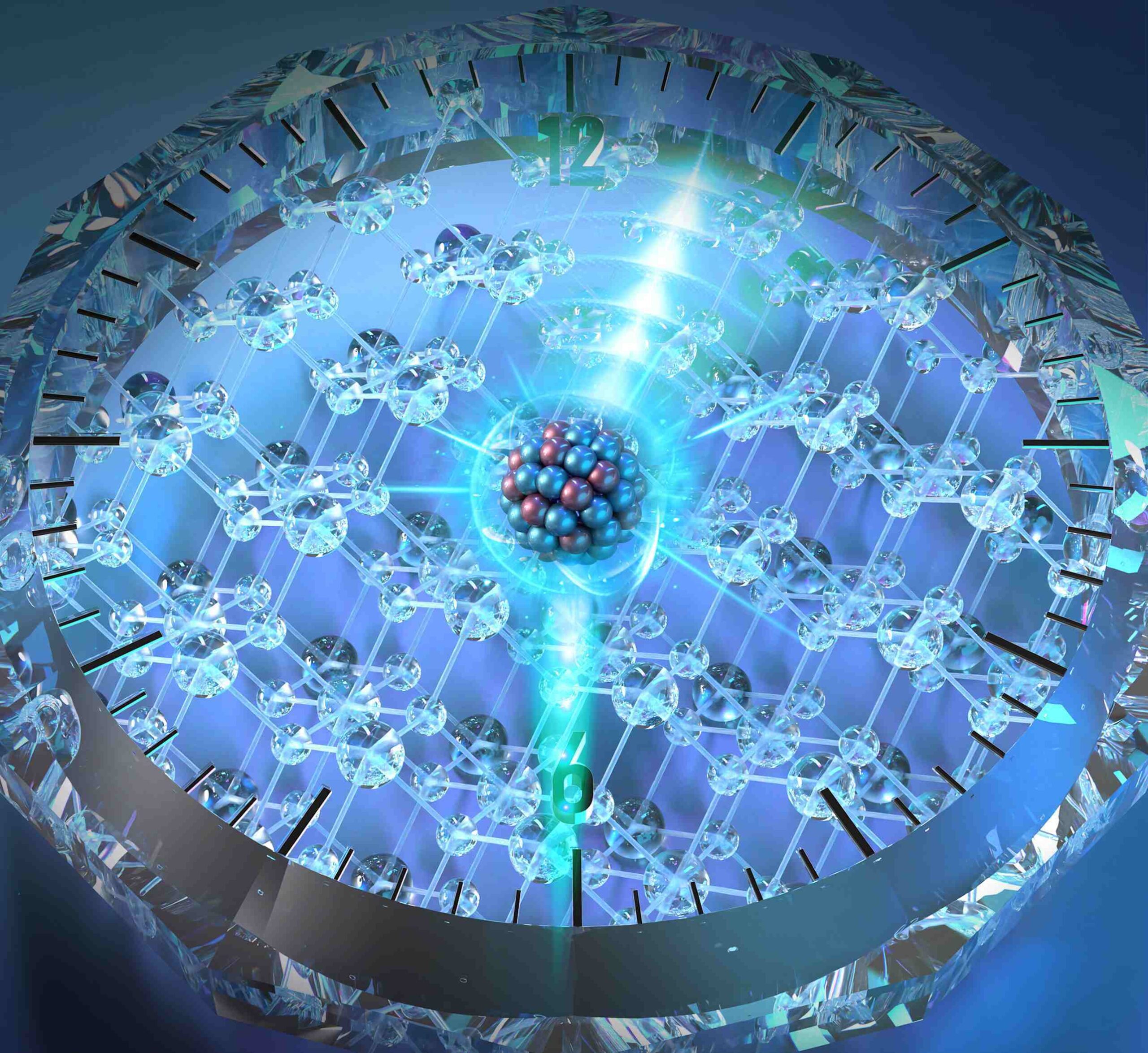
The picture shows the concept diagram of nuclear optical clock. (Photo courtesy of the research team)
Zhai Hui, director of the Department of Physics at Tsinghua University and professor at Zhenning Yang Institute for Advanced Study, said that the nuclear optical clock is expected to become a new generation of time and frequency benchmark, and its successful development is an important breakthrough in the field of quantum precision measurement this century. “The successful development and stable operation of nuclear optical clocks means that the ability of quantum control reaches the scale of atomic nuclei, opening up new research directions for quantum precision measurement and quantum control.”
Atomic clocks use the transitions of electrons inside atoms between specific energy levels as a frequency reference. They are currently the most accurate time measurement tools in the world. They are like “listening to the beat of electrons” to tell time. The nuclear optical clock puts the “pendulum” inside the atomic nucleus and uses the transitions between different energy levels of the atomic nucleus to measure time, which is equivalent to “listening to the beat inside the atomic nucleus” to measure time. Since the scale of atomic nuclei is much smaller than that of atoms and is less affected by disturbances in the external electromagnetic environment, nuclear optical clocks are expected to provide a more accurate and practical time and frequency benchmark than atomic clocks.
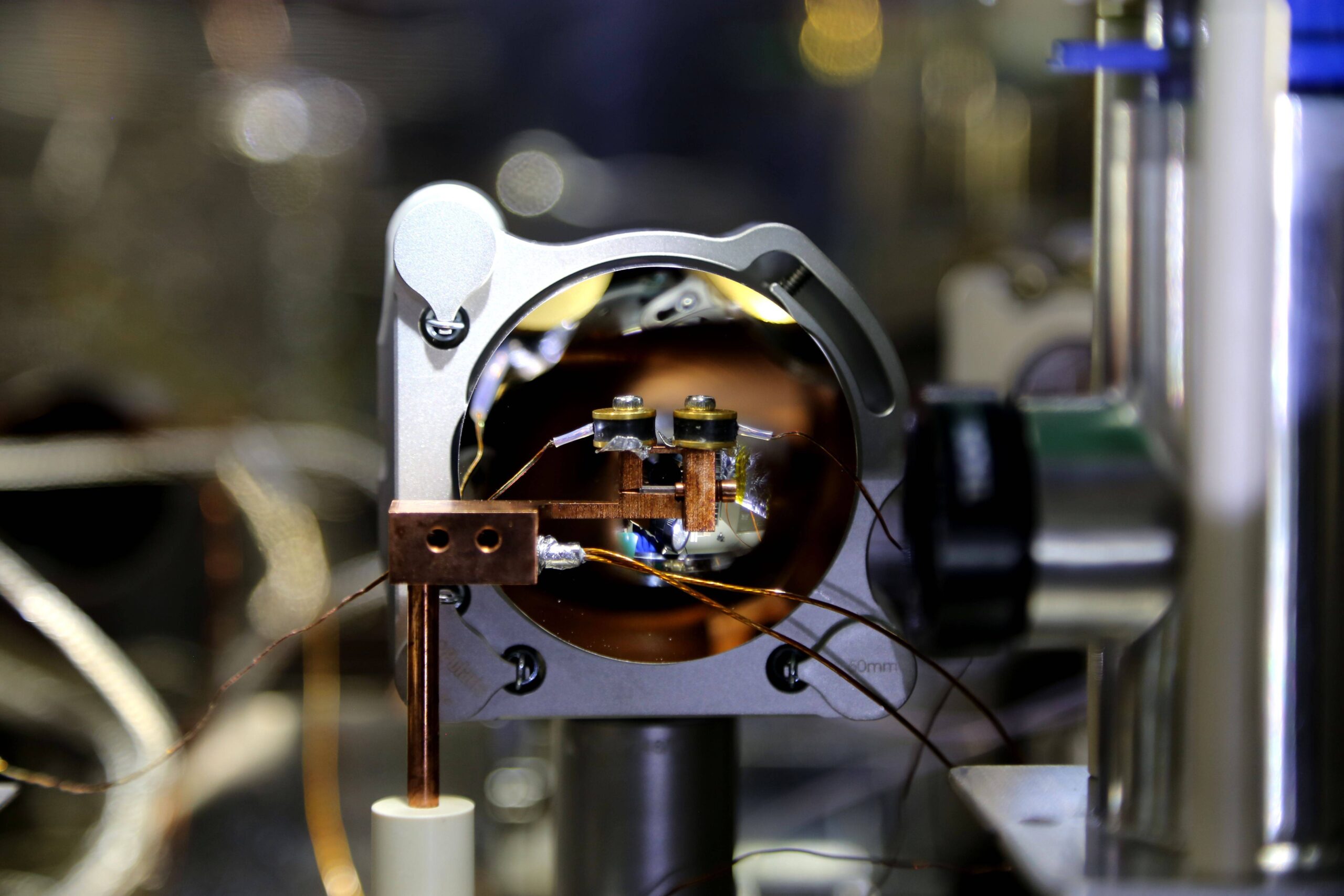
The picture shows the core area of the nuclear optical clock experimental device. (Photo courtesy of the research team)
Ding Shiqian, associate professor of the Department of Physics at Tsinghua University and part-time researcher at the Beijing Institute of Quantum Information Science, led the research team to develop a 148-nanometer continuous wave vacuum ultraviolet laser for the first time in the world, solving the core light source problem of accurately driving the internal energy level transition of the thorium-229 nucleus. At the same time, he and the cooperative team developed a trace amount of thorium-229 doped calcium fluoride crystal, which laid a core technical foundation for the development of nuclear optical clocks.
Ding Shiqian said that the team has now stably locked the laser frequency to the nuclear transition, achieving nuclear optical clock second-level stability that is nearly an order of magnitude better than that of the European team in the same period, and leading the world in performance. “Currently, we have established a complete technical system from core light source, nuclear optical clock crystal, nuclear transition spectrum to closed-loop operation.”
Related Reading
- Customs reminds: Don’t take these “souvenirs” back home2026-10-08
- Solve the century-old chemical mystery of “how homochirality occurs spontaneously”! Official explanation of why this year’s Nobel Prize in Chemistry was awarded to these two scientists2026-10-08
- Democrats cry foul as U.S. lifts sanctions on Serb nationalist, MAGA-linked firm gets huge Bosnia energy contract2026-10-08
- Weeks before Election Day, the nation’s campaign finance regulator can’t enforce the law2026-10-08
- “Insufficient balance” during vacation and “boiling” on the way home! Various places usher in peak return passenger flow during the holidays2026-10-07