China’s largest dumpling shop is about to go public.
The investment community has learned that Yuanji Food Group Co., Ltd. (referred to as “Yuanji Food”) has passed the listing hearing of the Hong Kong Stock Exchange and is only one step away from listing.
Many people often pass by this internet famous dumpling and wonton shop. Walking past a dumpling shop with a green sign on the corner, several aunties in aprons were sitting in the back kitchen, squeezing dumplings quickly with their hands. Not long after, the steaming dumplings were scooped out of the pot.
Started in 2012, Yuan Ji Yun Dumplings was formerly a small stall of a few square meters in the Guangzhou wet market. It quickly became popular in the Pearl River Delta with its main focus of “freshly packaged and sold now”.
The person at the helm is a post-90s generation from Hunan. He has teamed up with franchisees to sell a bowl of dumplings across the country. It has opened more than 4,700 stores so far and is about to create the largest dumpling IPO in China.
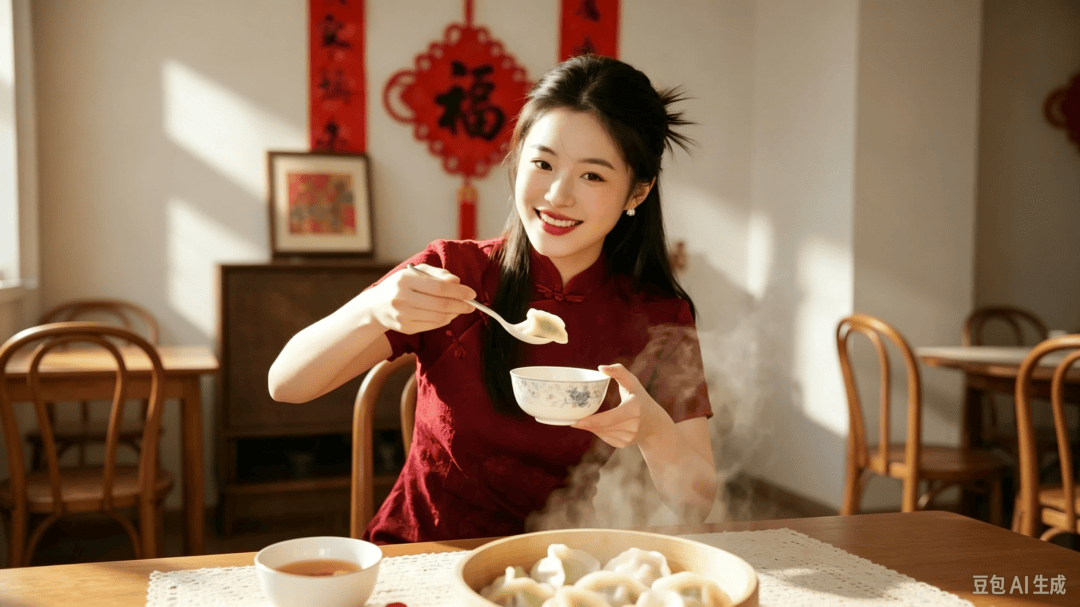
The post-90s generation from Hunan went south to Guangzhou,Open a shop selling dumplings and wontons
Yuan Ji’s story begins with a post-90s sports student.
Born in Yiyang, Hunan in 1990, Yuan Lianghong was passionate about business since he was a child and opened a mobile phone store in the town during high school. Later, he entered Hunan University of Science and Technology and seized the opportunity of e-commerce to become a Taobao consignment agent. He also joined a roast duck brand, but failed due to lack of experience.
He chose to go south to Guangzhou to look for opportunities, and accidentally discovered a business opportunity in a wet market – customers wanted to eat dumplings that were packaged and sold immediately, but most of the dumplings on the market were quick-frozen products. In 2012, Yuan Lianghong teamed up with his university classmate Tian Wei to open a 5-square-meter stall in Liwan, Guangzhou, and the first “Yuan Ji” was born.
The dumpling shop specializes in selling freshly made dumplings, and the business is booming rapidly. In order to improve the taste of dumplings, the early team continuously adjusted the formula and “almost ate all the time-honored brands in Guangzhou.” After opening for franchising, the number of stores expanded to 100 in just two years.
Although it is better to make it by hand, it is inefficient and costly. Yuan Lianghong took a compromise path – establishing a central kitchen in Foshan to process the fillings and dough uniformly, and deliver them to the store through the cold chain. The store is only responsible for packaging and cooking.
In 2016, the company successfully deployed in the Hunan, Hubei and Sichuan markets, expanding the brand from the region to the country. The following year, it began to explore “raw and cooked” stores. With the concept of hand-cooked freshly made dumplings, Yuan Ji Yun Dumplings quickly broke out in the field of quick-frozen siege. In 2021, the number of stores nationwide exceeded 1,000.
Now, Yuan Ji is setting his sights on overseas markets. The first overseas stop will be in Singapore in 2024, and the first UK store will be opened in the East End of London in May this year. As of May 2026,Yuanji Food has 41 overseas stores, located in Singapore, Thailand, Malaysia and the United Kingdom.
Investors followed. The first to enter the game was Black Ant Capital, which completed a 30 million yuan Series A financing for Yuanji Food in June 2023.
In May 2025, the company completed the shareholding reform, and the B round of financing of 150 million yuan was launched in the same year. Investors include Xinghan Chuangshi, Qicheng Capital, Shanghai Yiyong, PSHK, Shanghai Bird’s Nest, Hainan Yinsong, Lingyue Delicious, etc. After penetration, old shareholders Black Ant Capital, Qicheng Capital, Guanghong Holdings and Zhao Ding, founder of Zhao Yiming Snacks, participated.
Soon, Yuanji Food completed another B+ round of financing of 280 million yuan, adding strategic investors such as the listed company Arowana, C&D Emerging Investments under C&D Co., Ltd., and Xiamen Qimei Joint Investment Partnership (Limited Partnership), with the valuation reaching 3.5 billion yuan.
Before the IPO, Yuan Lianghong directly held 22.23% of Yuanji Food’s shares, holding a total of 82.54% of the company’s voting rights. This listing will create the first dumpling and wonton IPO on the Hong Kong Stock Exchange.
China’s largest dumpling IPO,Franchise stores everywhere
A prospectus reveals more details.
Specializing in handmade freshly packaged and ready-cooked products, Yuanji Food provides dumplings, wontons and related products in cooked and raw forms. In addition, it also sells prepackaged dumplings and wonton products through multiple channels through the retail brand Yuanji Weixiang.
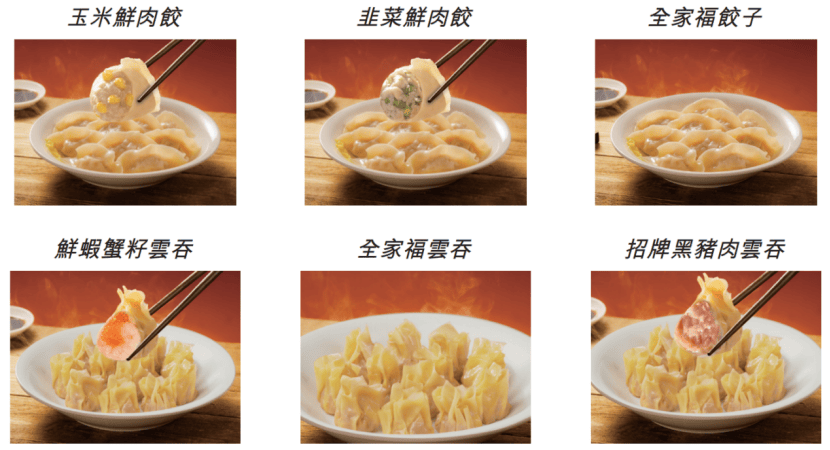
In the past three years,The number of Yuanji stores has expanded from 1,990 to 4,773, and its business covers 33 provinces and more than 250 cities across the country. However, there are only 23 directly operated stores, most of which are from franchisees.
Yuanji stores are moving down the market. The proportion of stores in first-tier cities has dropped from 58.1% in 2023 to 47.2% at the end of May 2026. The proportion of stores in third-tier cities and below has increased from 19.8% to 29.4%, and the number of stores has doubled.
Quietly, a dumplings and wontons empire has emerged – according to data from Chishi Consulting, Yuanji Food is one of the largest Chinese fast food companies in China based on the number of stores, and the largest dumplings and wontons company in China based on GMV in 2025.
You may not know,Yuan Ji Yun Dumplings does not directly make money from customers. It sells fillings, dough, and seasonings to franchisees and collects the price difference at the supply chain level.
Dismantling the financial data, from 2023 to 2025, the company achieved revenue of 2.026 billion yuan, 2.561 billion yuan, and 2.795 billion yuan respectively. In the first five months of this year, it increased by approximately 40% year-on-year to 1.306 billion yuan. Among them, more than 95% of the revenue in 2025 will come from goods and other sales, and franchise service fees and direct sales revenue will be almost negligible.
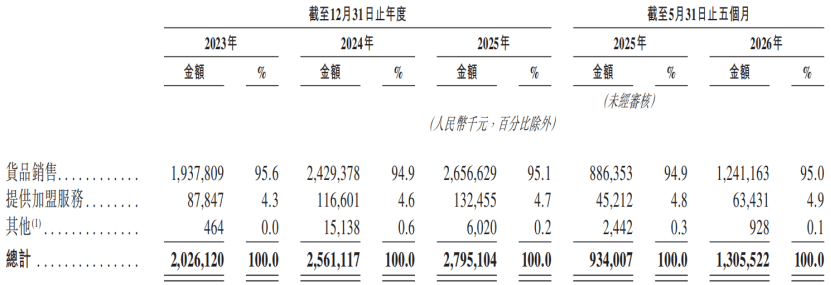
In terms of profitability,The company’s net profits in the past three years were 167 million yuan, 142 million yuan, and 199 million yuan respectively. In the first five months of this year, they were 157 million yuan, a year-on-year increase of 175%.. The gross profit margin is around 25%, rising with the decline in pork prices, production volume diluting fixed costs and other factors.
Although the number of stores is rapidly expanding, single store operations are under pressure. From 2023 to 2025, the average daily GMV of Yuanji Yun Dumplings per store was approximately 5394.4 yuan, 5010.8 yuan, and 4687.6 yuan respectively. In the first five months of 2026, it fell to 4627.3 yuan. The average total GMV per order dropped from 26.1 yuan in 2023 to 22.5 yuan in 2025.
In addition, the operational pressure of rapid expansion has also been passed on to the supply chain. In the past three years, the company’s inventory has been approximately 61 million yuan, 72 million yuan, and 88 million yuan respectively. It further increased to 95 million yuan at the end of May 2026, and the inventory turnover days rose from 12.1 days in 2024 to 14.7 days.
The difficulty of quality control and management has increased rapidly. In November 2024, a consumer ate an earthworm in the wonton noodles of Yuan Ji Yun Dumplings, and discussions began one after another about whether the raw materials delivered by the central kitchen were pre-made dishes.
Therefore, Yuanji Food frankly stated in the prospectus that the company faces risks in the franchise business model, including the revenue contribution of franchise stores, store operating capabilities, franchisee management, litigation, etc. “Each risk may have an adverse impact on revenue, brand image, and operating performance.”
Consumer IPO is in the cold winter, waiting for recovery
At this moment, consumer IPOs on the Hong Kong Stock Exchange are deserted as never before.
Since the beginning of this year, hard technology companies such as AI and robotics have attracted almost all the attention of the capital market; on the other hand, almost no one is paying attention to the consumer track, and consumer IPOs are hard to find.
Among the more than 100 companies listed on the Hong Kong stock market in 2026, technology companies account for more than half, and none in the catering category have yet been listed. The prospectuses of leading catering brands such as Aunt Qian, Banu, and Big Pizza that were previously submitted have become invalid, and the IPO road has become increasingly tortuous.
The stock prices of listed companies are not much better. The “Three Sisters of Hong Kong Stocks”, which hit record highs last summer, have now been significantly downgraded. The consumer sector has also fallen from being the protagonist of the much-anticipated new stock feast to being rarely noticed.
To some extent, behind the last round of IPO boom is the long-standing exit pressure. Many consumer companies do not come to Hong Kong stocks with full expectations, but face a more realistic choice: after the story exits, it will be difficult to obtain the valuation once given by the primary market.
This feeling, this scene, I know the warmth and coldness.
Some people firmly believe that the consumer market with a population of 1.4 billion is still long and snowy, but it is suffering before the dawn. I remember that in March this year, it was announced that the China Securities Regulatory Commission would add a more precise and inclusive set of listing standards on the GEM to support the issuance and listing of high-quality innovative entrepreneurial companies such as new consumption and modern service industries on the GEM.
Everyone is once again looking forward to the fact that the place where countless consumer stocks were born will once again open its doors to consumer companies.
Related Reading
- Fuel industry warns truck stops against selling ‘red dye’ diesel after Trump lifts restrictions2026-10-08
- Original: Ternus took office to focus on design, and Apple launched intensive new products in October. Is this a strategic shift to use hardware to save itself?2026-10-07
- Huawei Rotating Chairman: Shengteng China’s share has surpassed Nvidia’s, and the current bottleneck is supply2026-10-07
- Trillions of dollars are hitting high-speed charging piles, why is there still no solution to the queue?2026-10-07
- Disney increases park prices every year. Here’s how it avoids pricing out families2026-10-06