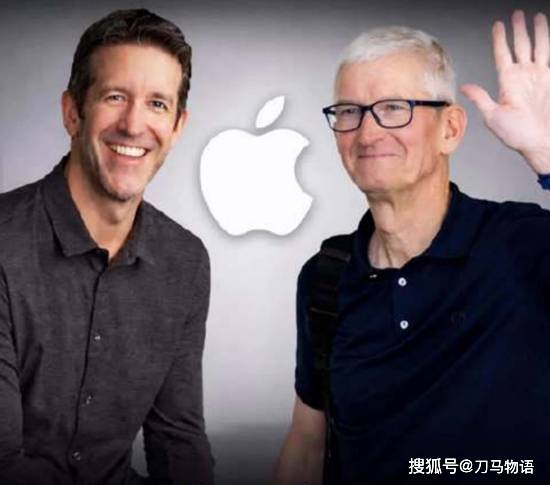
In the Cook era, Apple relied on its service business to support its profit bottom line; and Ternus took over and cut back to the source of its products. Taking over the design rights personally, and intensively releasing foldable iPhone, touch screen Mac, and AI home hardware in October, the essence is not a simple bombing of new products, but when the growth of high-margin service business peaks, Apple re-bets on the hardware ecosystem, uses terminal increments to save subscription growth, and regains the right to speak about products in the AI era.
In the more than ten years since Cook has been in charge of Apple, his core strengths have been global supply chain, financial control, global business negotiations, and ecological operations. He transformed Apple from a product company in the Steve Jobs era to a composite giant of hardware + high-margin subscription services. The gross profit margin of the service business has remained above 75% for a long time, and it was once Apple’s safety cushion to hedge against fluctuations in the iPhone hardware cycle. Cook rarely spends time in the design studio and spends more time running global markets, communicating with regulators, and maintaining relationships with major customers.
Ternus has a completely different style of play. As a veteran who joined Apple in 2001 and worked his way up from hardware engineering to senior management, within just a few weeks of taking office, he directly handed over the finance to the CFO and the supply chain to the COO. He joined the industrial design and UI design teams himself, stationed in the design studio multiple times a week, and personally served as the final decision-maker on product design. He no longer hired an external chief design officer. This is equivalent to the fact that the CEO personally serves as the chief design officer. This is a major change in Apple’s top power structure since Steve Jobs.
This is not a restoration of sentiment, but an organizational adjustment forced by the crisis. Apple’s biggest contradiction at the moment is its weak hardware innovation and long replacement cycle; its service business, which Wall Street once had high hopes for, has seen its growth engine stall. The pressure on the service business comes from a triple blow. The EU Digital Market Act forces the opening of external payment channels, which directly weakens the App Store’s commission; global consumption is weak, and users’ willingness to pay within the app decreases; coupled with domestic mobile phones diverting high-end users, the growth rate of Apple’s hardware ownership slows down, and the new user pool of subscription services peaks. In the latest financial report, although the absolute value of service revenue is still a record high, the growth rate is lower than expected, showing a rare month-on-month decline in many years. App Store revenue sharing has experienced negative year-on-year growth for the first time in four years. The once most stable profit engine has lost power.
When the “profit cushion” of services fails, Apple must return to its roots, hardware. Ternus takes charge of design personally to compress the decision-making chain and solve the problems that were criticized in the late Cook era – slow product iteration, conservative innovation, and separation of hardware and AI experience.
Ternus’s solution is very clear: intensively launch new hardware products, expand equipment ownership, and in turn drive service subscriptions, forming a new closed loop of growth. The list of Apple’s new products in October is the densest in recent years. The iPhone Duo folding screen, Apple’s first horizontally foldable mobile phone, was pre-sold on October 16 and officially launched on October 23, opening up a new high-end hardware track with more than 10,000 yuan and driving high-end replacements; the first touch screen + OLED MacBook Pro, the Mac product line has made up for the touch interaction that has been missing for many years; the OLED version of iPad mini strengthens the competitiveness of the portable tablet market; a smart home hub with a screen, a new generation of HomePod mini, and upgraded Apple TV, all with built-in Siri AI makes up for the shortcomings of the smart home hub and opens up the Apple Intelligence portal for the whole house.
These new products have a common core and all serve Apple’s end-side AI. Apple’s AI route is a large client-side model bound to hardware, which is completely different from OpenAI’s cloud-based agent route. The value of Apple Intelligence must rely on iPhone, Mac, and Home hardware carriers. Without enough new hardware terminals, Apple AI will not have a landing scenario, and services such as AI subscription, iCloud+, and Apple One will lack new paying users.
In a simple sentence, hardware is the entrance, AI is the experience, and subscription services are the long-term cash flow. Hardware cannot be sold, and service growth is a waste of water. In the past few years, Apple has been trapped in a paradox, with insufficient hardware innovation and prolonged user replacement cycles; device growth has stagnated, and fewer new users have subscribed to services; service growth has slowed, and capital markets have lowered valuation expectations. Ternus’s focus on launching new products in October is to proactively break this negative cycle. But this is different from the product logic of the Steve Jobs era. Jobs pursued “a disruptive product that changes the industry”; Ternus is filling gaps in multiple categories at the same time, with folding screens, touch screen Macs, and AI home hubs, complementing Apple’s shortcomings in high-end forms, interactive methods, and smart home hubs, broadening the hardware revenue plate, and laying a hardware foundation for Apple Intelligence.
The entire consumer electronics industry is experiencing clear differentiation. The first category is Google and OpenAI, which take cloud models and agent platforms as the core, and hardware is just an auxiliary carrier of AI, competing for software ecosystem, developers, and entrance to AI agents. The other type is Apple, which insists on hardware-defined AI. Its AI capabilities are deeply bound to its own chips, devices, and privacy systems, and relies on terminal hardware as the distribution channel for AI. Both routes have their own barriers and shortcomings. The advantage of OpenAI lies in its fast model iteration and open ecosystem; its shortcoming is that it lacks its own terminals and relies on third-party hardware for implementation. Apple’s advantage lies in its 2.5 billion active devices worldwide, which naturally has a large number of users; its shortcomings are that its model iterations are conservative, AI commercialization is slow, and its service business is facing double squeeze from global regulation and the market.
The essence of Ternus’ strategic choice after taking office is that Apple refuses to become a pure software subscription company and sticks to the moat of hardware + software and hardware integration. For Apple, hardware is not just a one-time gross profit from selling machines, but also a “traffic pool” for the service business. For every foldable iPhone or AI home hub sold, there will be one more user who can push Apple Intelligence, iCloud, Apple Music, and AppleCare. One-time revenue from hardware, plus multi-year continuous subscription revenue, this is Apple’s business model.
But the challenges along this path are equally prominent. First, the dividends from hardware innovation are diminishing. Neither the folding screen nor the touch-screen Mac were pioneered by Apple. They are catch-up innovations, and it is difficult to recreate the iPhone-style disruption of the past. Second, the cost pressure is rising. The folding screen core screen relies on Samsung, and high-end hardware BOM costs are high, which will squeeze the hardware gross profit margin. Third, the AI monetization cycle is long, and on-device AI currently improves the device experience more. It is difficult to independently generate large-scale revenue in the short term and can only be used as an additional selling point of the hardware. This is why the capital market remains cautious. Intensive new releases can boost hardware sales in the short term, but whether it can be transformed into long-term stable service growth is still unknown.
Ternus’s product choices hide his judgment on Apple’s future. The Cook era bet on Vision Pro as a long-term bet for the next generation of space computing, but market acceptance was not as good as expected. Ternus has a relatively cold attitude towards Vision Pro. There are internal signals that if the market continues to be cold, it will reduce its investment in head-mounted devices and tilt its resources towards folding phones, Macs, smart homes, and other hardware that can quickly increase volume and directly drive service revenue.
This represents an adjustment in Apple’s strategic focus, temporarily slowing down the distant next-generation space computing and giving priority to stabilizing the current fundamentals. Vision Pro belongs to the future track with high investment, long cycle, and low sales; while folding iPhone, touch screen Mac, and AI home hardware are categories that can generate sales immediately, quickly implement Apple Intelligence, and attract subscribers. Ternus’s management philosophy focuses resources on products that can quickly generate commercial returns, speeds up product iteration, and changes the rhythm of Apple’s “once a year autumn launch” in the past. In the future, new products will be released regularly throughout the year and the product development cycle will be shortened. At the same time, we are promoting cost optimization internally, streamlining inefficient projects in the service business, such as shrinking subscription sectors with weak growth such as Fitness+, and shifting budgets to hardware and AI research and development.
Related Reading
- Fuel industry warns truck stops against selling ‘red dye’ diesel after Trump lifts restrictions2026-10-08
- Huawei Rotating Chairman: Shengteng China’s share has surpassed Nvidia’s, and the current bottleneck is supply2026-10-07
- China’s largest dumpling IPO is coming2026-10-07
- Trillions of dollars are hitting high-speed charging piles, why is there still no solution to the queue?2026-10-07
- Disney increases park prices every year. Here’s how it avoids pricing out families2026-10-06