Reporter of Every Journal|Dan Zhongkui Editor of Every Journal|Yang Huan
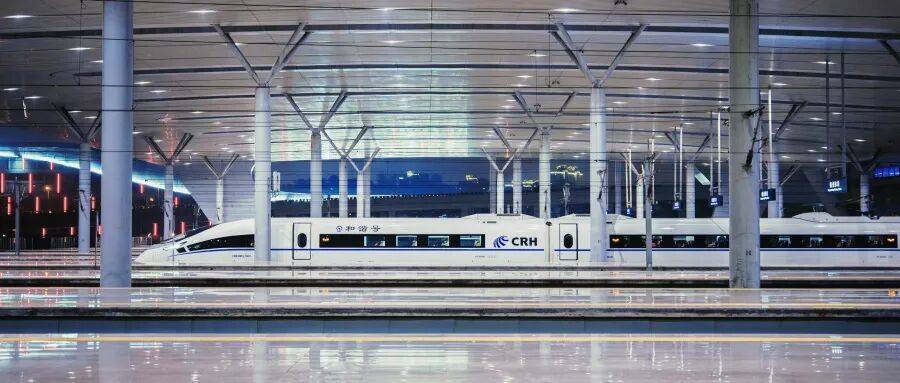
On September 28, all four lines of high-speed rail across the country were launched.
The Xiongan-Shangqiu section of the Beijing-Hong Kong high-speed railway, the Xi’an-Ankang section of the Xi-Chongqing high-speed railway, the Yichang-Xingshan high-speed railway, and the Harbin-Yichun high-speed railway were opened simultaneously, passing through North China, Northwest China, Central China, and Northeast China, further weaving the “eight vertical and eight horizontal” high-speed rail network.
With the opening of the Xikang New Line, Xi’an has become the third “meter”-shaped high-speed rail hub in the country and the first in the west after Zhengzhou and Hefei. Zooming in, the inland high-speed rail hub is entering a period of intensive cashing in which the word “meter” is taking shape. In addition to Xi’an, the construction of “meter”-shaped hubs in inland provincial capitals such as Jinan and Wuhan is also accelerating.
At the same time, connections between these superhubs are strengthening. At present, Xi’an will form the “Western Triangle” on the high-speed railway with Chengdu and Chongqing, allowing the three major urban agglomerations of the Guanzhong Plain, the middle reaches of the Yangtze River, and Chengdu and Chongqing to be directly connected at a speed of 350 kilometers per hour; along the Yellow River Basin, it is also expected to form a parallel pattern of three “meter” hubs of Zhengzhou, Xi’an, and Jinan…
A question that needs to be faced directly is that after the “meter” hub is formed, the real battle for traffic has just begun; and when these hubs are connected to each other, how will the inland economic geography be rewritten?
填補空白
At 9:16 a.m., a G9997 smart EMU train slowly departed from Xi’an East Station and arrived at Ankang West Station at about 10:10. This is the third high-speed rail in Shaanxi to pass through the Qinling Mountains after Xicheng and Xishi, bringing Zhashui, Zhenan and Ankang in the Qinba hinterland into the high-speed rail era.
This line has a total length of 171 kilometers and a design speed of 350 kilometers per hour. There are 5 stations on the entire line: Xi’an East, Niubeiliang, Zhashui West, Zhen’anxi, and Ankang West. Since then, the railway running time from Zhashui, Zhen’an, and Ankang to Xi’an has been shortened to 28 minutes, 40 minutes, and 45 minutes respectively.
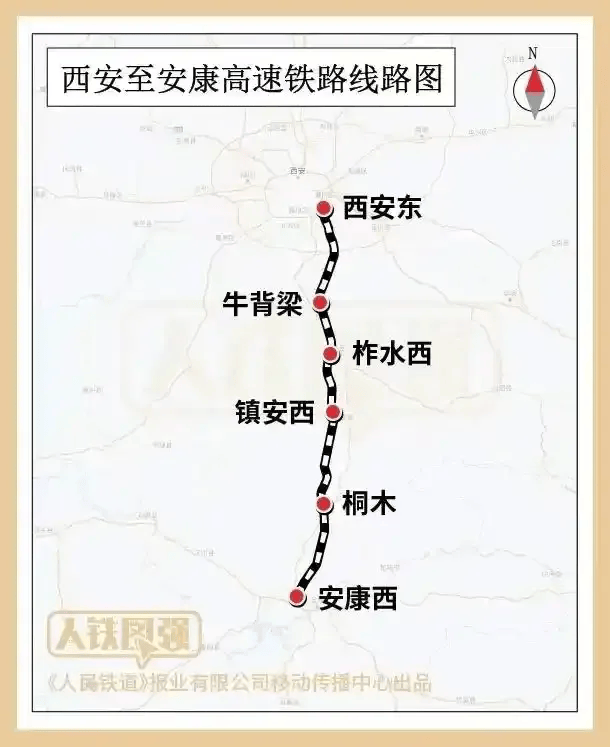
At the same time, the Ankang-Chongqing section of the west-Chongqing High-speed Railway is expected to be completed and opened to traffic in 2028. In the future, it will pass through Ankang, Dazhou, Guang’an and other places, and finally connect to Chongqing West Railway Station. By then, the train running time from Chongqing to Xi’an will be shortened from the current fastest of more than 5 hours to about 2 and a half hours.
This is very similar to the Xicheng-Chengdu high-speed railway that passed through the Qinling Mountains nine years ago, bringing Hanzhong into the high-speed rail era.
At that time, in just one year, Hanzhong Railway Station Hanzhong Station operated a total of 43,000 trains and carried 4.15 million passengers. The average daily number of passengers increased from 2,400 to 13,000 today.
Now, Ankang and Shangluo have also entered the express lanes of the two central cities of Xi’an and Chongqing. How will they handle the large traffic?
From the Shaanxi Provincial Department of Culture and Tourism to Ankang and Shangluo, they are all taking “high-speed rail + cultural tourism” as the main line to plan to convert high-speed rail traffic into economic increment. Among them, Ankang released the “County Exclusive Discount Undertaking List”, launched the “one county, one characteristic” exclusive preferential policy for the opening of high-speed rail, and announced that from the date of the opening of Xikang High-speed Railway to December 31, 2026 (excluding statutory holidays), with high-speed rail tickets or ticket purchase records within 7 days, you can enjoy free tickets for all paid scenic spots in Ankang City.
This is also the manifestation of various places seizing the opportunity of the opening of high-speed rail. But at the same time, the compression of time and space distance also means changes in urban relationships and division of labor.
Not long ago, the Shaanxi Provincial Party Committee and the Provincial Government issued the “Implementation Opinions on Promoting High-Quality Urban Development” which mentioned that “promoting the integrated development of Xitong, Xiwei, Xishang and Xiyang”. Shangluo has entered the “dual high-speed rail era”, and it is proposed to explore the “double-city life” model of Western merchants, jointly build an urban development circle, and build Shangluo into Xi’an’s “back garden”, health care destination, and industry undertaking place.
This means that the relationship between Xi’an and Shangluo is heating up. As it enters Xi’an’s “one-hour economic circle”, Ankang is also expected to have more linkages with Xi’an. In fact, Ankang is already planning to integrate into the Xi’an metropolitan area to the north for coordinated development.
In May this year, Zhang Xiaoping, mayor of Ankang City, said at a press conference held by the Shaanxi Provincial Government Information Office that he would consolidate and expand the “four-way” opening pattern that merges into the Yangtze River Economic Belt to the east, deeply connects with the Silk Road Economic Belt to the west, integrates into the coordinated development of the Xi’an metropolitan area to the north, and connects to the New Western Land-Sea Corridor to the south.
But opportunities often coexist with challenges. According to Fu Ying, associate professor and director of the Economic Management Teaching and Research Section of the Party School of Ankang Municipal Party Committee, opportunities and challenges coexist for Ankang’s tourism industry, and we must be especially wary of a potential risk – the “transitization” of tourism.
“Ankang is located at the passage node between Guanzhong, Sichuan, Chongqing, and northwest Hubei. If its own tourism products lack sufficient recognition and appeal, tourists will easily ‘go straight to the topic’ and use Ankang as a short-term stopover.”
This is a test that cities along the route must face.
中心直聯
Behind the encryption of high-speed rail networks, central cities are moving towards direct connections.
At present, the Xikang section of the Xi’an-Chongqing high-speed railway is open to traffic in 2028. The time and space distance from Xi’an to Chongqing is expected to be shortened to more than 2 hours. The time and space distance between Chongqing and Wuhan is also changing——
The Yixing High-speed Railway, also opened today, starts from Yichang North Station of the Shanghai-Chongqing-Chongqing High-speed Railway, passes through Yiling District, Yichang City, enters Xingshan County, and connects to Xingshan Station of the Zhengzhou-Chongqing High-speed Railway. The total length of the line is 101 kilometers and the design speed is 350 kilometers per hour.
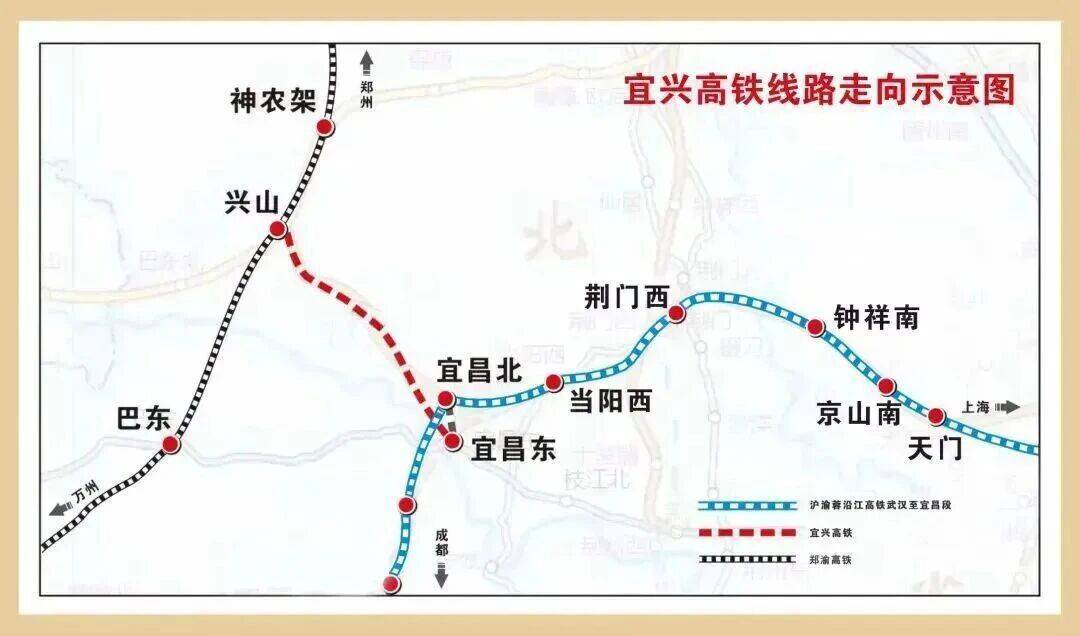
From Yichang North to Xingshan Station, it can be reached in 30 minutes at the fastest. After the Wuhan to Chongqing High-speed Railway runs via the Yixing High-speed Railway, the time and space distance is further compressed to 3 hours and 54 minutes at the fastest.
“The original intention of building the Yichang-Xingshan high-speed railway is to solve the problem of the Yichang-Wanzhou railway running at a speed of only 120 to 160 kilometers per hour after reaching Yichang along the river.” Shang Zejin, deputy chief engineer of the Railway Siyuan Line Station and head of Yixing high-speed railway design, told local media.
This means that the Chengdu-Chongqing twin-city economic circle, the Guanzhong Plain urban agglomeration, the middle reaches of the Yangtze River urban agglomeration, and the core cities of the Central Plains urban agglomeration are directly connected, making cross-regional coordinated development more possible.
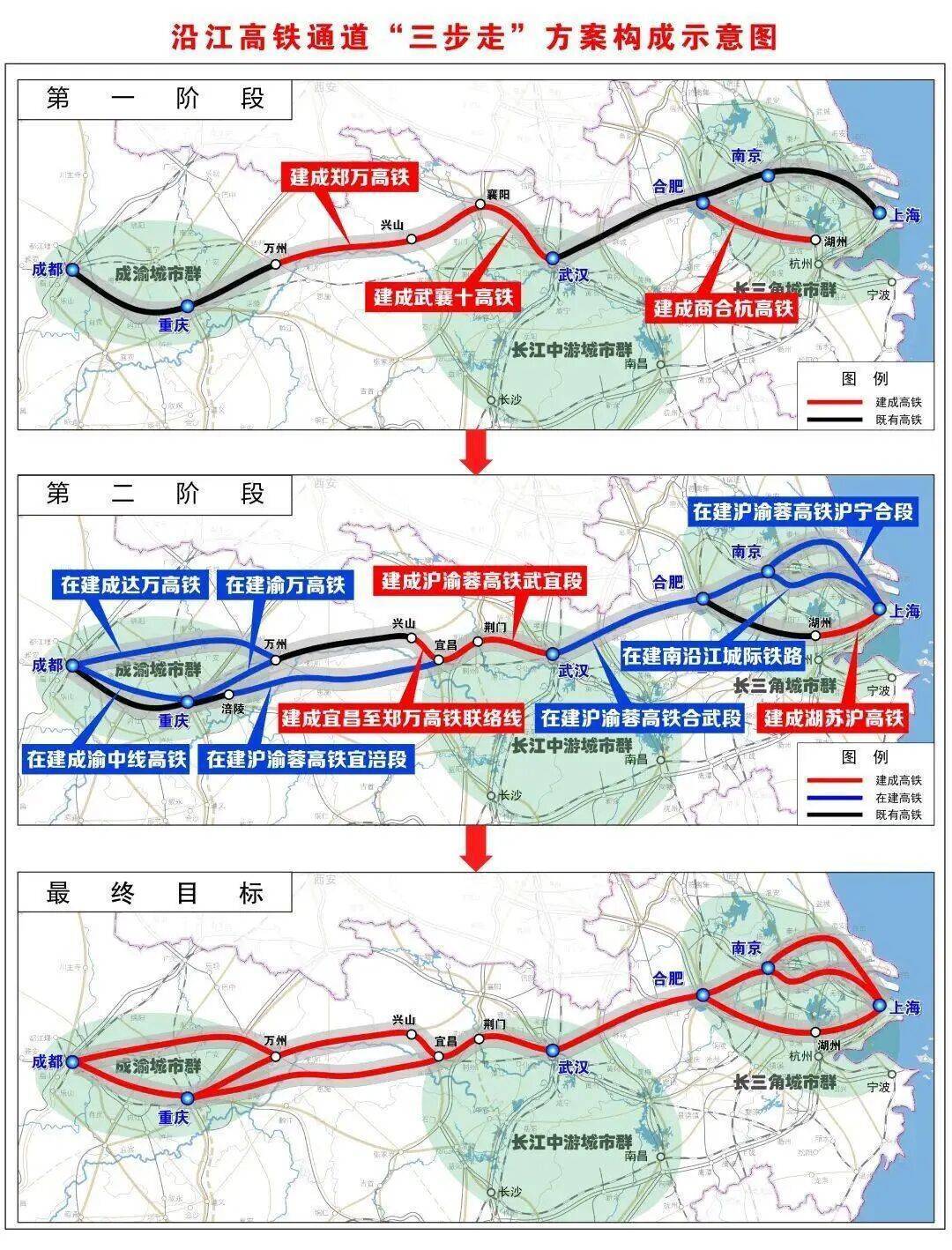
“This passage has accelerated the connection between Wuhan, Chongqing and Chengdu, making the upper reaches of the Yangtze River and the middle reaches of the Yangtze River closely connected.” Qin Zunwen, vice president of the China Urban Economics Society and advisory committee member of the Hubei Provincial Government, analyzed the theory of urban evolution. Even the time distance from Chongqing, Chengdu to Shanghai and other places will be shortened, and the middle and lower reaches of the Yangtze River Economic Belt will become an organic whole.
“my country’s regional strategy is shifting from scale expansion to functional synergy. In the future, it will focus on the intertwined main thread of stimulating strategic superposition effects and promoting regional linkage development, providing spatial support for new breakthroughs in Chinese-style modernization during the ’15th Five-Year Plan’ period.”
Jin Fengjun, a researcher at the Institute of Geographic Sciences and Natural Resources of the Chinese Academy of Sciences, pointed out in the study “Spatial Strategies and Implementation Paths of Regional Interconnected Development” that we should focus on promoting regional interlinked development with the “three belts and two regions” (Yangtze River Economic Belt, “One Belt and One Road” and Yellow River Strategic Belt, New Western Land-Sea Corridor and Western Development Belt; Northeastern Region, and Southeastern Coastal Region).
For example, the Chengdu-Chongqing twin-city economic circle, as a cross-regional connection area that links multiple strategic sectors, was officially elevated to a major national regional strategy in the “15th Five-Year Plan”, which clarified the high-level positioning of the region’s composite functions, guided the strategies to align policies, and avoided positioning conflicts and resource dispersion among local governments.
Qin Zunwen believes that with the help of the Zhengzhou-Chongqing high-speed railway and the Xi-Chongqing and Xicheng high-speed railways, Chengdu and Chongqing will be connected to the north with Xi’an and Zhengzhou. The Chengdu-Chongqing twin-city economic circle will be connected with the Guanzhong Plain urban agglomeration and the Central Plains urban agglomeration, and the central and western regions will form a more effective linkage.
“As the upper reaches of the Yangtze River, it is very meaningful for the Chengdu-Chongqing region to radiate and integrate with surrounding areas. Especially to the east and north, to the economically active and densely populated direction, and to the east of the Hu Huanyong Line, the task of ‘creating an important growth pole and new source of power for high-quality development across the country’ can be better implemented,” he said.
“rice” racing
The “15th Five-Year Plan” outline emphasizes when deploying “regional linked development” that it should be “based on large cross-regional and cross-basin channels and use the linked development of urban agglomerations as the carrier.” This means that hard connectivity, represented by high-speed rail, shipping and other networks, is an important driver to support regional linkage development.
This is why the “meter”-shaped high-speed rail network is attracting so much attention.
As the third city in the country and the first city in the west to build a “meter”-shaped high-speed rail hub, Xi’an’s Zhengzhou-Xi’an high-speed rail to the east connects directly to the Central Plains and the Yangtze River Delta, the Xilan high-speed rail to the west connects to the Hexi Corridor, the Xikang high-speed rail to the south connects southern Shaanxi and Chongqing, and the north-west high-speed rail connects Tongchuan and Yan’an. At the same time, Yinxi, Xicheng, Xisheng, and Daxi radiate to the northwest, southwest, southeast, and northeast respectively.
“If there is only one line, it is just a node, and only a cross is called a hub. Then, the word “rice” is equal to the overlap of two crosses, forming eight-directional radiation such as east, west, south, and north. This can make the spillover effect or radiation effect of the central city more balanced. If there is a missing line in the word “rice”, it may mean that there is a problem with the radiation in one direction.” Qin Zunwen said.
In fact, in addition to Zhengzhou, Hefei, and Xi’an, the construction of “meter”-shaped hubs in many provincial capital cities is also accelerating.
According to the “Jinan Railway Hub Master Plan (2016-2030)”, Jinan’s “rice-shaped” high-speed railway blueprint is: Beijing-Shanghai high-speed railway in the north-south direction, Jiqing-Qingdao high-speed railway in the east, Jizheng high-speed railway in the west, Shiji-Jinan Passenger Railway in the northwest, Ji-Bin high-speed railway in the northeast, Jilai-Lai high-speed railway in the southeast, and Ji-Ji high-speed railway in the southwest.
Among them, the Beijing-Shanghai, Jiqing, Zhengji, Shiji, and Jilai lines have been completed and put into operation. On September 24, as the penultimate phase of Jinan’s “meter”-shaped high-speed railway, the Ji-Bin high-speed railway entered the joint debugging and testing stage and is expected to be put into operation before the end of the year.
From a local perspective, once Jinan’s “rice”-shaped hub is completed, there will be a pattern of three “rice-shaped” hubs in Zhengzhou, Xi’an and Jinan along the Yellow River Basin. Different from the previous two, Jinan is located at the eastern end of the Yellow River. The word “meter” connects the two large urban agglomerations of Beijing, Tianjin and Hebei and the Yangtze River Delta. This also gives the high-speed rail corridor along the Yellow River an additional radiating interface at the east end.
It is worth noting that Wuhan, Nanjing, Chongqing, Chengdu and other places have also proposed the goal of building “meter”-shaped high-speed railways to accelerate the construction of key corridors.
Among them, Nanjing proposed that during the “14th Five-Year Plan” period, the “meter”-shaped high-speed rail network has basically taken shape. Nanjing North Railway Station is planned to be completed and put into use simultaneously with the North Yangtze River High-speed Railway and Ninghuai Railway in 2027. “Nanjing’s ‘meter-shaped’ high-speed rail will complete the key work here.”
Wuhan proposed that by 2028, Wuhan will truly realize full coverage of 350 kilometers per hour high-speed rail in all directions and all channels, and fully complete the “super meter-shaped” high-speed rail hub, becoming a core transportation node that connects the country’s economic sectors and radiates to the inland hinterland.
Chengdu proposed that Chengdu’s “m-shaped” high-speed rail line will be officially formed by 2030;Chongqing proposed that by 2030, Chongqing will have built 11 high-speed railways with an operating mileage of about 2,100 kilometers, and the main skeleton of the “meter”-shaped high-speed railway has basically taken shape.
These are the popular candidates for the “meter”-shaped high-speed rail network during the “15th Five-Year Plan” period. In Qin Zunwen’s view, the “meter”-shaped high-speed rail network is an important support for central cities to perform their distribution functions. It gathers the country’s resource elements and radiates and flows to hinterland cities.
Related Reading
- Original Luo Yonghao makes enemies everywhere, Zheng Gang resorts to “tax evasion” killer weapon2026-09-29
- Li Bin pledged part of Weilai’s most valuable wealth to Geely2026-09-29
- power plant2026-09-29
- Original: Parents chatted about physics at the dinner table and raised a 29-year-old billionaire2026-09-29
- ‘Is it really worth it to keep going on?’ Economic pain hits America’s farm belt.2026-09-28