The two-day tripartite talks between Russia, the United States, and Ukraine ended on the 11th in Abu Dhabi, the capital of the United Arab Emirates. Russia and Ukraine have reached an agreement on a large-scale exchange of captured personnel, but there are still “major differences” on key issues such as territory and Ukraine’s security.
Analysts believe that the restoration of communication and negotiation channels between Russia, the United States and Ukraine is a positive development. However, the positions of Russia and Ukraine on core issues are still far apart, and it is difficult for negotiations to achieve substantive breakthroughs in the short term. As long as there are no fundamental changes in the strategic considerations of both sides, the situation of “promoting talks through war” will not change.
Progress: Russia-Ukraine prisoner exchange
The talks will be held behind closed doors starting from the 10th. This is the first time that Russia, the United States and Ukraine have resumed face-to-face negotiations since February this year. The talks lasted nearly 4 hours on the first day and less than 2 hours on the second day. Konstantin Blokhin, director of the Security Issues Research Center of the Russian Academy of Sciences, believed that the hasty end of the second day’s talks showed that neither Russia nor Ukraine had the will to compromise and that the peace process had not made substantial progress.
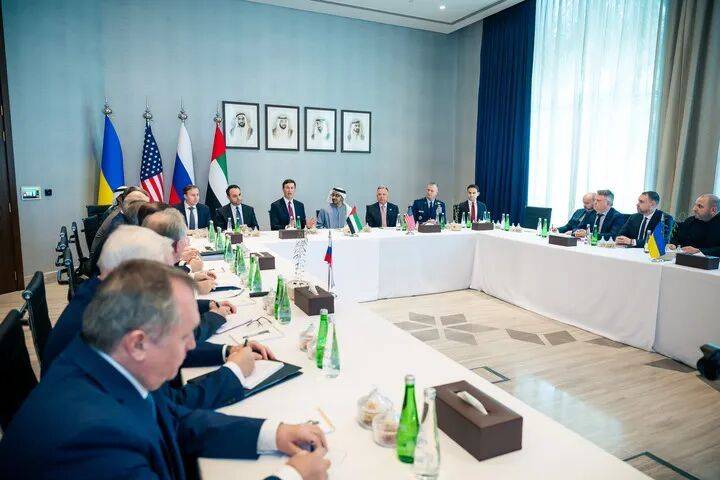
This is the scene of the tripartite talks between Russia, the United States and Ukraine taken in Abu Dhabi, the capital of the United Arab Emirates, on November 10. Xinhua News Agency/Emirates News Agency
The talks were characterized from the beginning as working-level technical consultations, and outsiders generally expected to be cautious. After two days of talks, Russia and Ukraine only agreed on a large-scale exchange of captured personnel. According to Zolin, a member of the Russian negotiating delegation and the first deputy director of the Information Management Bureau of the General Staff of the Armed Forces, Russia and Ukraine may each hand over more than 1,000 captured personnel to each other in the next two to three weeks.
However, Russia, the United States and Ukraine all recognized that the talks were constructive. Russian presidential assistant Ushakov commented that the talks were substantial and useful; Umerov, a member of the Ukrainian negotiating delegation and director of the Foreign Intelligence Service, said that “major differences still exist” between the parties, and there are also opportunities to continue to advance the negotiation process; US negotiator and President Trump’s son-in-law Kushner said that the talks were difficult but meaningful, and that all parties saw room for compromise in some areas, while other issues still require consultation.
Kushner also said that he and the US presidential envoy Vitkov will go to Moscow to meet with Russian President Vladimir Putin on the 12th. They plan to discuss the possibility of involving Europe in negotiations with Putin, and then go to Dublin, the capital of Ireland, to brief Ukrainian President Zelensky on the talks.
Public opinion generally believes that although the results of the talks are limited, the restoration of diplomatic communication channels is an important progress in itself. Samuel Charlap, a senior analyst at the Rand Corporation, an American think tank, said that under the current situation, it is difficult to expect all parties to quickly reach major agreements on complex issues. The more important significance of the current negotiations is to resume dialogue, gradually narrow differences, and create conditions for subsequent negotiations.
Deadlock: Three Difficulties
Since the beginning of this year, Russia, the United States and Ukraine have held four rounds of talks, each time showing similar characteristics: all parties affirmed the constructive significance of the talks, and some progress has been made on technical issues such as the exchange of prisoners of war and ceasefire supervision. However, it has always been difficult to bridge differences on the following three major issues involving the core concerns of Russia and Ukraine.
One is the territorial issue. Russia demands control of the entire Donbas region, including Donetsk and Luhansk, and currently some territory in Donetsk is still controlled by the Ukrainian army. Ukraine refused to voluntarily withdraw from this part of the territory and advocated freezing the conflict with the actual line of contact and conducting negotiations on this basis.
The second is safety and security. Russia insists on using the “principle of indivisible security” as the basis for negotiations, demands that NATO stop its eastward expansion and stop absorbing Ukraine, and advocates the establishment of a new European security framework. Ukraine is worried about Russia’s “resurgence” after the armistice and demands credible and enforceable security guarantees such as Western troop garrison. Russia firmly opposes this and believes that such arrangements seriously harm Russia’s security interests.
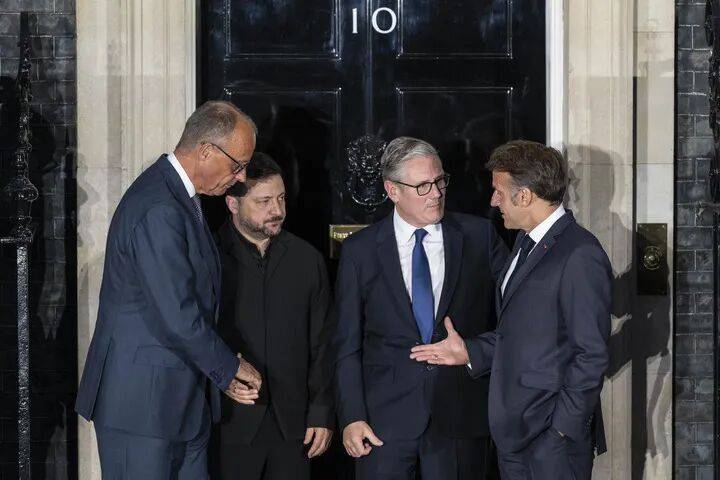
On June 7, in front of the Prime Minister’s Office at 10 Downing Street in London, England, then British Prime Minister Starmer (second from right), French President Macron (first from right), German Chancellor Mertz (first from left) and Ukrainian President Zelensky prepared to leave after talks. Published by Xinhua News Agency (photo by Stephen Cheng)
The third is the ceasefire sequence. Ukraine advocates a ceasefire first, and then discussions on supervision mechanisms, security guarantees and follow-up political negotiations. Russia advocates that basic principles should be formed first on issues related to the comprehensive settlement of the conflict such as territory, Ukraine’s military status, and European security mechanisms. Otherwise, a ceasefire will only give Ukraine time to breathe and prepare for war.
Sergey Markdonov, an expert at the Moscow Institute of International Relations in Russia, said that only achieving a ceasefire without resolving deep-seated issues such as territory and Ukraine’s status cannot guarantee lasting peace. The failure of the 2015 New Minsk Agreement has proved this. At present, the positions of the two sides are still far apart, and we should not have too high expectations for a breakthrough in the negotiations.
Choice: Fight to promote conversation
Analysts believe that in view of the above-mentioned principled differences, military confrontation will still be the main line between Russia and Ukraine in the short term, and negotiations will be more of a supporting means for battlefield games.
During the two days of this meeting, the exchange of attacks between Russia and Ukraine did not stop. Russia has attacked substations, railway infrastructure in many areas of Ukraine, and ships on the Black Sea transporting supplies for Ukraine. Ukraine continues to launch long-range drone attacks in many areas of Russia.
As winter approaches, severe cold temperatures will limit the ground offensives of both sides. Russia and Ukraine may further intensify their long-range mutual attacks, and both sides will focus on attacking energy, electricity and other infrastructure to intensify the pressure on the other side’s socioeconomic and people’s livelihoods and undermine their will to fight.
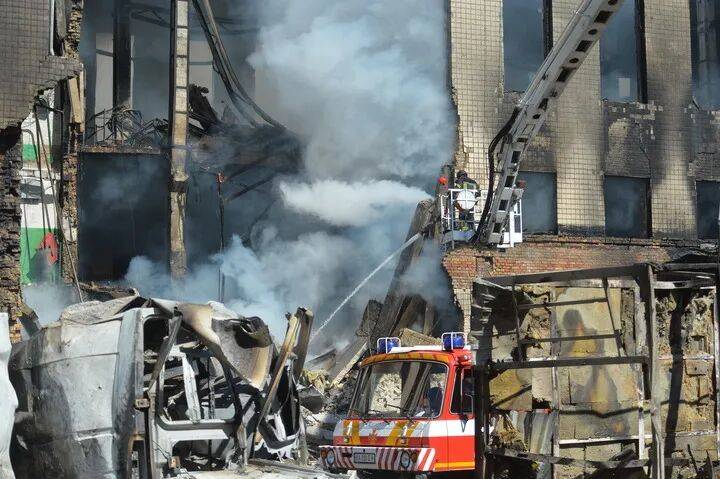
On September 8, rescue workers from Ukraine’s State Emergency Situations Service put out an infrastructure fire that was attacked and on fire in Solomensky District, Kiev City. Published by Xinhua News Agency (photo by Peter Drucker)
However, the continuation of battlefield confrontation does not mean that the negotiation process is interrupted. All three parties have the need for negotiation: the U.S. government wants to obtain a landmark diplomatic “achievement” by mediating the conflict between Russia and Ukraine; Russia hopes to use negotiations to consolidate the momentum of easing Russia-U.S. relations; and Ukraine intends to win continued support from the United States through active cooperation.
Chen Yu, deputy director of the Eurasian Institute of the China Institute of Contemporary International Relations, said that Russia and Ukraine will try their best to deal with the United States and use the Trump administration’s “enthusiasm for mediation” to guide U.S. policies in a direction that is beneficial to them.
At the same time, both Russia and Ukraine believe that “the advantage is mine and the time is mine,” resulting in a lack of willingness on both sides to compromise. From Russia’s perspective, Ukraine faces difficulties such as a shortage of troops and severe damage to infrastructure, and there is also uncertainty about the extent of Western aid to Ukraine. Ukraine believes that Europe is currently more determined to aid Ukraine, and after the U.S. midterm elections, the Democrats in control of Congress are expected to increase the scale of aid to Ukraine and increase sanctions against Russia.
Related Reading
- Being “black” for no reason, living a life of being watched, Brother Dayi and his “traffic past”2026-11-13
- Türkiye’s “Mediterranean COP”: When the climate crisis approaches “heaven on earth”2026-11-13
- With El Niño coming, will coffee become more expensive next year?2026-11-13
- Latest research: Obesity diagnosis cannot be based solely on weight, BMI has natural flaws2026-11-13
- The first in the country! How to learn “unpopular secret skills”? Who will teach? Dean’s interpretation2026-11-12