It took Jen-Hsun Huang 33 years to build NVIDIA. Now Nvidia needs to prove that what he built can go further than he can.
Text | Zhang Xueying
After 33 years at the helm of Nvidia, Huang Renxun’s departure only took a few days. On November 8, he admitted to being unfaithful to his wife in an email to employees and apologized to his family, employees and shareholders. The board of directors subsequently launched an independent investigation.
A few days later, the media revealed that he had an intimate relationship with a female executive who reported directly to him. On November 12, local time, Nvidia announced that Huang Renxun resigned from his positions as president, CEO and director, effective immediately, and was temporarily replaced by CFO Colette Kress. The 63-year-old founder left the company he built with his own hands.
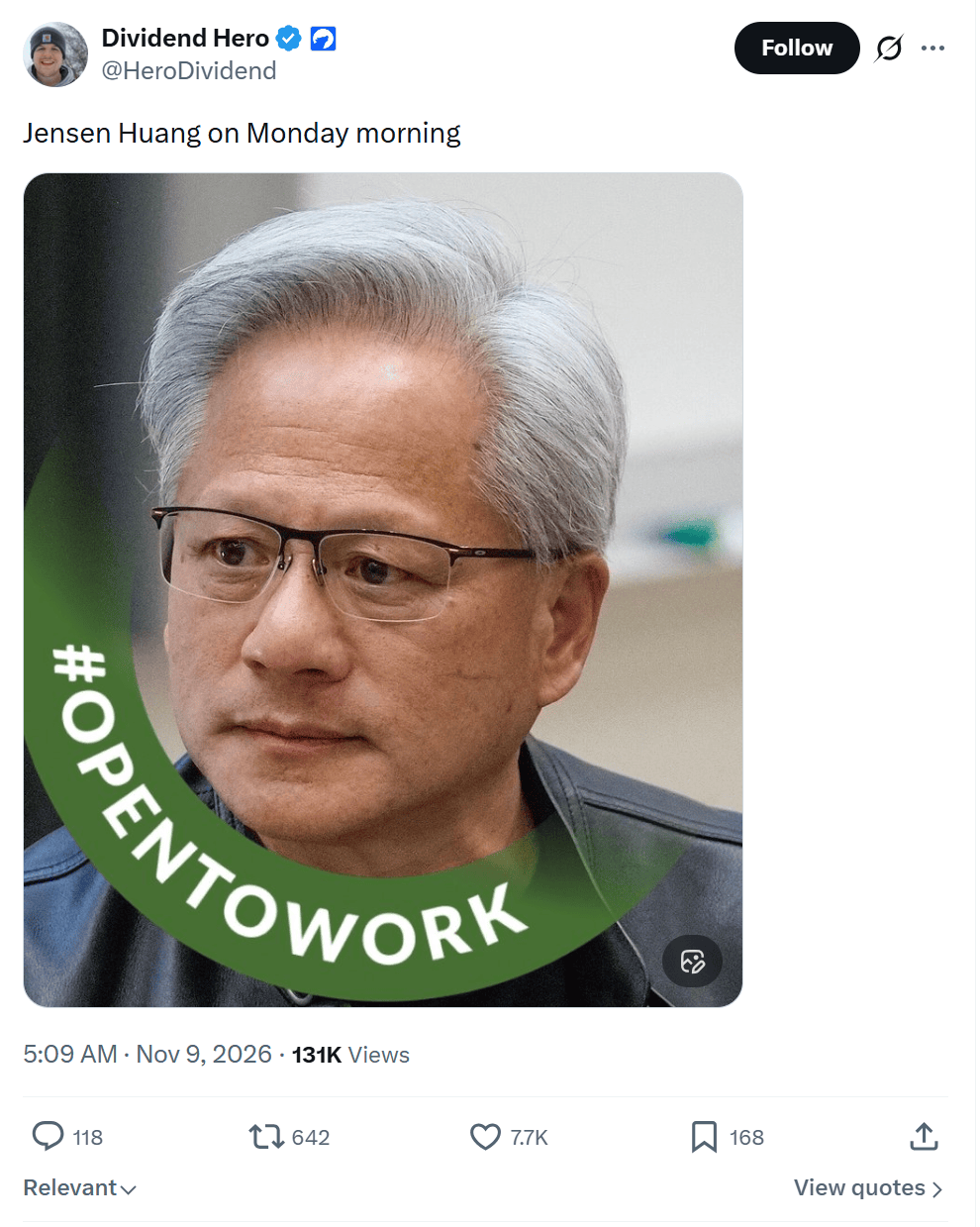
Netizens who have always loved watching the excitement are already worrying about his next job. LinkedIn’s iconic green “(Looking for a job)” profile picture frame was placed on Huang’s photo.
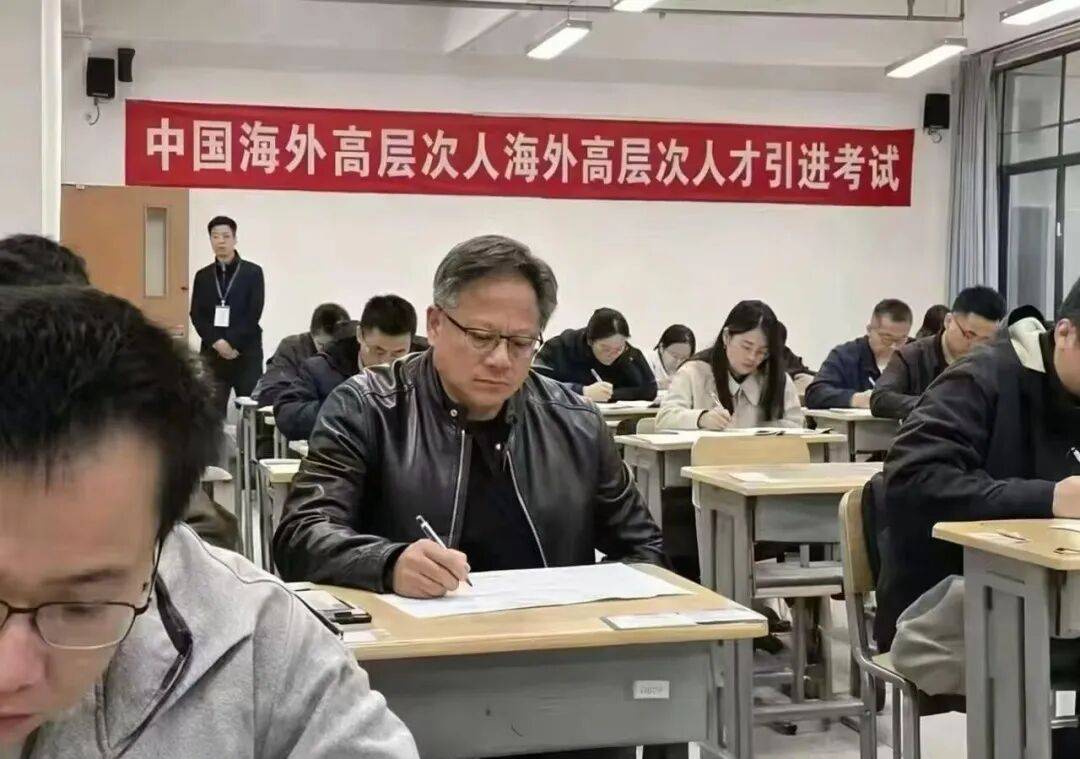
Someone else made a spoof picture and arranged for him to take the “Overseas High-Level Talent Introduction Examination.”
The boss needs to find a job, and the vacancies left by the boss quickly attract the attention of job seekers. Netizens who were busy with autumn recruitment were shocked to find that Nvidia had “released a HC” and quickly called on everyone to submit.
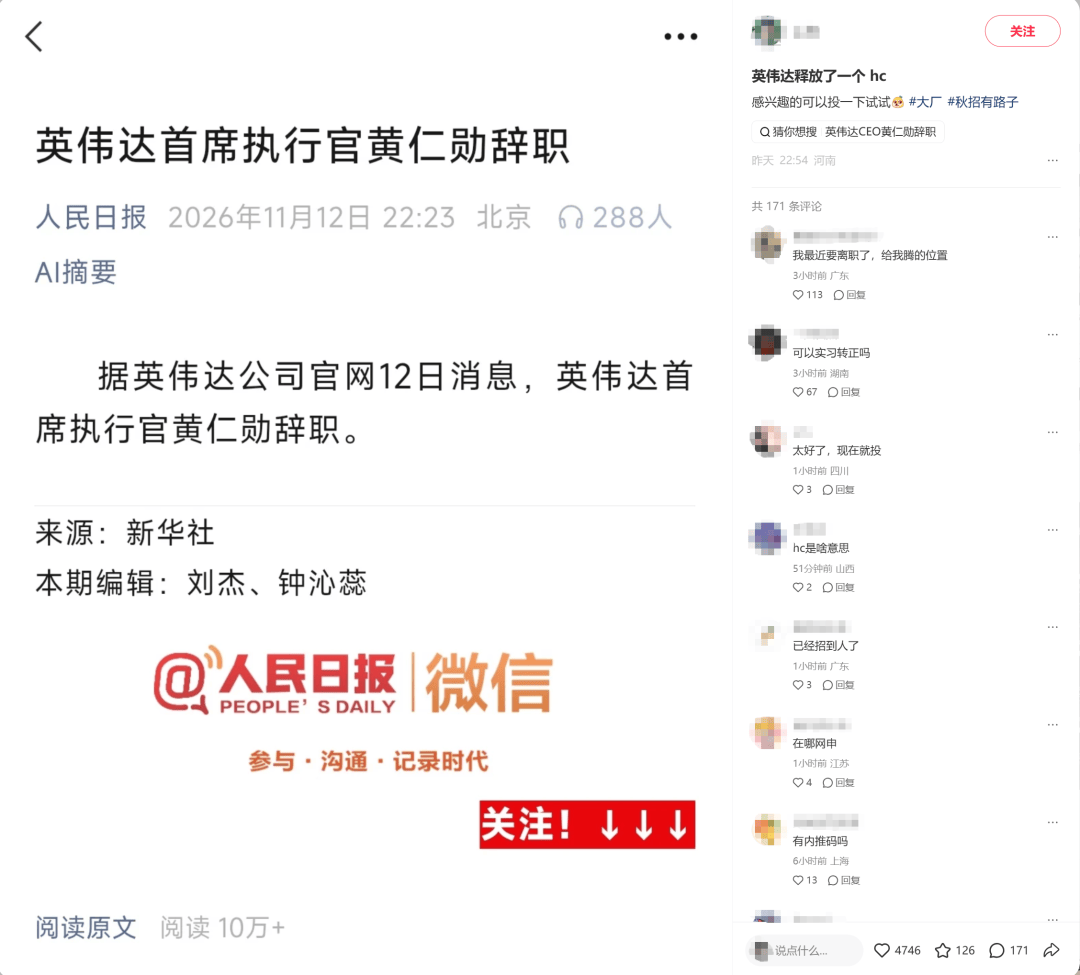
Some people volunteered and were ready to join the company; others solemnly stated that they had no plans to take over as CEO of Nvidia and would continue to focus on their jobs.
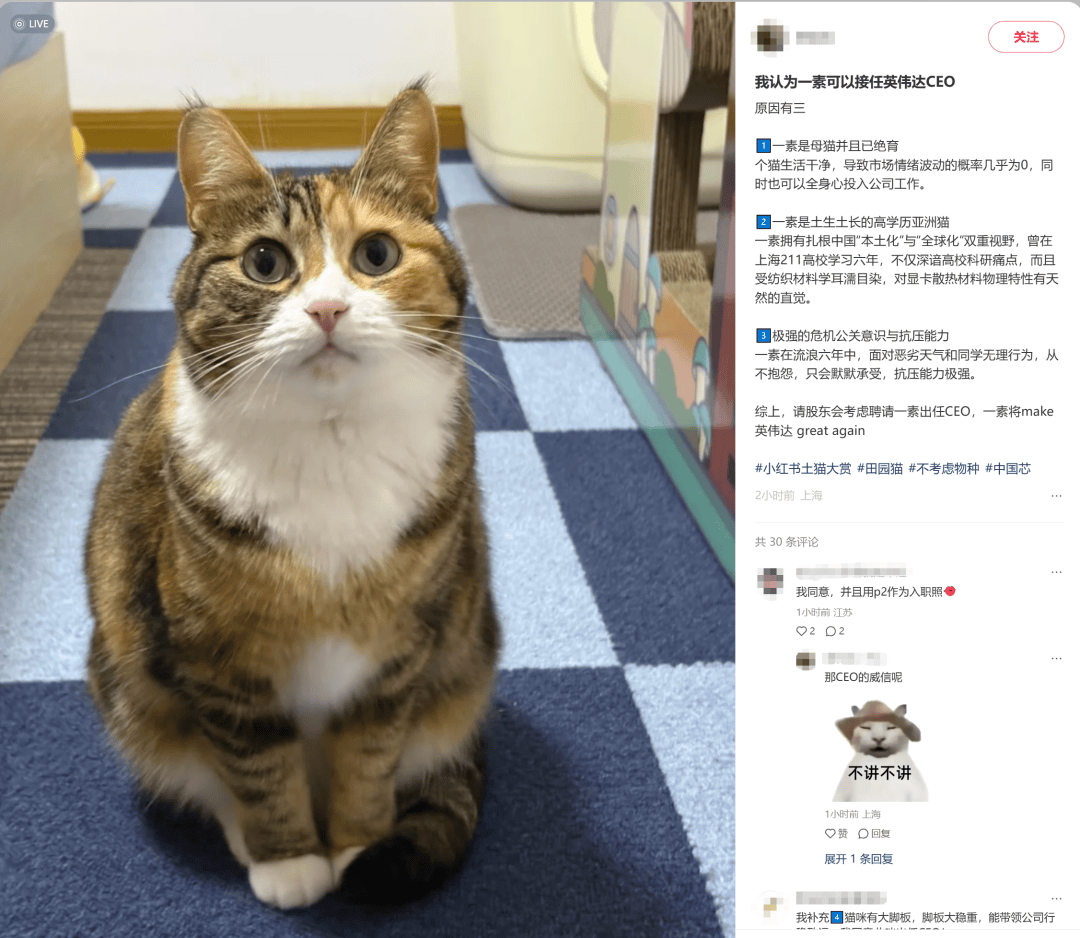
Candidates aren’t even limited to humans. A netizen recommended his own kitten to compete for this globally recognized job.
Even Jen-Hsun Huang’s iconic black leather jacket couldn’t escape. Netizens used AI to make a spoof picture of the entrance of xAI, hanging leather jackets on flagpoles, calling it “Half Clothing”.
In addition to the jokes, there were also real farewell scenes. Outside the NVIDIA headquarters in Santa Clara, California (hereinafter referred to as California), someone spontaneously placed flowers and candles in front of the NVIDIA company logo.
The Internet is busy looking for a job for Huang Renxun and choosing a new boss for Nvidia, but inside the company, some employees are seriously thinking of ways to bring Huang Renxun back to work.
01
The boss just left,
The employees started calling him to come back.
Nvidia employee Gavan Woolery has never spoken to Huang and only crossed paths with him once at company headquarters. But when Huang Renxun’s departure caused controversy, he still posted publicly and talked about how the boss changed his life.
During the epidemic, Nvidia was freezing recruitment, but he got the opportunity to join. He said that he was told that Huang Renxun approved the recruitment, and only three people were approved during that time. In his mind, the job might save him from spending the rest of his life in debt.
He had almost no personal interactions with his boss, but he remembered the turning point a hiring decision brought to him. As for the current turmoil, he expressed it very directly in his post that he has no involvement in his private life, but as a leader, he has never met anyone better than Huang Renxun.
Some are speaking out about their experiences on public platforms, while others are trying to get employee voices into the boardroom.
A senior engineer posted a message in the company’s internal “suggestion box” requesting that the results of the investigation be released and that employees also want to hear whether employees hope that Huang Renxun will continue to serve as CEO. His demands include publishing the results of the investigation and formally soliciting employees’ opinions on whether Huang will continue as CEO.
After Huang Renxun left, this post became a place to retain him. The post received more than 1,600 comments, and some people asked the board of directors to find a way to bring him back.
“If you believe in the mission of the company, bring the boss back.”
Another employee wrote, “We are all human and we all make mistakes. Jensen Huang has done so many things right and he needs a second chance.”
Others sent support to company-wide mailboxes. One employee sent a group email asking management to explain Huang’s departure more transparently. He expressed his support for Huang Renxun, not because he believed that no one would make mistakes, but because he did not believe that insisting on fairness meant that he had to distance himself from a leader who meant a lot to everyone.
Some employees thought they would read a copy of the survey results before discussing whether their boss could stay. As a result, they received the resignation announcement just as the investigation began. The request in the post about “should I stay?” has also become a request for “can I come back?”
On November 13, a Tesla engineer posted on X, suggesting that Nvidia employees who wanted Huang Renxun to return resign. He believes that excellent GPU engineers are difficult to find and difficult to replace, and employees should take their destiny into their own hands.
Musk later replied to this post, “A petition calling for Huang’s reinstatement is in progress, and I want to sign it.”
Previously, some netizens suggested that he directly recruit Huang Renxun. Musk replied, “That would be my honor.”
Within hours after Huang Renxun resigned, about two dozen Nvidia employees posted on LinkedIn, with some describing their trust in his leadership as “unwavering.” However, during the same period, no Nvidia employees were seen publicly posting in favor of his resignation.
A spontaneous employee poll showed that more than 97% of participants wanted him to stay in office.
“We feel that NVIDIA is Jen-Hsun Huang, and Jen-Hsun Huang is NVIDIA,” one employee said.
Huang Renxun’s departure has also caused some employees to reconsider their future. Will the new management adjust the company’s direction, and how will their positions and development space be affected? These questions are all placed in front of them with the resignation of their boss.
02
舍不得,
也留不住
Looking through the mobile photo albums of some Nvidia employees, Huang Renxun is probably the boss who has a very high appearance rate.
In 2024, he visited the offices in Beijing, Shanghai and Shenzhen. At the annual meeting, the black leather jacket that the public is familiar with was replaced by a Northeastern flower vest. He and his employees danced Yangko and presided over the lottery. Those who didn’t win any prizes received autographs or hugs.
According to Phoenix Technology, some employees said that they see Huang Renxun every year, chat and discuss business when they meet. Employees posted photos, red envelopes and annual meeting scenes on social platforms, and Huang Renxun was always surrounded by the crowd.
A company can become so large that it is difficult for employees to meet with top managers. However, Huang Renxun has entered the personal memories of many people through these activities that have lasted for many years. When an announcement is made announcing his departure, employees will remember the person who once stood next to them.
Deeper trust comes from choices in difficult times.
In 2022, Nvidia’s performance is under pressure. Huang Renxun once stated in an internal email that the company has no plans to lay off employees in the near future, and mentioned that it will help employees cope with inflation through salary increases. When the AI wave arrives, companies grow, stocks appreciate, and many people’s career prospects are linked to his technical judgment.
This relationship has been built up over many years and is difficult to sever immediately after a resignation announcement. What employees retain is a familiar boss and a familiar future.
What’s more, Huang Renxun’s work at NVIDIA is indeed difficult to hand over just by changing his work badge.
Reuters reported that he has about 60 direct reports who will go deep into technical discussions at startups, help them find customers, and even participate in financing calls to attract investment. He not only participates in deciding where to go with the next generation of products, but also personally connects companies, customers and investors.
Company employees will report the five most important tasks via email, allowing Huang to understand what everyone is busy with. In the past, he used to respond quickly, day and night. In the past few days during the turmoil, the response has begun to slow down. The almost ubiquitous boss first showed signs of fatigue through each email.
To succeed such a CEO, you need to take over technical judgment, organizational coordination and industrial relations, and you have to let the outside world continue to believe in the company’s direction. The Associated Press reported that Nvidia had not prepared a succession plan for his departure.
But how important a person is to the company and how the company should handle his behavior are ultimately two things that need to be answered separately.
According to Bloomberg, before publicly apologizing, Huang had denied to friends and colleagues that he had been unfaithful to his wife. After the new reports emerged, the company’s general counsel, Tim Teeter, went to his home to talk with him about the incident. Huang later admitted to the extramarital affair.
On November 8, he sent a letter of apology to all employees, and the board of directors announced the launch of an independent investigation, still publicly expressing its trust in him and his leadership team. Days later, The New York Times reported that he had an intimate relationship with a female executive who reported directly to him. On November 11, the directors held a remote meeting that lasted until late at night.
According to an insider quoted by Bloomberg, Huang, who has always been energetic and accustomed to taking control of situations, has begun to say “whatever” and “I don’t care.” People who have spoken to him in recent days have also revealed that he has denounced himself as a “scumbag” and said that he is most worried about his wife and does not want to ruin the lives of the women with whom he has affairs in the public imagination.
But his decision to stay or go is no longer up to him alone. Bloomberg said that after the board meeting that lasted until late at night, Huang Renxun finally had no choice but to resign. Nvidia announced the news the next morning. The announcement thanked him for his contribution and stated that his resignation was “effective immediately.”
Hours after news of his resignation was announced, people were still coming in and out of Huang’s San Francisco home. According to the British “Daily Mail” report, relatives and friends continued to visit, and takeaways were also delivered to the door one after another, and were taken over by uniformed butlers. One of the orders was from local chain Proposition Chicken, which delivered enough fried chicken and fries for four people.
Fried chicken happens to be what Jen-Hsun Huang has publicly said is “comfort food.” In a previous interview, the host asked him which comfort food he likes best, and his answer was simple, “fried chicken.”
An unmarked white truck also drove into the compound, carrying several large cardboard boxes. Within half an hour, it left with another batch of boxes. The delivery address on the carton pointed to a UPS store in Oakland, California. The Daily Mail called the gathering of relatives and friends “crisis talks,” but what was actually discussed in the room was unknown to the outside world.
While employees are still pleading for him to be given a second chance, the company has begun searching for a successor. What made the board of directors change its initial attitude of supporting him? The resignation announcement did not disclose the complete reasons. But as reports emerged involving direct reports, the turmoil has taken on another layer of issues that the company needs to deal with.
When an intimate relationship occurs between a boss and a subordinate, it is difficult to completely classify it into the scope of private life. The boss has the power to make decisions about promotions, compensation and work arrangements. Whether this relationship affects business judgment, whether other employees are treated fairly, and whether relevant situations are truthfully disclosed all need to be explained. The fact that both parties consider each other voluntary does not mean that the company can ignore the conflict of interest.
A similar controversy once caused another chip giant to suddenly lose its CEO. In 2018, Intel confirmed that then-CEO Krzanich had a consensual relationship with an employee in the past, violating internal policies that apply to all managers. Subsequently, he resigned as CEO and director at the same time, and the CFO took over on an interim basis. Eight years later, Nvidia experienced a similar personnel transition.
Former McDonald’s CEO Easterbrook paid more than just his job. In 2019, he was fired for violating company policy on employee relations. Subsequent investigation revealed that he also concealed other employee relationships. McDonald’s sued and eventually settled to recover more than $105 million worth of stock and cash.
Having a high personal reputation does not mean that you can decide whether to stay or leave alone. Nvidia’s 2026 documents show that Huang Renxun holds about 3.6% of the company’s shares, and the company implements one share, one vote. Having a long-term voice in operations cannot be equated with the power to control the appointment and dismissal decisions of the board of directors.
Employees can remember how he protected themselves in the past and can trust that he is still capable of taking the company forward. The board of directors also needs to answer questions such as whether the company can continue to trust his judgment and how to deal with management problems that have arisen.
The harder he is to replace, the more expensive it will be to replace him. And the cost of replacing people is so high, which also exposes another problem. Why does a company that promotes AI to take on more human jobs leave so many jobs to the same people?
03
Who will take over?
Or wait for him to come back?
Nvidia’s new boss has not yet been decided, but Trump gave it a thumbs up.
He recommended Cook on social platforms, saying “one legend succeeds another legend.” Cook has already experienced Apple’s post-Jobs era, and now he is being recommended to take over from another star founder.
However, this recommendation vote has not yet turned into a formal invitation. There is no public information that Nvidia is considering Cook or that Cook is willing to take over. The president can have his say, but the board remains ultimately responsible for making selections.
The person who actually took over the job was 59-year-old Kress.
She joined Nvidia in 2013 and previously worked at technology companies such as Microsoft and Cisco. Reuters reported that her two sons encouraged her to join because they were familiar with Nvidia’s chips through games. More than ten years later, this company once famous for its gaming graphics cards has stood at the center of the AI wave, and she has also changed from the financial director to the temporary helm.
She knows the business and she knows Wall Street. She has been the one working with Jen-Hsun Huang to explain the company’s operations to investors on earnings calls for years. For Nvidia, which is experiencing a shock, this familiarity is valuable in itself.
According to the Wall Street Journal, in August this year, Huang Renxun convened several financial executives to discuss the issue of the company providing huge financing guarantees to customers. During the meeting, he interrupted Kress’s report and described her as “a deer caught in the headlights,” meaning she was at a loss. He also questioned that she could only report numbers and could not help him formulate strategies and make decisions.
Kress has previously asked who should be given these guarantees, how their value would be calculated, and what kind of returns the company would receive. A few months later, she temporarily took over Huang Renxun’s position after being questioned about her decision-making ability.
In the past, both judgments could be balanced against each other within the same leadership team. Today, those who are accustomed to raising risk issues need to be at the forefront to convince employees and the market that the company can still grow. She has not yet been officially given the chance to take the helm long-term, and questions have arisen about whether she has enough technical vision.
This situation is reminiscent of a “glass cliff.” Relevant studies have found that women are more likely to be appointed to leadership positions that are higher risk and prone to failure when the organization is in crisis. This concept cannot directly prove that Kress was arranged to “take the blame”, but it provides an observation angle. When she took over the position, could she obtain sufficient authorization, support and time at the same time?
Nvidia has other possible candidates. Ian Buck, who participated in the development of the CUDA software system, is favored by some analysts and investors. His technical background responds to external concerns about product direction. CUDA can be simply understood as a set of software tools that allow developers to use NVIDIA chips to complete calculations. It is also an important part of the company’s competitive advantage.
The outsider selection, Arm CEO and former Nvidia executive Rene Haas, has moved from analyst discussions to media reports on contacts. On November 13, the Financial Times quoted people familiar with the matter as saying that Nvidia’s board of directors contacted Haas to discuss the possibility of succession.
However, Nvidia later responded that the board of directors is still selecting headhunting companies and has not yet formally contacted any potential candidates. Speculation on specific candidates is “premature.” There is still no definite answer as to who has been approached and who will receive a formal offer.
Some people also pointed out that since Huang Renxun has too many responsibilities, it may not be necessary to continue to let one person take over them all. Investors interviewed by Reuters had imagined that people familiar with operations and finance would stabilize the business, and then the technical person in charge would control the product direction and share the originally centralized responsibilities.
Former Twitter CEO Dick Costello publicly predicted that in three or four years, if Nvidia has poor performance for one or two quarters, the company may ask Jen-Hsun Huang to take the helm again. The return of Jobs and Altman has made Silicon Valley always look forward to this kind of story.
For now, this is still just a prediction. The board of directors has launched a formal CEO selection and has not publicly expressed its intention to reinstate Huang Renxun. The retention of employees cannot draw conclusions for the unfinished investigation.
But such expectations have formed the working environment for successors. If the company continues to grow, people may think that is the foundation left by the predecessor; if it encounters difficulties, someone may ask to bring the predecessor back. The new boss not only has to prove himself, but also has to fight for a chance to be evaluated individually.
NVIDIA is scheduled to release its financial report on November 17, and the new management also plans to hold a staff meeting on the 18th. No matter where Huang’s story unfolds next, the company needs someone to explain performance, respond to customers, and tell employees what to do next.
The future of this company cannot remain in discussions of “waiting for his return”.
It took Jen-Hsun Huang 33 years to build NVIDIA. Now Nvidia needs to prove that what he built can go further than he can.
今日互動
Related Reading
- At the age of 29, she became the core figure of Bit Group AI2026-11-15
- Byte’s 2029 and Tencent’s “Half People”2026-11-15
- Jen-Hsun Huang is out of class, and there is no permanent master in Silicon Valley2026-11-14
- Can a digital person be a CEO? Robin Li talks about organizational changes in the AI era again2026-11-14
- Huang Renxun resigns with “double standards”, Musk: Welcome to Tesla2026-11-14