Capital and technology have joined forces to produce and reproduce an entire discourse system with unprecedented efficiency, putting it into the mouths of hundreds of millions of people. Perhaps you and I are undergoing an unprecedented language experiment.
文 |L
Editor | You Lei
題圖 | CFP
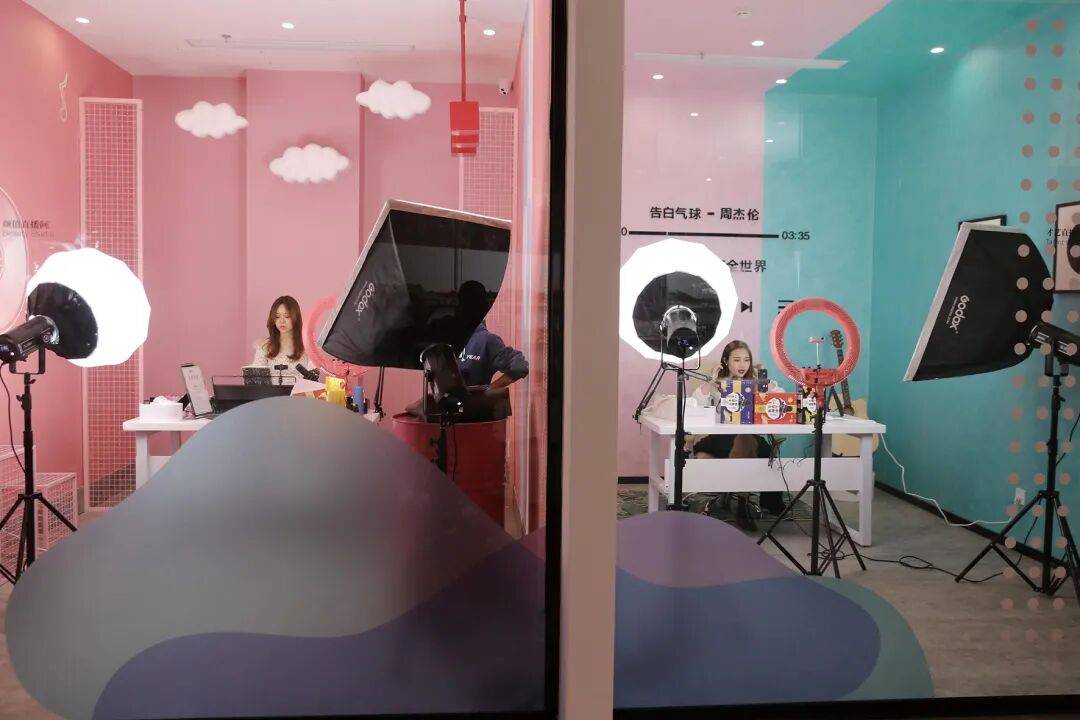
Do you still remember the last time you were called “family”? Is it at the family dinner table or in a live broadcast room? I believe that your answer is most likely the latter, and it is also likely to be accompanied by a picture like this: an anchor who has never met before faces the camera, enthusiastically opens his arms, and shouts a friendly title, followed closely by “3, 2, 1, link up.”
These common expressions have become the most frequently used languages on the Internet. They grow out of the live broadcast room, crawl into life, and then affect your and my daily expression. As a result, we see that “Who knows, family members?” has become the universal beginning of short videos, “getting in the car” no longer refers to taking transportation, and “getting the price down” has become a universal sentence for bargaining.
Live broadcasting, a professional term that only served a few practitioners a few years ago, now seems to have become a language resource shared by all. But tracing back to the source, you will find that this is not just salesmanship in the traditional sense. It is likely to be a brand new thing that is spawned by the joint action of algorithms, platform rules, consumer psychology and business interests.
From TV shopping to AI, the evolution of live broadcast language
The art of live broadcasting did not appear out of thin air. If you extend the timeline, you will find that it has already existed. This kind of rhetoric can be traced back to the TV shopping that emerged in about the 1990s. On the TV screen at that time, the host was wearing a crisp suit and told you in an unquestionable tone, “This product is only 998 yuan and is limited to 1,000 sets. The phone line is busy, please call patiently.” But as soon as you dial the number, you are guaranteed to be able to buy the product as you wish.
Loud sales, limited-time flash sales, the lowest prices on the entire network, endorsements by celebrities and experts…the familiar routines in today’s live broadcast rooms are almost all the “legacy” of TV shopping in the early years. The only difference is that TV shopping is a one-way communication, where the audience passively receives information; live broadcast is a two-way interaction, where the audience can ask questions and participate in real time.
Although the advancement of technology has transformed speech from one-way communication to dialogue, its underlying logic has not changed at all. In the past, speaking skills mainly relied on the anchor’s personal abilities and experience, with low standardization and low efficiency. However, with the development of artificial intelligence technology, live broadcast techniques are evolving in the direction of intelligence and data.
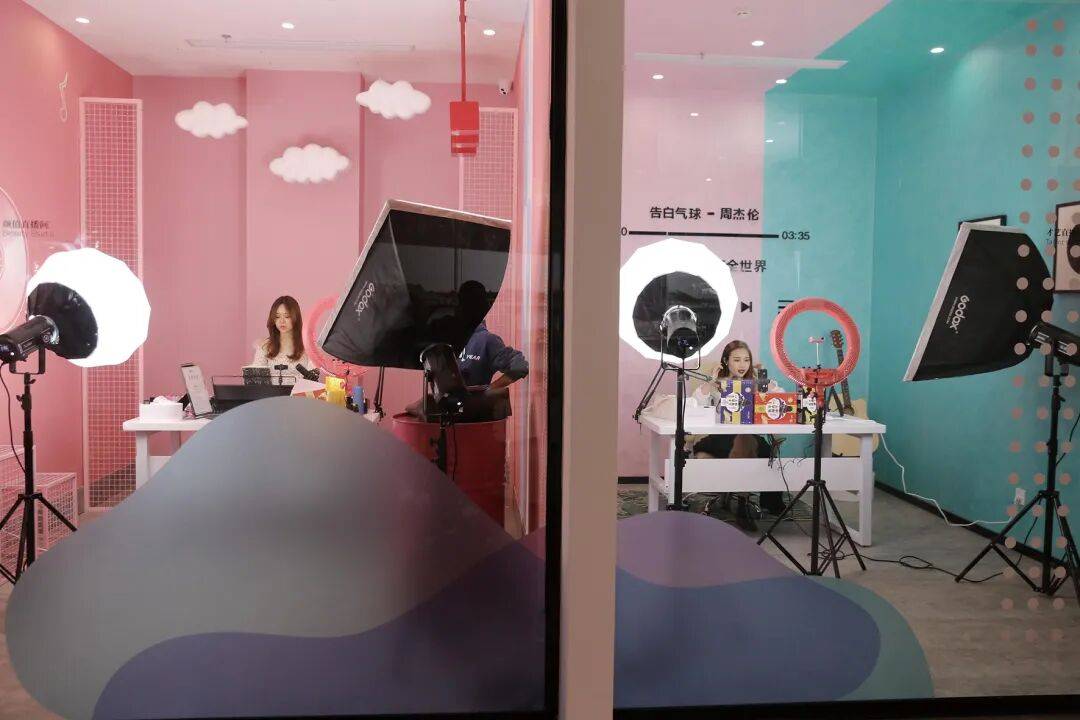
On November 17, 2020, the Hainan Free Trade Port Internet Celebrity Incubation Demonstration Base was officially put into use in Haikou Fuxing City Internet Information Industrial Park, with e-commerce anchors bringing goods in the live broadcast room. (Photo/CFP)
The real turning point occurred around 2016. With the rise of live streaming e-commerce, speaking skills became a necessity for anchors to survive. What an anchor has to face is thousands of real-time viewers. In this high-pressure environment, speech has transformed from an expressive art that is icing on the cake to a language system that requires precise calculations.
At this point, the industrial production of words began. Live broadcast training institutions have sprung up like mushrooms after a rain, breaking down the skills into standardized processes: opening and retaining people, product explanations, interactive order promotion, and finally finishing and retaining. The modular live broadcast language has turned into a producible and replicable product.
It must be admitted that no matter how advanced the technology is, it cannot change a basic fact: the essence of these words is persuasion. From the street vendor’s “pass by, don’t miss it”, to the TV shopping’s “phone line is busy”, to the live broadcast room’s “3, 2, 1, link up”, the logic is the same. What has changed is only the carrier, speed and accuracy. What remains unchanged will always be the basic business proposition – how to get people to take money out of their wallets for consumption.
Emotion and discipline in the virtual world
After understanding the underlying logic, you can just click into a live broadcast room and stay for five minutes, and you can basically figure out a set of fixed processes. The anchor first shouted at the top of his lungs “Welcome to the new family members who have entered the live broadcast room”, and then “Follow the anchor to avoid getting lost” popped up in the barrage. Then an assistant-looking person appeared, often holding samples and approaching the camera. The anchor on the side began to talk about the product’s functions, ingredients, and how expensive the original price was, and then suddenly changed the subject and said, “Today, we won benefits for the viewers in the live broadcast room.”
This process has been performed repeatedly in millions of live broadcast rooms across the country, and practitioners are quite skilled. But have you ever thought about why these few sentences always work wonders? In fact, its success is no accident. After repeated verification and polishing, it always hits those points in human nature that are difficult to get around.
Let’s talk about “family members” first. This is of course not an expression of true feelings, but a set of extremely shrewd social currency exchange rules. But don’t underestimate it. The anchor uses this friendly name to instantly turn you from a passerby to one of his own. You are no longer a salesman in front of you, you are unconsciously included in the “family conversation”.
Its brilliance lies in letting people put down their rational defense mechanisms. So, you put down your guard, and under the bombardment of sugar-coated bullets, you come up with the idea of ”How about I give it a try”. The anchors are naturally well aware of this, and frequently use expressions such as “our family” and “we won it for the family” to package cold business transactions into communications between relatives.
Of course, the popularity of such slang is also related to the rules of the platform. If you often watch live broadcasts, you must have heard the words “how many meters”, “steamed buns” and “咩咩毛”. People who come into contact with them for the first time must be confused, but old viewers can understand them. “Mi” refers to money, “Steamed Bun” refers to 100 yuan, and “咩咩毛” means there is wool to be harvested.
Why do anchors use these riddle-like words when they can obviously speak well? To a large extent, this is because the platform has strict restrictions on banned words. The price of saying something wrong is likely to be that the live broadcast room is directly restricted or even blocked. Therefore, the anchors chose to avoid it and invented a new live broadcast language to convey real information using seemingly unrelated words.
Interestingly, the discipline of the platform has given rise to a unique creative language. Those who can understand these slang words have a unique identity. And it continues to influence new audience groups, because old audiences will enthusiastically explain these slang words in the barrage, and a sense of belonging is established over and over again.
After shortening the distance and establishing a sense of belonging, the language of live broadcast has reached the most critical and psychological stage. After the anchor makes a grand statement, he will definitely add words such as “inventory is in urgent need”, “how many orders are there in the last time”, and “the price will not be available after a certain period of time”.
What they have in common is creating a false “last moment.” The psychological principle behind them is quite simple: scarcity makes people anxious, and anxiety turns into impulse. Impulse can make people forget the functions of price comparison and thinking. The anchors use this psychological mechanism to the extreme by combining the countdown and the real-time beating of inventory numbers.
This style of play worked when it first came out. Nowadays, more and more consumers are beginning to realize that the so-called “non-returning” products appear again with another link two days later, and the countdown of “3, 2, 1” is gradually adapted to the audience. After discovering that the audience’s sensitivity has declined, the anchors once again innovated and said things like “Family members, don’t worry, listen to me before deciding whether to buy or not” and “Really don’t buy indiscriminately.”
The Tao is one foot high, and the devil is one foot high. The invention of words has become a never-ending game. It’s just that we don’t know how long this set of words will last after they have been repeatedly practiced by countless anchors. That is the more interesting question.

June 26, 2018, Qingdao, Shandong. The “Internet Celebrity Butler” of an online live streaming company held meetings with Internet celebrity anchors to study development strategies and formulate training plans. (Photo/CFP)
After infiltrating into life, where will the language of live broadcasts go?
The influence of live broadcasting has never been limited to cyberspace. It has already jumped off the screen, overflowed at an alarming speed, and spread into ordinary life.
The most intuitive evidence is the generalization of word meanings. For example, “family” is no longer just a term used by anchors to address their viewers. It has become a common opening on social media. “Sisters” can refer to people of any gender, and “baozi” can refer to people of any age… These words have been stripped away from the specific context of the live broadcast room and have gained a wider space for use.
In this regard, there have been many related reports in recent years. Hot internet memes from short videos and live broadcasts have been translated into real life by primary and secondary school students regardless of the occasion. When a child calls “family” to his classmates and teachers, he may not understand the business logic behind the words, but he has unknowingly accepted this discourse system.
This is not just the semantic evolution of certain words, but also the transplantation of a whole set of expression habits. The characteristics of live broadcast speech are straightforward, exaggerated, and full of emotions. However, when these characteristics are put into daily life, sometimes they become simple and lacking. When you are used to using “Jue Jue Zi” to describe all good things, you actually lose the ability to use more precise language to describe your feelings.
We can say that language is inherently fluid and alive, and it metabolizes. But the crux of the problem is that this metabolism is driven by business logic rather than the natural needs of daily communication. The art of speaking has entered daily life, not because of the needs of daily communication, but because of business needs.
However, the most fascinating thing about language games is that no words can work all the time. Because people are adaptable, they will eventually get tired of aesthetics. When the anchor shouts “Family”, the audience automatically translates it into “Dear Consumers” in their hearts; when the anchor shouts “Last Day”, the audience assumes that there will be another “last day” – the game of rhetoric and counter-narrative will continue and never end.

(Photo/Visual China)
Looking back, the evolution of live broadcasting skills over the past 10 years is a microcosm of the fate of language in the digital age. Capital and technology have joined forces to produce and reproduce an entire discourse system with unprecedented efficiency, putting it into the mouths of hundreds of millions of people. Perhaps you and I are experiencing an unprecedented language experiment. Unknowingly, we have become the corpus of this experiment – you think you are using language, but in fact language is completing proliferation and regeneration through you.
But you don’t have to be too pessimistic. No matter how ferocious your live broadcasts are, they are just a small wave in the long river of Chinese. Language is alive after all, it will be shaped and it will resist shaping. And all you and I can do is be a little more cautious before speaking and listening next time.
Typesetting: Ding Xiaoyi, He Xitian
This article was originally published in the 715th issue of “New Weekly” “Live Broadcast is Very Busy”
Original title: “Fierce words: Language war in the traffic field》
715期雜志已上市
, available for purchase
Related Reading
- “Bring the boss back”, after Huang Renxun resigned, Nvidia employees couldn’t sit still for the first time2026-11-15
- At the age of 29, she became the core figure of Bit Group AI2026-11-15
- Byte’s 2029 and Tencent’s “Half People”2026-11-15
- Jen-Hsun Huang is out of class, and there is no permanent master in Silicon Valley2026-11-14
- Can a digital person be a CEO? Robin Li talks about organizational changes in the AI era again2026-11-14