Source | Bohu Finance (bohuFN)
Author | Kaikai
There’s been a lot of good news about Apple recently.
On the front foot, Apple announced that the Apple smart phone will be launched in China soon. It will be connected to the Alibaba Tongyi Qianwen large model. It will be opened for testing on November 4 and will be officially launched with iOS 27.3 in December. On the backfoot, Apple delivered its fourth-quarter report card for fiscal year 2026: revenue and earnings per share exceeded market expectations, and iPhone revenue hit a record quarterly high for the same period in history, bringing a perfect end to the “best fiscal year in history.”
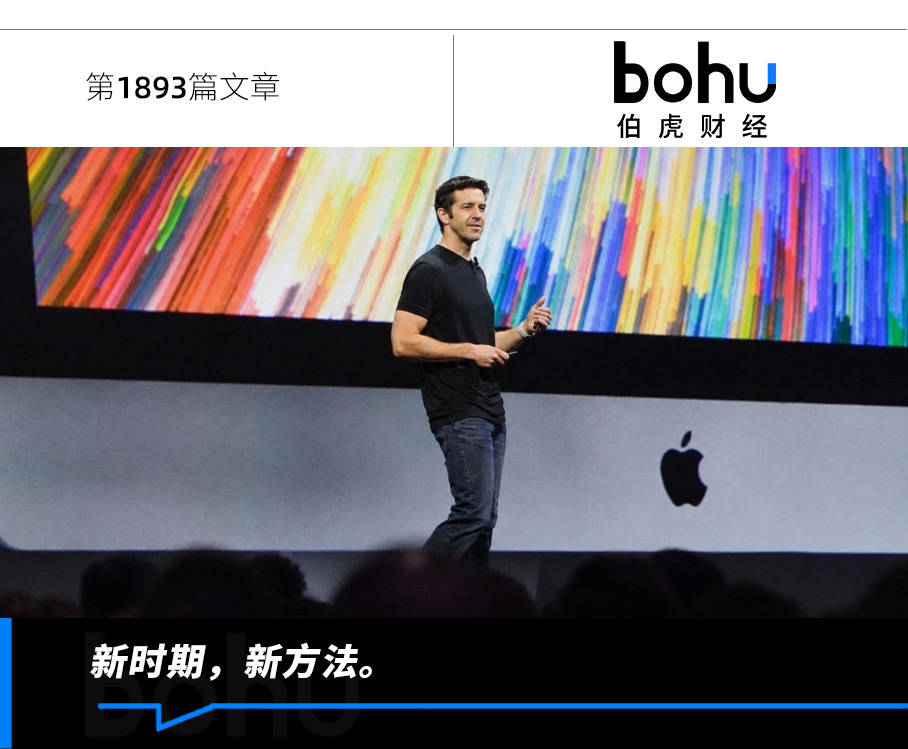
However, new CEO John Ternus is not satisfied with Apple’s current situation. Last week, in a closed conference room at Apple Park, he reportedly issued an unprecedented and stern reminder to the software team:
Apple has fallen far behind its competitors in AI and must embrace AI with the same urgency as its competitors, accelerate its roadmap, and quickly move beyond the stage of “just making necessary fixes to Siri.”
This is probably the real good news for Apple – the new big brother is not satisfied with just winning.
In the past year, Apple’s inaction on AI has outperformed most companies; even the storage storm caused by AI has further deepened the iPhone’s share of the high-end market. But AI is fundamentally changing the value of smartphones, user access and the profit model of technology companies, and this happens to be Apple’s core business value.
As the definer of smartphones, Apple is the biggest beneficiary of the mobile Internet era. But its current moment seems to be just like Nokia’s at that time.
01 Anxiety in financial reporting
In the fourth fiscal quarter of fiscal year 2026 (the third quarter of the natural year), Apple achieved revenue of US$114.5 billion, a year-on-year increase of 12%. It was also the fourth fiscal quarter with the highest revenue in Apple’s history; net profit was US$30.7 billion, a year-on-year increase of 12%.
In addition, iPhone revenue this quarter was US$57.58 billion, a year-on-year increase of 17.5%, setting a record quarterly high for the same period in history; service business revenue was US$31.57 billion, a year-on-year increase of 9.8%, a record high. New CEO Ternus said, “This is our best fiscal year ever.” Especially now, when Wall Street technology giants are struggling with AI capital expenditures, Apple’s report card is even more impressive.
But if you take it apart carefully, you can find that Apple’s problems are also obvious.
In the past year, the iPhone 17 series’ product strategy of “increasing volume without increasing price” allowed it to enjoy more replacement bonuses amid the global mobile phone price increase. At the same time, the iPhone series began to increase in price in September, which also led to further growth in iPhone revenue. However, as the storage price increase cycle further extends, Apple will not be able to survive alone.
On the one hand, profits are being gradually eroded. Research agency TrendForce estimates that using the 256GB version of the iPhone 18 Pro as a calculation sample, the BOM material cost of the entire machine will increase by approximately 38% compared to the Pro model in the same period in 2025. Management said it expects gross profit margin in the next fiscal quarter (45%-46%) to be lower than this quarter.
On the other hand, sales of other hardware began to decline significantly. According to Omdia data, global iPad shipments in the third quarter of 2026 were approximately 11.5 million to 11.58 million units, a year-on-year decline of 27.5%, which was higher than the global tablet market’s average decline of 23%. Data from Luotu Technology shows that in the third quarter of 2026, iPad sales on China’s e-commerce platforms fell sharply by 45.2% year-on-year, and its market share decreased by 8.5 percentage points year-on-year to 19.1%.
At the same time, revenue growth from services, Apple’s main source of profit in the past, began to slow down. Although Apple’s service business revenue reached $31.57 billion in this fiscal quarter, a record high, its growth rate was only 9.8%, and the growth rate fell below 10% for the first time in the past three years.
Management said that the slowdown in service revenue growth was mainly due to exchange rate reasons; but in fact, under the requirements of regional supervision, Apple’s commission rates and payment channel restrictions have been loosened in many places. For example, starting from October 1st, the EU App Store commission will be reduced from 30% to 26%, and lower rates will apply to some qualified developers.
But these are just appetizers. The biggest challenge is AI.
02 “Intelligence” is long overdue
In June 2024, Apple smart phone was unveiled at WWDC, stunning the audience. But by the time Chinese users could use it, two years and four months had passed.
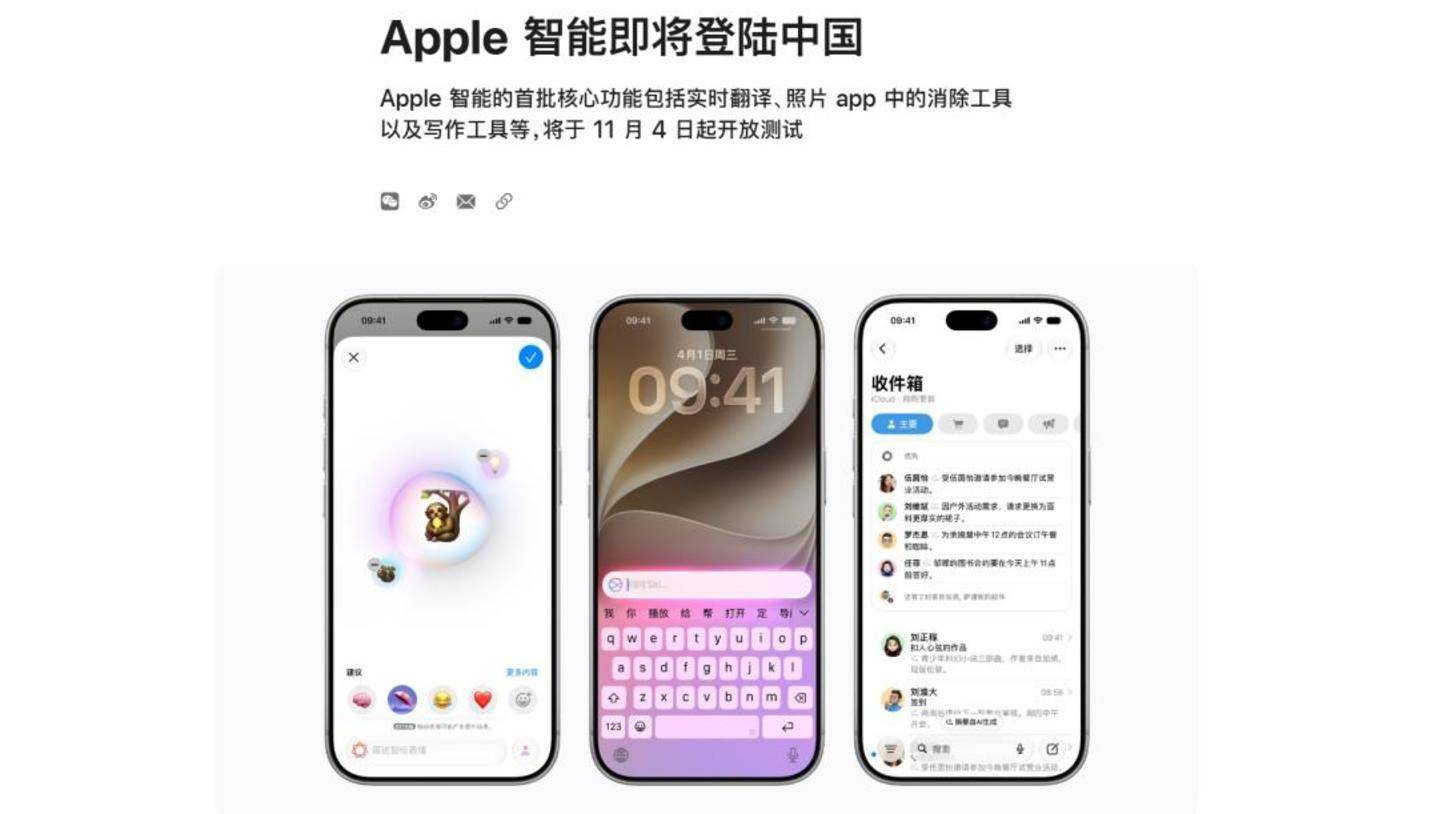
What’s disappointing is that although the new feature was belatedly arrived two years later, Apple’s time seems to be stuck two years ago.
In terms of the layout of device-side AI, domestic manufacturers have made many innovative attempts. For example, Xiaomi is trying to use mobile phones to connect the smart ecosystem, and Nubia’s Beanbag mobile phone has reshaped the interaction logic through GUI. AI assistants are all trying long-chain operations to solve user needs in one step.
It’s not that Apple doesn’t understand the importance of AI.
Over the past decade or so, the business model of smartphones has had a very important feature: whoever controls the operating system controls users’ entry into the digital world. This is also the fundamental reason why Apple can control application distribution channels and obtain revenue through the App Store, payment and subscription businesses.
And AI is changing this structure. On-device AI is gradually evolving into a one-stop solution to problems. In the past, users needed to know which app to go to to find services; now users may only need to know which AI assistant to make requests to. This resulted in the migration of portals.
But there are two main reasons that currently plague Apple’s AI progress.
One is that Apple’s progress in research and development speed, model capabilities, and technical talent in cutting-edge basic large models cannot match its status in hardware and operating systems at all. This resulted in Apple having to rely on external technologies to promote AI-first OpenAI, then Google, and domestically Alibaba and Baidu.
The second is Apple’s insistence on privacy protection.
The display of AI capabilities on the device itself requires users to give up part of their personal privacy and use long-term memory to help you plan and make decisions.
But Apple has left all decision-making power to the user for so many years that even for operations such as accessing the pasteboard, Apple will constantly pop up windows to obtain your consent. This inertia has made Apple’s software chief Federighi cautious about the advancement of generative AI for a long time.
According to Bloomberg, Federighi has an extremely strong style in the software team and is accustomed to using technical details under his control to push his position in meetings, which makes it difficult to implement many more radical explorations within the team.
Archetypal backwardness also exacerbates this conflict. Apple needs models from Google, OpenAI and other companies to complement its capabilities, but because these involve user data security, core technology autonomy, etc., it cannot completely hand over the product. During WWDC 2024, Federighi talked about the integration of ChatGPT with Siri in an interview with the media, saying, “We will ask for your consent before moving to ChatGPT,” and “from a privacy perspective, the user always has control, and the entire process is transparent.”
03 “New Direction” in the AI Era
Apple is already adjusting the pace of AI.
In addition to the closed-door meeting at the beginning, Bloomberg revealed that in the development of the next-generation system code-named iOS 28, Apple will officially adjust the “4 weeks of coding + 4 weeks of system integration” model that has continued for many years in the first phase (M1) to “6 weeks of coding exploration + 2 weeks of system integration.” The obvious shift in focus is to free up time for underlying engineers to experiment freely, forcing the team to explore radical Agent architecture.

Another focus is the hardware ecosystem.
Reuters pointed out in an analysis on April 22, 2026 that Apple has achieved great success through a highly controlled ecosystem in the past, but AI competitors rely on open models and developer ecosystems to innovate rapidly, which may change the rules of competition. Generative AI changes the way users interact with the digital world. In the future, users may only need to put forward requirements to the AI assistant, and the Agent will automatically call different applications to complete the task.
Therefore, Apple needs to extend the ecological advantages of the iPhone to the home space, improve user stickiness, and gain more access.
In the second half of the year, Apple began to participate in the definition and design of third-party smart home products, launching the Apple Home Collection in conjunction with brands such as LG Electronics and Schneider Electric. Products include smart video doorbells, smart door locks, indoor cameras, room sensors and other products.
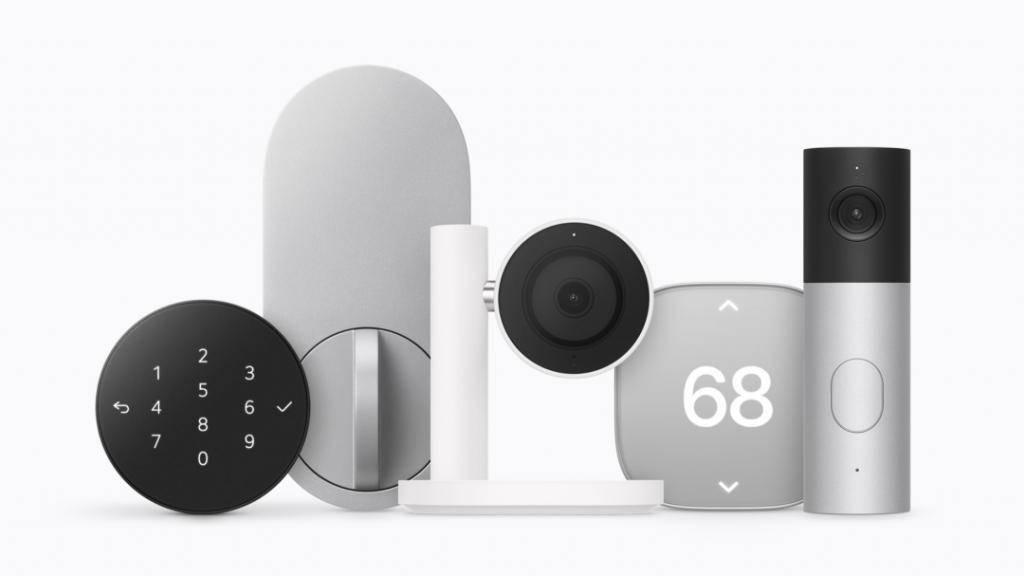
Of course, Apple still has powerful enough hardware, chips and ecological advantages, but these advantages cannot determine Apple’s fate in the AI era.
In addition to the ability to catch up with prototypes, Apple also needs to get out of the R&D and product inertia established in the past ten years and enter the rhythm that should be expected in the new era.
Reference sources:
1. Apple financial report
2. Ai Faner: Ternus puts pressure on Siri boss, Apple AI can’t wait any longer
3. Reuters: In the AI era, Apple’s strengths may become its constraints
Related Reading
- “Bring the boss back”, after Huang Renxun resigned, Nvidia employees couldn’t sit still for the first time2026-11-15
- At the age of 29, she became the core figure of Bit Group AI2026-11-15
- Byte’s 2029 and Tencent’s “Half People”2026-11-15
- Jen-Hsun Huang is out of class, and there is no permanent master in Silicon Valley2026-11-14
- Can a digital person be a CEO? Robin Li talks about organizational changes in the AI era again2026-11-14