“If you lay off workers, we will take you off the shelves.”
On October 26, the topic “Rumors about Laoganma AI layoffs caused controversy” became a hot search topic on social platforms. The reason is that several self-media published articles saying that “Laoganma’s annual revenue is as high as 5.4 billion yuan, but it uses AI to reduce its 600 workers to 48.”
In the eyes of many netizens, this is because companies have failed to make good management decisions, allowing AI to take away people’s jobs. Some consumers even said they would no longer buy Laoganma.
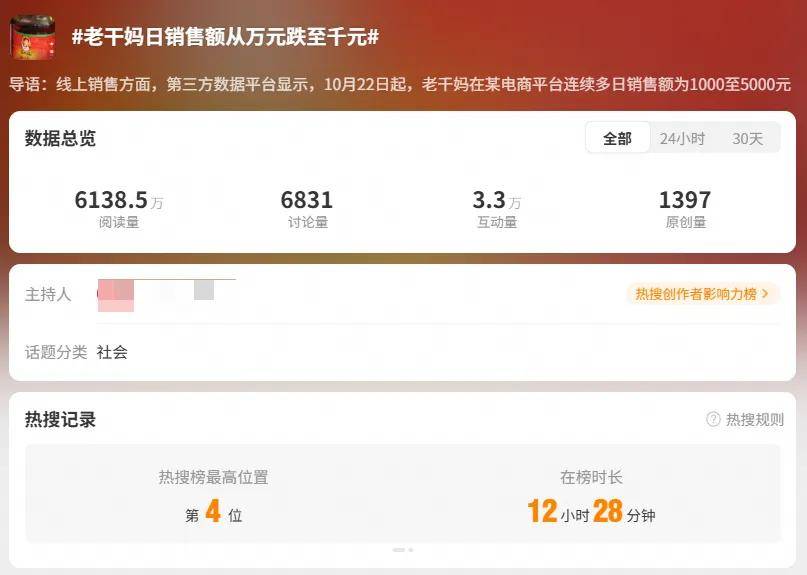
Affected by this rumor, Laoganma’s recent online sales have experienced a significant decline. Public reports show that taking a certain e-commerce platform as an example, Laoganma’s sales for many consecutive days since October 22 were 1,000-5,000 yuan. Before the rumors began, its daily sales were mostly stable at 5,000-10,000 yuan.
In response, the operator of Laoganma’s official hotline responded that the rumors of AI layoffs were false information and that the company had never released such information. Consumers were asked to treat it rationally.
Previously, Li Xin, executive vice president and chief quality officer of Laoganma, disclosed at the 2026 Guizhou Provincial Quality Development Conference that after Laoganma’s AI visual quality inspection went online, the product defect rate dropped significantly, and revenue in 2025 reached 5.4 billion yuan.
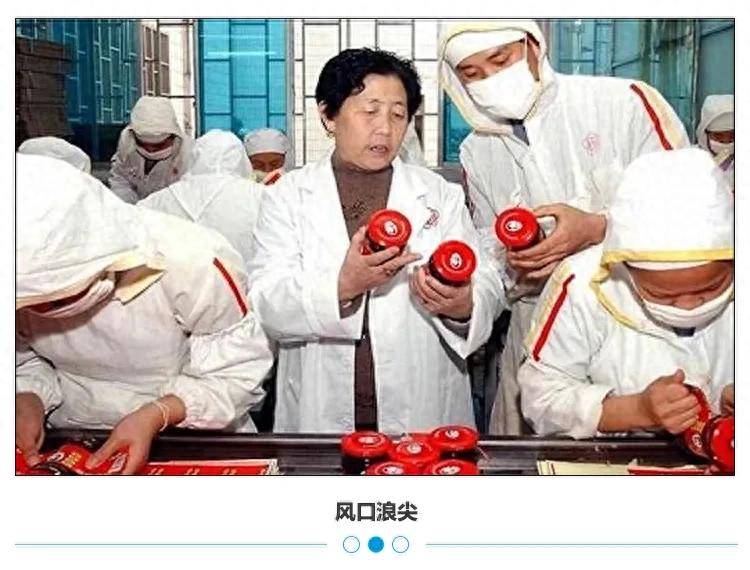
According to China Business Daily, Li Xin also mentioned in his speech: “Previously, there were more than 600 pepper picking workers on the entire assembly line, but only 48 were retained after the system went online.”
When the good news that “79-year-old Tao Huabi made 5.4 billion a year using AI” was superimposed on the question of “AI layoff controversy”, questions also emerged in the public opinion field – the “national goddess” who started her business by selling cold skin at a stall, and whose face is printed on every bottle of hot sauce, still doesn’t care about frontline workers after AI enters the workshop?
For a company like Laoganma, which started from the grassroots and then counterattacked to become a national brand, AI has never been a single technical issue, but also a human issue.
“National Goddess” Lao Ganma
Laoganma is by no means the only company that has introduced AI technology into factories, but the reason why it has aroused such a huge public opinion is inseparable from its history of corporate development from grassroots counterattacks and its high national popularity.
It can be said that Laoganma’s brand equity was not built on efficiency from the beginning, but on the human touch and trust spread by word of mouth.
Public information shows that Tao Huabi, the founder of Laoganma, is an ordinary woman from rural Guizhou. She has never read a book. To make a living, she has run a street stall and worked as a coolie. She has also traveled to other places to work and earn money.
Tao Huabi, who once made a living by setting up a stall selling cold noodles, has a good skill in making hot sauce.
In 1989, 42-year-old Tao Huabi used her savings to open a small restaurant in Longdongbao, Guiyang, specializing in cold noodles and cold noodles. She also carefully prepared 8 kinds of chili sauces with different flavors, which were widely praised by customers.
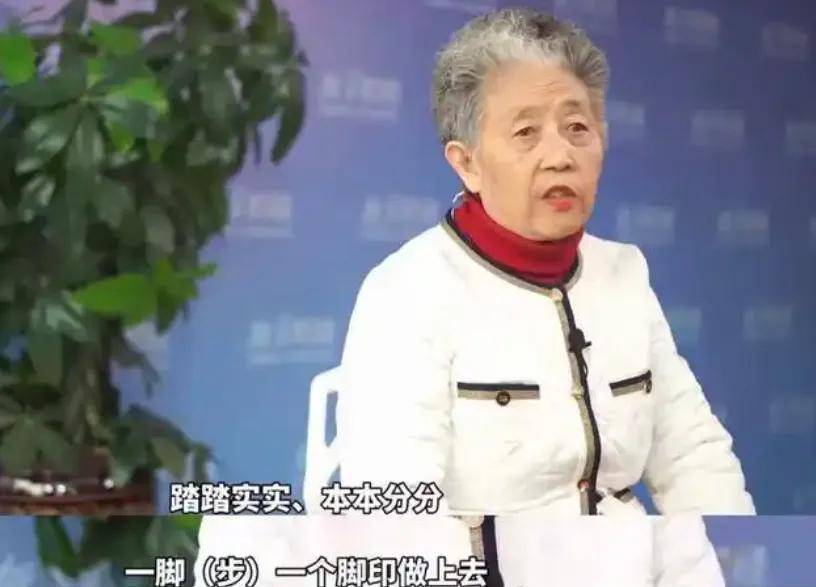
There is a school near the restaurant. Tao Huabi often lets children from poor families eat rice noodles for free. After getting acquainted with Tao Huabi, one of the children directly called Tao Huabi “godmother”. Over time, the students all started calling her “godmother”. From one word to ten, the locals all know that there is a generous “Lao Ganma” on the street of Longdongbao.
In 1994, Guiyang City built a ring road, and the originally remote Longdongbao became the main road of the highway. Truck drivers passing by often came to the small shop to eat. Tao Huabi felt sorry for them because they were traveling all the way and could only eat some vegetarian rice and noodles when delivering goods, so she made a lot of chili sauce for them.
Truck drivers who travel all over the world have made Tao Huabi’s hot sauce famous, and the whole Guizhou knows that Longdongbao’s “Laoganma” hot sauce is delicious. Some people even drive here just to have a bite of the hot sauce.
In 1996, Tao Huabi officially founded the Laoganma brand, specializing in chili sauce. Tao Huabi’s personal photo printed on the chili sauce bottle is the best synonym for the quality of the chili sauce. Locals all know that the old lady on the bottle means being honest, not playing tricks, and not bullying others.
In 1998, the annual output value of Laoganma chili sauce exceeded 50 million yuan, and in 1999 it exceeded 100 million yuan. With its exclusive taste, Lao Gan Ma broke out of Guizhou and became famous throughout the country – by 2005, the output value of Lao Gan Ma chili sauce had exceeded 1 billion yuan, and the products were successfully exported abroad and sold around the world.
Tao Huabi’s portrait on the chili sauce is also affectionately called the “National Goddess”.
However, it is precisely because of this entrepreneurial background of working from the bottom and showing concern for the livelihood of ordinary people that the controversy over “Laoganma AI layoff rumors” gave many consumers the first feeling of “stabbing in the back”.
Why does Lao Gan Ma need AI?
For Lao Gan Ma, who is trapped in a “succession dilemma”, the transformation of AI technology may be necessary.
In 2014, Tao Huabi transferred the shares to her two sons. The eldest son, Li Guishan, holds 49% of the shares, and the second son, Li Miaoxing, holds 51% of the shares, while she retreats behind the scenes.
Around 2015, multiple media reported that the new management replaced some Guizhou peppers with lower-priced Henan peppers under cost pressure. Guizhou peppers are about 12-13 yuan/jin, and Henan peppers are about 7 yuan/jin. Judging from Laoganma’s huge consumption, replacing cheaper peppers can save Laoganma more than 50 million in raw material costs every year.
Costs were saved, but reputation declined, and revenue naturally began to plummet. Public information shows that from 2016 to 2018, the company’s revenue dropped continuously from 4.549 billion yuan to 4.447 billion yuan and 4.389 billion yuan, and its market share was also impacted by emerging brands.
In 2019, 72-year-old Tao Huabi had to go back to work, restore Guizhou peppers, destroy 500 tons of substandard inventory, and use the most “stupid” and most honest way to rebuild trust.
In this case, the emergence of digital technology can be said to have brought new ideas to the problem of Lao Ganma’s succession.
After all, the addition of science and technology can undoubtedly make production more stable. On the one hand, digitization allows production machines to be completed according to set standards to ensure product quality; on the other hand, the record retention of batch information of raw materials also makes it easier for enterprises to verify.
When Xinhua News Agency visited the Laoganma factory in 2024 for an interview, it was observed that the workshop already had automatic filling, capping, boxing and robot palletizing. The report also revealed that the factory invested nearly 80 million yuan in automatic filling equipment, and a single production line can complete 157 bottles of filling per minute.
Laoganma’s use of AI is also part of the development of production transformation with technological upgrading. The launch of AI visual quality inspection can clearly identify the quality of peppers, making core raw materials 100% traceable.
From the perspective of production logic, using AI technology to replace high-intensity and high-loss visual sorting is a routine step in the quality improvement and upgrading of the food manufacturing industry. It is also Laoganma’s effort to ensure quality and standardize “Tao Huabi Taste” to the greatest extent.
The problem lies mainly in the narrative style. Li Xin, a company executive, disclosed that “previously there were more than 600 pepper picking workers on the entire assembly line, but only 48 remained after the system went online” – this sentence seems to the company to be showing the results of “cost reduction and efficiency improvement”, but in the public’s ears it is a cruel subtraction.
The people behind the 552 jobs, where have they gone? Should I transfer jobs, outsource, or leave? Lao Gan Ma has not yet given public details of the placement.
“Human-machine collaboration” is the key
Laoganma’s dilemma is that while it enjoys the brand equity brought by national sentiment, it must withstand the strict scrutiny of national morality.
However, this does not mean that national enterprises like Laoganma must reject AI and give up efficiency. After all, AI technology has become a general trend. In the fierce market competition, companies that do not embrace AI are destined to be eliminated.
The real way to break the situation may lie in how to control AI to achieve “technology for good” and “human-machine collaboration.”
On October 23, the “Opinions on Adapting to the Development of Artificial Intelligence Technology to Help Build an Employment-Friendly Development Model” issued by the General Office of the State Council also made it clear that we must adhere to the priority orientation of employment, effectively mitigate the impact of employment substitution by artificial intelligence applications, and strive to achieve inclusive development that coordinates technological progress, industrial upgrading, employment promotion, and improvement of people’s livelihood.
AI transformation is inevitable, but it cannot be redeemed by “sacrificing the interests of employees.” If Lao Ganma wants to regain the public’s trust, relying on sophisticated public relations skills will definitely not work.
What Laoganma needs to do is to clearly tell the public how many pepper pickers have been trained to move into new positions such as equipment operation, quality control review, and supply chain traceability, and how many people’s labor relations are protected. Informing the public of a visible and verifiable “human arrangement” will have a completely different reception to it.
After all, the ultimate purpose of technological upgrading is to liberate people, not to make people silently silent in the efficiency narrative.
For Laoganma and all national brands, the real test question in the AI era is not “how many people can machines replace?” but “whether companies are still willing to treat people as human beings after using machines to replace people.”
A jar of Laoganma is half the history of the struggle of Chinese grassroots entrepreneurs. From Tao Huabi, who set up a street stall selling noodles and hot sauce, to today’s modern workshop embracing AI, every turn of Lao Gan Ma reflects the changing times of Chinese business.
The “AI layoffs” crisis in 2026 is a wake-up call and an opportunity. It reminds all national brands that in the era of rapid algorithms, efficiency determines how high a company can fly, but human touch determines how far a company can go.
Related Reading
- Hongguo shakes Tencent Games? True stories of 5 players2026-10-28
- Grassroots actor, the first victim killed by AI2026-10-28
- The middle class went crazy for the 2,000-piece “fabric belt”2026-10-28
- Instead of bean bags, it’s better to make an elderly machine first.2026-10-28
- Original Wang Xingxing admitted his mistakes twice, Yushu soared by 110 billion2026-10-28