After September 7, everyone is waiting for Huawei’s “other boot”.
On that day, Huawei released its first commercial chip “Kirin 9050 Pro”, the most powerful Hongmeng system to date “HarmonyOS7”, and its disruptive innovative mobile phone product Mate XT 2. However, everyone knows that as long as Huawei’s latest main flagship has not yet appeared, this battle will always be suspenseful.
Therefore, even if the autumn release feast is taking turns, Apple DUO, Xiaomi 18 series, vivo x500, OPPO Find X10… all kinds of gods compete to appear on the stage, and almost all the cards that should be played are played. But everyone knows that there is still one card left.
Finally, it’s here. On October 1, Huawei Mate 90 series was officially released and went on sale at 12:08 on the day of release.
At this point, we can see the full spectrum of mainstream high-end flagship mobile phones, and can examine the boundaries and dimensions of industry innovation from a broader perspective. From this perspective, the launch of the Huawei Mate 90 series means far more than the release of a flagship phone.
However, when we talk about the Huawei Mate 90 series, what exactly are we talking about? In other words, is it worth the wait? I believe that after some close dismantling, everyone will draw their own conclusions.
The legendary “perfect performance”
What is striking is that the entire Huawei Mate 90 series is equipped with flagship Tao chips. This move means that Huawei has come up with a “complete set of performance” on the Mate 90 series.
Why is “complete performance” important?
Literally, this means that Huawei’s “most powerful brain” has begun to equip its strongest combat capabilities. What was unveiled this time was the complete lineup of Huawei Mate series and Tao chips:
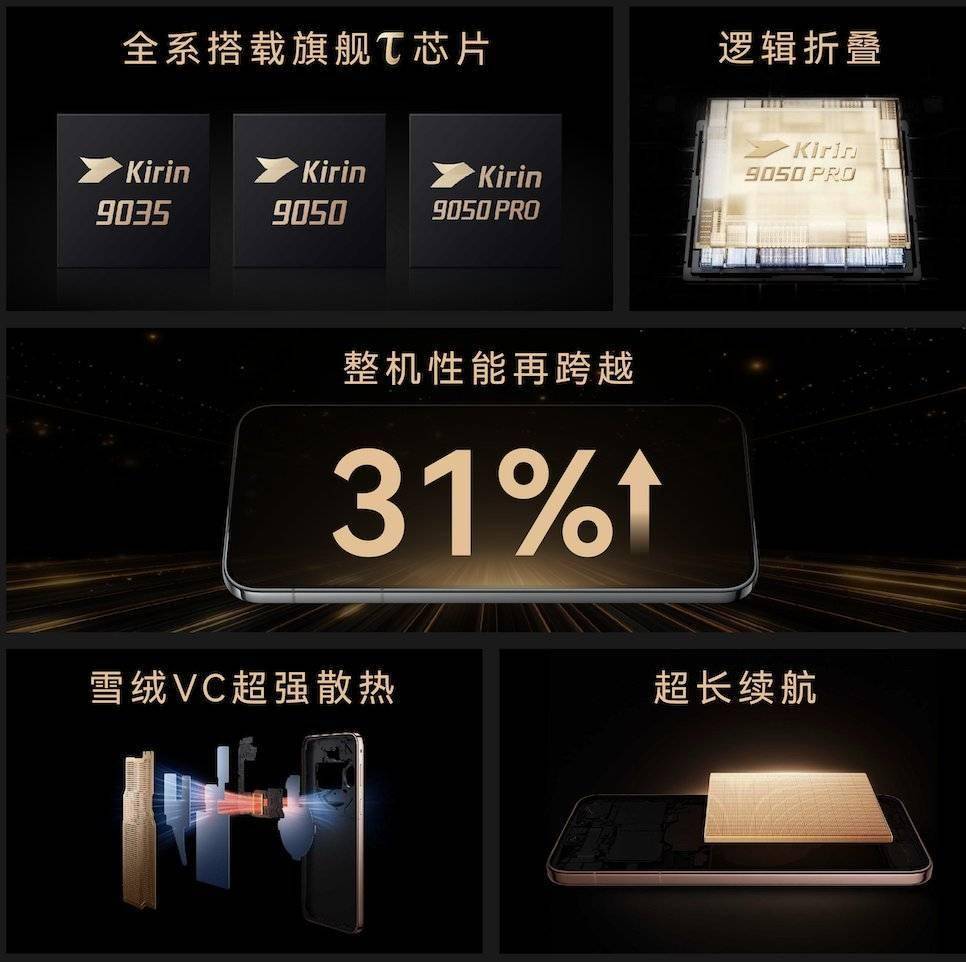
The standard version is equipped with the Taotao chip Kirin 9030, and the Pro version is equipped with the Taotao chip Kirin 9035. The Pro Max version is equipped with a stronger “logical folding” Tao chip Kirin 9050. The 16G version of Pro Max, Collector’s Edition, and RS Master use the most powerful “logic folding” Tao chip 9050 Pro. Overall, the entire Huawei Mate90 series is equipped with all products of Tao chips.
The performance of the entire machine has also been improved. Through vertical integration of soft and hard core clouds, the standard version, Pro version and Pro Max collection version of Huawei Mate90 series have improved by 27%, 20% and 31% respectively compared with the previous generation.
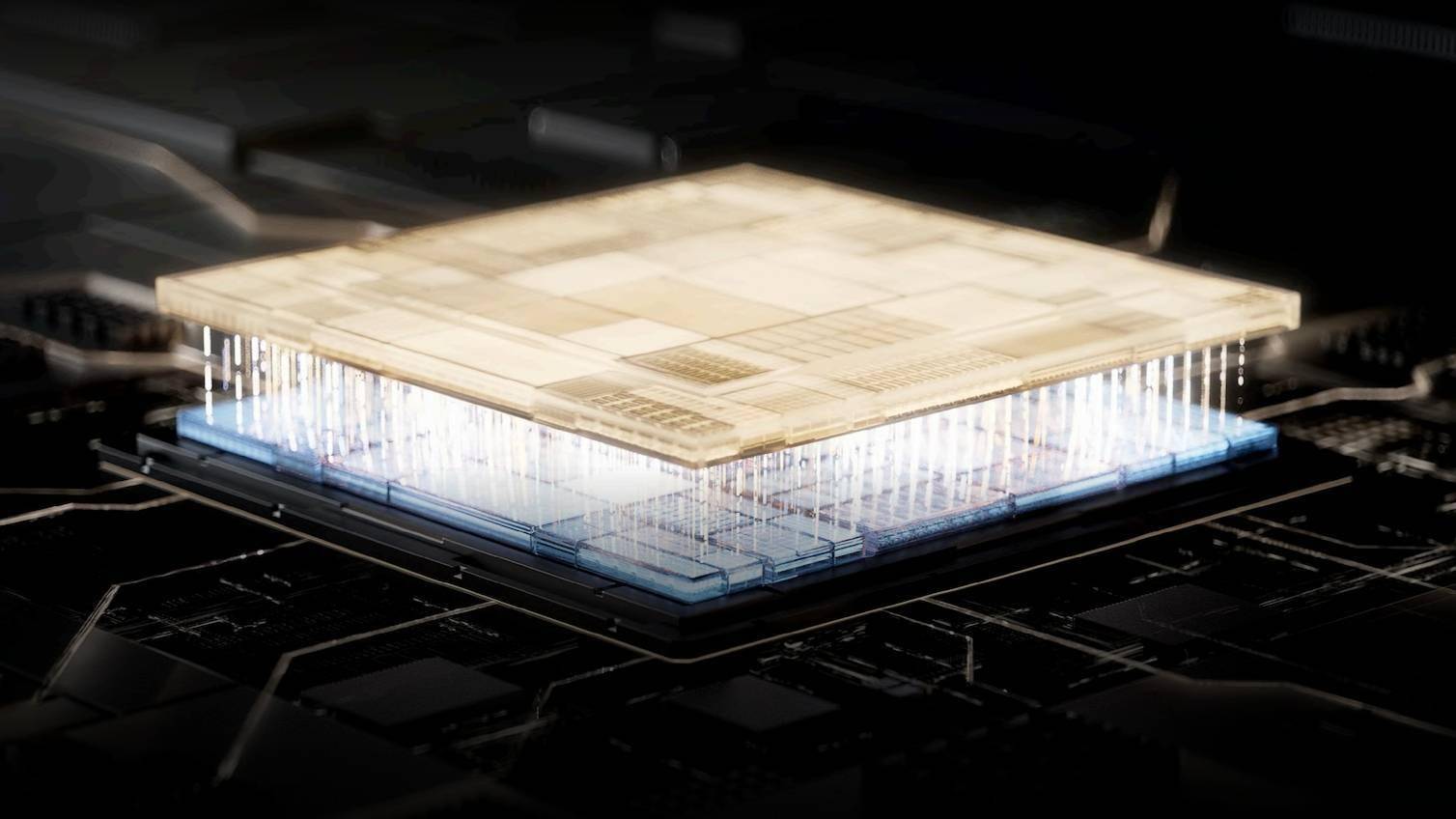
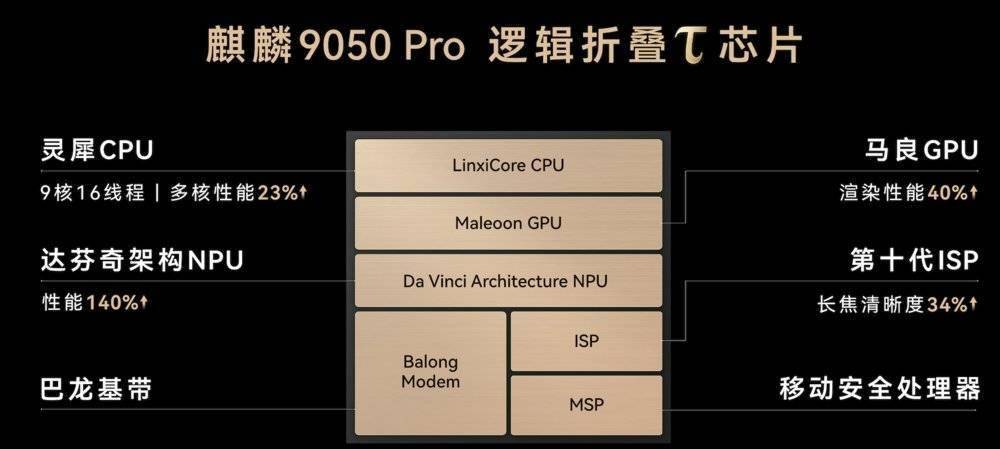
What is “logical folding”? The idea is to stack vertically on a constant chip area to compress key delays and achieve a new peak in Kirin performance. With this, the transistor density of Kirin 9050 Pro is increased by 28%. Through 5 million signal transmission bonds, a cross-Die transmission bandwidth of 125TB/second is achieved, and the critical path delay is reduced by 30%.
What is rare is the simultaneous improvement of power consumption. Logic folding shortens the “commute distance” of signal transmission, with more transistors and lower power consumption per unit task. Taking Kirin 9050 Pro as an example, under the same performance, the power consumption of the three major modules of NPU, GPU, and CPU dropped by 66%, 58%, and 41% respectively. This means that performance and energy efficiency have greatly improved at the same time, which is of great significance to both Huawei and domestic high-end chips.
It is worth mentioning that Huawei’s high-end chips have been questioned by the outside world about yield rate and production capacity. This time, the most powerful chip is no longer exclusive to a certain high-end model. The whole series uses Tao chips and logical folding Tao chips. The subtext is that Huawei can produce hundreds or even tens of millions of products. No matter in terms of “quality” or “quantity”, it is like a declaration.
Closely related to this, the Hongmeng 7 system can also demonstrate the effect of “system-level intelligent infrastructure”. Overall, Hongmeng 7’s intelligence pursues a “closed loop of perception, understanding, decision-making and execution.” From a sensory perspective, “Xiaoyi Xiaoyi” is no longer limited to answering questions. Instead, it implements cross-App retrieval and actually solves the problem. For example, when a user copies a flight number, it will automatically pop up the check-in portal. Under the premise of user authorization, Xiaoyi can call more than 2,100 system capabilities, perceive more than 200 system-level user data, and can also access agents and skills. The user says something he wants to do, and it can schedule multiple apps to complete the task. If the actual effect is really like this, then we may see the dawn of some AI phones.
At the same time, Huawei Mate 90 series also brings innovations in the fields of screen, imaging, communications and other fields. For example, Pro models and above adopt the full Kunlun Xuanwu architecture, and the lens cover is equipped with the industry’s first optical Kunlun glass, which improves drop resistance by 20 times. Mate 90 Pro is equipped with the second-generation Linglong screen, which pushes the peak brightness to 12,000 nits, which is still clearly readable under the scorching sun at noon; Pro Max and RS are the first full-color Linglong screens, which achieve BT.2020 full link connectivity based on the ultra-high brightness of 12,000 nits. The entire series is equipped with the third-generation red maple primary color camera. The Pro Max is equipped with an 18EV ultra-high dynamic main camera and a 200 million telephoto lens. It is worth mentioning that the Huawei Ruiying Z10 module camera is also included. This is not a teleconverter, but the industry’s first 10x continuous light module camera with a sensor. In terms of communication, Pro Max continues its advantages with the industry’s first four-SIM and three-standby, multi-device mutual communication and sharing, and 5A speed.
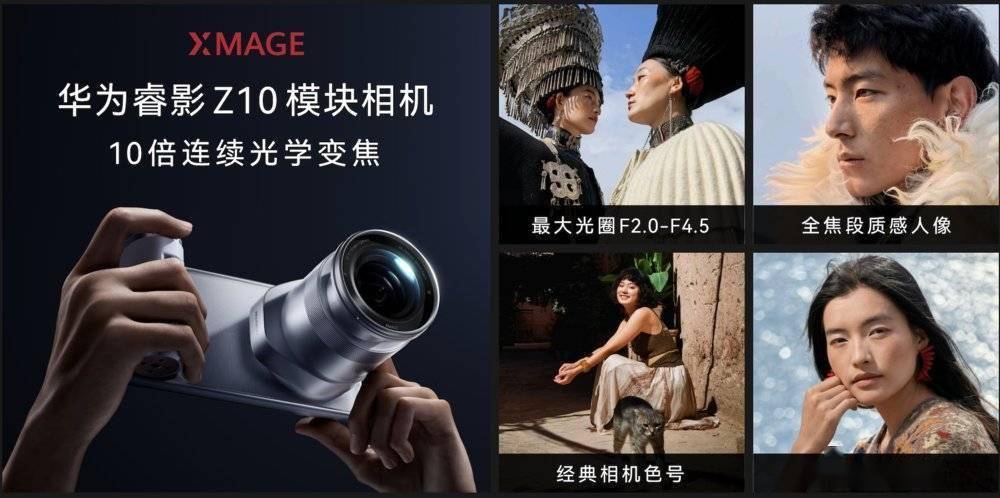
Overall, the Tao chip and the Hongmeng 7 system form the foundation, while other innovations continue to expand the boundaries of innovation in different fields, which has improved the overall product strength of the Huawei Mate 90 series. Judging from the contents of the press conference demonstration, this time the product performance has jumped across generations, and this alone is worthy of a domestic flagship highlight moment.
Before becoming a “complete performance unit”, Huawei’s Mate series already had a huge user group labeled as high-end, business, and quality. The multi-dimensional expansion strategy has also allowed Huawei Mate series to form a moat in office, imaging, AI and other scenarios.
IDC data shows that on the brand side, Huawei was the only domestic mobile phone brand with positive growth in the first half of the year. Focusing on the Huawei Mate series, shipments of the Mate 80 series are about to exceed the 10 million mark.
Nowadays, the arrival of “complete performance” undoubtedly gives fans of Huawei Mate series more reasons to support. However, dismantling the Huawei Mate series should not stop at a certain generation of products themselves, but should penetrate its innovation system that continues to this day.
The end of the old map
In fact, each generation of the Huawei Mate series lights up some new areas in the skill tree. Turning the needle back to thirteen years ago, it can be said that each generation of Huawei Mate, each generation of Hongmeng, and each generation of Kirin have brought new light to today’s Huawei Mate 90 series.
This “trail of light” is also a miniature history of the breakout:
With the “Popular euphratica spirit” of “Salute to Tenacity in Adversity”, Mate40 handed over the Kirin 9000, which was called the “swan song” by some at the time. Under the “Kunlun spirit” of “Salute to Daring in Extremes”, Mate50 integrates Kunlun glass and satellite communications into mobile phones. Mate60 ushered in the quiet return of Kirin with “Salute to the Endless Power”. For the first time, Tiantong satellite calling allows mobile phones to make direct satellite calls without relying on ground base stations.
Since then, Mate70 has brought Hongmeng AI, satellite paging and red maple primary color images with “Salute to the Power of Integration and Symbiosis”, while Mate80 has “Saluted the Courage of Infinite Exploration” and its outdoor exploration mode, pushing the boundaries of the flagship from the city to the wilderness.
Nowadays, Huawei’s Mate90 series, which has achieved “complete performance”, echoes its spiritual proposition of “paying tribute to the determination to move forward” and breaks through with the installation of Tao chips, creating a new light.
And this bright light happens to shine on the “old map” of Moore’s Law.
In the field of semiconductors, Moore’s Law, once regarded as the industry’s bible, is now facing the dual squeeze of physical limits and economic benefits. After entering 2nm and more advanced processes, the design and development cost of a single chip has easily exceeded 1 billion US dollars, and the inflection point of marginal effects is approaching.
Facing this “map of the old world” that can be seen to the naked eye as having reached its end,Huawei’s breakthrough idea is not to blindly stick to a single physical scale, but to propose the “Tao’s Law” theoretical framework that replaces the traditional “geometric size shrinkage” with “time constant (τ) shrinkage”. From “paving the ground” to “raising high buildings”, the use of logic folding technology has achieved performance improvements equivalent to cross-generation processes.
It is true that 3D stacking, hybrid bonding and other related technologies themselves are not proposed by Huawei for the first time. Issues such as vertical stacking’s long-term reliability, thermal management, and interconnect costs also mean that it still needs a longer period of time to be tested by the market and engineering practice.
But the significance of Huawei is that it reorganizes scattered technologies into a new evolutionary framework. It took the lead in demarcating the end of the old world and polishing the fire of the new world.
This bright spot has opened up a new path for China’s semiconductor industry that takes into account engineering feasibility and long-term evolution potential. It has also driven close collaboration in upstream EDA design, packaging materials and manufacturing equipment, giving the local semiconductor industry the opportunity to work together to overcome difficulties and form an industry synergy that will move forward.
How 100 million Hongmeng units will change the future of technology
It is not only the “new world” that is illuminated, but also a new ecology. Data shows that in the fourth quarter of this year, Huawei’s Hongmeng terminal equipment is expected to exceed 100 million units, and the total number of Huawei’s full-scenario ecological equipment exceeds 1 billion units.
We have said before that what we are waiting for is a broader perspective to examine and analyze the technology industry. Today, the “Hongmeng Army” has confirmed its status as the third largest technology stack in the world. This means that we will see Hongmeng Ecosystem shift from functionality to maturity and ease of use, and to a new stage of spontaneous and independent innovation.
The shift is starting to become clear. On the system side, the Xiaoyi platform has access to more than 2,000 Hongmeng intelligent agents and more than 500 partner-selected skills. Apps that used to do their own thing can now be coordinated by the system to complete the same thing. On the industrial side, cases of open source Hongmeng continue to emerge in fields such as finance, transportation, energy, education, and medical care.
The shift is also reflected in the data. IDC data shows that in the second quarter of 2026, Huawei’s domestic shipments of mobile phones increased by 19.4% year-on-year, ranking first again with a share of 22.6%. With 100 million devices, over 10 million developers, and 400,000+ applications and services, it is difficult not to change the direction of the technology industry at this scale.
The industry once joked that if Huawei doesn’t move, I won’t move, and if Huawei moves, the world will know. In another sense, Huawei has indeed illuminated a new direction for innovation in the field of science and technology, especially breakthroughs in China’s technology industry.
So, back to our original question: Is it worth the wait?
Related Reading
- OpenAI fires workers for mishandling ‘sensitive information’2026-10-02
- Original 380,000 kilometers away, a world-changing battle is taking place: China and the United States are eyeing the moon2026-10-02
- Captain Smit Machchhar: The ‘jovial’ pilot and father who thwarted the Flydubai attacker2026-10-01
- Flydubai passenger describes putting attacker in chokehold after cockpit stabbing2026-10-01
- Exclusive interview with Apple executives: What are Apple waiting for with its foldable screen?2026-10-01