Author|Xiaoman
Statement | The title picture comes from the Internet. Original article from Jingzhe Research Institute. If you need to reprint, please leave a message to apply for permission.
Once upon a time, Internet cafes were the youth memories of many Chinese young people. After school, you can sneak into a dimly lit and smoky Internet cafe. For an Internet fee of 1.5 yuan per hour, you can play a few games of “Warcraft” and “CS.” During holidays, you can invite friends to the Internet cafe to play hacker games, and you can book a hotel room for less than 10 yuan.
But now Internet cafes have completely changed. Not only are the lights bright, but the decoration is becoming more and more personalized, coupled with professional e-sports equipment, the Internet fee has risen directly to 10 yuan per hour. In first-tier cities, Internet fee standards of 30 yuan and 50 yuan per hour have become the norm, which has increased by at least 30 times compared with more than ten years ago.
The Jingzhe Research Institute reviewed statistics from the Ministry of Culture and Tourism and found that at the end of 2024, there were only 83,000 Internet access service business locations nationwide, a decrease of more than 40% from the historical peak of 146,000 in 2011. At the end of 2025, this number rebounded to 97,000.
Why is it that Internet cafes, which were once labeled as “sunset industries”, are now able to return to the public eye again and become “unaffordable”? Will the reborn Internet cafe be a new outlet?
The rebirth of Internet cafes
Looking back 30 years ago, the emergence of Internet cafes was mainly due to the lack of popularization of home computers. But now, computers have almost become “standard” household appliances, and a large number of young Internet users born after 2000 have completely skipped the PC era and directly entered the mobile Internet era. So when users no longer need to visit Internet cafes in order to “surf the Internet”, traditional Internet cafes lose their value.
But at the same time, a number of new business formats began to emerge. For example, there are a large number of e-sports stadiums that have opened up new battlefields in first- and second-tier cities. It is difficult to associate them with traditional Internet cafes: e-sports consoles worth tens of thousands of yuan, RTX4080 or even 5090 level graphics cards, e-sports monitors above 240Hz, plus ergonomic e-sports chairs, independent boxes, and immersive lighting designs. These investments from hardware to experience have become industry standards.
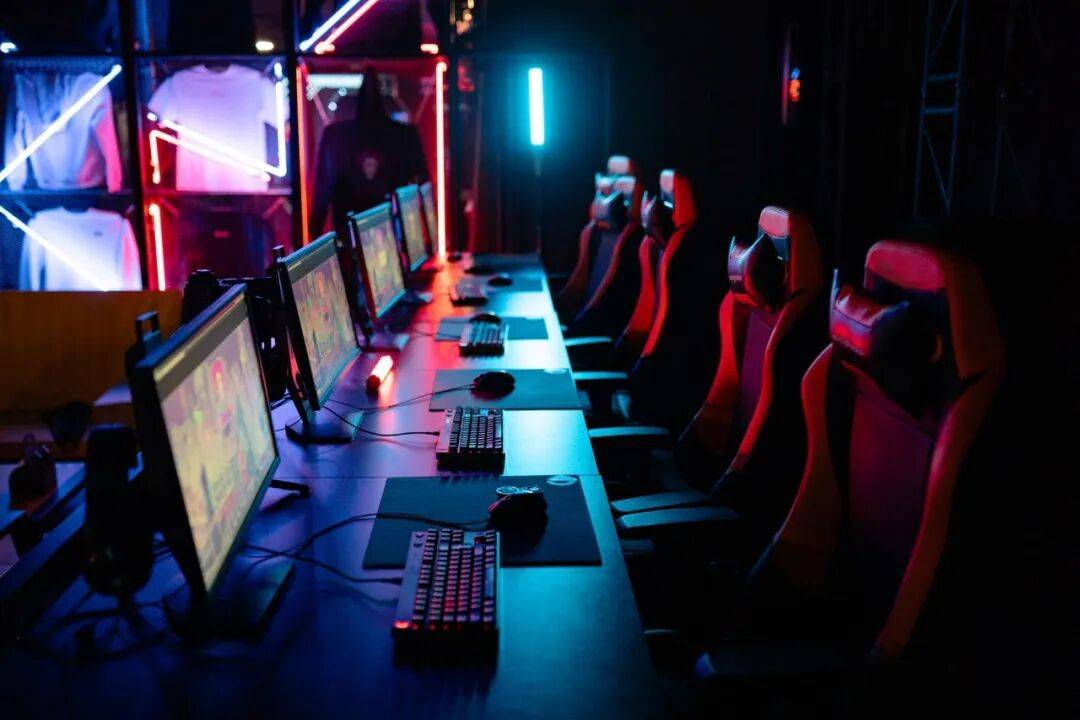
Some high-end e-sports halls will also set up equipment areas according to different functions, such as double private rooms for couples, black private rooms for 5 people, and 5V5 battle areas. In order to attract users, some chain brands will also open live broadcast rooms in their stores. What is even more unexpected is that some Internet cafes are equipped with bathrooms and laundry rooms. Including the store decoration style, the e-sports hall is also closer to an e-sports club and a trendy space, rather than a “dirty and messy” Internet cafe in the traditional sense.
The business innovation of e-sports stadiums does not appear out of thin air. For example, Wangyu E-Sports, which is currently the most common, was formerly the old Internet cafe “Wangyu Internet Cafe” founded in Songjiang, Shanghai in 1998. In 2021, it was officially upgraded to “Wangyu E-Sports”. The brand positioning also shifted from traditional Internet cafes to e-sports communities, and eventually developed two business formats: Internet cafes and e-sports hotels. Public data shows that as of the end of 2024, Netfish has more than 40 million global members, with stores covering more than 80 cities.
In addition to Wangyu Esports, there are currently a number of chain brands in China such as Green Tree Esports, Jela Esports, Tree Bear, and Esports Bee, and most esports brands show obvious characteristics of regional layout. For example, Green Tree E-Sports is rooted in the western region, Tree Bear’s store layout is mainly in Anhui Province, and E-Sports Bee is centered in Fuzhou and radiates throughout South China.
The regional layout of chain brands means that the industry is still highly fragmented, and the initiative of leading brands to seek change has also become a reference model for other individual Internet cafe operators.
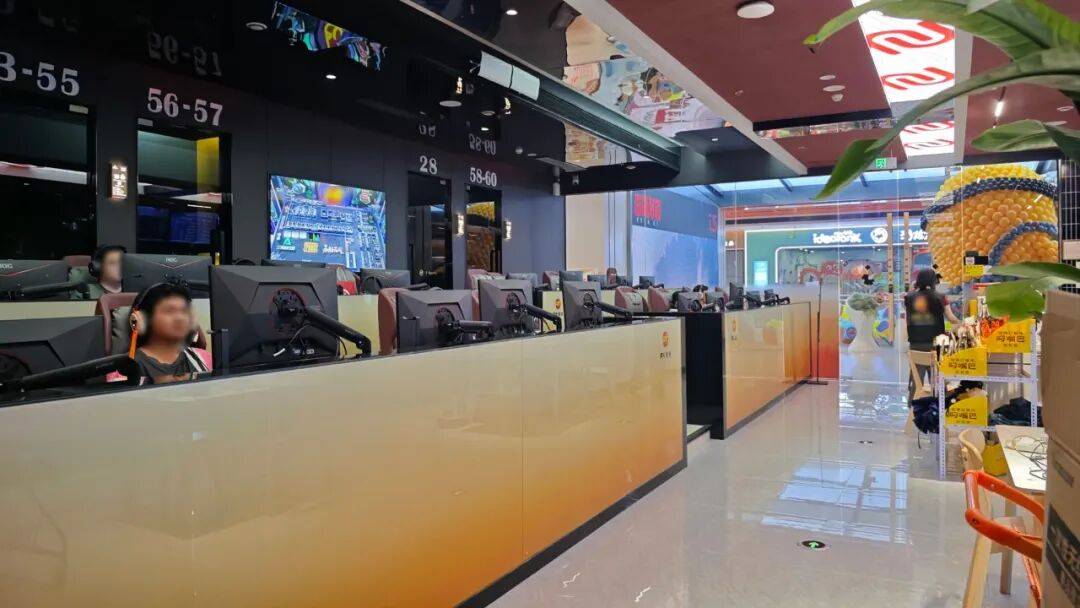
Jingzhe Research Institute saw in a non-chain Internet cafe in Songjiang District, Shanghai that the entire store was decorated with a large number of transparent acrylic and glass materials, giving it a sense of e-sports and business. The number of machines in the store is about 80, which are divided into halls and private rooms according to hardware configuration and number of seats. However, the lobby of the store is not a traditional large bay, but is designed as a double-layered stepped battle stage. In addition, there is a box that can accommodate 12 people, which can meet the needs of a variety of e-sports battles.
To a certain extent, “e-sports” has been the core theme of this round of Internet cafe upgrades.
After the upgrade, is the Internet cafe more profitable?
From an operational perspective, the key to the revival of Internet cafes is not to attract a group of users back to the Internet through external upgrades such as decoration style, but the underlying business model has changed.
Most old Internet users who have experienced the PC era must have the impression that the core business model of traditional Internet cafes in the past was to rely on low-priced Internet fees combined with recharge activities to attract users to pre-deposit Internet fees to increase turnover. However, due to low unit prices, traditional Internet cafes often fall into fierce price competition.
But today’s e-sports stadiums are more like a composite “experiential consumption”.
For players who pursue high frame rates and low latency, the equipment experience provided by e-sports halls is often better than that of ordinary home computers. Jingzhe Research Institute also found during offline visits that many e-sports venues also provide free rental services for professional peripherals. Players only need to provide a small deposit or certificate to use professional peripherals worth thousands of yuan for free. This kind of gaming experience that is close to the e-sports arena is very attractive to players.
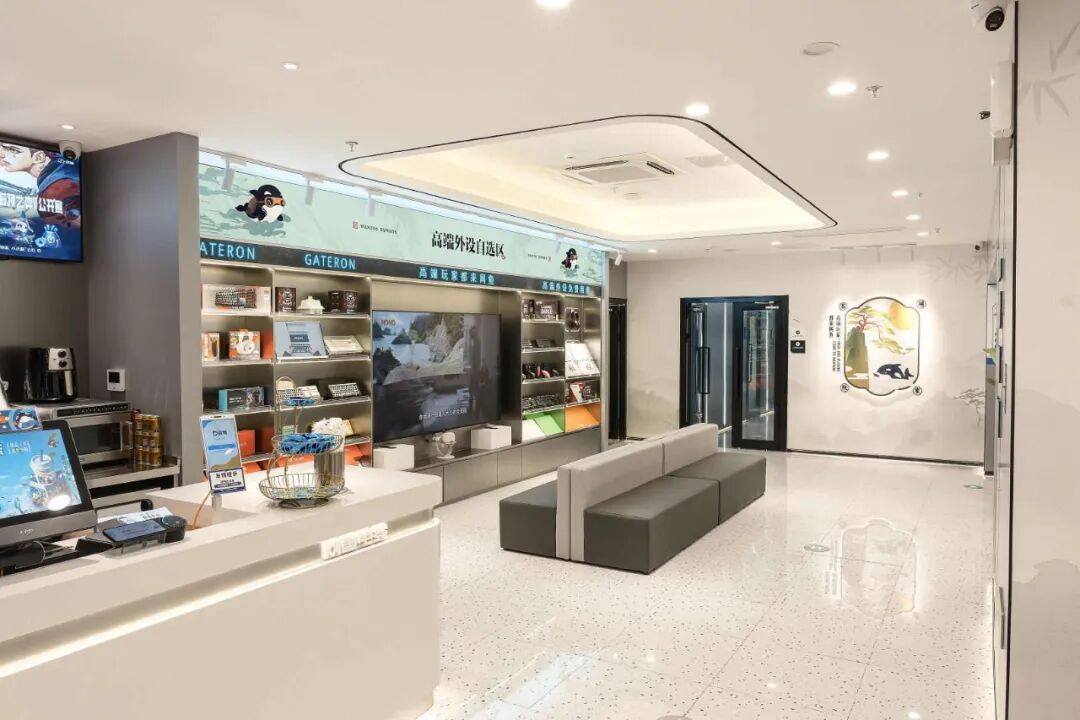
In terms of service, the immersive private room environment, ergonomic gaming chairs, beverage and snack delivery and other configurations also allow players to experience the Internet for a long time without any worries. Jingzhe Research Institute saw in an e-sports stadium in Songjiang District, Shanghai, that players can order snacks, drinks, and even freshly made milk tea and coffee directly from their seats. In addition, the setting of multi-person private rooms also meets the needs of various social scenes such as friend gatherings and group blackout. On the one hand, multi-person consumption increases the attendance rate, and on the other hand, it also increases the repurchase rate.
For Internet cafe operators, upgrading from hardware to software is not only a cost, but also brings new profit points. One of the most intuitive changes is the increase in Internet fees.
In the era of traditional Internet cafes, Internet fees were generally priced at 2 to 5 yuan per hour. The Jingzhe Research Institute combined with Dianping’s store public information found that the mainstream pricing range of e-sports venues is 5 yuan to 20 yuan per hour. In high-end areas with higher configurations, the unit price can reach 20 yuan to 50 yuan per hour, and prices in first-tier cities can generally reach 2 to 3 times that in second- and third-tier cities.
Although the Internet fee is not cheap at first glance, almost most chain brand e-sports venues will launch large-scale recharge promotions such as “recharge 100 and get 50” and “recharge 1,000 and get 1,000” during the new opening period or in normal times. And as the recharge amount increases, the gift ratio also increases from 40% to 100%.
In addition, the profits from retail products such as snacks and drinks are also very considerable.
Jingzhe Research Institute compared the prices of conventional retail channels and found that the prices of instant noodles, grilled sausages and other products in e-sports stadiums have generally increased by 100%. For example, in Tmall Supermarket, 12 bowls of Master Kong braised beef jerky noodles are priced at 48.18 yuan, which is equivalent to 4 yuan a bowl. Jingzhe Research Institute saw the same product priced at 8 yuan in the e-sports stadium store. Grilled sausages that are commonly sold on the street for 2 yuan each are sold for 4 yuan in e-sports stadiums.
It is worth mentioning that in addition to these relatively common business projects, there are also some e-sports halls that cooperate with other platforms or institutions to provide online companionship services. A few chain brands provide real-person companionship services in the store, with charging standards ranging from 20 yuan to hundreds of yuan per hour.
In addition, Jingzhe Research Institute also saw on the social media platform that some netizens showed the Internet cafe desktop ordering system, which showed that players can designate network managers to provide services, and can also purchase virtual gifts with prices ranging from 50 yuan to 200 yuan to reward network managers. In return, the network administrator will give you a drink or provide back-beating service, or even exchange WeChat messages.
Taken together, the change from traditional Internet cafes to e-sports venues is essentially a shift from “selling time” to “selling experience.” To put it more bluntly, consumers pay not just the Internet fee to use the computer, but an immersive entertainment space with high configuration and strong social interaction.
Competing for the “third space” of e-sports consumption
When seeing the number of Internet cafes growing against the trend, many people will have a question in their minds: Why do people still go to Internet cafes when almost every household has a computer? This question is actually not difficult to answer.
For players who love online games, especially combat games, dormitories, shared rooms, and family environments where multiple people live are not suitable for long-term gaming – either they worry about disturbing others or being disturbed by others. For example, young people will be labeled as “playing with things” by their incomprehensible elders. It is also difficult for middle-aged people to enjoy themselves at home under the burden of family responsibilities.
Therefore, although Internet cafes were once regarded as a sunset industry, the market demand has never really disappeared. In fact, if you raise your perspective to the industrial dimension, you will also find that the changes in the Internet cafe market are not unrelated to the development of the game industry.
As a part of the gaming industry, Internet cafes were once one of the driving forces behind the development of the e-sports industry. For example, CityHunter Internet Cafe in Chengdu has exclusively sponsored and tapped the CH team, which is one of the four largest DOTA teams in China along with EHOME, FTD, and CD. The aforementioned Wangyu Internet Cafe has become the official sponsor of the LPL since 2014, deeply tied to the IG club, and subsequently cooperated with PUBG’s 4AM, LGE and other teams to provide the latter with training bases and event support.
The mature operation of large-scale e-sports events has directly driven the demand for offline consumption scenarios. For players, the eSports Arena is not only a place to play games, but also an important place for watching games, gatherings, and club activities.
Another industry change that must be mentioned is that the emergence of phenomenal games has increased the requirements for game hardware configuration. For example, “Black Myth: Wukong”, which will be released in 2024, has attracted a large number of game enthusiasts because of its exquisite visual effects and artistic style. In order to obtain better picture quality and smoothness, many players choose to experience e-sports halls with high-end hardware. At that time, many Internet cafes also welcomed the return of players with hardware upgrades. In the past two years, the emergence of popular games such as “Operation Delta” and “Fearless Contract” has also brought continuous growth in customer flow to e-sports venues.
To a certain extent, the e-sports stadium also has the attributes of a “third space”. It is neither a home nor an office, but a public space where people can entertain, socialize, and connect because of their interests. It is this change in the perception of the value of the scene that has promoted today’s “resurgence wave” of Internet cafes and attracted a group of entrepreneurs to join in.
Wan Wan, who returned to her hometown of Tianchang City, Anhui Province in May 2025 and started running an Internet cafe, told Jingzhe Research Institute that compared to catering, massage, and KTV, going to Internet cafes to play games is a more cost-effective way of entertainment for male consumer groups. Therefore, even in county-level cities like Tianchang, market demand is relatively stable. “Customers often come to our store to open a private room, play old games such as QQ Speed and Street Basketball for a while, and then check their mobile phones. In fact, they don’t want to go home or go out to play after get off work, so they find an Internet cafe to relax.”
*Equipment configuration table (picture provided by Wanwan)
According to Wan Wan, she invested 2.2 million yuan to open an Internet cafe with an area of 600 square meters and a total of 87 devices. “During the peak season, the average daily attendance rate can reach 60% to 70%, and it would be good to reach 40% in the off-season. The current monthly income from Internet fees is about 90,000 to 130,000 yuan, and the supermarket’s income from selling snacks and drinks is 50,000 to 70,000 yuan. Based on the initial investment of 2.2 million yuan, it is estimated that the capital can be recovered in less than three years.”
However, in Wanwan’s view, although the Internet cafe market has released clear signals of recovery in recent years, competition in the industry has also been intensifying, and the risks faced by operators have also increased. “Five years ago, all Internet cafes were almost closed, and the prices of graphics cards and storage had not increased, so the payback period for newly opened Internet cafes was probably only one and a half to two years. But now the costs of graphics cards and storage have almost doubled, and there are many Internet cafes renovating nearby old stores, as well as new entrepreneurs. In this competitive environment, it would be good for newly opened Internet cafes to pay back their investment in three to four years.”
Wan Wan told Jingzhe Research Institute that after her Internet cafe opened in May last year, two new stores were opened within a 300-meter radius within two months, and two old stores were renovated. Opposite Wanwan’s Internet cafe, a new Internet cafe with an area of 1,000 square meters is about to open. “So now we have seven Internet cafes on this street of less than one kilometer. You can imagine the level of competition.”
Looking back, the essence of the revival of Internet cafes is actually the result of the integration of social consumption and experience economy.
In the era of mobile Internet, there is no shortage of online entertainment. What is really scarce are specific scenarios that can combine online entertainment, offline social interaction and immersive experience. Whether it is an e-sports hall or an e-sports hotel, on the basis of meeting the need for “Internet access”, it also meets the compound needs of “social interaction, experience, interest, and entertainment”, giving consumers more reasons to go to Internet cafes.
Therefore, the revival of Internet cafes is not a return to the past, but a complete reshaping of identity. It has changed from a “dirty and messy” low-price Internet place in people’s minds to a new space integrating e-sports consumption, social entertainment and experience economy. And when games, social interaction and experience are re-integrated, Internet cafes are also returning to urban life with a new identity.
Related Reading
- Original Mate 90 series real phone experience, the telephoto cannon is so explosive!2026-09-30
- The genius girl born in 1995 was promoted to Xiaomi’s highest rank by Lei Jun2026-09-30
- Short plays have been hard to make money for a long time2026-09-30
- Magic9 invites Alai, Honor will not be a substitute this time2026-09-30
- McDonald’s AI pricing push is widening the divide with some franchisees2026-09-30