Huawei really caught the old fox off guard today!
I originally took photos of test drives out of town, but missed the first batch of real machines in the store.

No, I will go back to Guangzhou tonight and go straight to the store to show everyone the new products.
This time, five models of the Mate 90 series were directly displayed in offline stores, including the standard version, Pro, Pro Max, Pro MAX Collector’s Edition, and RS Extraordinary Master Edition.
Without further ado, let’s go straight to the picture.
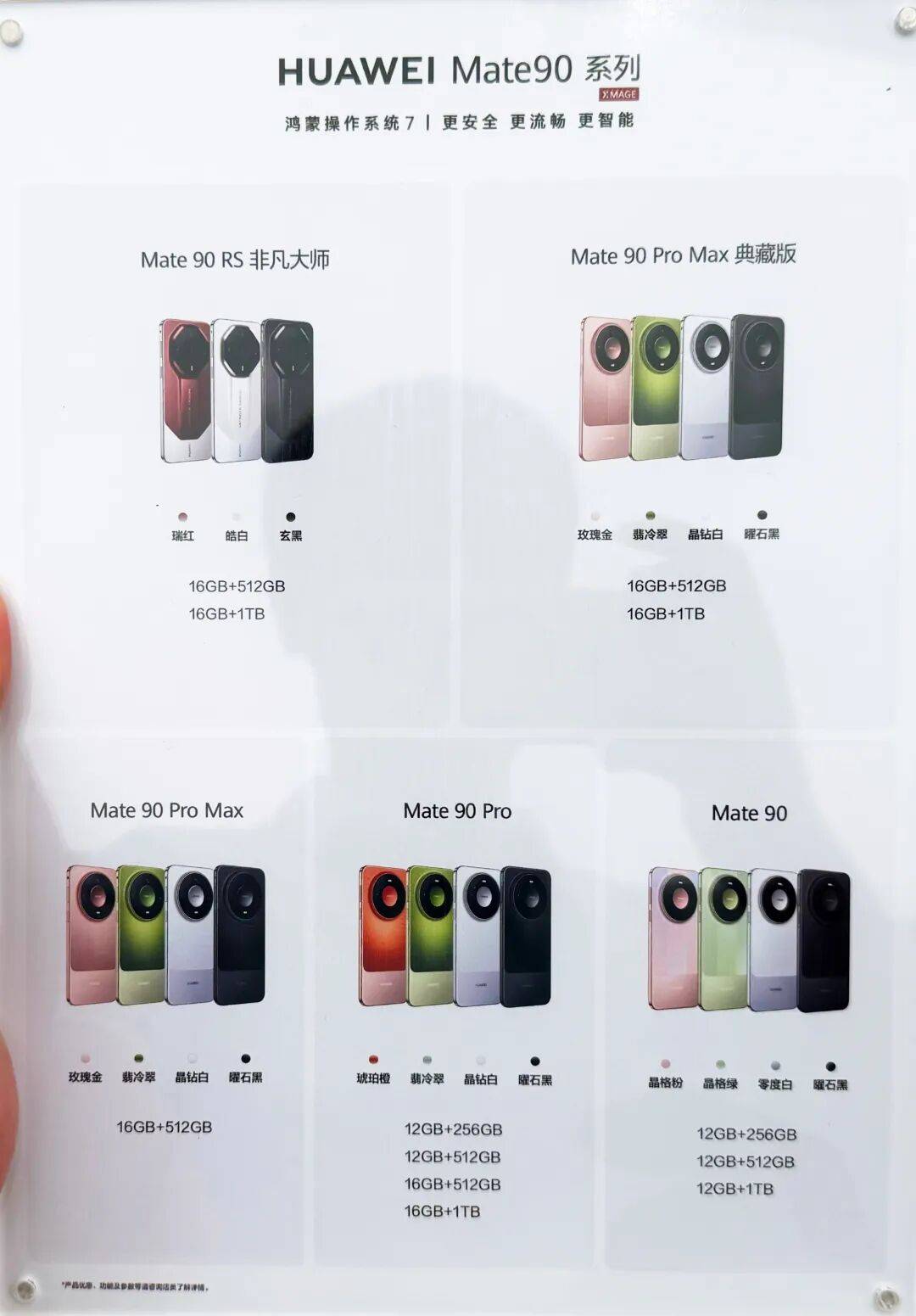
In terms of appearance, this generation of Mate 90 series has canceled the star ring design of the Mate80 series. The design language of the back panel of this generation is actually closer to the classic Mate 60 series. The same method of splicing materials is used.
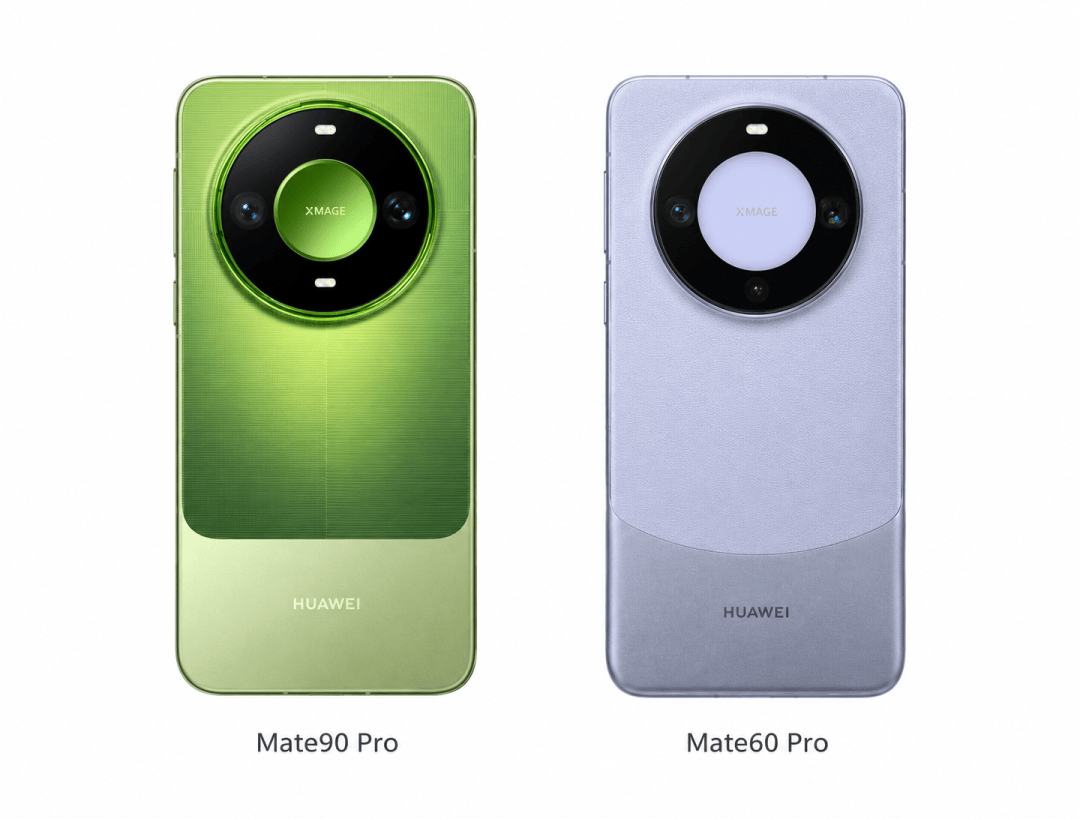
The line processing of the green version is very stunning. You can refer to the lines of the previous wide straight board.
The appearance of RS Extraordinary Master still has the “extraordinary” flavor of octagonal point ~
Due to time constraints, other more detailed parameters will be shown to you at the press conference. Next, let’s talk about some things “that can be seen” on site.
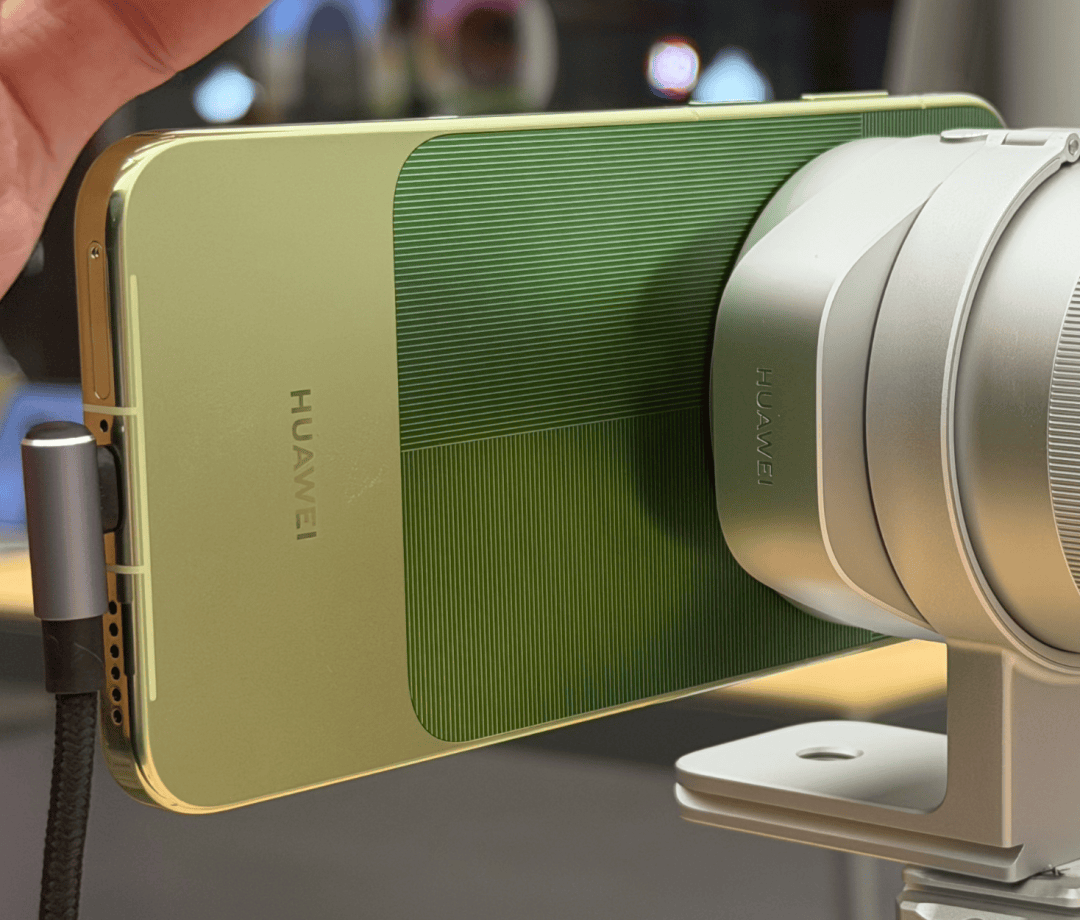
Smart friends must have guessed that it is the legendary external optical zoom lens-Huawei Ruiying Z10, which looks like this when connected to the phone~
Currently supported models are Mate 90 Pro Max Collector’s Edition and RS Edition.
Unlike the external teleconverters that have been common in flagship mobile phones in recent years, Ruiying Z10 does not simply add a set of optical lenses in front of the mobile phone lens, but directly builds a one-inch sensor with an independently designed optical system and built-in imaging, which is linked to the mobile phone through a bayonet.
As for the specific data transmission method between it and the mobile phone, Laohu guessed that it is directly connected through contacts.
The image data is transmitted to the mobile phone and then handed over to the mobile phone ISP for processing.
In this way, it is equivalent to combining the optical imaging capabilities of traditional cameras with the computational photography of mobile phones, and is no longer limited to the limited space inside the mobile phone.
In our actual hands-on experience, the equivalent focal length of Ruiying Z10 covers approximately 24-240mm, especially the 240mm telephoto end. This pure optical blur is amazing!
Even in a night scene environment, combined with the mobile phone’s own algorithm, Ruiying Z10 can ensure the stability of the picture as much as possible and reduce the probability of blurring.
For example, the sample below was purely handheld.
You can note that the shutter speed when shooting is only 1/33 seconds, but the focal length has reached 240mm.
If you switch to a SLR or mirrorless camera with a telephoto lens, it will be difficult to avoid image shake at such a shutter speed. Even Lao Hu, who usually shoots with a camera and a telephoto lens, will control the shutter speed to above 1/100 second in order to avoid blur as much as possible.
It can only be said that the mobile phone algorithm is working hard!
It is a pity that Ruiying Z10 should not have optical image stabilization, but there is no blurry phenomenon in several sample photos.
Let’s make a bold prediction: this is likely to be the next generation concert artifact.
There is another detail. The optical design of the lens of Huawei Ruiying Z10 is obviously aimed at professional lenses. The lens diameter has reached 62mm, which is almost the same as many half-frame mirrorless lenses with the same focal length.
To a certain extent, this is actually a plug-in for mobile phone imaging. It is directly connected to a professional camera to optically benchmark the mirrorless camera. The key is to use the algorithmic photography of the mobile phone. What is the use of this mirrorless camera!
What do you think of this external lens solution?
It is not difficult to see that Huawei has actually made plans in the field of imaging and has played a big game.
Do you still remember the “full of German flavor” Huawei P9? Although Huawei is not the first manufacturer to make dual cameras on mobile phones, the P9 cooperated with Leica to combine color and black and white dual cameras, so that the dual cameras can really start to improve image quality.
Later, the P20 Super Night Scene, the P30’s RYYB super-sensitive sensor and periscope telephoto, and later the launch of its own XMAGE imaging brand, Huawei has continued to explore the imaging road for nearly ten years.
Now, Huawei has begun to accumulate these imaging technologies and extend them to more devices and scenarios besides mobile phones.
For example, the Pocket4 jointly customized with DJI two days ago directly integrates handheld imaging devices into the Hongmeng ecosystem. After shooting, it can be directly integrated with the Hongmeng ecosystem. Seamless transfer.
A real machine was also on display at the store, and Laohu actually tried it out. Except for mutual transmission of interconnections and logos, other functions are consistent with ordinary Pocket4.
But can you bear it? The OSMO at the bottom has been directly replaced by the five letters HUAWEI.
As for the “Huawei Cannon” displayed today, it has a 10x optical zoom, a one-inch sensor, and an equivalent focal length of 24-240mm. These parameters were previously only found in professional card-based micro-standalone machines such as the “Sony Black Card”.
Obviously, Huawei no longer just wants its mobile phones to shoot farther and clearer, but has begun to extend its tentacles into more professional imaging fields.
The hardware includes XMAGE, and the software includes Hongmeng Ecosystem.
The domestic imaging ecosystem is really coming…
The Mate90 series officially announced today will be released at 10 a.m. on October 1 and will go on sale on the same day. When the time comes, Laohu will also be the first to hold a press conference for everyone!
According to reports from some online bloggers, the standard version is likely to be priced within 6,000 yuan in order to receive state subsidies.
But combined with the fact that all SKUs of Pro Max this time start with 16G of storage, and the RS top configuration even provides 2T of storage, the price of the top configuration is definitely not low.
Friends who are interested can also go to the store to try it out in the next two days. It should be available in all stores one after another~
Written by: Xia Qing
Related Reading
- Original Price has increased 30 times, are Internet cafes living better?2026-09-30
- The genius girl born in 1995 was promoted to Xiaomi’s highest rank by Lei Jun2026-09-30
- Short plays have been hard to make money for a long time2026-09-30
- Magic9 invites Alai, Honor will not be a substitute this time2026-09-30
- McDonald’s AI pricing push is widening the divide with some franchisees2026-09-30