文|明殊
She founded “Today’s Statement” and single-handedly promoted Sa Beining to the anchor stage, but she died suddenly at the age of 55.
He did not mention the trophy or glory before his death, leaving only 26 words.
What does this “iron-faced beauty” want to warn us about?

鐵面美人
In August 1962, a girl was born in an alley in Changsha, named Xiao Xiaolin.
At that time, no one thought that this girl, who would later be admitted to the broadcasting department of the Beijing Broadcasting Institute, would sit in front of the camera in an image that would make the audience respect and fear her.
She is the first batch of college students after the resumption of the college entrance examination.
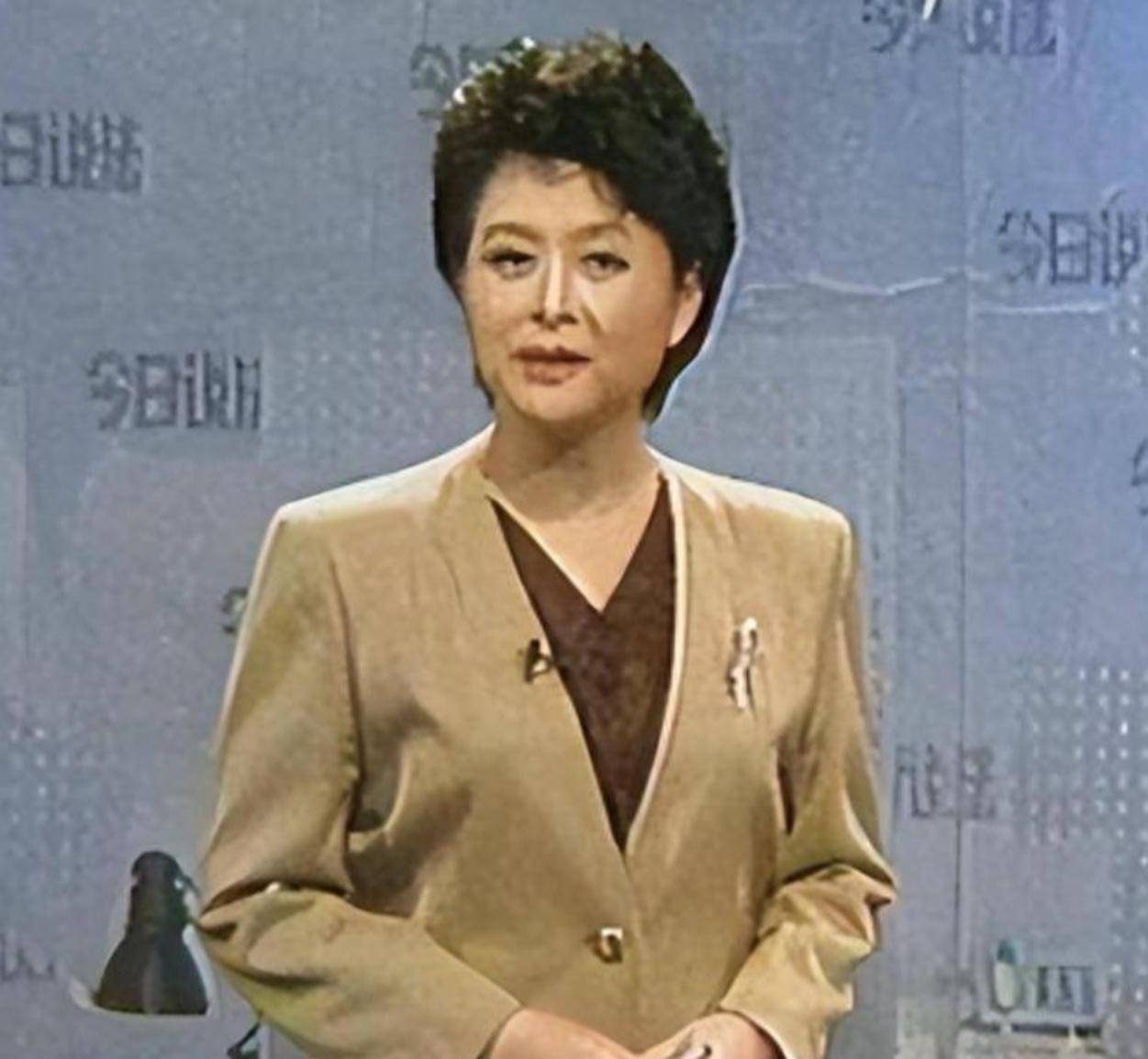
She was admitted in 1977 and did not stay in Beijing after graduation. She returned to Changsha and worked at the city radio station. In 1985, Changsha TV station was established. She was one of the first announcers.
It is said that this road is stable enough, and if you gain a firm foothold in a local station, you will have a hard time in the future.
But in 1987, before she was thirty, she returned to the examination room and was admitted to the Journalism Department of the Graduate School of the Chinese Academy of Social Sciences.
This turn of events sent her directly to CCTV.

In 1988, he went to CCTV and served as the host of “Observation and Thinking”.
This program is positioned to criticize current ills, and the station is in urgent need of a host who can both appear on camera and understand news commentary.
Xiao Xiaolin, who was in her early thirties, was pushed to the stage.
She sat upright in front of the camera, spoke slowly, had few expressions, and rarely smiled. The audience quickly nicknamed her “Iron Beauty.”

This nickname has followed her for most of her life.
Later, her name was tied to a series of columns: “Observation and Thinking”, “Focus Interview”, “Half the Sky” and “Social Economics”. She also briefly appeared on the anchor desk of “Xinwen Lianbo”.
At that time, CCTV’s hosting talent was in short supply and the number of programs was exploding. She took on several roles by herself, planning, interviewing, writing, and hosting all by herself.
In 1995, when her career was on the rise, she did something that surprised people around her – she put down her work and went to the Journalism Department of Utah State University in the United States for two years as a visiting scholar and associate professor.
After returning to China, she declined invitations to join many columns, chose “Social Economics”, and took the lead in preparing a new legal column.
On January 2, 1999, “Today’s Statement” was launched.
How popular did this show become?
Every day at around 12:30 noon, countless people watched her break down a case and explain it clearly.
But what really makes this show memorable is not just the case itself, but also her discerning eye.
At that time, the column team wanted to recruit hosts with professional backgrounds from the law departments of major universities.
She happened to fall in love with a senior undergraduate student at Peking University Law School – Sa Beining.
The version at that time was: Sa Beining missed the school recruitment registration because he was rehearsing his graduation drama. After returning to school, he asked his teacher for the producer’s phone number and recommended himself.
He later recalled that he was pacing back and forth in the corridor of CCTV alone, grinning when he saw people, and calling out to the teacher.
Xiao Xiaolin later described him as “like a monkey”.
But when they really sat down to chat, she found that this young man had a solid legal background, quick reactions, and a clear mind. His a little bit raw in front of the camera could be polished off.
She defied all opinions and pushed Sa Beining, who had not yet graduated, to the stage of “Today’s Statement”.
The people around me were very excited at the time.
Is it possible for a small mid-day column to use a student who has not graduated?
We don’t need to say much about what happened next.
From here, Sa Beining walked all the way to the Spring Festival Gala stage, to “The Legend of Classics”, and to the little Sa in the variety show who always makes jokes when he opens his mouth.
The mid-day program “Today’s Statement” has been running for more than 20 years.
There is another detail here that few people mention.
Zhang Shaogang was also selected into the column together with Sa Beining.
The first three hosts of the column – Xiao Xiaolin herself, Zhang Shaogang, and Sa Beining – did not even have a fixed office in the early years of preparation. They often worked in the coffee shop, making a pot of tea, and stayed there all day long.
At that time, there were a lot of letters from the audience every day, and only a few full-time lawyers followed the host to open, classify, and reply to the letters.
No one expected that this small mid-day program would become an enlightenment lesson on the rule of law for a generation.
No one thought that the person who founded it would use another method to make this program remembered by people across the country not long after his retirement.
twenty-six words
In February 2017, Xiao Xiaolin took the stage to give a retirement speech at the annual meeting of CCTV’s Social and Legal Channel.
She said she would go to the United States after retirement to stay with her son for a while.
Colleagues in the audience applauded, and some joked that this eldest sister, who is known as “iron” in the stage, can finally breathe a sigh of relief.
The scene looked like an ordinary farewell ceremony, but no one really regarded it as a farewell.
She flew to the West as planned and settled in Logan, Utah.
She was familiar with this place when she visited school more than 20 years ago, and it was also the small town where her son got married and settled down.
Not long after arriving in the United States, my stomach started to hurt.
At first, no one took her seriously. During those years of working in the media, she had irregular eating habits, stayed up late at night to catch up on manuscripts, and suffered stomachaches. It was a common occurrence for her.
Just be patient and bear it and it will pass.
But this time it was different. The pain was getting worse and worse, so severe that I couldn’t move normally.
Her son and daughter-in-law sent her to a local hospital, and the test results came out: rectal cancer had metastasized.
There was only about four months between her retirement speech in February 2017 and her departure at her son’s house in late June.
On the evening of July 12, employees of the “Today’s Statement” column confirmed the news to the media.
The next day, People’s Daily Online, China Central Broadcasting Network, China News Network, and Beijing Youth Daily issued reports almost simultaneously.
Aged 55.
What really pushed this incident from an ordinary celebrity obituary to a topic on the entire Internet was not any program she hosted, nor the Golden Microphone Award, nor the nights she stayed up until the early hours when she founded “Today’s Statement”.
It was a passage she left before her death, relayed by her daughter-in-law to her colleagues, with a total of twenty-six words:
“Spread the word and don’t neglect your health like me. If you are healthy and live a long life, I am here. Thank you!”
The daughter-in-law’s account was later circulated among colleagues.
She said that Xiao Xiaolin was strong, brave, and optimistic in the last few months, and she died peacefully with her family around her.
She didn’t want everyone to be too sad for her, she just wanted those twenty-six words to be spread.
But when it was her turn to lie on the hospital bed, she realized that the rules of her body also did not wait for others, did not respect people’s feelings, and did not accept the extension application of “I’ll come back when I finish my busy work for a while”, the last “report” she could do,
The subject of the report was herself, and the content of the report was a fact that she had ignored for too many years.
In these twenty-six words, there was no mention of any of the programs she had hosted, no mention of the golden microphone, and no mention of the debate about “style” between her and Sa Beining.
There’s only one thing I keep saying over and over again – don’t be like me.
For a person whose profession is “explanation”, what he leaves behind in the end is not a defense, but an unmodified reminder.
誰在硬撐
Xiao Xiaolin has been gone for almost ten years.
In the past ten years, “Today’s Statement” has been broadcast on time at noon every day.
Sa Beining has become a well-known variety show face. He can be found everywhere as the host of the Spring Festival Gala, “Let’s Talk” and “Classics”.
But his connection with this mid-day show has never been broken.
On November 18, 2021, he returned to the anchor station after four years and hosted an episode of “The Will Controversy”, which directly topped the trending list.
CCTV staff later said that he never really left, he just stopped hosting daily.
On February 1, 2026, another host, Li Xiaodong, posted a video on social media announcing his resignation from CCTV, using two words – “graduation”.
The show is still on the air, the host has changed one after another, but the founder is no longer there.
Every day at noon, when the familiar title song plays, what we hear is no longer the voice of “The Beauty in the Iron Mask”.
If you look away from her alone, you will find that this is not an isolated case.
A joint survey of current and deceased journalists from 10 major news organizations in Shanghai in 2000 was circulated online and stated:
The average age of employees who have died is only 45.7 years old, of which 72.7% died of cancer; the average age of those who were hospitalized due to illness is 44.2 years old; only 18.4% of employees are completely healthy, and the rest are in varying degrees of illness or sub-health.
Digestive system diseases, cardiovascular and cerebrovascular diseases, and cancer are at the top of the list.
This data was later cited repeatedly by “Journalist” magazine, CCTV’s “Chinese Medicine” column, and China Youth Daily.
As of 2004, the media were still using it to discuss the “short life of journalists”.
After more than 20 years, has the pace of the industry really slowed down?
Among the CCTV hosts, there are numerous examples of the body sounding the alarm.
Wang Xiaoya was diagnosed with chronic nephritis in 2006, and the head of the program team personally admitted that she would take a break from the screen.
The doctor said that this disease was a “disease of wealth” and could not be tolerated due to travel and fatigue, but she returned to work without long recuperation.
Zhang Quanling was coughing up blood every day in early 2015 and was still coughing while diving in Palau. The doctor directly advised her to rule out lung cancer.
Just some time ago, Jing Yidan passed away in Beijing due to illness at the age of 71.
You will find that this is not a problem of someone “not taking care of his body”.
The working environment of CCTV is a microcosm of the high-pressure media industry: programs are broadcast on time, manuscript deadlines are not waited for, and night shifts, filming, live broadcasts, and outing interviews are layered one after another.
When “working hard” becomes the background of the industry, “taking care of yourself”, which has no deadlines, no KPIs, and no one urging you from behind, will be pushed back one round after another.
From the “iron-faced beauty” in front of the camera to the time when Xiao Xiaolin was diagnosed with terminal rectal cancer, no one could count how many physical examinations she had to postpone and how many appointments she canceled.
She herself concluded the matter in twenty-six words.
The scene she described in her retirement speech was originally an ordinary middle-aged ending: making up for unused leave, flying to her children, and spending time with her family who had been absent for those years.
It’s just that she didn’t have enough time.
Those twenty-six words did not call anyone to make any grand decision.
Related Reading
- She went from the Spring Festival Gala to being hospitalized for mental illness. It is really a pity that the “Queen of Sketch” has reached this point.2026-10-27
- The latest situation of 61-year-old CCTV celebrity Zhang Zequn is exposed! He once had a son with Hu Jiana, and now he is retired and living alone in Beijing, which is sad.2026-10-25
- US accuses government contractor of leaking classified info to girlfriend’s Substack2026-10-25
- The delivery boy who married an American wife after five months of a flash marriage is planning to divorce, saying the reason is cultural differences and there is no fake marriage.2026-10-24
- The latest situation of 55-year-old CCTV host Dong Qian is exposed! Married to Wang Shilin and gave birth to a son. Now the marriage is very happy.2026-10-09