When she came across the hot search topic “Little genius shuts down social media and forces parents to buy it”, Gao Hong felt that someone finally spoke out for her. She lives in Liaoning. Her eldest daughter just entered the first grade of elementary school last year. When she came home one day, she asked to change her phone and watch, but she refused. But in the next few days, when the eldest daughter came home every day, she would talk about which classmate in the class used a little genius watch to invite new friends to play with. Listening to the child’s envious tone, she had to be “kidnapped and consumed.”
Gao Hong’s helplessness is not unique. On October 19, the blogger “Dongya” retweeted a video of “A teacher talks about the Little Genius Watch” and sparked a heated discussion. The blogger analyzed that the Little Genius Watch has built a closed social platform within the product that is not compatible with the outside world, which is an important reason why it is difficult to be replaced. “If you buy other children’s watches, you are not allowed to enter this social system. Taking advantage of children’s need for social interaction, parents can only choose little geniuses.”
“Parents cannot see their children’s friend circle directly from the app unless they buy a Little Genius watch and add their children as friends.” Gao Hong told China News Weekly. What worries her even more is that the next day, there was a hot search for “Little Genius, the youngest user has just started kindergarten.” Her youngest daughter is only three years old. Whether she makes new friends is also defined by the brand of a watch.
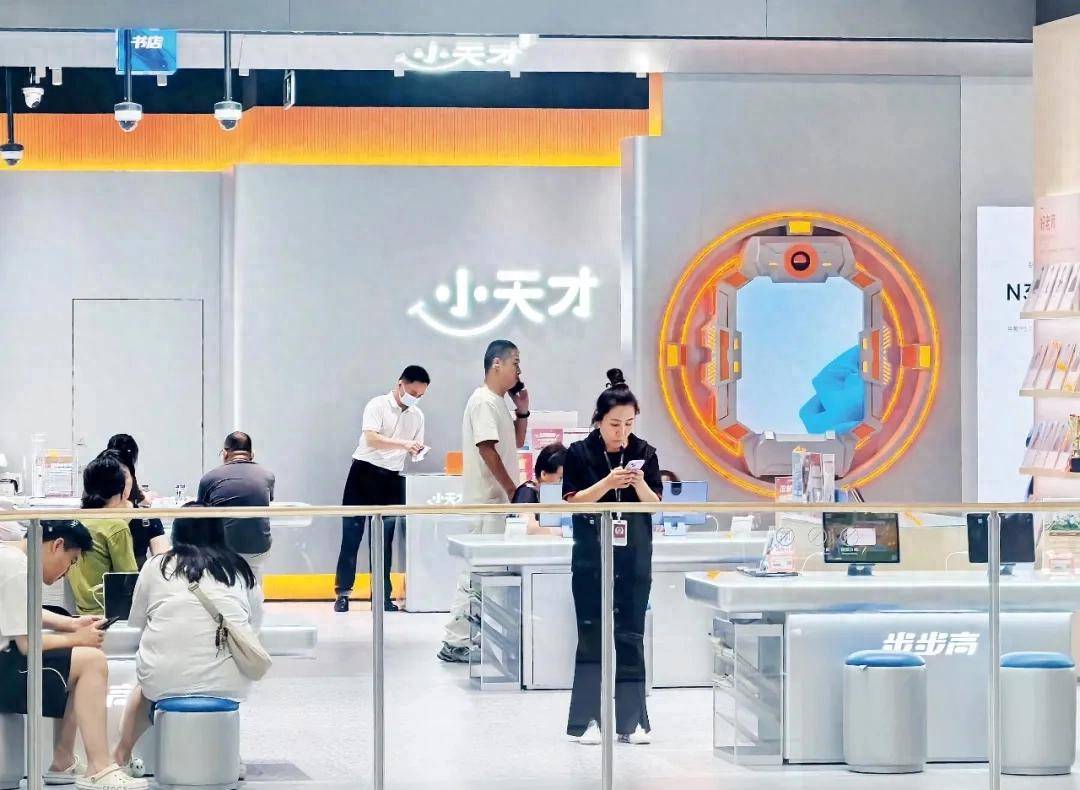
July 2025, a small genius watch store in Beijing. Picture/Visual China
More “addicted” than playing with mobile phones
Zheng Ye, a second-grade junior high school student in Zhejiang, has been using his little genius watch Z9 for more than three years. This is his second phone watch. The previous one was a no-name brand. Before changing the watch, his classmates once laughed to his face as the watch he used was “really rubbish.”
He claimed that he didn’t care about comparisons among his classmates. The reason he chose to change his watch at that time was very real: waterproof and drop-resistant. But the new watch is more than twice as expensive as the original one. He soon discovered that the daily use of the new watch went far beyond “making phone calls and positioning”.
During the summer vacation of sixth grade, Zheng Ye went on a trip to Tibet with his parents and posted five or six updates to the “Moments” on his watch every day. Every time he received a like, he had a “feeling of being noticed.” During the summer vacation when he was a junior high school student, he went to Beijing to play. His parents gave him a mobile phone, but he still used to use the little genius to make calls and send messages. “WeChat is a social software used by parents, and we use little geniuses,” he said. He spends more time checking his watch than his mobile phone every day. Even when playing games, teammates don’t turn on their mobile phones to talk to each other, but use Xiao Genius to talk to each other.
“What’s more addictive is getting likes.” Zheng Ye told China News Weekly that little genius accounts have ranks and levels, which are accumulated through exercise and various medals. The higher the level, the more likes it can give others every day. At low levels, you can only give 5 likes to a friend per day, and at higher levels, you can like 10, 15, and up to 20. Each account can receive up to 3,000 likes per day. “The number of likes on the homepage is public. You can tell who has more likes and who has less.”
Zheng Ye’s homepage only has more than 3,000 likes, ranking at the bottom of the circle of friends. According to the “in-circle” rules, accounts with more than 600,000 likes are respectfully called “big bosses”. In order to improve their grades, some students spent four to six hours a day during the holidays in watch social circles, and even added senior students they didn’t know in the group. Zheng Ye said frankly that the “delete if you don’t like” trend is popular in student circles. As long as there are no likes for one day, you will delete it directly and shout that the other person “is not worthy of being a friend.”
The watch also has a “virtual currency system”, which Zheng Yehe and his classmates call “gold coins”. In public reports and Xiaocai Tiantian’s official user agreement, it is more commonly known as “points”. It cannot be recharged with RMB and can only be obtained online every day, received as a gift from friends, or by completing tasks. Zheng Ye used 25 “gold coins” to exchange for Iron Man’s voice skin. In order to continue the monthly subscription, he also began to spend more time soaking in the watch.
On his birthday, Zheng Ye asked his friends to help him “stack cakes” together. The higher the number of layers, the better the benefits that can be exchanged. When you stack a certain number of layers, you can exchange for Kugou Music VIP and listen to music directly on your watch. A classmate once accumulated 10,000 likes and posted a message in his circle of friends, asking others to “send him gold coins in exchange for likes.” Get likes – ask for “gold coins” – change your outfit – win crowds, and a cycle is closed.
Wang Chaoyang, an associate professor at the School of Journalism and Communication at Wuhan University, and his collaborators interviewed 18 children aged 9 to 12 and 7 parents. In the study of the paper “Socialization on the Wrist: Two-way Adjustment of Children’s Cognition, Role and Value by Phone Watches”, they found that a 9-year-old fourth-grade boy gained a sense of superiority because of having a “King Badge”, while another 11-year-old sixth-grade boy developed status anxiety of “feeling like a bronze player” because of using a basic skin. The phone watch’s functions such as point ranking, level badges, friends’ likes and content sharing transform children’s sports, social and other behaviors into intuitive data indicators. Such external quantitative indicators may encourage children to over-bind their self-worth with digital achievements.
The above-mentioned research also found that some of the children interviewed regarded “giving out red envelopes with points” as a way to cultivate feelings. This tendency to quantify emotional relationships may cause children to focus too much on the instrumental value of friendship, simplifying relationships into reciprocal transactions, and lead to children prematurely internalizing utilitarian social logic.
Dependence on watches may also lead to insufficient socialization of children. The paper pointed out that some of the children interviewed were “at a loss” in real-life social conflicts. Isolation by brand technology may lead to the narrowing of children’s social circles, while high-frequency virtual interactions may crowd out face-to-face communication time and affect the development of children’s empathy and conflict resolution abilities. In addition, continued use of micro-screens may also cause health problems such as vision loss, further affecting children’s willingness and ability to participate in offline activities.
From “renting an account” to “cracking”
One of Zheng Ye’s classmates once sold an account with more than 200,000 likes together with a phone card, making more than 80 yuan. “This is not uncommon in the industry.” Zheng Ye said that accounts with millions of likes can be sold for more than 1,000 yuan. The people who buy and sell accounts around him are mainly minors of similar age.
Previous investigations by many media found that accounts with more than 500,000 likes on their homepage were priced at about 500 yuan, and an account with “990,000+” could be sold for 800 yuan. On second-hand platforms, this type of transaction is often marked as “virtual account cannot be returned or exchanged.”
Based on the demand for likes, services such as collecting likes on behalf of others, renting accounts, and selling “big boss friend slots” have emerged. Pay 100 to 180 yuan and send the watch to the relevant personnel. After about 10 days of processing, a third-party automation tool called “bot” can be installed. After that, posts will automatically receive likes within 5 minutes, and you can also find out who has not been liked with one click.
Further downstream is the cracking business. On the second-hand trading platform, if you enter keywords such as “flash children’s watches” and “unlock children’s watches”, a large number of merchants will pop up. The price of system cracking for watches ranges from a few yuan to dozens of yuan, and the services include unbinding accounts, removing administrator privileges, cracking the system, and freely downloading applications, etc. Previously, a media reporter undercovered a QQ group called “Little Genius Crack Resources” and “Deep Brush Communication” and found that nearly a hundred members discussed how to hack the phone and bypass parental supervision.
As a result, phone watches have also spawned multiple social circles outside the “home page circle” such as the “cracking circle”. “Crack Circle” targets the closed system of watches and turns the watch into a fully functional mini phone by breaking through the parental control mode and flashing the phone. The cracking tutorials on the Internet continue to improve with official system updates, and some students will also use AI to develop detailed rooting plans.
The real harm caused by the gray industry has emerged. In May 2024, the head of a family in Shenyang, Liaoning Province, posted that his 10-year-old daughter had received obscene graphic messages from a friend on her watch. Police investigation found that the other party was using an unnamed number. In February 2025, a parent in Chongqing posted a video on a social platform saying that his child’s watch was applied as a guardian by an unknown number. After the parent refused to bind, the other party was still successfully associated and could check the child’s real-time location and send a voice. Some parents reported that they found a large number of unknown friends in their children’s watch address books who were not identified by their real names. Those people were added layer by layer by “classmates of classmates.” Some people sent them irrelevant pictures, and some people sent comments such as “If you don’t reply to messages, you will die.”
The “monopoly” of social circles?
Initially, Guangdong Xiaocai Tiancai Technology Co., Ltd. applied for a patent for “a dating method and system based on wearable devices and wearable devices.” The patent scans Wi-Fi hotspots, extracts social accounts and establishes friend relationships by the server. One of the optional solutions involves device brand verification: first compare the brand information of the two devices, and then submit the accounts of both parties to the server to continue the friendship process.
“Add friends of the same brand” was originally designed to solve security issues. The children’s watch industry generally faced a problem in the early days: it was too risky to allow young children to socialize with strangers. The little genius’s solution is that adding friends requires meeting offline and touching two watches, and cannot be added remotely through the Internet. This technically raises the threshold for evil.
But subsequent additions to phone watches pushed the product in another direction. Friend circles, homepage decoration and talent show, level badge tasks, points exchange for virtual rights, these designs can no longer be explained by “anti-stranger”. The industry generally believes that these functions point to extending the use time and building exclusive social barriers.
Ye Canming, a partner lawyer at Shanghai Jia Fucheng Law Firm, wrote an analysis that the “Regulations on the Protection of Minors on the Internet” requires that such products must have anti-addiction functions. But Xiao Tiantian’s design is contrary to “anti-addiction”. Some lawyers have pointed out that the design of this social function itself is touching the red line of compliance.
In the comment area of blogger Dongya, some parents shared that they had bought other brands of watches for their children, but because they were unable to participate in social interactions with their peers, they had no choice but to exchange them for Little Genius watches. Some parents directly shared the data. There are 44 people in their child’s class, 3 of them use Huawei, 2 of them use Xiaomi, and the rest are little geniuses.
Jin Zhijiang, CEO of BBK Educational Electronics Company, once introduced in a speech that the secret of the success of little geniuses is “an attitude of squatting down to make products.” When adults buy children’s watches, they consider safety, control, and command. But if you squat down and look at a child’s perspective, you will see that children also have communication needs, points, and games. Among the many brands of children’s watches, Little Genius is almost the only one to have “make friends” engraved on the watch.
Some parents pointed out in comments on Weibo that when children choose watches (brands), the first thing they consider is “whether they can add classmates.” The high premium of Little Genius does not entirely come from its product strength, but its “monopoly” on children’s social circles.
Ma Lihong, a lawyer and senior partner at Beijing Deheheng Law Firm, responded to China News Weekly that the determination of monopoly requires proof that it has a dominant position in the relevant market and has committed abuse of market dominance. Xiaotiancai closed social networks on the grounds of safety, but there is no sufficient basis for directly determining that it constitutes a monopoly.
“But from the perspective of consumers’ right to choose, Xiao Tiancai’s behavior does constitute a restriction on in-product selection.” Ma Lihong analyzed that the manufacturer’s unilateral blocking of the original social portal will weaken the functional selection rights of purchased users, and is suspected of violating the relevant provisions of fair trade, right to know and other provisions of the Consumer Rights Protection Law.
Ye Canming also pointed out in the article that the legal definition of “restriction of independent choice” usually depends on whether there is any explicit bundling or forced transaction. The clever thing about Little Genius is that it doesn’t need to be tied up, but allows the children to ask their parents for it. But the law depends on the substance. When the core selling point of a product is based on “if you don’t buy it, you will be excluded from the social circle”, the “right to choose independently” is eclipsed.
The mandatory national standard “Children’s Watch Safety Technical Requirements” released in December 2025 clearly requires that children’s smart watches should allow the exchange of phone numbers and nicknames between watches of different brands, and will be mandatory from January 1, 2027. Xiaocai Cai is one of the main drafting units of this national standard along with Huawei, Xiaomi, 360, Xiaoxun and other drafting units.
“The new national standard is more of a mandatory technical specification for safety, electromagnetics, and bottom-line content. The purpose is to maintain the basic safety threshold, but it is difficult to resolve all parents’ concerns once and for all.” Ma Lihong analyzed that the national standard is a bottom-line rule and cannot cover all online social scenarios. The issue of “little geniuses closing social networks” is essentially a balancing problem between safety, minor protection, business autonomy, and consumer choice. It is more suitable to solve it through comprehensive models such as compliance filings, transparent rules, and a model that can be switched on and off by parents, rather than closing or completely liberalizing it across the board.
Published in the 1258th issue of China News Weekly magazine
Magazine title:Little genius watch, using social barriers to force consumption?
Reporter: Li Mingzi
Related Reading
- Lei Jun, whose wealth has shrunk by nearly 50%, “sold his house” to Xiaomi employees2026-10-29
- LABUBU cools down, Bubble Mart cuts in half2026-10-29
- Starbucks is a mirror2026-10-29
- Only 39 days after Mbappe was signed by a well-known brand, related promotional materials were quietly removed from the shelves2026-10-29
- With profits exceeding RMB 100 billion, the “King of Chinese Stocks” still suffered from the fall of investors2026-10-28