Text | vbartery.com
Laboratory monkeys to test drugs for humans are becoming increasingly expensive.
“The spot price of an experimental monkey has reached 300,000 yuan/animal, and orders have been scheduled until after the Spring Festival next year. Even a ‘futures monkey’ costs 150,000 to 200,000 yuan/animal, which is really outrageous.” A practitioner who has personally witnessed the price of monkeys rising from 100,000 yuan/animal at the end of last year to 300,000 yuan/animal lamented to Artery.com.
Price increases are also spreading overseas. Vietnam, an important import source of domestic experimental monkeys, now costs hundreds of thousands of yuan to import a cynomolgus monkey, but in the past it only cost tens of thousands of yuan.
Monkey prices have skyrocketed, and those who benefit most directly are companies that own monkeys. Artery.com statistics show that several head CROs in China have about 90,000 experimental monkeys in their hands.
The third quarterly report of Zhaoyan New Drug, a leading CRO company in the non-clinical safety evaluation of domestic drugs, disclosed a set of astonishing figures: the net profit attributable to the parent company in the first three quarters was 930 million yuan, a year-on-year increase of 1051.94%.
But if you look closely, you will find that of the more than 900 million yuan, 800 million yuan comes from “changes in the fair value of biological assets” – in layman’s terms, it is not the money earned from selling drugs, but the increase in the book value brought about by the increase in the “worth” of the experimental monkeys raised on the company’s account. This item accounts for 93% of profits.
How many monkeys does Zhaoyan New Drug have? According to industry data disclosed in Dingtai Pharmaceutical Research’s prospectus, Zhaoyan New Drug has approximately 30,000 NHPs (non-human primates, covering monkeys, apes and other experimental animals). Industry estimates show that even if the monkey price remains unchanged, these monkeys can bring an estimated value increase of about 100 million yuan each quarter by relying solely on natural growth.
In the face of the skyrocketing monkey prices, this “monkey giant” behaved quite restrained. Zhaoyan New Drug believes that although the current market price is high, there are very few actual transactions and there is no market for the price. In order to prevent overestimation of assets, the book unit price of the experimental monkeys will not be increased in the evaluation in the third quarter of 2026.
So why did the price of experimental monkeys suddenly get out of control this time? Is there a real gap between supply and demand, or is it artificially pushed up by the market’s hoarding of monkeys? And what is the real judgment of the monkey price trend by the leading CRO holding heavy assets?
“The monkey price has gone up so weirdly”
In its 2018 annual report, Zhaoyan New Drug wrote a rather prophetic statement: “Owning primate model resources or technology will gain market initiative and even be used as a strategic resource for monopoly.” At that time, the average price of an experimental monkey was less than 40,000 yuan.
Eight years later, this statement is being fulfilled in a surprising way.
According to data from Dingtai Pharmaceutical Research’s prospectus, the average market price of three- to five-year-old cynomolgus monkeys (the main species and age group of experimental monkeys) followed a curve that first bottomed out and then rebounded: it was 112,500 yuan per monkey at the end of 2023, fell back to 81,500 yuan at the end of 2024, and returned to 102,000 yuan at the end of 2025. In mid-2026, the winning bid for a cynomolgus monkey reached 188,000 yuan.
But this was only old news half a year ago. Artery.com learned that the latest inquiry price in the cynomolgus monkey market has reached 300,000 yuan per monkey. It should be noted that 300,000 is an extremely high quotation, and very few orders are actually traded based on this, but it truly reflects the madness of the current market.
The price increase is not limited to domestic prices. A practitioner who imports experimental monkeys from Southeast Asia told Arterial.com that driven by the price of monkeys in China, the export of experimental monkeys throughout Southeast Asia is following the market: Nowadays, the cost of importing an experimental monkey from Vietnam has reached about 150,000 yuan, while in the past it only cost tens of thousands of yuan. “The price increase in the past two years has been too drastic and ridiculous.”
Why are monkey prices taking off again? You must first understand both ends of the scale.
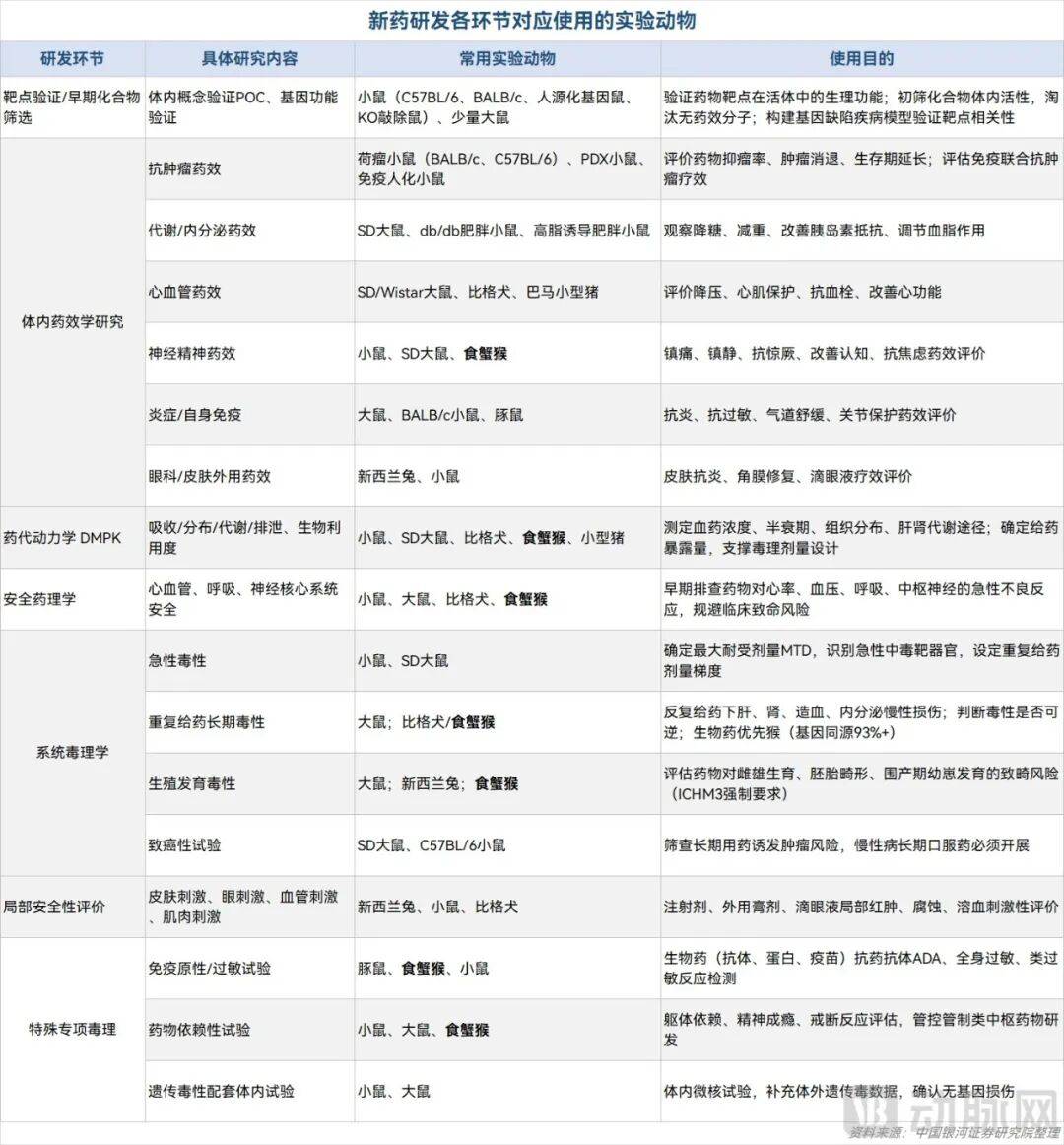
On the demand side, the prosperity of innovative drug research and development has rebounded. The National Development and Reform Commission disclosed on November 3 that in the first three quarters of this year, the amount of foreign technology licensing (BD overseas) of my country’s innovative drugs was approximately US$130 billion, which was close to the level of the whole of last year. Financing and licensing transactions continue to pick up, directly igniting the R&D pipeline of pharmaceutical companies, and also igniting the demand for “living reagents” at the top of the industry chain – from university scientific research institutions to innovative pharmaceutical companies to CROs. Experimental monkeys run through the entire process of target verification, drug efficacy screening to toxicological safety evaluation, and are an unavoidable necessity for preclinical research and development.
Experimental monkeys required for clinical trials of new drugs must be standardized and artificially bred by units holding an “Experimental Animal Production License” and “Experimental Animal Use License”. They require complete genetic pedigrees, controlled microbial indicators, and animal welfare ethics review. Wild-captured primates are strictly prohibited from entering the experimental animal market. Therefore, although there are many monkeys in Mount Emei, it cannot alleviate the domestic shortage of experimental monkeys.
A further push comes from changes in drug structure. The genetic homology between experimental monkeys and humans is as high as 90%-98%, making them an irreplaceable species for toxicology and immunogenicity evaluation of macromolecule drugs such as monoclonal antibodies, ADCs (antibody drug conjugates), and oligonucleotides. Large molecules and complex molecules account for a rapid increase in this round of innovative drug recovery, and the consumption of monkeys by a single project of these molecules is much higher than that of small molecules.
On the supply side, we are stuck in a link that no one can fast forward: the monkey’s growth cycle.
According to research data from Galaxy Securities, cynomolgus monkeys take an average of 4 years to reach sexual maturity, and the gestation period and lactation period each take half a year. After birth, the monkeys usually have to be raised to 2-3 years old before they can be used in experiments. In other words, it takes 6 to 7 years from a weaned baby monkey (6 months old) to “produce” the next generation of commercial monkeys for experiments.
More thorny is the problem of population structure. Young monkeys with the highest breeding value mainly rely on foreign imports. In the past few years, the industry’s population has continued to age and new production capacity has been limited.
As a result, the market presents a contradictory state: extremely high prices, very few transactions, and there is a price but no market.
“It’s a seller’s market now, not a buyer’s market.” A practitioner described it vividly, “It’s the buyers who take the money and look for monkeys all over the world.”
Is the price increase caused by CRO’s stockpiling?
So, is this round of price increases caused by CRO’s “monkey hoarding”?
This is not unfounded. There is indeed a view in the market that the shortage of domestic experimental monkeys is related to the large-scale acquisition of monkey farms by the head CRO in the past few years, resulting in excessive concentration of monkey sources. When monkeys are taken into CRO’s own farms, there will naturally be fewer monkeys that can circulate freely on the market.
Judging from the actions, “Hoarding Monkey” is indeed a well-known brand in the industry. Experimental monkeys are the core strategic assets of CROs. Under the dual pressure of strong demand and declining supply, acquiring breeding farms has become the most direct way to lock upstream supply: WuXi AppTec successively acquired Guangzhou Chunsheng, Guangxi Fangchengang Changchun, and Hainan Primate; Taicang Zhaoyan acquired Yunnan Yingmao and Guangxi Weimei; Pharmaron acquired Zhongke Lingrui (now renamed Ankai Yibo) and Zhaoqing Chuangyao; Jiangsu Dingtai acquired Kunming Yaling.
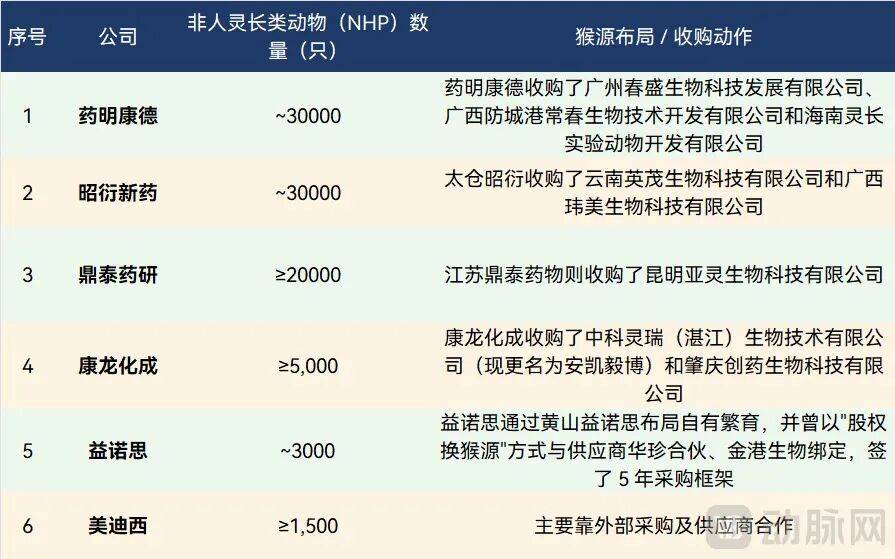
Data source: Dingtai Pharmaceutical Research prospectus, Yinuosi prospectus, public information
After intensive acquisition of monkey farms, domestic CROs have basically mastered more than one-third of the domestic experimental monkey population. At the end of 2024, there were approximately 219,000 to 220,000 experimental monkeys in the country. There were 32,000 new monkey babies born that year, and the actual supply for slaughter was only about 30,000. According to statistics from Arterial Network, there will be approximately 90,000 NHPs in domestic CRO stock in 2025.
However, in the eyes of industry insiders, “monkey hoarding” and “monopoly raising prices” are two different things. There are two reasons: first, the overall supply of domestic experimental monkeys is in short supply, and the monkeys stocked by CRO are mainly used to digest their own orders, rather than hoarding them and selling them at a price; second, the supply channels are diversified, and the import channels are being liberalized, so no company can truly lock in the market price. The fundamental reason for the price increase is still the imbalance between supply and demand.
The channel for imported experimental monkeys is gradually being widened. According to the Hebei Provincial Forestry and Grassland Bureau’s reply to Recommendation No. 1088 of the Fourth Session of the 14th People’s Congress of Hebei Province, since 2023, the General Administration of Customs has actively promoted the admission of foreign experimental monkeys to China, and has facilitated the admission of artificially bred monkeys from Cambodia, Laos, Vietnam and other countries.
According to the query data of the General Administration of Customs of China, the commodity code is 0106111000. In 2025, 9198 improved breeding primates were imported from Cambodia and 1338 improved breeding primates were imported from Vietnam. The import channel can effectively supplement the domestic supply of experimental monkeys.
But the import channel does not mean that there is water just by turning on the faucet. In addition to CITES quotas (the quota limit for primate trade under the Convention on International Trade in Endangered Species of Wild Fauna and Flora), the actual scale of imports is also subject to two major bottlenecks: First, the scarcity of overseas compliant breeding farms – experimental monkeys must meet strict experimental standards, find overseas suppliers that meet the standards and establish stable cooperation, which is a prerequisite for import; second, domestic isolation field resources are tight – the number of isolation fields that meet the new standards is limited, monkeys must queue up for isolation as soon as they enter the country, and the hardware blocks the upper limit of customs clearance.
CRO hoarding monkeys has objectively narrowed the source of monkeys that can be freely circulated. Factors such as the layered price increases by middlemen in import channels have certainly contributed to pushing up the price of experimental monkeys, but these two factors are not enough to monopolize the market. What really determines the tight supply of experimental monkeys is the deep-seated contradiction in the supply and demand structure: on the one hand, the continued expansion of innovative drug research and development has brought about rising demand; on the other hand, the breeding cycle of experimental monkeys is too long, making it difficult for supply to respond quickly, thus locking the upper limit of supply.
How long can this round of price increases last?
As for the price peak that the market is most concerned about, the predictions of industry insiders are relatively consistent: the price of this round of experimental monkeys has approached the top, and the top range may be between 350,000 and 400,000 yuan per animal. The shortage of lab monkeys may ease in the next two to three years.
The first major logic supporting this judgment is that it takes two to three years to breed monkeys after introducing them. This wave of price increases has led domestic monkey farms to increase the introduction of breeding monkeys. When this wave of breeding monkeys matures, the market will turn to a buyer’s market in the future.
Arterial Network also learned that the domestic head CRO will introduce a batch of breeding monkeys of suitable age for fertility in early 2026. Based on the breeding cycle, it is expected that this batch will bring about a significant increase in slaughter volume in two or three years. At the same time, the number of self-propagated experimental monkeys in the industry has maintained a slow but steady climb in recent years.
The second logic is that with the liberalization of the import policy for non-human primate experimental animals, the supply will become more diversified. Data from the General Administration of Customs shows that Cambodia and Vietnam are the two main source countries for domestic experimental monkey imports, with Cambodia occupying a dominant position and Vietnam’s import volume also continues to increase.
These two countries are also the core producing areas of global experimental monkeys. Therefore, what domestic buyers face is not regional competition, but “monkey grabbing” with global giants. In January 2026, the global CRO leader Charles River Laboratories (Charles River) announced the acquisition of a Cambodian non-human primate supplier for US$510 million, which was a landmark event in this battle for resources. When giants choose to directly lock upstream production capacity through mergers and acquisitions, the bargaining space at the channel end will be further squeezed.
Faced with crowded traditional channels, domestic CRO companies have begun to try to “detour” and explore countries such as Indonesia and Laos that have abundant monkey sources but lack smooth import channels. This is both an opportunity and a risk: new channels mean lower procurement costs and fewer competitors, but each link requires time and capital investment in the docking of quarantine standards, fluctuations in exporting country policies, and the establishment of transportation and isolation systems.
Related Reading
- Anthropic engineer’s warning about Claude Code explains why tech outages could get much worse2026-11-22
- Original Unexpectedly, just one day after the APEC summit, China became famous around the world because of its three “specialties”2026-11-21
- Original Anthropic goes public and creates wealth: 96% of employees became millionaires overnight2026-11-20
- The beauties and handsome guys from UB.com want to enter your home and wait until they arrive.2026-11-20
- Original: Tencent’s shareholders will suffer again2026-11-20