From the time he published a letter admitting his cheating on November 9 to his official resignation on November 12, the “Godfather of AI” Huang Renxun suddenly collapsed, causing public outcry and panic in the capital market. The highlight of Huang Renxun’s “house collapse” is not a frivolous matter of personal ethics, nor a political conspiracy theory, but the darkest moment of the global AI technology industry.

Chinese people like to talk about politics. After Huang Renxun’s “accident”, the most concerned thing among domestic public opinion was politics.
The first is the identity politics of Lao Huang’s Chinese identity. Nationalist narratives such as “Chinese are being liquidated” earn traffic through their own pathos;
The second is the geopolitical factors of US chip export controls.
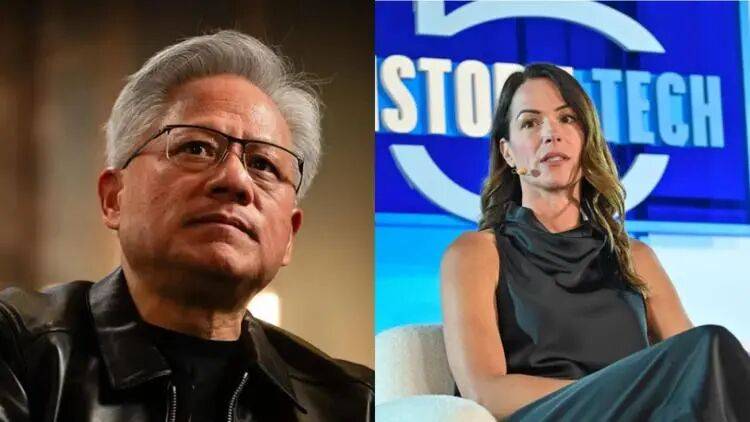
The first thing to note is that Huang Renxun’s accident has nothing to do with ethnic identity politics. Huang Jen-Hsun was born in Tainan City, Taiwan Province, China. Compared with mainland Chinese, Taiwanese Chinese are more integrated into American society. Moreover, Lao Huang went to the United States when he was 9 years old and spent most of his life in the United States. He has a high degree of “naturalization”, which can be seen from his image in a leather jacket. What’s more, Americans have long been accustomed to the high proportion of immigrants and ethnic minorities in the IT technology industry, and have little sense of ethnic identity. Therefore, since Lao Huang’s accident, the political and business circles and mainstream public opinion in the United States have rarely mentioned his Chinese identity. Even in the list of Nvidia successors after Lao Huang resigned, the head of AMD蘇姿豐Still a popular choice. Ms. Su is not only a Chinese-American born in Tainan, but also a distant relative of Huang Jen-Hsun. If the ethnic identity of the head of Nvidia is sensitive, who will get this “niece”? Therefore, when talking about politics, we should talk about it carefully and seek truth from facts, and don’t add nonsense to the “nationalist narrative” that is not there.
As for the political factors of the US chip control policy, this is indeed the case, and the impact is indeed not small. But it should not be over-exaggerated. Even if there is no policy red line for chip control, Lao Huang’s “derailment scandal” is enough for him to drink.
Lao Huang’s cheating is not as simple as a loss of personal ethics. The regulation of the “private ethics” of executives by U.S. listed companies is not a simple moral judgment, but a strict corporate governance and supervision system, the core of which is the conflict of interest rules.Executives’ lack of personal ethics and causing losses to the company’s shareholders and other stakeholders is a taboo for U.S. listed companies.
Take NVIDIA as an example. As an established technology listed company, NVIDIA’s equity is highly dispersed. Any disturbance at the equity level may cause an earthquake in the company’s operations.Huang Renxun is the largest individual shareholder, directly and indirectly holding 3.58% of Nvidia’s shares. Two major institutional shareholdersbelgradeand Pioneer Linghang’s shareholdings are just over 7%.Therefore, even though Lao Huang’s personal shareholding ratio is not high, he holds a key bargaining chip for Nvidia’s dominance. If Lao Huang’s marriage breaks down due to his affair and his equity is divided, Nvidia is likely to fall into a turbulent period of struggle for dominance. Therefore, Lao Huang’s derailment was not a purely private matter, but a public matter that affected the governance of listed companies and endangered the interests of investors.
What’s even more serious is that Huang’s cheating partners were not just “friends” but also cheated on him by his subordinates. This directly steps on the “conflict of interest” red line of corporate governance rules, and there are a lot of fatal cases, all of which are big names, such as McDonald’s CEO Steve Easterbrook in 2019, Intel CEO Krzanich in 2018, HP CEO Mark Hurd in 2010, Boeing CEO Harry Stonesey in 2005…
Therefore, after the cheating was exposed, Huang publicly apologized for “standing up and being beaten.” The NVIDIA board of directors launched an independent investigation but did not let Huang go. On November 12, after the New York Times discovered that Huang was “eating on the sidelines”, the situation took a turn for the worse. Huang had no choice but to announce his resignation, which was quickly accepted by the board of directors. This is what is generally recognized by the U.S. technology and financial circles as the “last straw that breaks the camel’s back,” rather than suspicions of espionage or political factors that “endanger national security.” That is to say,Even if there is no red line involving chip export control, it will be difficult for Lao Huang to escape this wave of “differences between internal and external” upgrades.
Touching the political red line of chip export control was not the direct reason for Lao Huang’s resignation, or even the main factor. However, the resulting compliance risks do make investors uneasy. Unlike Chinese investors, most U.S. investors do not care about the grand narrative of “China-U.S. technology competition.” Instead, they are worried that Nvidia deliberately “de-Sino-izes” its performance statements and conceals its performance share of its Chinese business in order to circumvent export controls. This year Nvidia disclosed revenue from China (including Hong Kong) of approximately US$19.68 billion, accounting for 9.11% of total revenue from 26.4% in fiscal year 2022. However, short-selling agency Culper Research pointed out in a report in May 2026 that in fact, more than 20% of computing power revenue in fiscal year 2026 will be driven by Chinese demand. It is accused of hiding the true supply to China through statistical methods such as Singapore business.
“Coincidentally”, Nvidia suddenly canceled the separate column of “Singapore” business in the second half of 2025 and revised the statistical caliber, which coincided with the investigation by the U.S. Department of Commerce. Megaspeed Chip smuggling overlaps.The target of Lao Huang’s cheating this time was Huang Le, a senior executive of Megaspeed.
Investors don’t care about the “China-U.S. tech hegemony”; they only care about whether Nvidia has made false disclosures or falsified financial reports. This is the reason why investors are dissatisfied with Huang Renxun’s “derailment scandal”. On November 10, 2026, Nvidia shareholders filed a class action lawsuit in a California court, clearly accusing the company and Huang of “misleading investors regarding national security and export compliance risks, as well as true business exposures.”
However, so far, no regulatory agency has made formal accusations of “financial fraud” or “disclosure of accounting errors” against Nvidia. In the U.S. regulatory system, the “grey area” of legal avoidance has long existed, providing an important buffer layer for Sino-U.S. AI technology cooperation.No matter how Huang Renxun’s “derailment” ends, this buffer layer is in danger and will severely damage the development prospects of global AI technology.

Huang’s departure will have a fatal negative impact on Nvidia. Nvidia’s corporate governance structure is extremely flat, with no “number two” at all. About 60 senior executives report directly to him. Employees across the company send him emails every day reporting the “five most important things,” which is the famous “Top 5 email.” The highly flat company structure is extremely efficient, but it is highly dependent on Huang Renxun’s micro-management. Lao Huang is a famous “sleepless machine”. No matter what time in the morning he receives an email, he will reply with instructions instantly. Therefore, Lao Huang suddenly collapsed. Nvidia did not lose a CEO, but had its CPU dismantled.
What’s ridiculous is that some market commentators have optimistic fantasies about Nvidia’s heavy setbacks, claiming that AI chip market share and pricing power will be redistributed. As everyone knows, NVIDIA is not only a leading company that occupies a dominant position in the market, but also the fulcrum that supports half of the U.S. AI industry. Important customers such as OpenAI and CoreWeave funded by Nvidia through equity investments or guaranteed loans will be affected. The resulting technological stagnation and computing power supply gap are amplified through the financial system, forming a “chain of damage” affecting the industry. This cannot be compensated by the “benefit chain” of rising stock prices of several competing companies.
The biggest loss is that hawkish politicians have taken advantage of the situation and used “national security” as an excuse to tighten intervention policies such as export chip controls, creating greater resistance to Sino-US AI technology cooperation.
Huang Renxun is recognized as a “dove” on China within the White House circle. He has long been committed to promoting Sino-US scientific and technological cooperation and lobbying against the tightening of chip export controls. Lao Huang’s “pro-China” is not an emotional preference due to Chinese identity, but a dual consideration of business interests and the development prospects of the AI industry.
The commercial interests are easy to understand. China’s AI industry is developing rapidly and has huge demand for computing power. It is an important market that Nvidia attaches great importance to. Huang Renxun has never been shy about the consequences of losing the Chinese market through control and blockade. He bluntly pointed out that “blocking China is neither wise nor feasible.” It will “force China to speed up independent research and development, and ultimately cause American companies to lose the Chinese market.”
However, just because of immediate commercial interests, Lao Huang does not need to take risks and touch the control red line. With NVIDIA’s gross profit margin of 75%, market share of more than 80%, and rapid demand growth, it can produce a “pentagonal” financial report for a year or two, so there is no need to take risks. Colette Kress, the chief financial officer who is currently the interim CEO of Nvidia, is a conservative who opposes the “radical line”. As CFO, her “conservatism” is understandable. However, as an industry leader, Huang Renxun has a far-reaching vision.He saw the indispensable Chinese factors for the AI technology industry—power and talent.
In Huang Renxun’s “five-layer cake” theory of the AI technology industry, energy is the “first principle”, and its importance is even higher than computing power chips. Huang Renxun has publicly stated many times that electricity is the ultimate bottleneck in AI computing power competition, and China has significant advantages in power scale and cost, which are enough to make up for the disadvantages of chip technology. China’s total electricity capacity is about twice that of the United States, and electricity prices are so cheap that they are “almost free.” Moreover, the approval efficiency of China’s power infrastructure is high, and there are a large number of technical personnel to support it.
In contrast, in the United States, the power system is outdated and a large number of new infrastructure projects are needed to support AI. However, political interference is huge, making it difficult to improve power supply. In the just-concluded midterm elections, many Democratic gubernatorial candidates played the “AI power card”.On the one hand, it exaggerates the contradiction between data centers and local residents competing for power, on the other hand, it imposes many restrictions on power infrastructure, such as labor policies and environmental protection.The political scene in Texas has “changed”. The new Democratic governor has not yet officially taken over. He hastily stopped the SPACEX data center project that his predecessor was trying to promote. One of the main reasons is electricity. In the context of intensified political conflicts between the two parties, it is clear that American AI technology companies cannot count on the rapid growth of computing power to obtain local power supply in a timely manner. Once it enters the power bottleneck period, no matter how good the chip performance is, AI will not be able to run.
In addition to electricity, the Chinese factor that Lao Huang values is the AI talent pool. He repeatedly mentioned that “50% of the world’s AI researchers are Chinese”, believing that this is the core confidence of China’s AI industry, and even said that if “China and the United States decouple”, “half of the world’s AI talents will be lost.”
Compared with many colleagues whose “butt determines their head” and who only look at whether there is business in China, Lao Huang focuses more on determining the future of AI technology development and pays more attention to the basic elements that limit the ceiling of technological development. After all, he is a leader who stands at the top of the industry. He is far-sighted and has seen a different landscape and the importance of Sino-US AI technology industry cooperation. Therefore, he did not hesitate to get involved personally and publicly criticized the US chip export control policy.
What is regrettable is that Lao Huang “capsized in the gutter” and created an excellent counterattack opportunity for his opponent. The background of the cheating partner and the so-called “endangerment of national security” will not only put Huang Renxun under tremendous pressure, but also make his previous policy mediation achievements come to naught. If the United States, with its favorable conditions for innovation and solid technology accumulation, is the locomotive of the global AI industry, then China, with its ample power supply, huge talent pool and huge application market potential, is the railroad track.Only through close cooperation between Chinese and American technology companies can the global AI technology industry run fast and steadily. On the contrary, once this Sino-US cooperation train derails, the global AI technology industry will take a long detour.This scene will become a negative example in future economics textbooks of geopolitical disputes interfering with technological progress and administrative intervention slowing down industrial development.
Needless to say, Lao Huang really caused a disaster this time. He himself called himself a scumbag and regretted it extremely. He paid a heavy price for his careless “private ethics”, and he blamed himself and others.However, due to the chip control policy, Lao Huang had to take desperate risks in the “gray area”. It was the helplessness of political interference that “forced girls into prostitution”, and it was not Lao Huang’s fault.
Related Reading
- Anthropic engineer’s warning about Claude Code explains why tech outages could get much worse2026-11-22
- Original Unexpectedly, just one day after the APEC summit, China became famous around the world because of its three “specialties”2026-11-21
- Original Anthropic goes public and creates wealth: 96% of employees became millionaires overnight2026-11-20
- The beauties and handsome guys from UB.com want to enter your home and wait until they arrive.2026-11-20
- Original: Tencent’s shareholders will suffer again2026-11-20