This winter is a bit long!
At the end of October, Ingolstadt, Munich and Stuttgart handed over their report cards for the third quarter of 2026 almost in the same week.
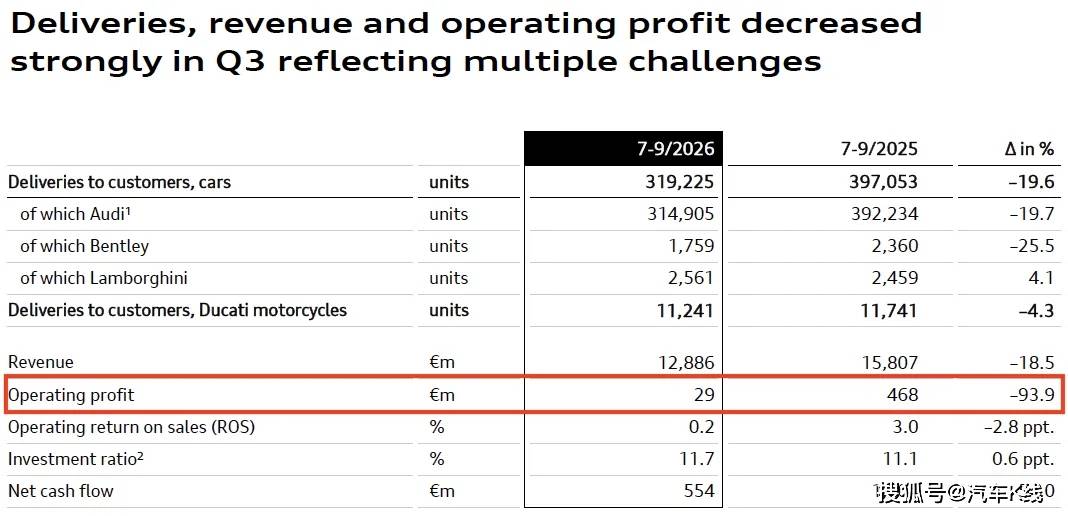
Audi’s quarterly operating profit was only 29 million euros, almost gliding close to the profit and loss line; Mercedes-Benz’s group profit before interest and tax (EBIT) increased by 136% year-on-year, but after adjusting items are separated, the adjusted EBIT of the core automobile business was cut by more than half.
Although BMW’s delivery decline was the smallest among the three, it lowered its full-year automotive business EBIT profit margin guidance to a range of -0.5% to 0.5%. A global luxury car giant has begun to accept that it may not make money in the next year.
However, “Auto K Line” believes that among Mercedes-Benz, BMW and Audi, who earns less and who has suffered a more serious decline. These figures are of course important, but what is really worthy of attention in the third quarter report is that there are three pressures falling on BBA at the same time –The old model in the Chinese market is unsustainable. U.S. tariffs have forced the rearrangement of production capacity and costs. Electric competition has shifted from parameters to product definition rights and iterative efficiency.。
01
For the three BBA companies, the most consistent signal in the three quarterly reports comes from the Chinese market.
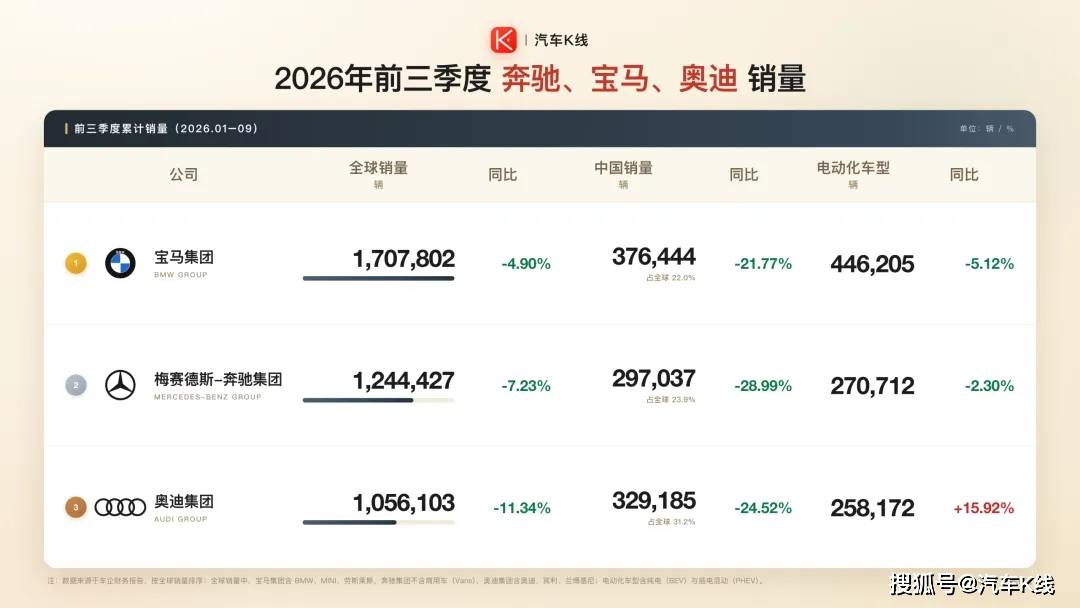
Audi delivered 329,200 units (including Bentley and Lamborghini) in China in the first three quarters, a year-on-year decrease of 24.52%; during the same period, BMW China delivered 376,400 units (including MINI and Rolls-Royce), a year-on-year decrease of 21.77%; Mercedes-Benz passenger cars sold 297,000 units in China in the first three quarters, a decrease of 28.99%.
The contraction of sales volume in the Chinese market is directly transmitted to the profit side.The financial income of Audi’s China business fell to 38 million euros (approximately RMB 280 million) from 386 million euros in the same period last year.
The profit shared by the Mercedes-Benz Group based on the equity method from the joint venture Beijing Benz has turned from a profit of 602 million euros in the same period last year to a loss of 408 million euros (approximately RMB 3.01 billion). In addition, an impairment of 747 million euros (approximately RMB 5.51 billion) was made for the Chinese joint venture business.
The BMW Group did not separately disclose the Chinese market revenue in its financial report, but China is no longer a stable profit pool. The overall data of the three companies has already illustrated the problem.
Audi Group’s revenue in the first three quarters was 42.063 billion euros (approximately RMB 310.31 billion), a year-on-year decrease of 13.06%; operating profit fell 26.05% to 1.15 billion euros (approximately RMB 8.49 billion), with an operating profit margin of 2.7%; of which,The operating profit in the third quarter was only 29 million euros (approximately RMB 210 million), and the operating profit margin was only 0.2%.。
BMW Group’s revenue in the first three quarters was 92.718 billion euros (approximately RMB 684.12 billion), a year-on-year decrease of 7.28%;The EBIT of the automotive business was 2.875 billion euros (approximately RMB 21.21 billion), a decrease of 43.8%, and the EBIT profit margin was 3.5%.。
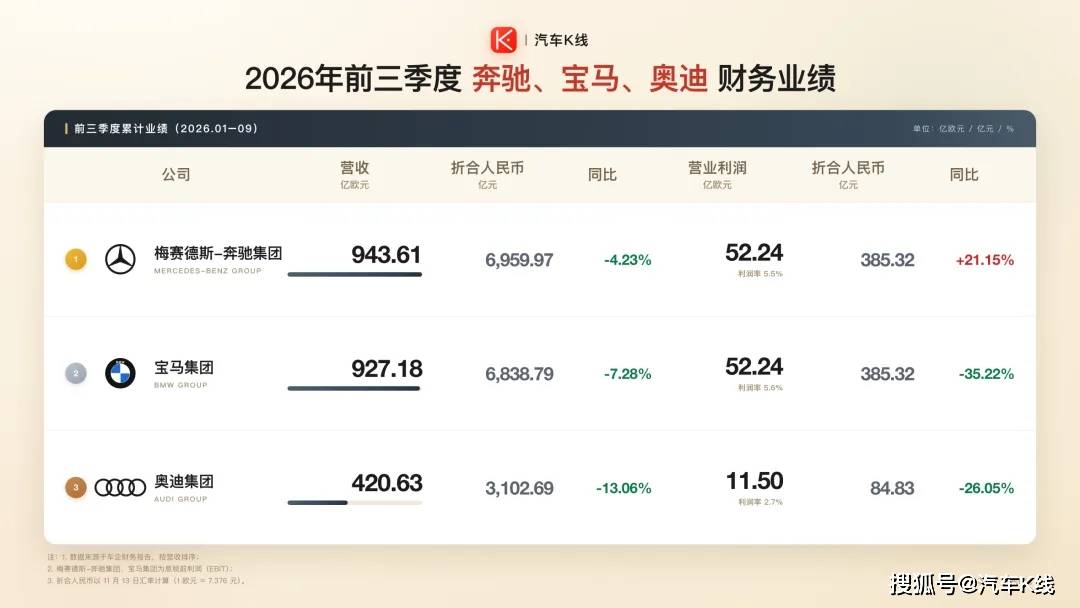
Mercedes-Benz Group’s revenue was 94.361 billion euros, a year-on-year decrease of 4.23%; the group’s EBIT was 5.224 billion euros (approximately RMB 38.51 billion), a year-on-year increase of 21.2%, butThe adjusted EBIT of Mercedes-Benz Passenger Cars in the first three quarters was 2.402 billion euros (approximately RMB 17.72 billion), a decrease of 42%, and the adjusted sales profit margin was 3.5%; in the third quarter, the adjusted EBIT fell by 51%.。
“Auto K-Line” discovered through financial reports,Although the Chinese market has seriously dragged down the performance of the top three German luxury cars, their overall profit shrinkage has also been compounded by US tariffs, electrification investment and restructuring costs.
02
BMW clearly wrote in its third quarter report that additional tariffs would reduce its automotive business EBIT margin by approximately 1.25 percentage points in the third quarter and the first three quarters; Mercedes-Benz would face an estimated annual cost of 1.3 billion euros under higher tariffs.
Audi is in the most passive situation. Since it does not have a vehicle factory in the United States, import tariffs directly penetrate into the income statement. Net profit in the third quarter plummeted to only 95 million euros (approximately RMB 700 million). The core brand is close to losses, and it was forced to lower its full-year profit forecast for the second time, with operating profit margin guidance falling to 3% to 5%.
The importance of tariffs on BBA varies. The biggest difference in the response of the three companies comes from their production capacity base in the United States.
BMW relies on its Spartanburg plant in South Carolina. About half of its models sold in the United States are not affected by high import tariffs. U.S. deliveries still achieved a 2.5% growth in the third quarter.
Mercedes-Benz plans to invest an additional US$4 billion in the Alabama plant by 2030 and transfer part of the Mercedes-Benz GLC production capacity to the United States.
Audi has chosen a more direct exchange path, investing US$4 billion to build a new vehicle factory in Georgia, in order to win the United States to reduce its imported vehicle tariffs from 15% to about 10%.
It takes years for new or expanded capacity to generate actual output, but the erosion of tariffs on current statements is immediate.
According to “Auto K-Line”,Audi is essentially paying for its third-quarter profit pain as a ticket to stay in the U.S. market. The existing factories of BMW and Mercedes-Benz provide buffers, but buffers do not equal exemptions. Tariffs are still a stone that weighs on the profit margins of the automobile business, but the size is different.
—Extended reading—
BBA is falling into a rare depression
Profits increased 40 times! Why Porsche?
03
In addition to external costs, the competition rules on the product side are also changing.
Globally, the electrification ratio of BBA is indeed increasing. Adding up the data from the three financial reports, in the first three quarters of this year, the total electric vehicles (including plug-in hybrids) of Audi, BMW and Mercedes-Benz passenger cars accounted for approximately 24.3%, of which pure electric vehicles accounted for approximately 15.6%, which were 1.9 and 1.6 percentage points higher than the same period last year respectively.
However, the gap in profitability is also obvious. The profit margin of electric vehicles is generally lower than that of fuel vehicles. Mercedes-Benz also admitted that the gap is particularly prominent in large-battery models. As the proportion of electrification increases, the real test of BBA’s product definition capabilities is naturally the Chinese market.
“Auto K Line” believes that,In the past, BBA’s electrification stalled. The core was the “global R&D, China adaptation” strategy, which resulted in products being out of touch in terms of intelligence and iteration speed. The way the three companies are now correcting this problem just shows that the right to define products is shifting to China.
The Audi Innovation Technology Center (AITC), a joint venture between Audi and SAIC Motor, has been established in Shanghai and is positioned as an independently operated R&D entity rather than a traditional foreign-funded R&D center.
Currently, AUDI brand models are equipped with the smart driving solution of Chinese technology company Momenta, and the development and iteration of subsequent models are also led by the Chinese team.
For BMW’s new generation models in China, nearly 70% of the source code for the smart cockpit is written by the Chinese team. Mercedes-Benz has upgraded its Shanghai R&D center to the world’s largest overseas digital hub. The new generation S-class rear entertainment system is developed by a Chinese team and plans to export it globally.
These actions point to the same change –China is no longer just a sales market, but the source of BBA’s intelligent capabilities and product definition capabilities.
04
But in the eyes of “Auto K-Line”, the differentiation on the market side is equally clear.
BMW’s new-generation iX3, which is about to be officially launched, has solved the psychological barriers on the demand side with its sincerity in pricing and configuration. The real test has shifted to the ramp-up of production capacity at BMW Brilliance’s Shenyang plant and the consistency of quality control of the first batch of vehicles.
Audi uses AITC and Momenta to make up for the shortcomings of smart driving. The smart driving capabilities of the AUDI brand proven in China have entered the technical system of Audi’s global models through the Audi Q9. The path of Chinese technology feeding back global products has been initially verified commercially.
Mercedes-Benz’s product definition is not lagging behind, but the delay in the delivery of pure electric GLC this year exposed the supply chain and production capacity rhythm that may cause Mercedes-Benz to miss the best window to build initial momentum in the fiercely competitive Chinese market.
Therefore, “Auto K-Line” believes that the Chinese market is not only the biggest drag on BBA’s current profits, but also becoming the source of their intelligent capabilities.But the problem is that capacity building takes time, but profit shrinkage is immediate. This time difference is the most direct pressure in the third quarter report.。
05
In addition to the three pressures, there is another point in BBA’s third quarter report that should not be ignored, that is, all three companies are using internal adjustments to gain time for transformation.
Mercedes-Benz is advancing the German productivity offensive and voluntary severance plan, aiming to achieve annual normalized cost savings of about 5 billion euros by the end of 2027. However, as of April this year, only about 5,500 employees have resigned through the compensation package, and the progress is far below management expectations.
BMW plans to cut about 8,000 white-collar jobs by the end of 2027 and save about 1 billion euros annually from 2028. The timetable is relatively clear.
Audi plans to lay off up to 7,500 employees in Germany by the end of 2029, saving more than 1 billion euros per year in the medium term. At the same time, it announced that it will invest approximately 8 billion euros to upgrade its two major bases in Ingolstadt and Neckarsulm. Staff shrinkage will be parallel to core investments.
At the same time, asset disposals are also accelerating. Mercedes-Benz sold Athlon Group, part of Daimler Trucks and Germany’s Own Retail business, while Audi divested a majority stake in Italdesign. These actions have provided cash flow for the electrification transformation.
06
Looking back at BBA’s third quarterly report at this time, it is almost a transformation schedule with obvious differences.
BMW’s comparative advantage lies in the fact that the old model has less trauma, the delivery decline is the smallest, the growth in the European and US markets is a hedge, and the new generation product cycle and electrification momentum are the clearest among the three.
However, automobile free cash flow fell by 73% year-on-year, and the full-year automobile EBIT profit margin guidance is already between profit and loss, indicating thatEarnings bottom line continues to be squeezed by tariffs, Chinese pricing pressure and restructuring costs。
JPMorgan Chase and Deutsche Bank both lowered their target prices for BMW after the earnings report, but maintained their “overweight” and “buy” ratings.
Mercedes-Benz’s financial report is the one that requires the most careful analysis among the three. The growth of the group’s EBIT and net profit came from the support of special items, asset disposal income, and light commercial vehicles and financial sectors. The adjusted EBIT of the core passenger vehicle business was halved in the third quarter.Industrial free cash flow in the third quarter was only 172 million euros (approximately RMB 1.27 billion), a year-on-year shrinkage of 87%。
JPMorgan Chase maintained its “overweight” rating but set the target price at 70 euros, while Deutsche Bank lowered its fair value to 48 euros. The differences among institutions just illustrate that when profits and cash flow quality are out of touch, the capital market cannot form a consensus on its transformation expectations.
Audi’s financial performance is the most severe, but its transformation actions are also the most thorough.
AITC’s independent entity structure, the AUDI brand’s independent product definition away from the four-ring standard, Momenta’s smart driving solution entering global flagship models, and the use of U.S. factory investment in exchange for tariff reductions are all exchanging the future in the most painful way at the moment.
The operating profit approaching zero in the third quarter is a manifestation of the profit pool of the old model shrinking to the limit, while net cash flow bucked the trend and increased by 15.7% to 2.439 billion euros, indicating that Audi still retains its ability to fund transformation.
Views of AutosKline:
The third quarterly report is like a mid-term exam on the way to BBA’s transformation. Faced with three pressures, the three companies chose different paths, and the prices they paid and the progress they received were also different.
Porsche, which is in a similar situation, has judged that 2027 may be worse. For BBA, the global capital market will continue to wait and see whether a real recovery in financial performance can be achieved in 2027 or even 2028. But by then, it is also worth looking forward to whether the codes developed in China and the models defined in China can truly enter the global product series.
Related Reading
- Nvidia stock extends $2.7 trillion rout as SEC probe reportedly investigates its accounting2026-11-22
- Original: Three brothers from Hebei started with just 200 yuan and became number one in the world2026-11-21
- Global computing power enters the “post-Huang Renxun era”2026-11-21
- Stock market today: Dow, S&P 500, Nasdaq sink as Anthropic IPO fails to ease AI worries2026-11-21
- Anthropic is on the market, and the big model bubble is not far away2026-11-20