Source | Bohu Finance (bohuFN)
Author | Qin Sanqian
Recently, major domestic manufacturers have shifted their focus from personal intelligence to organizational intelligence.
In mid-August, ByteDance renamed Feishu Aily as Doubao Work Partner, and then launched active working capabilities, and cooperated with Feishu 8.0 to reconstruct the underlying system; Tencent then launched WorkBuddy Enterprise Edition and Enterprise WeChat joint suite, using Buddy One to connect the scattered office ecosystem; Robin Li also proposed the concept of “intelligent organization” at Baidu World 2026, and launched the Ci Yuan Institute to measure the authenticity, quality and credibility of enterprise model services.
Various signs indicate that the focus of AI offices is shifting from serving individuals to serving teams and organizations.
Understanding context, calling tools, and delivering results—these Agent capabilities, which were originally considered more at the level of personal productivity, have also entered the organization’s weights and measures.
Among the many product paths, Alibaba’s direction seems a bit outstanding. On the afternoon of November 9, Alibaba Qianwen Office released version 2.0, launching capabilities such as multi-person collaboration, human-machine co-creation, data space, automatic tasks, and three-terminal interconnection.
In the past ten years, Chinese enterprises have relied heavily on IM group chats for daily collaboration. Forming a group is the starting point for almost all cross-departmental businesses. Group robots are also a common form of early office AI entering IM.
But this time, Qianwen Office tried to change its focus and make organizational collaboration revolve around Agent. It supports users to create a collaboration space directly within the client, and then associate multiple DingTalk groups, online documents, AI forms and business materials.
It can be seen that when AI enters real organizations, it does not quickly smooth out the boundaries of existing office software. Instead, it must first rely on the wealth accumulated by Feishu, Qiwei, and DingTalk in the past ten years to rearrange the positions of Agent and IM in the old organizational order.
01 How to run AI in an organization?
“Context is all you need”. More than a month ago, Qianwen Office CEO Chen Yusen gave his core judgment on enterprise-level agents at the Yunqi Conference.
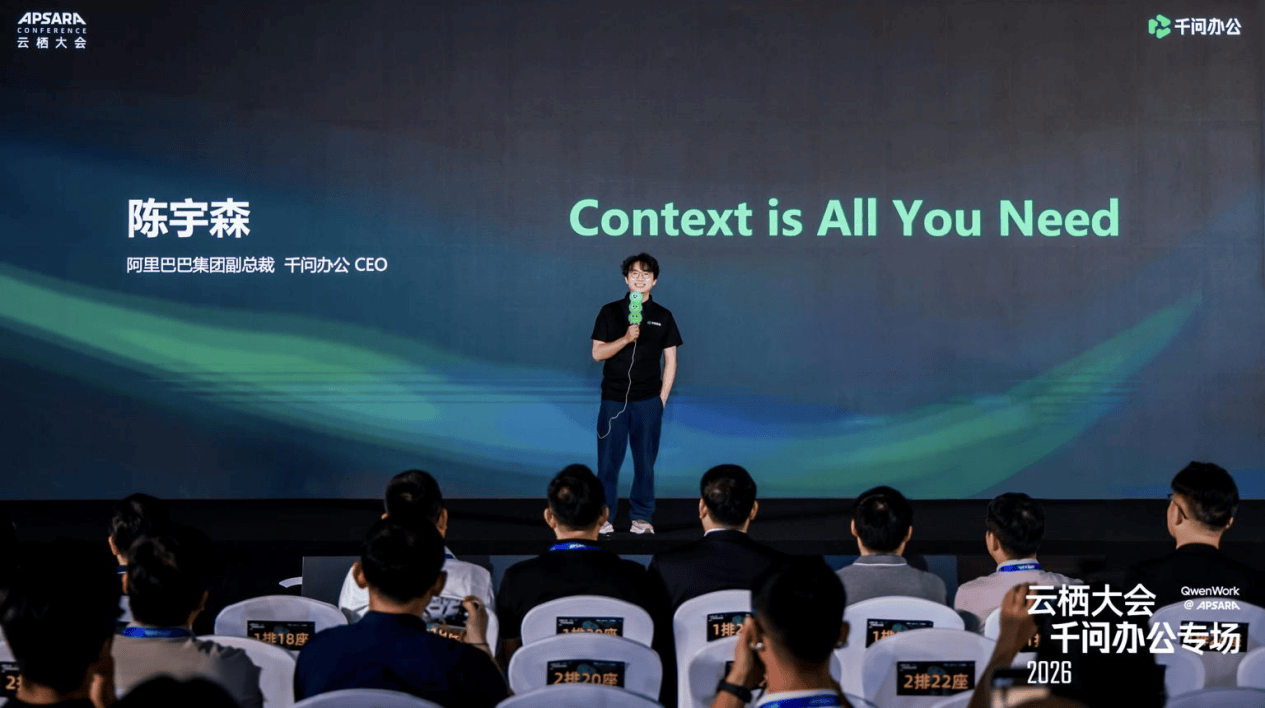
To deliver results at the organizational level, context is the basic condition that determines the availability of agents.
But in a real-running company, business context is never fed to AI out of thin air. In addition to various business systems such as ERP, CRM, and email established in the SaaS era, IM that pops up and scrolls day after day is also one of the important sources of organizational context.
For enterprises, which IM to use often involves long-term organizational investment. The address book structure, approval flow, historical document permissions, and even the communication methods that employees are accustomed to are all deposited on the platform.
Compared with the possibility of piloting a single point tool, the cost for enterprises to directly migrate the underlying IM is much higher. This means that when office agents provide organizational intelligence services, it is the path of least resistance to follow their respective platform endowments accumulated in history.
At present, Byte, Tencent and Alibaba are all reconstructing the relationship between Agent and IM, not only laying out independent workbench or client portal, but also retaining native IM access capabilities.
ByteDance follows Feishu’s knowledge and document density and turns Agents into a type of organizational member in Feishu.
Since its birth, Feishu has emphasized information transparency, cloud document co-creation and multi-dimensional table precipitation, and has gathered a large number of knowledge-intensive teams. Feishu 8.0 reconstructs the data, tools and permissions system around Agent.
Therefore, its office agent product Doubao Work Partner, in addition to having an independent PC client and Doubao entrance, is also specially embedded in Feishu group chat and document scenarios. Its core value is to use existing knowledge, comment records, meeting minutes and schedules within the scope of employees’ authority to advance tasks with the team.
Looking at WorkBuddy, as one of the earliest office agents to come out, its implementation path is to rely on the advantages of multi-application ecology and connection, using independent workbench to connect information scattered everywhere.
WorkBuddy has been positioned as an independent desktop workbench since its launch, supporting access to communication tools such as Qiwei, Feishu, and DingTalk. It also provides two benefits solutions for commercialization: the Buddy One intelligent body suite and the enterprise WeChat joint suite. The typical problem it solves is cross-application calls, bringing together data originally scattered in different software windows and customer communications to complete end-to-end delivery.
Alibaba relies on DingTalk to enter into hierarchical processes, authority and heavy business systems.
In the past ten years, DingTalk’s deepest moat has been in moving the organizational structure, OA approval, attendance and business flow of Chinese companies online. As of early 2026, third-party monitoring shows that its MAU has stabilized at about 200 million.
The need for hierarchical management has always been engraved in DingTalk’s product genes. From DingTalk, which was a strong reminder in the early years, to DingTalk Real, an enterprise-level AI hardware that can “physically cut off power” launched last year, the underlying logic is in compliance with top-down organizational control.
At this year’s Yunqi Conference, Qianwen Office CEO Chen Yusen also expressed a similar idea: “Agent must be implemented in real enterprise scenarios… Each task execution must have boundaries and be traceable.”
Product design is of the same origin, and the answer given by Qianwen Office 2.0 is to give Agents the opportunity to intervene in actual execution across departments and positions.
02 AI in front of the stage, DingTalk behind the scenes
For a long time in the past, employees needed to find the corresponding software entrance to handle their work, and switch back and forth between group chats, emails, documents, meetings, and various business systems.
Agent is changing this set of rules. Natural language dialog boxes become the front desk facing users directly, and business systems retreat behind the scenes and become capabilities.
When enterprise servers sprouted, employees needed to open ERP and CRM separately to process work. Later, these scattered entrances were brought together by IM. Nowadays, Agent also shows signs of swallowing up the previous generation software entrance.
Similar tension also exists in the relationship between Qianwen Office and DingTalk. If a team is already accustomed to communicating and doing things in DingTalk groups, why should they take an extra step and create a new collaboration space in Qianwen Office? Qianwen Office provided the case of Intime Department Store as a sample at the press conference.
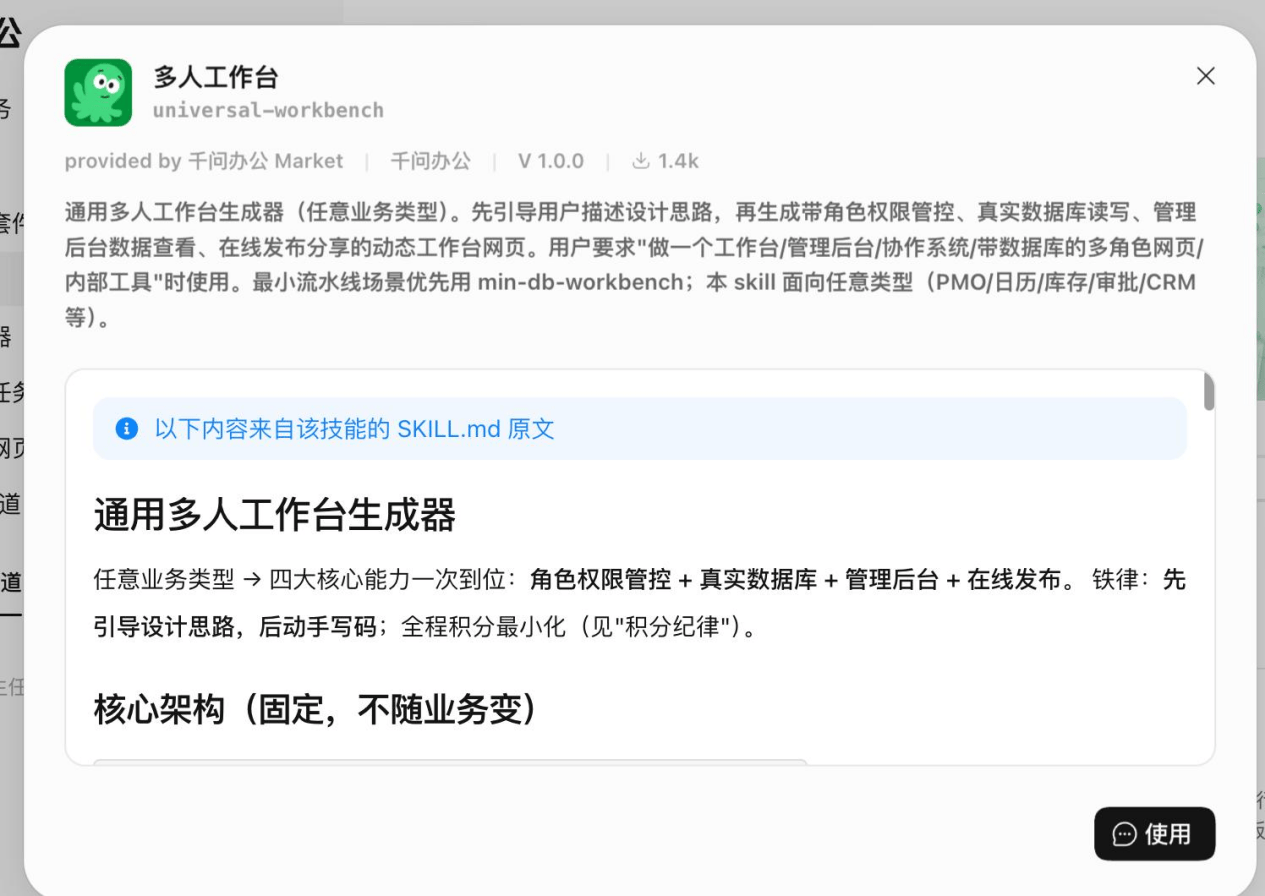
According to the press conference, live broadcast coupons are Intime Department Store’s annual transaction volume exceeding 200 million yuan, covering more than 62 stores and involving more than 200 collaborative personnel. However, the daily communication between organization members is scattered in more than 60 DingTalk groups.
Under the original working method, about 50 pieces of information such as name, price, validity period, applicable stores and materials need to be collected for a group buying coupon from submission to release. Five operations staff have to read messages back and forth between more than 60 groups every day, urge to complete the information, and then manually summarize it into a table.
Group chats are essentially single-column streams of information designed for instant communication. Once the business splits into dozens of groups, AI Q&A in a single group will be difficult to help. Cross-group information verification and progress tracking are the real pain points.
During internal testing, Intime linked these more than 60 store groups and card and coupon AI tables to the collaboration space of Qianwen Office, and the Agent summarized the progress of each group and updated the AI tables.
In order to achieve this cross-group takeover, Qianwen Office uses command line tools and protocols at the bottom level to disassemble DingTalk’s group chat messages, documents, AI audio notes and even Yidai applications into atomic capabilities that can be directly scheduled.
In the past, people worked in DingTalk and easily called AI assistance; Qianwen Office 2.0 attempts to change this to people working in the Agent space to keep an eye on business results, allowing DingTalk to retreat behind the scenes and become a communication channel and database silently called by intelligent agents.
Furthermore, Qianwen Office must not only inherit the understanding of organizational processes accumulated by DingTalk for ten years, but also try to take over the task entrance of high-frequency business from DingTalk.
When Qianwen Office can also create groups, collaboratively edit documents, and manage tasks, will DingTalk be ignored? At present, what Qianwen Office officially gives is not an alternative narrative, but the caliber is relatively vague.
Organizationally, Chen Yusen is responsible for both Qianwen Office and DingTalk; at the product level, two entrances exist at the same time.
Shu Junliang, vice president of Qianwen Office and head of production and research, once said in an interview that traditional office software will not disappear, but will “retreat to a data base and context base, precipitating business processes that are solidified and cannot be generalized.” Old software and AI should be in a coordinated relationship.
In the case of Qianwen Office and DingTalk, he also retained an open mind on the form of the final product. Qianwen Office and DingTalk may eventually become one product, or they may each find their own ecological niche. Everything depends on the development of the times and customer needs.
03 Take the organization as a unit to leverage payment
Whether the Agent is parasitic on IM or is used as an overhead IM, the direction of organizational intelligence is very clear. That is to break the growth ceiling of traditional enterprise software selling seats on a per-person basis, and leverage enterprises to pay for organizational intelligence.
The aforementioned office agents have already explored commercialization on the road of individuals and seats, and the business model is points quota and subscription. However, from the perspective of enterprise procurement, tools that purely serve individual productivity are difficult to leverage organizational budgets.
As for basic AI functions such as group chat summary, meeting minutes and search, they have also evolved into regular capabilities of the collaboration platform. It is difficult for companies to continue to invest heavily just because employees can write weekly reports faster.
Let the individual belong to the individual, and the organizational matter belong to the organization. At present, it seems to be a relatively reasonable solution.
Not long ago, before Qianwen Office launched version 2.0, it teamed up with Taotian and asked Li Jiaqi to sell basic memberships for 1 cent in the first month. For individual users, efficiency improvement does not seem to be a particularly urgent need, and the entire personal productivity market is still in the cognitive stage.
If they want to make a lot of money from their corporate accounts, big companies must come up with another set of scripts.
Doubao Work Partner Enterprise Edition is billed based on annual points; Tencent WorkBuddy Enterprise Edition and the joint enterprise and micro suite introduce team sharing points; Qianwen Office 2.0 also shows a pricing plan that combines seats with a shared points pool.
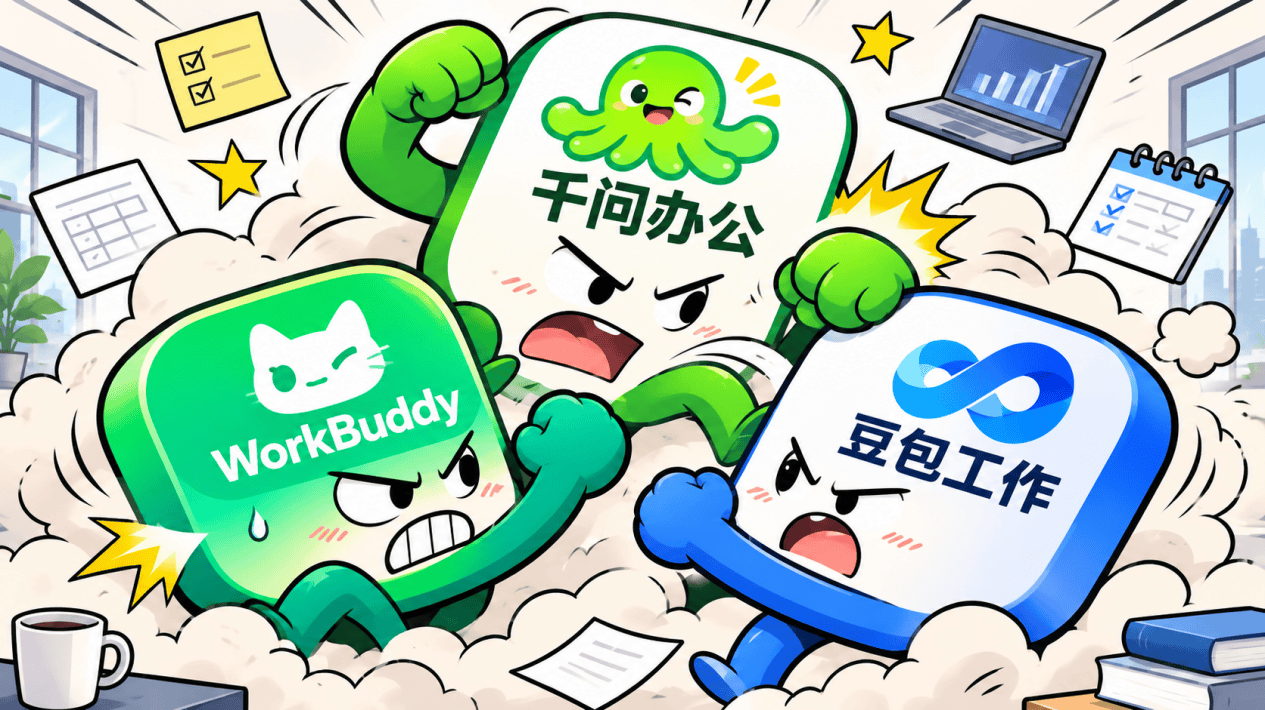
It is not difficult to find that players from all sides are promoting the seat plus shared usage model. In addition to functions, the charging method is also moving closer to enterprise organizations.
In the short term, due to the accumulation of organizational relationships and historical data, the IM fundamentals of Feishu, Qiwei and DingTalk remain stable, and the additional purchases and renewals of existing customers are the primary battlegrounds for each player. However, with the evolution of independent workbench and cross-platform calling capabilities, the corporate budget of the Agent execution layer is opening up a new competitive space.
At present, each office agent is still competing with itself in its own ecological territory, trying to convert existing customers into additional purchases. By next year, we may see fiercer competition than the coworking wars of the past.
Related Reading
- Nvidia stock extends $2.7 trillion rout as SEC probe reportedly investigates its accounting2026-11-22
- Original: Three brothers from Hebei started with just 200 yuan and became number one in the world2026-11-21
- Global computing power enters the “post-Huang Renxun era”2026-11-21
- Stock market today: Dow, S&P 500, Nasdaq sink as Anthropic IPO fails to ease AI worries2026-11-21
- Anthropic is on the market, and the big model bubble is not far away2026-11-20