Source | Bohu Finance (bohuFN)
Author | Qin Sanqian
In just one week, Tencent has taken a big step forward in the AI poker game.
On October 29, Tencent first launched Buddy One at the application layer, using WorkBuddy as the main workbench, which connected Tencent meetings, Tencent documents, Tencent network disks and ima in one go; then on November 4, the underlying Hunyuan model was handed over to the official version of Hy4, which concentrated on making up for the shortcomings of visual understanding, computer operation, and long-distance tasks that had been talked about for a long time.
From the bottom-level base to the upper-level applications, the gears of Tencent’s models and products have finally meshed together, and it can be said that it has a full set of chips and can seriously sit on the poker table. This is a rare positive response for Tencent, which has been repeatedly criticized for being “slow” in the past two years.
Logically speaking, it’s time for Tencent to breathe a sigh of relief. The problem is that the scrutiny from the market has also changed during this period.
Just a week before Tencent’s intensive announcement, Google’s parent company Alphabet handed over its financial report. Cloud revenue, which increased 103% year-on-year in the quarter, did not bring the expected investor enthusiasm. On the first trading day after the financial report, Alphabet’s stock price fell 12.64%.
Investors no longer only listen to technology and product stories, but begin to calculate the return on investment of the company’s AI investment. It has evolved so far, and it has become like a stock market crash. In response to the violent sell-off of large technology stocks, any AI-first technology company needs to re-evaluate the investment and return on AI infrastructure.
At this time, Tencent can sit down and seriously talk about its AI prospects. The questions this giant needs to answer are much more difficult than simply training a good model and putting together a set of good products.
01 The base mold is served
The progress of the official version of Hy4 is first reflected in the fact that it truly broadens the boundaries of capabilities to the “work” level.
This model uses a hybrid expert (MoE) architecture, with total parameters reaching 770B, activation parameters 49B, and the context window exceeding 1 million Tokens.
Compared with the Hy4 preview released at the end of August, the official version not only continues to increase pre-training and post-training, but also adds visual understanding and computer operation capabilities for the first time. It can not only read complex professional charts, but also combine the command line and graphical interface to directly operate professional software such as Blender and CAD, and complete continuous cross-application tasks in one go.
In the financial public test launched by Tencent and the financial technology team, 213 industry experts scored 579 real business tasks. Hy4’s overall performance surpassed the open source models of DeepSeek, Kimi and GLM at the same time; in the actual test of its own WorkBuddy, its task pass rate reached 96.15%.
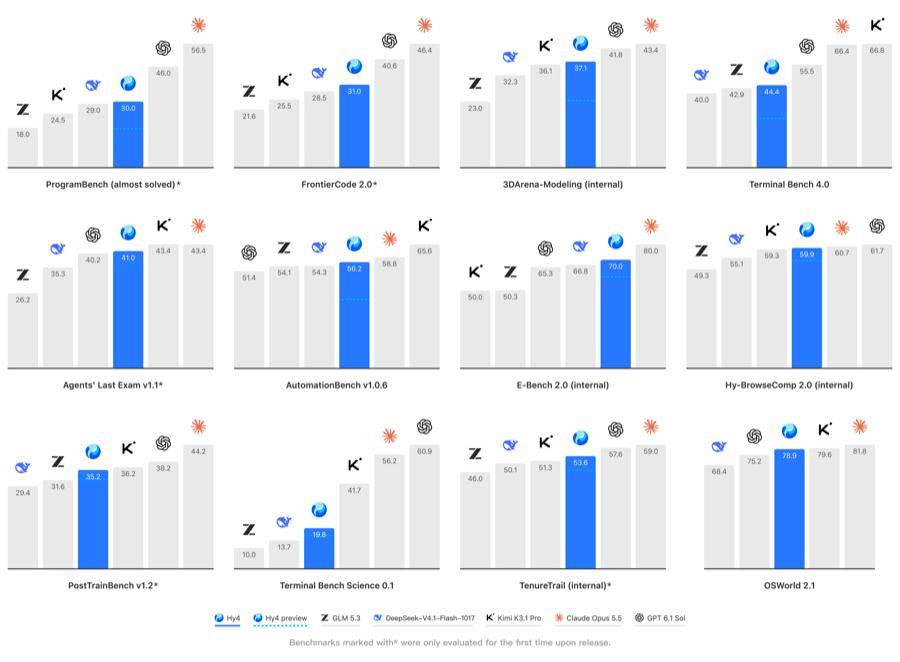
Although these results are a “black box” of the manufacturer’s self-test, and the weight of the official version of the model has yet to be fully liberalized, Hunyuan has indeed accumulated enough qualifications to participate in the open source head competition.
After all, Tencent’s chief AI scientist Yao Shunyu has clearly complained that there is a bad tendency in the domestic industry, which is to be too keen on “swiping the rankings”. He is more concerned about how to set up correct Eval (evaluation standards) internally and pursue model and product Co-Design (collaborative design).
It can be said that the progress of any Tencent-based model is left to users to observe the performance in actual tasks instead of looking at benchmarks. What deserves more attention from the outside world is whether the model iteration is running at a sufficiently agile pace.
Tencent’s answer did not disappoint the market. Since the Hy3 preview was explored in April, Tencent has taken small steps along the way. In July, the official version of Hy3 was launched. At the end of August, the Hy4 preview took over. By November, the official version of Hy4 was launched as scheduled.
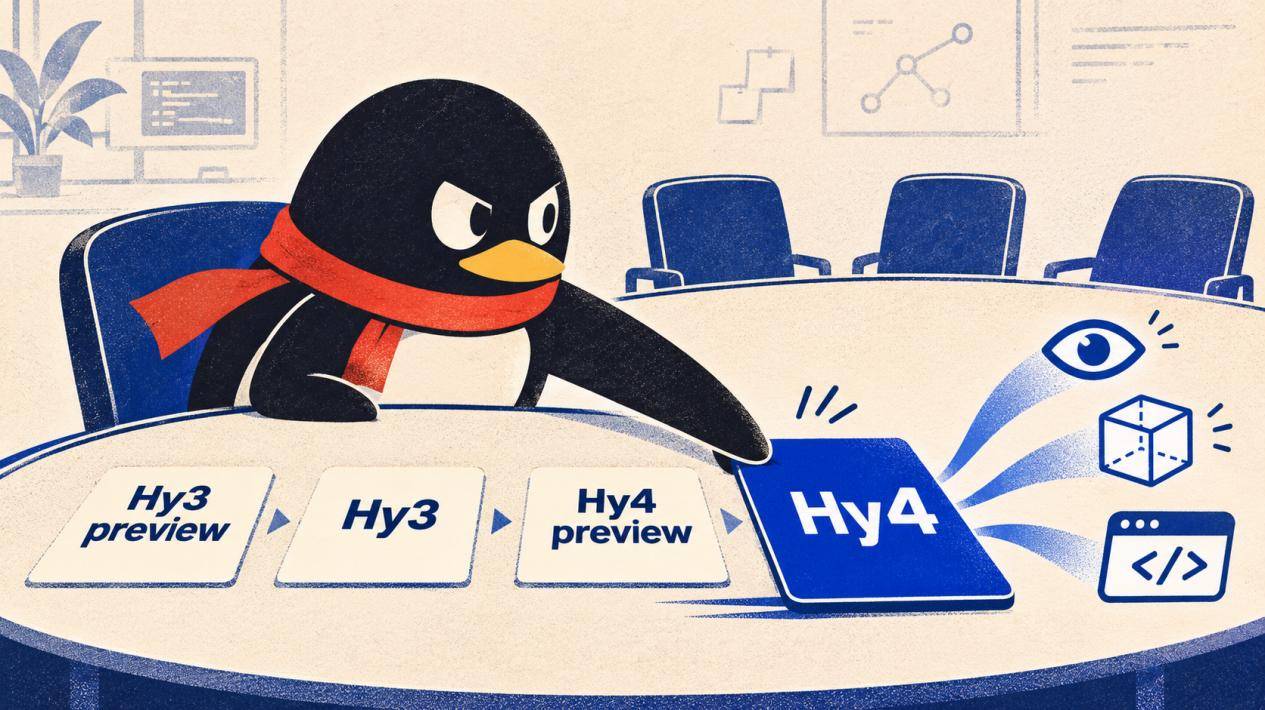
The small steps are fast, but the style of play has always been similar. Whenever a new model is open sourced, Tencent always prioritizes integrating the model into its own products such as Workbuddy. It first puts the preview version into its own product to collect real problems, and then uses the official version to focus on fixing the shortcomings in capabilities.
Developing this set of small combos is not easy for a large company that has often been criticized by the outside world for its “bloated organization and slow movements.” It is also more significant than concentrating computing power on a single time to rush to the rankings.
Tencent takes this to prove that it does not only rely on buying and selling, huge traffic and ready-made scenarios to indirectly participate in the AI competition. It also has the ability to send the results of the underlying model into the real workflow with high frequency and stability.
It should be noted that Tencent Hunyuan also frankly disclosed in the technology blog that there is still a big gap between Hy4 and the world’s top closed-source models, especially in hard bones such as cutting-edge mathematics, long-term development, model self-iteration and complex visual question and answer.
From this point of view, Hy4 is just a phased answer sheet.
To understand why Tencent has been able to adjust its breathing and run continuously in the past six months, you have to look behind the model. Let’s see how it performed the “tissue surgery” on itself.
02 “Reserves” organized by AGI
Tencent’s overall changes need to start with Yao Shunyu’s larger goal.
In June of this year, when talking with Tencent Cloud CEO Tang Daosheng on the same stage, Yao Shunyu gave his judgment on the second half of AI: the top priority is to “build a long-term, AGI-based organization in China.”
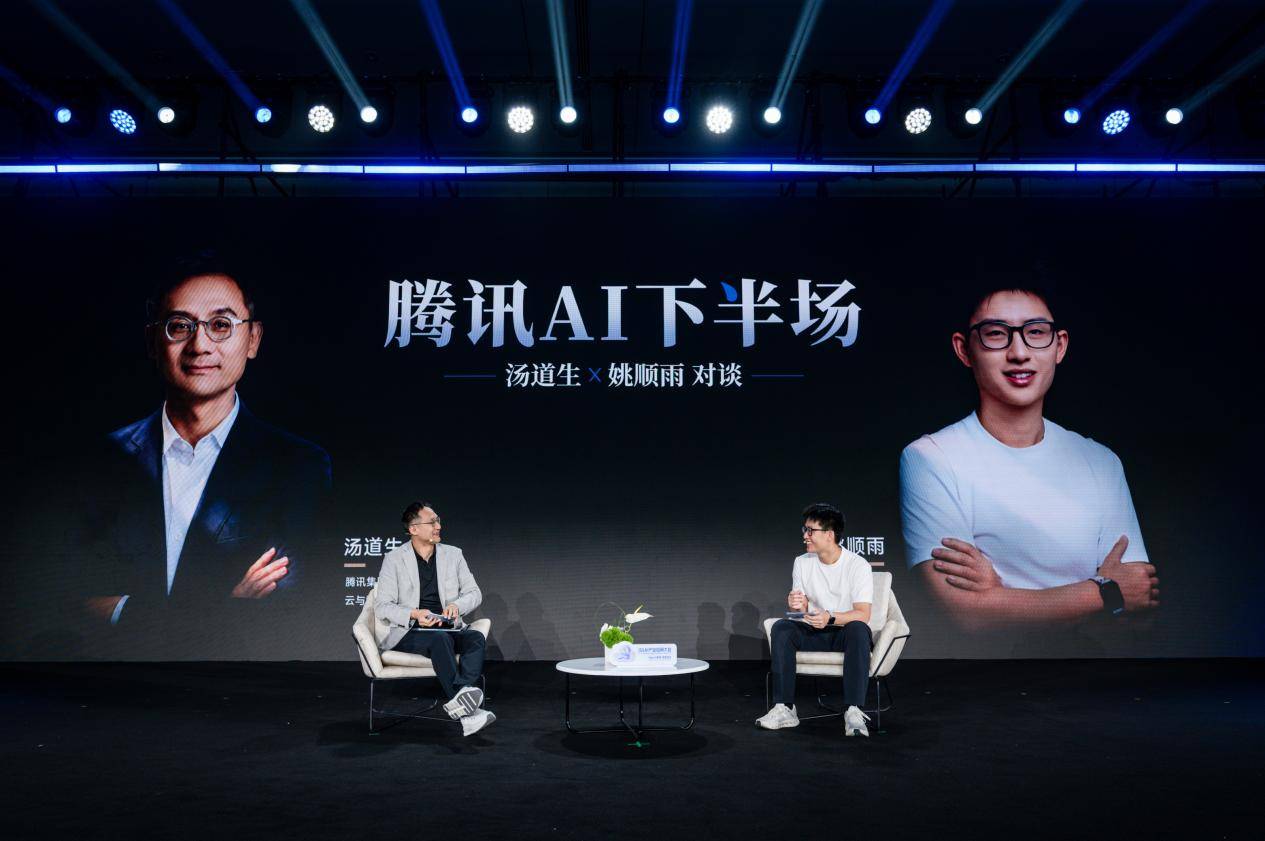
This organization should be like a balanced triangle. One corner is the basic model team, which ensures solid pre-training and post-training; one corner is the product team, which allows technology to generate value for people and society; and the other corner is Frontier (frontier team), which explores new research paradigms.
In an Internet giant with tens of thousands of employees and deep barriers to business groups, the first step in building such an organization is often not to look up at the stars, but to lower the head and tear down the high walls between departments.
Relevant people have complained to us before that different project departments have their own AI middle stations, but the superiors require that projects must cooperate with TEG (Technical Engineering Group). “Several groups of people crowded on the same table, and no one was happy in the end.”
This phenomenon points to a disease called “big company disease.” Tencent has never lacked resources. It has cloud, games, financial technology, social networking and office scenarios, and engineers and professional data are piled up.
But in the traditional bureaucratic assembly line, these assets are scattered among different business groups and reporting lines. The model team and the business team are consumed by the organization consumption of “who cooperates with whom” and “how to communicate”, and it is obvious that they cannot develop combat effectiveness for AGI.
Therefore, after Yao Shunyu joined the company, he performed a series of operations on these obstructed joints. Since then, Tencent’s organizational adjustments related to AI have been building the skeleton for such a team structure.
Starting and ending with Yao Shunyu joining Tencent in December last year, in less than a year since then, Tencent has successively rebuilt pre-training, reinforcement learning, data and evaluation infrastructure, canceled the AI Lab in March, and merged the large language model department and the multi-modal model department into the basic model department in July. By September, the AI Data Department was also included.
It can be seen that according to the research logic of the AGI era, Yao Shunyu has opened up the bottom layer of Tencent’s algorithms, computing infrastructure and data, allowing these technical forces to operate around the same set of research and development goals.
With such a foundation, the collaboration between business and models has also made great progress.
In the traditional delivery pipeline, the model team trains the model behind closed doors, and then the product team comes to find scenarios. The feedback back and forth is long and distorted. Tencent’s approach is to directly insert the product front-end into the research and development process. A typical example is Workbuddy, which is the first to access and offer free trials of the latest Hy series models.
This internal collaboration mechanism has now begun to spill over to the product side. Buddy One, which debuted at the end of October, connects products such as WorkBuddy, Tencent Documents, Tencent Meetings, Netdisk, and ima to the same Agent base, connecting accounts, points, and underlying data.
After authorization, WorkBuddy can retrieve meeting minutes of Tencent meetings at any time and can also read ima’s knowledge base. By connecting isolated product entrances to the same Agent base, the model “eats” a more vivid real scene, and the product gets a more complete context.
Data shows that since WorkBuddy was launched in March, it has completed a total of 9 billion task requests, and the enterprise version has covered half of China’s top 500 companies.
From separate business groups to coordinated operations around Agents and basic models, Tencent is working hard to transform itself into a “reservist” that adapts to the evolution of AGI.
03 Time waits for no one
As Tencent accelerates organization and model iteration, the global capital market’s attitude towards AI has changed.
As mentioned before, Google suffered a sharp decline in its stock price after delivering impressive cloud growth. Microsoft, which released its financial report on the same day, escaped the disaster and did not trigger the panic of AI skeptics. It basically closed flat on the first trading day after the financial report was released.
Both companies are increasing investment in AI and promoting cloud business growth, but market feedback is completely different. The root cause lies in cash flow and the affordability of the core business.
Alphabet’s capital expenditures in the quarter reached US$51.36 billion, directly reducing free cash flow to -US$9.07 billion, which was negative for the second consecutive quarter. At the same time, the growth rate of its search advertising has slowed down, and the market has begun to worry that AI infrastructure consumes a lot of cash, and the monetization efficiency of the traditional “money printing machine” is declining.
In contrast, Microsoft’s free cash flow in the quarter was still positive, and the capital market therefore accepted a higher investment limit. Based on this logic, which investments can generate self-generation and which ones will overdraw cash flow in the long term is a question that many technology companies cannot escape.
Looking at Tencent with this question in mind, its financial report for the second quarter of 2026 shows that the company’s single-quarter capital expenditure soared to 52.78 billion yuan, a year-on-year increase of 176%; R&D expenditure was 27.28 billion yuan, a year-on-year increase of 35%. As aggressive as Google’s investment, and with unclear liquidity, it directly emptied free cash flow in the quarter, recording -13.8 billion yuan (after excluding prepayments for computing power purchases, free cash flow was 37.6 billion yuan).
For Tencent, which has always been good at cash flow management and is accustomed to operating with high gross profit and light assets, AI is both a ticket to the future and a burden.
It is true that Tencent has three cash cows in gaming, advertising and financial technology, but under new market scrutiny, whether its rich wealth can be exchanged for an “exemption from inspection” remains to be seen in the third quarter.
But at this juncture, the overseas computing power supply chain has undergone another change.
On the day the official version of Hy4 was released, according to media reports, Oracle canceled an AI chip leasing agreement with Tencent valued at approximately US$7 billion. According to the original plan, Tencent originally planned to rent approximately 100,000 advanced AI chips through multiple data centers in Southeast Asia within five years. As of press time, neither party has responded publicly.
Changes in overseas computing power have made Tencent’s already-promoted adaptation of domestic computing power even more urgent. Tencent Cloud disclosed that after joint tuning with the Hunyuan team, the single-card throughput of domestic chips was abruptly increased to five times its original value two weeks before the model was launched.
When Buddy One and more AI products that connect the whole office are fully rolled out, the inference computing power consumed every day will only double. Tencent not only has to train the model to be smarter, but also has to find ways to reduce the cost of each call.
In the past two years, the outside world has always been worried about Tencent, fearing that it would move too slowly and not be able to catch up. Now, Tencent has finally increased its speed, but the market has changed its test paper.
Whether it’s settling accounts or doing research, Tencent’s small steps are far from slowing down.
Related Reading
- Nvidia live updates: Jensen Huang ousted, CFO Colette Kress to serve as interim CEO2026-11-13
- Are mangoes not afraid of red fruits?2026-11-12
- Original: After Huang Renxun, who is most likely to take over Nvidia?2026-11-12
- Samsung’s roll-screen mobile phone is exposed, creating a new form ahead of Huawei and Apple, and folding screens are expected to be eliminated2026-11-12
- Musk’s favorite car is going to be discontinued.2026-11-12