Hongguo’s user base exceeds that of Doubao. On November 3, the 2026 China Mobile Internet Autumn Report released by QuestMobile stated that in September, the number of users of Hongguo’s free short drama deduplication reached 430 million, becoming Bytedance’s application second only to Douyin in user scale.
Among the 430 million users, there is Yang Meng. At first, she just wanted to watch it casually, then she watched it while eating, on the subway, and even while lying on the bed. An episode only lasts a few minutes, and if you watch it continuously, you will lose it in an evening.
The audience is waiting for the next episode. On the other side of the screen, a group of people are also busy working on the next episode: the novel author revise the beginning, the production team looks for themes and generates images, and the platform delivers the story to the people who are most likely to be interested.
“Financial World” talked to a number of novel authors and short drama practitioners, trying to figure out: How are these irresistible stories written, and why can they continue to reach the audience?
01. I know it’s a routine, but I also want to finish it.
It’s not that Yang Meng can’t see the tricks. Sooner or later, the despised person will reveal his identity, the wronged protagonist will finally stand up, and the villain will be punished no matter how arrogant he is. But the misunderstanding has not yet been resolved, and the person who did the wrong thing has not yet paid the price. She wants to see with her own eyes: How can the protagonist get his revenge back?
Nam Hwan, the novelist, is familiar with this expectation. She wrote novels and did not directly participate in the production of short plays. After some of her works were collected, they were adapted into short plays. Among the short story submission requests she encountered, making readers want to know the follow-up as soon as possible is an important condition for whether the manuscript can be accepted.
She had several scrapped manuscripts, but the problem was at the beginning: they were not gripping enough. Even if the rest of the story is already written, it still needs to be rewritten. She described this adjustment as “moving the more impactful parts to the front.” She mentioned a requirement: “a three-second hook.” The character’s life experience, relationship origin, and story background all need to make way for the attraction at the beginning. Something happens first that makes people surprised, angry, or immediately want to know the follow-up.
She gave an example: On the day of the engagement, the male protagonist left to save another woman. The reason was that if the other woman failed in the strategy, she would be wiped out by the system. Written in the order in which things happened, the story can stop when the male protagonist rushes out of the door. But a more attractive way of writing is to tell the readers: the heroine also has a strategy task. The moment the hero walks out of the door, her task fails, and the punishment is to forget him.
The same group of characters, the same departure, a different time to reveal the information, and what the readers want to know has changed: What will happen when the male protagonist comes back and faces someone who no longer recognizes him?
Novel author Li Li mentioned that short play writing attaches great importance to “emotional logic”. Some settings don’t require much context to build the audience’s expectations. The partner cheats, and the betrayer joins forces with someone close to the protagonist. The relationship is clearly explained, and the anger is there. Next, the story will answer how the protagonist seeks justice.
In the type of sadomasochism and regret stories that Nan Huan is familiar with, the writer will make the audience “hold their breath.” The protagonist encounters a misunderstanding, the matter is unresolved, and a new conflict arises. The audience already knows who they want to win, but they can’t wait for the result.
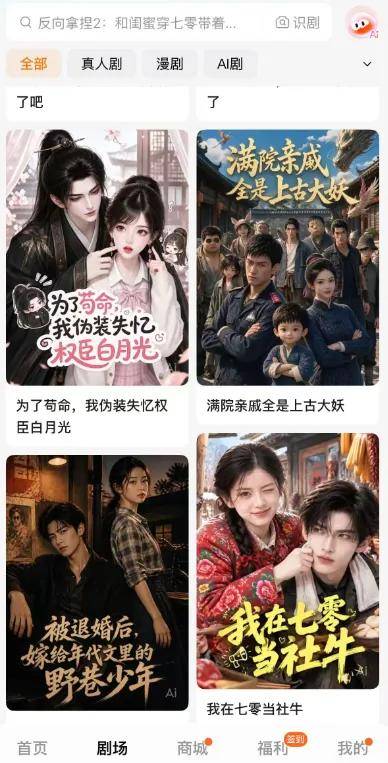
▲Picture source/Hongguo Short Drama
It seems that “cool” stories are being told everywhere, and the viewing process may not be comfortable. In her opinion, sometimes it is just because she is angry that it is more difficult to quit midway: If you leave after seeing this, isn’t that person still suffering? Such stories have appeal in trading, too. Nan Huan has observed that in some of the short story deals she has been exposed to, the remuneration for some sadomasochism and regret themes will be significantly higher than that of sweet pets.
She herself is reluctant to write some extreme female abuse plots. The characters are pushed towards a single good and evil, and harm becomes a tool to advance the story. It will be very uncomfortable after writing, “I don’t treat the characters as human beings at all.”
But whether the manuscript can be sold will also affect the author’s choice. Nan Huan mentioned a similar type of stories: “Heart-Burning Box Lunch”, “Heart-Burning Spicy Soup”, “Heart-Burning Beef Noodles”… The themes and rhythms were used repeatedly, and the characters and details were changed, and they were written again. If you provide contributions according to the agreed direction, the remuneration may be more clear; if an independent author writes ten stories that he wants to write, he may not be able to sell any of them.
There is a common way to look for experience that can be used for reference: “scraping the list”. Authors study how popular works begin, where conflict arises, and when information is revealed, and then apply the learned rhythms to their own stories. Nan Huan emphasized that this is to learn narrative arrangements, not to copy the plot.
There are also people chasing news hot spots. Among the short story submission requests she has encountered, sometimes the news is trending on the same day and must be submitted in the evening. After a slight delay, similar manuscripts may have been submitted by others. If you write slowly, no one will want it.
Just because the short story is handed in does not mean that it will be completed immediately. Nan Huan distinguishes two speeds: short story writers can chase the news of the day, while the production team pays more attention to topics that have already received market feedback. If a story becomes popular, similar works may appear in the next few months.
She also values stories with solid characters. Audiences will remember the characters and be willing to watch them again and again. But it is difficult to write an unforgettable character using fixed steps. In contrast, where the conflict is placed and when the truth is revealed, it is easier to take it apart and learn.
For Yang Meng, seeing these arrangements does not mean that he can turn them off immediately. The protagonist is still feeling wronged, and the result she wants to wait for has not happened yet.
02. If one person brushes, the whole ecosystem is busy.
When it comes to “hooks”, Zhelin, the founder of Wenhua Qianyi, made a different observation. He doesn’t think hooks are enough to explain the growth of Hongguo: short dramas on other platforms also have twists and suspense. To understand why so many people come to Hongguo, we also need to look at where the content comes from, how it is produced, and how it finds the audience. He values ecology, plot and personalized recommendations more.
The audience opens the red fruit to watch a drama. When preparing a project, producers will first go to Tomato Novels to find stories. Some works have already accumulated readers and discussions before adaptation, which can provide reference for producers. Readers who are familiar with the title and characters of the book may also become viewers of the adaptation.
But stories cannot be used directly after being selected. According to Zhelin, in the cooperation arrangements he understands, some ordinary IPs can be used for free, but there are quota restrictions; some high-quality IPs require additional payment, and the specific conditions are related to the cooperation model.
Zhang Feng, who works in a short drama production company, mentioned a similar option: some cooperation uses IP provided by the platform, which can reduce upfront costs, but the work needs to be launched on the corresponding platform as agreed. Where a story comes from may also influence where it ends up being broadcast.
Zhang Feng makes AI comics. He described the process he had used in the past: first generate visual assets including character drawings, try to keep the characters consistent in subsequent scenes, then prepare prompt words according to the script, generate video clips, and finally edit with clips.
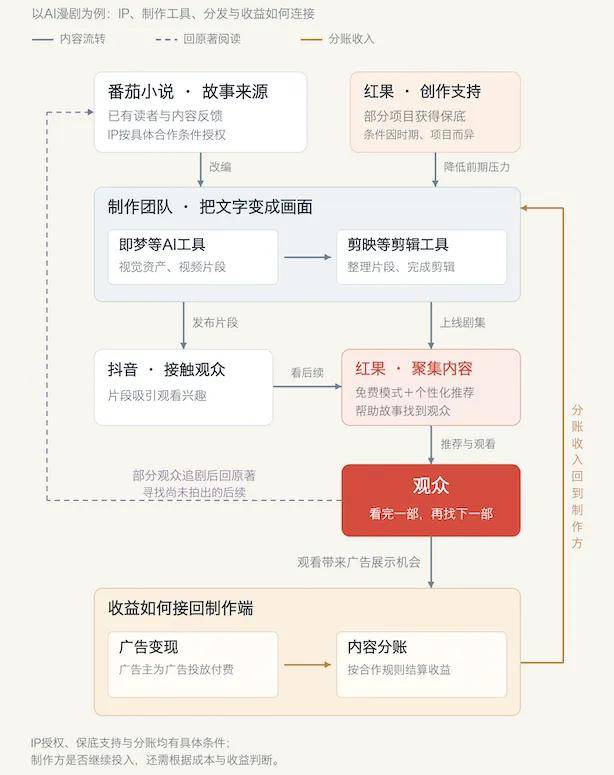
▲Source/”Financial World” compiled based on conversations
Dreams and editing are the production tools he has come into contact with; Douyin and Hongguo are the platforms through which his works can reach the audience. From story finding to production to distribution, the team may switch between multiple byte-based products. When talking about this business, Zhang Feng used a straightforward statement: “You can make money wherever you go.”
This is what it feels like on the production side. Novel copyright, production tools, distribution and advertising do correspond to different business links. However, how to charge for specific projects and how to distribute income depends on their respective cooperation arrangements.
In addition to tools and stories, producers also need a reason to take on the project. Zhelin recalled that when Hongguo attracted partners in its early days, in addition to opening up IP cooperation, it also provided guaranteed support to qualified scripts and production projects. For the team, having someone to shoulder the initial investment and having a clear release channel after the work is completed will affect whether they are willing to start work. “It is not only developing the C-side market, but is also developing the B-side market.” This means that while gathering audiences, the platform is also attracting people who can provide the next drama.
After the work is produced, it must find an audience. Douyin provides an entrance: users browse the clips, become interested in the story, and then go to Hongguo to watch the follow-up. A cut out plot may be the first meeting of the entire drama with the audience.
Zhelin observed that interest does not flow in only one direction. Some people have read the novel and want to see what the characters will look like in the film; some people have finished chasing the filmed part of the short play and then go back to the original work. The drama hasn’t been filmed yet, and the subsequent plot is still in the book. Watching it may continue into reading.
When it comes to Hongguo, personalized recommendations are also involved in content distribution. In Zhelin’s understanding, in addition to a sufficient supply, the platform must also deliver stories that may suit a person’s interests to people who may be interested.
The free model reduces another barrier. Viewers do not have to pay episode by episode like paid short dramas, but they will be exposed to advertisements during the viewing process; some content also involves watching advertisements to unlock. Advertising monetization and content sharing, linking viewing and producer income.
Finding stories, creating content, and finding audiences are all connected together. The producers have a reason to enter, and new works are constantly appearing in front of the audience.
However, whether the work can be launched online and whether the next one is worth continuing to invest in are two different questions.
03. Behind the free, everyone has his own account.
Wang Lei first spent 7,000 yuan to buy an annual membership of a third-party AI creation platform. He hopes to use natural language to talk to the tool, and let it assist in writing scripts, making storyboards, and regenerating images. After actually getting started, he discovered that he needed to prepare much more than he imagined.
Characters, costumes, props, backgrounds, scenes, vehicles, aircraft, buildings…he lists a long list of digital assets. What the people in the story are wearing, where they are standing, and what is around them all require corresponding materials. “It’s not as simple as you think.”

▲Wang Lei’s unfinished AI comic heroine. Picture source/Xiaohongshu
As of the time of the conversation, his skit had not been completed and had not been released. The annual fee has been paid, but the work has not yet reached the stage of testing the profit. “It’s too slow for me to do it alone.”
He considers creation as a hobby. When he released short videos and songs before, the views the Byte platform brought to his works made him willing to continue trying. When a stranger clicks on the work, it is already an encouragement. But when giving advice to others who want to get involved, he still reminds: perfect the script first, try basic tools, and don’t invest too much money at the beginning.
Wang Lei is still preparing for his first work, and Zhang Feng’s company already needs to consider where the story will be distributed when selecting the topic. Zhang Feng said that as far as their company’s business is concerned, Douyin and Green Pao are relatively more profitable, so the topic selection will also consider whether they can be adapted to multiple platforms. Some themes that perform well on Hongguo may not still be popular if they change channels.
Before a drama is produced, production costs, promotion expenditures and distribution channels all need to be considered together. When you see someone else doing something, you can’t rely on the results to predict your own gains. “The same subject may be popular among others, but you are not popular,” Zhang Feng said.
Zhelin is concerned about whether the cooperation conditions can support continued investment. The guarantee provided by the platform in the early stage is one of the reasons for the team to enter; when preparing for the next project, it is still necessary to confirm the applicable account sharing arrangement and whether the revenue can cover the cost. His concerns about changes in platform rules also fall on this expectation. The user base is huge, and it still requires a lot of calculations when it comes to your own works.
For the storyteller, the account begins much earlier. Li Li found that in the manuscript-receiving environment she was exposed to, some partners increasingly valued whether the author had experience in making hits. Newcomers need to get a chance to submit a manuscript and be accepted before they can talk about subsequent adaptations and income.
Nan Huan has his own order of submission: submit to the recipient with the higher bid first. If it is not accepted, find an editor you are familiar with or another studio. Selling the novel first is a more direct goal than waiting for the work to be adapted.
But she was still happy when someone selected her work to be used in a short play. The story has another way to present it, and I have one more opportunity to earn income. After the manuscript is sold, whether the author continues to share the profits depends on the cooperation method.
According to Nan Huan’s introduction, the deals she came into contact with include buyout and share-sharing; some cooperations pay a part of the payment first, and then continue to distribute the proceeds after the subsequent income exceeds this amount. After other manuscripts are bought out, the authors will no longer participate in subsequent profits. If the same work becomes popular, the author under different cooperation methods may receive different amounts of money in the end.
The stories that are presented to the audience for free go through choices again and again like this: the author decides who to give the manuscript to, the producer decides how much to invest and where to publish it, and then based on the performance of the work and actual income, considers whether to make the next one.
When it comes to the audience, these processes often leave only one action: click. You don’t have to decide to set aside an entire evening when you start watching. A few minutes passed, but the misunderstanding was still unresolved; a few more minutes passed, and a new conflict arose.
Platforms are also adjusting mechanisms related to viewing. On October 21st, Hongguo announced that it plans to offline the gold coin function in stages: starting from November 1st, the gold coin function will no longer be provided to users newly activated on or after that day; it will be offline for all users before December 31st.
Reports on October 23 showed that Hongguo has launched rest reminders and sleep reminders, and is gradually covering more users. When watching dramas continuously or late at night, users may see text prompts, or familiar characters from short dramas may appear to advise people to take a rest.
The characters who were still leading the audience into the story began to remind them that it was time to take a break.
Yang Meng also needs a way to stop. In the two months after downloading Hongguo, she often saw it at one or two in the morning. At first, I just wanted to know the ending of the story. Later, the few minutes I read continuously took up the time originally reserved for sleep.
Finally, she unloaded the red fruit.
(The characters in the article are all pseudonyms)
Related Reading
- Nvidia live updates: Jensen Huang ousted, CFO Colette Kress to serve as interim CEO2026-11-13
- Are mangoes not afraid of red fruits?2026-11-12
- Original: After Huang Renxun, who is most likely to take over Nvidia?2026-11-12
- Samsung’s roll-screen mobile phone is exposed, creating a new form ahead of Huawei and Apple, and folding screens are expected to be eliminated2026-11-12
- Musk’s favorite car is going to be discontinued.2026-11-12