文|Maxx
編輯|Rango
The emergence of GPT-6 Astra has opened up a hole in the “brain” problem that has plagued the embodied intelligence industry for a long time in an unexpected way, and also brought about waves of impact.
In Astra’s actual test video, this general-purpose large model, which is not specially trained for robots, controls a several-hundred-dollar robotic arm holding a paintbrush to draw the Golden Gate Bridge on white paper. The lines were still crooked the first time, but by the fourth time, the outline and details of the Golden Gate Bridge were clearly visible.
After Thijs Simonian, an employee of the OpenAI robotics team, released this actual test video on
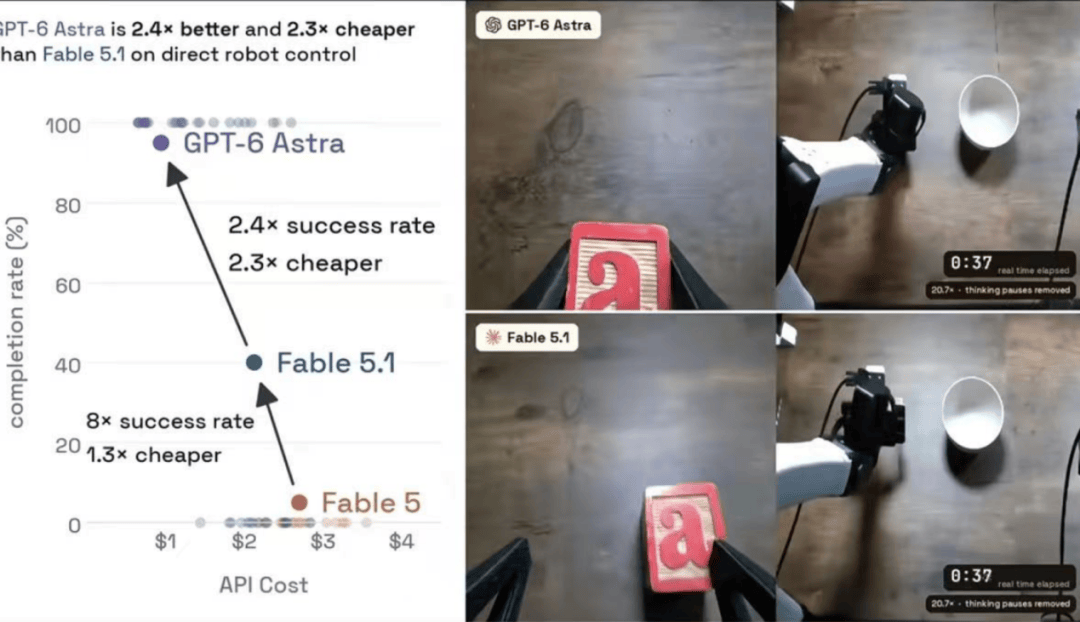
In addition, at this time, China’s primary market’s enthusiasm for embodied intelligence investment is cooling down. Discussing Astra at this point provides a rare technical benchmark for the embodied brain narrative that was almost impossible to falsify in the past.
List rankings can be refreshed, demos can be edited, and the scale of real machine data collection can be used as a reason for valuation, but as long as Astra can do something well, there may no longer be room for a premium. Players in the embodied intelligence industry no longer compete within this seemingly independent industry.

危與機
Yushu Technology is the first embodied intelligence company in China to openly talk about Astra. Founder Wang Xingxing admitted that his biggest mistake in the past was “not believing enough in AI” and predicted that GPT-7 will be released next year and “may directly solve the problem of embodied intelligence.”
Without any special training on large models, Yushu Technology successfully used GPT-6 Astra to allow the robot to complete actions such as autonomously identifying color palettes, changing paints, and cleaning brushes. More complex tasks (such as tidying up the room according to instructions) may be realized next year.
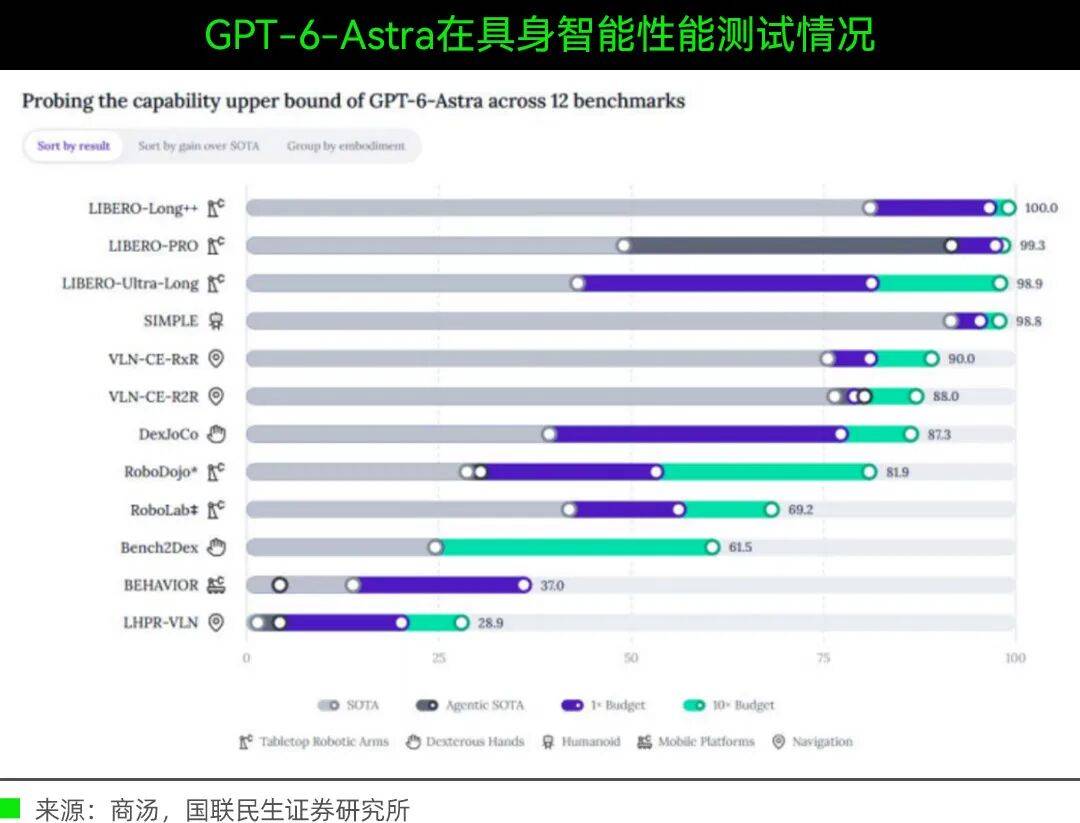
After evaluating GPT-6 Astra, SenseTime also stated that the general model can now handle robot operation and navigation tasks that were mainly undertaken by special models such as VLA and WAM in the past, and has demonstrated capabilities such as zero-sample generalization, context learning, and failure recovery.
For head body manufacturers such as Yushu Technology and Zhiyuan Robot, this is actually a delicate moment where danger and opportunity coexist.
On the one hand, the ontology performance, motion control and cost advantages that ontology manufacturers relied on in the past need to find new support under the expectation that “brain” capabilities may be quickly equalized by general models.
On the other hand, when the supply of “brains” begins to become diversified or even excessive, the “body” that can carry intelligence, collect data, and complete delivery may turn from a low-barrier link in the past definition into a strategic asset that cannot be bypassed.
The statement of Zhiyuan co-founder Peng Zhihui is very interesting. He believes that regardless of whether the universal archetype ultimately takes over the embodied abilities, intelligence must be placed on a reliable body.
If the basic model covers everything, the competition will be who can put intelligence into the real world at a lower cost and with higher consistency. If the basic model cannot be generalized, then the data of the vertical domain model will still come from the deployed ontology – but in the end, high-quality ontologies that can be scaled will become more and more important.
At the “2026 Zhiyuan Innovation Day” on October 29, Peng Zhihui even said, “Zhiyuan can also be an AI company.” In order to support the specific tasks of 30 million levels, the company’s training cluster this year has approached the scale of 10,000 cards, and its computing power consumption is among the best in the industry.
It is foreseeable that embodied intelligence is competing with large models for computing power, and Zhiyuan is looking for new legitimacy for the ontology + full-stack route under the impact.If the core elements of industry competition shift to models and computing power, then the head embodiment companies themselves are already operating according to the logic of AI companies.
What’s more, Astra is not omnipotent. The high latency problems inevitably caused by cloud reasoning are very typical. The success rate of highly dynamic and fine operations involving force-touch feedback is basically zero. So for head body manufacturers, the time window still exists.
But for science and technology companies with embodied brains, the situation is much more embarrassing.As a sustainable and barrier-free entrepreneurial direction, the most important narrative logic of “independent embodied brain” has been shaken.
We must know that in the domestic embodied intelligence track financing in the first half of this year, companies with “brain” as their core business accounted for more than 50% of the financing, while Ontology complete machine companies accounted for only 12.8% of the financing in the same period. But now, the flood of financing is gone forever.
問估值
Recently, the embodied brain company Force Unlimited completed an A++ round of financing of nearly 100 million yuan, led by Zhejiang Venture Capital Group (Zhejiang Venture Capital). More than two months ago, Force Infinite just announced its Series A and Series A+ financing of nearly 1 billion yuan.
Just the high-profile financing of a few embodied brain companies does not represent the true popularity of this industry.
According to NE Times statistics, there were 46 financings in the domestic embodied intelligence primary market in September, with a reference amount of approximately 11.624 billion yuan, down 4.2% and 40.1% respectively from August. Moreover, there are many projects where investment decisions were completed in May and June, but delivery was not announced until September.
The large-scale financing of head-brain-based embodied companies almost occurred before May. The main ammunition for such companies as Xinghaitu, Qianxun, Galaxy General, Zhi Square, and Independent Variables was loaded from Q1 to early Q2. The total financing amount of the top five companies accounted for about 70% of the entire embodied brain track.
Those that can still obtain financing of more than 100 million yuan after May are mainly those with clear state-owned assets endorsement (such as Infinite Force, Brain Rock), or anchored by real orders (such as the Fifth Century of China Science and Technology).
Moreover, in the new financing after May, the amounts and rounds of companies that truly position themselves as “universal brains” have been significantly downgraded.
For example, Unbounded Power’s US$200 million angel round, Yuance Future’s hundreds of millions of seed rounds, and Mooshen Intelligence’s hundreds of millions of Pre-A, the amount alone is not small, but compared with the 2 billion to 5 billion level financing received by Xinghaitu and Qianxun in Q1, the valuation magnitude may no longer follow the same narrative logic.
You must know that capital has been so concentrated on the embodied brain track before, and the bet is that this is a technological highland that needs to be conquered by independent companies.
When Xinghaitu’s CFO explained the doubling of valuation, he listed “the scarcity of authentic brain targets” as one of the three core reasons, which is a typical expression of this narrative. In this framework, Brain Company is a platform, an entrance, and a candidate for the “operating system” in the era of embodied intelligence.
Capital has even derived another layer of belief from this, that is, the data required to train the embodied brain also requires specialized companies to collect, label and commercialize delivery.
What Astra shattered was precisely this “independent OpenAI” valuation imagination. If the general large model company itself is the strongest supplier of “embodied brain”, then the independent existence value of pure brain startups needs to be re-demonstrated – not to prove whether the technology is good or not, but to prove why you have to do it.
What’s even more troublesome is that large model companies have huge advantages in scene data and customer relationships compared to pure brain startups.
For example, Alibaba launched the Qwen-Robot Qianwen embodied intelligent large model complete set (VLN mobile model, VLA operation model, world model) in June, with the purpose of creating a complete universal base for robots. Alibaba’s existing offline fulfillment scenarios such as rookie warehousing and instant delivery happen to be a natural testing ground for these embodied intelligence models.
On the other hand, the scene information obtained by pure-brain startups is often only remote operation videos and laboratory workstations provided by the main body factory. In the future, in terms of customer acquisition costs, the gap will easily widen compared with large model manufacturers.
It’s important to note, however, that this does not mean that embodied brain startups are a unified and equally vulnerable camp.
測極限
Stress testing never applies damage uniformly; it is more likely to expose differences in the texture of different commercial structures exposed to the same impact source.
The survival space of the embodied brain company actually depends on what kind of business structure it is embedded in – whether it is embedded in the financing narrative that is impacting the IPO, embedded in the industrial cash flow that has been run through, or embedded in the closed loop of scene operations.
The core brain school (Star Map, Qianxun Intelligence, Infinite Force) is betting on the long-term future in which “the brain itself becomes a platform”. It has the largest narrative space, but the depth of defense is the shallowest when faced with the overflow of general large model capabilities. Future changes will depend on who first develops a business anchor that Astra cannot replace.
Take Qianxun Intelligent as an example. It is following the “VLA + world model” integration route. Based on its continuous leadership in benchmark tests, Spirit v1.6 once reached the top of RoboArena and surpassed NVIDIA and PI. However, after Astra’s outstanding performance, the questions that the market wants to ask will definitely become a commercial test.
Qianxun Intelligence has previously adopted a composite model of complete machine sales + algorithm licensing + capability subscription, and launched clear tiered subscription pricing (standard version 300,000/year, enterprise version 880,000/year, flagship version 3 million/year). This may be seen as the starting point of a business model from “selling brains” to “selling tokens”.
The scene anchor of Infinite Force is more practical. Its FORCE charging robot has a market price of 368,000 yuan per unit. By the end of 2025, 300 units have been delivered, covering more than 20 cities and more than 90 leading customers, with a total of 200,000 orders. This year, it has exceeded 100 million in revenue.
If it becomes an “embodied brain + dedicated body” company rooted in vertical scenarios, the lower limit of the infinite force will at least be guaranteed.
Among the brain-body fusion faction, Galaxy Universal and Cloud Deep represent two opposite risk structures.
Galaxy General’s ontology is governed by its brain. Its core assets are the Galaxy Star Brain and scene operation closed loop. On the retail side, it has smart pharmacies, with hundreds of locations in more than 30 cities, and has received more than 1 million orders in total. On the industrial side, it has production line cooperation with CATL, and the cooperation model covers complete machine sales, RaaS and data services.
Faced with the pressure from Astra, the differentiation of Galaxy General’s self-developed star brain must increasingly fall on the closed loop of proprietary data generated by scenario operations. Perhaps becoming a scene operation platform with embodied brain as the core will lower the upper limit of valuation, but it is more likely to maintain commercial sustainability.
The risk in Deep Cloud is more likely to come from the erosion of Ontology’s fundamentals. The company invested RMB 1.169 billion in IPO funds into embodied algorithms and models, but only 4 humanoid robots were sold in two years. Compared with the two, the embodied brain is more of a defensive investment than an offensive move.
This is actually similar to the situation of component groups like Mecamand. Astra will not replace industrial 3D visual guidance, nor will it replace the engineering requirements of production lines for rhythm and yield. However, the “brain” business that the company wants has never contributed large-scale revenue, which is obviously detrimental to the company’s valuation based on the “eyes, brains and hands” narrative.
Related Reading
- Nvidia live updates: Jensen Huang ousted, CFO Colette Kress to serve as interim CEO2026-11-13
- Are mangoes not afraid of red fruits?2026-11-12
- Original: After Huang Renxun, who is most likely to take over Nvidia?2026-11-12
- Samsung’s roll-screen mobile phone is exposed, creating a new form ahead of Huawei and Apple, and folding screens are expected to be eliminated2026-11-12
- Musk’s favorite car is going to be discontinued.2026-11-12