
From gathering traffic to calculating costs, AI companions began to face commercial exam questions.
AIX Finance (AIXcaijing) original
Author | Li Mengran
Editor | Wei Jia
After Character.AI filed for bankruptcy protection, the AI companion business is being re-examined.
This star company, which has been valued at US$1 billion more than a year after its establishment and has tens of millions of monthly active users, was once regarded as one of the most representative players in the AI companionship track. With a product that allowed users to chat with virtual characters, it attracted a large number of users and capital, but eventually went bankrupt and reorganized.
On October 12, the parent company of Character.AI filed for bankruptcy protection. Continuous investment in computing power, operating costs, as well as litigation and regulatory pressure related to the protection of minors have put this star company into operating difficulties. Currently, Disney is the first bidder for US$20 million for the non-exclusive permanent license to some of its intellectual property rights. Star companies that were once valued at US$1 billion now have to dispose of some of their assets through bankruptcy proceedings.
But the fall of Character.AI does not mean that the AI companion market has lost its growth momentum. Chai, another AI character chat platform, disclosed that as of early October, it had more than 1 million daily active users and an annualized revenue of US$120 million. According to data from Sensor Tower, in the first quarter of 2026, global AI companion mobile application revenue reached approximately US$150 million, more than 12 times that of the same period in 2023.
The domestic market also has many players. From MiniMax’s Hoshino and Talkie, to ByteDance’s Cat Box, to a number of entrepreneurial products focusing on segmented needs, companies with different backgrounds are exploring business opportunities accompanied by AI.
On the one hand, star companies with tens of millions of users are going bankrupt, on the other hand, industry revenue continues to grow, and different players are exploring their own paths to monetization. The AI accompaniment industry has shown obvious differentiation.
It’s the same as chatting with users. Why do some people make money from it, while others make more and more losses? What kind of business is AI companionship?
01. With the company of AI, some people go bankrupt and others grow.
Overseas markets were the first to produce a number of star products, and they were also the first to accept the test of commercialization.
Character.AI once accumulated a large user base by relying on virtual character chat, but the user scale has not translated into enough revenue to support operations.
According to Reuters, the company’s monthly computing power expenditure will be approximately US$13.8 million in 2024, which will drop to approximately US$10 million in 2025, and the total from January to August 2026 will be approximately US$56.1 million. On the revenue side, monthly subscription revenue increased from approximately US$600,000 in January 2024 to approximately US$2.8 million in August 2026; advertising revenue increased from approximately US$500,000 in July 2025 to US$2.5 million in August. Revenue in August totaled about $5.3 million, which was still not enough to cover its operating expenses.
It is worth noting that Character.AI adopts a “free + paid model”. The paid version is divided into light membership at US$4.99/month or US$2.49/week; advanced membership at US$9.99/month or US$94.99/year. The lower-priced model will only be launched in September 2026 to alleviate the financial pressure of continued losses. But before filing for bankruptcy, it was still losing $8 million to $9 million a month.
Another Chai, which also focuses on AI character interaction, has a different situation. As of early October 2026, its daily active users have exceeded 1 million, and its annual revenue has reached US$120 million. Chai said the company has achieved a positive unit economic model and is profitable after excluding sales and marketing expenses. However, these data are not audited and do not mean that the company’s overall net profit has turned positive.
Chai charges are divided into consumer subscriptions, in-app purchases and advertising. According to data cited on its official website, its app store net revenue was US$5.08 million from September 10 to October 9, 2026 (mainly covering subscription and in-app purchase revenue). According to company data, approximately 60% of its revenue comes from subscriptions and in-app purchases, and 40% comes from advertising.

In addition, AI virtual companion products that entered the market earlier, such as Replika, are still in operation. The user scale, income level and operating results of different products are not consistent.
Compared with overseas, there are many players in the domestic AI companion market, which can be roughly divided into three categories.
The first category is large model manufacturers, represented by MiniMax.It has successively launched AI character interactive products such as Hoshino (domestic) and Talkie (overseas), applying the underlying model capabilities directly to the consumer market and monetizing them mainly through subscriptions and advertising.
AI companion applications were an important support for MiniMax’s early commercialization. According to data previously disclosed by the company, in the first nine months of 2025, Talkie and Hoshino’s combined revenue was approximately US$18.75 million, contributing approximately 35.1% of revenue, exceeding Conch AI’s 32.6%. Among them, Talkie is also one of MiniMax’s important products to open overseas markets.
But this business does not mainly rely on membership subscriptions to make money, but relies more on online marketing services such as advertising. In the first nine months of 2025, the two products have a total revenue of US$18.75 million, of which online marketing service revenue is US$11.188 million, accounting for approximately 59.7%; subscription revenue is US$6.604 million, accounting for approximately 35.2%; in-app recharge revenue is US$958,000, accounting for approximately 5.1%.
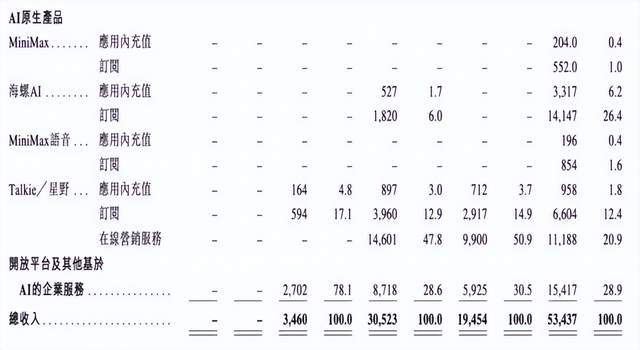
Even if advertising accounts for the majority, it does not mean that related businesses have higher gross profit margins. Looking at MiniMax’s broader AI native product business, including Talkie, Hoshino, Conch AI and other products, the gross profit margin in 2024 will be -8.1%; it will not become positive until the first nine months of 2025, and it will only be 4.7%. But it should be noted that this is not the gross profit margin of Talkie and Hoshino alone.
In terms of user scale, as of August 2026, Talkie has approximately 31.07 million global monthly active users, and Hoshino has approximately 3.38 million users. However, some products have also seen a significant decline in new downloads. Diandian data previously showed that from January to May 2025, Hoshino Apple’s monthly downloads dropped from 4.86 million to 930,000, a drop of approximately 81%. However, the daily activity in January and May was approximately 960,000 and 970,000 respectively, which remained basically stable.
What’s more noteworthy is that MiniMax’s revenue focus is shifting. In the first half of 2026, the company’s AI native product revenue was US$42.64 million, accounting for 36.6% of total revenue from 69.7% in the same period last year; the revenue from open platforms and enterprise services rose to 63.4%. For this large-scale model company that was the first to open up the market with AI companionship, its growth momentum has mainly come from the enterprise side.
The second category is incubated by the Internet and content platforms, such as Catbox owned by ByteDance, Dream Island incubated by China Literature (now independently operated), etc.Such companies have advantages in traffic portals, product operations, and user reach, and can integrate AI role interactions into the existing consumer Internet ecosystem.
Sensor Tower data shows that in the first quarter of 2026, Catbox ranked first in China’s iOS AI application revenue list, and its iOS in-app purchase revenue has exceeded US$22 million, not including Android channels and advertising revenue. In August 2026, based on the iOS revenue generated by a single monthly active user, Catbox will be approximately 5 times that of Dream AI, 4 times that of AI Mate, and approximately 4 times that of Hoshino and Zhumendao.
The way Cat Box makes money is also different from the traditional membership system. In addition to subscriptions and advertising, there is also recharge virtual currency. The continuous monthly membership of Cat Box is 25 yuan, and users can get longer voice call time, more advanced conversation modes and other rights; in addition, users can also purchase a virtual currency called “cat food”, 100 cat food costs 1 yuan, which can be used to unlock some plot chapters, character dynamics and other content, and can also obtain cat food by watching advertisements. It provides AI companions with a source of revenue other than subscriptions, but there is no official disclosure as to which method contributes more revenue.
The third category is independent start-up companies.Such players usually do not have the traffic base of major manufacturers, nor do they necessarily have self-developed large models, so they rely more on product positioning, user needs and operational efficiency to find market space. For example, Xinyingsuixing, which received tens of millions of dollars in Series A+ financing, launched Doudou AI, which focuses on real-time companionship for games; Solulu, which has original IP and focuses on AI chat companionship; and Tianzhiling AI, mentioned below.
This type of player is usually smaller in scale and has more product focus. Compared with the first two types of players, the common problem faced by independent startups is how to attract users, establish a payment model, and control the ongoing model calling costs under limited resource conditions.
On the track of AI companionship, having technology, traffic or content resources does not mean that you will be able to succeed. Large model manufacturers have technical advantages, Internet platforms have user bases, and content companies hold IP resources, but these advantages will not automatically translate into business returns and may even become a cost burden.
02. Income is rising, why is it still difficult to make money?
There is no shortage of growth stories for AI companionship, but what is missing is a profit model that can run smoothly.
From the perspective of the industry, AI companionship is still heating up. According to data from Zhongyan Puhua Industrial Research Institute, China’s AI emotional companion market segment alone will reach 3.866 billion yuan in 2025, and is expected to exceed 59.5 billion yuan in 2028, with a compound annual growth rate of 148.74%. At the same time, the revenue generated by global AI companion apps in the first half of 2025 has reached US$82 million, with a significant year-on-year growth trend.
However, more than one AI companion application entrepreneur reported to “AIX Finance” that the more realistic situation is that profitability is still a practical problem faced by many practitioners.
The problem lies at both the revenue and cost ends.
Looking at the revenue side first, the reasons for users to pay for independent applications are weakening.
Previously, long-term memory, role-playing, voice interaction and other capabilities were important selling points for AI companion products to attract users. However, as large model capabilities continue to be upgraded, these functions are no longer unique to specialized AI companion applications. For basic needs such as daily chatting, talking about worries, and seeking emotional comfort, users can open general AI assistants such as Doubao and ChatGPT.

Image source / Unsplash
Zhang Yi, an AI companion entrepreneur and founder of Tianzhiling AI, believes that if an AI companion product only connects to other companies’ model APIs and provides simple conversation functions, then it is indeed not much different from a general AI assistant.
An AI product manager told “AIX Finance” that there is an unspoken industry consensus that in the past, some AI companion products attracted users through more intimate character interactions, ambiguous relationships, and even content with adult implications. This type of content may be the main reason why some users are willing to pay.
However, in China, regulations are getting tighter and tighter, and relying on breaking through content boundaries to attract users will hardly become a stable and sustainable business model even if revenue can be obtained in the short term.
This means that it is increasingly difficult for standalone apps to charge users solely for the ability to chat.
Looking at the cost side, the cost structure of AI companionship is different from that of traditional Internet products.
The Internet industry is accustomed to measuring product value using indicators such as monthly active users, retention rate, and length of use. The more users and the longer they stay, usually means greater advertising monetization space and easier access to capital attention. Traditional Internet products serve one more user, and the marginal cost is almost negligible.
However, every time a user of an AI companion product initiates a conversation, model inference fees may be incurred. As the user scale and usage time increase, the service costs that enterprises need to bear may also increase simultaneously.
Zhang Yi believes that directly transferring the growth logic of the traditional Internet to the AI companion industry may be a risk faced by entrepreneurs. For example, some entrepreneurs hope to increase user activity through operational means, but ignore the ongoing costs of AI dialogue itself. Some heavy users may send 20,000 to 30,000 messages a month. If the product cannot control the cost of a single conversation, such users may even bring losses to the company.
The dilemma of Character.AI is a case in point.
According to public materials, Character.AI has approximately 12 million active users. In August 2026, each active user of the platform brought in monthly revenue of approximately US$0.44, including approximately US$0.21 from advertising; and the corresponding computing power cost per user was approximately US$0.58. The more active the user, the higher the computing power bill. Coupled with personnel expenses, litigation costs and regulatory pressure, the huge user scale has not brought about the narrowing of losses.
Chai has experienced similar cost challenges. Its founder, William Beauchamp, once mentioned in a media interview that in some markets, users can only create about $0.1 in revenue for every $1 of computing power they consume.
An investor who pays attention to AI applications believes that AI-accompanied companies need to calculate not only the customer acquisition cost and payment conversion rate, but also the service costs that each user continues to incur during the use process. It is necessary to pay attention to the revenue contributed by users in a certain period, how much is left after deducting direct service costs such as model inference, and whether these revenues can further cover customer acquisition and daily operating expenses.
In his view, entrepreneurs also need to first think clearly about what kind of company they want to build, whether it is a small company that can sustainably make profits, or a company that is worthy of continued investment from venture capital and has the potential for large-scale growth. The former only needs to find enough stable paying users and control operating costs within revenue; the latter must further prove that the user scale can be expanded, revenue growth is replicable, and growth will not continue to rely on high subsidies and computing power investment.
Of course, this does not mean that user scale completely loses value.
For AI companion platforms that adopt an advertising model, the user scale and usage time may still bring advertising revenue. Products such as Chai are also exploring monetization methods that combine subscriptions with advertising. As long as the revenue a single user brings can cover the costs he consumes, large-scale users may still be an advantage.
In contrast, some players have begun to make a fuss about pricing. In early 2026, Chai founder William Beauchamp publicly explained that due to differences in advertising monetization capabilities in different regions, Chai retains free services in markets such as the United States, Europe, and Japan where advertising revenue is sufficient to cover computing costs, while temporarily setting payment thresholds in some markets such as India and Pakistan. He said the package would be priced at the “absolute minimum” to just cover the electricity bill, but would still serve ads to users.
There is also the “cat food recharge” mentioned above for the cat box. Compared with relying solely on membership subscriptions, this model is closer to the payment logic of games and online literature: users not only pay for AI dialogue capabilities, but also make small purchases for characters, plots and interactive content of interest. By binding payment to specific content, the platform not only lowers the user’s single consumption threshold, but also has the opportunity to earn more income as users’ interactive needs increase.
For the AI companion industry, traffic is still valuable, but the traffic itself is no longer enough to prove that a business can be established.
03. The next opportunity: Unpopular, product and hardware?
When general AI assistants gradually cover basic chat needs, but the traffic scale may not be able to be converted into profits, what are the opportunities for independent AI companion applications?
First, it may be those market segments that seem unpopular but have real paying needs.
Tianzhiling AI mainly uses AI technology to help users communicate with their deceased relatives in the form of “AI relatives”. Zhang Yi mentioned to “AIX Finance” that when the product was first launched, the payment page was not well designed and was not even easy to find. However, there were still users who actively contacted the team to ask how to pay. In his view, the main reason is that the product meets the real and strong emotional needs of users.
He revealed to “AIX Finance” that Tianzhiling AI currently has a total of about 111,000 registered users and about 2,000 to 3,000 paid members. The common membership price is 99 yuan per year. Although it started late and the products are relatively new, it has already achieved profitability.
The above-mentioned investors believe that to judge whether a market segment is worth entering, at least three questions need to be considered: whether the user’s demand is strong enough, whether the existing products have fully satisfied this demand, and whether the user is willing to continue to pay for a better experience. More importantly, whether the payment demand can support the long-term operation of the company.
Of course, being unpopular does not equate to high willingness to pay. Although many segmented needs exist, the user scale is limited, the frequency of use is low, or they lack the motivation to continue paying.
Secondly, rather than simply competing on model capabilities, whether a product can provide services that meet user expectations may be more important.
Even though Tianzhiling AI has found the right market segment, Zhang Yi bluntly said, “There were refunds in the early stages of the product because the dialogue performance did not meet user expectations.”
For ordinary users, they may not care which big model an AI companion app calls, nor may they be able to perceive the subtle technical differences between different models. What they care more about is whether the product can provide the companionship experience they want.
Image source / Unsplash
Of course, users can directly ask general AI assistants such as Doubao and ChatGPT to play a certain role, but for a product that specifically provides related services, in addition to being able to generate answers, it also includes whether the identity of the character is stable, whether the response conforms to a specific relationship, and whether there will be sudden “drama” during the conversation. Zhang Yi said that for AI to continue to provide responses that meet user expectations in specific scenarios, it is necessary to repeatedly test and adjust dialogue strategies and optimize prompt words to ensure the experience while reducing the cost of model calling as much as possible. “These are things that look simple but are difficult to do.”
Some entrepreneurs have begun to think about whether the commercial value of AI companion applications must be limited to software subscriptions.
For example, after a virtual love companionship application attracts a large number of users, some of them hope to have offline companion robots in addition to online chatting. For enterprises, software may also become a channel to understand user needs and find hardware consumers.
The aforementioned AI product manager also told “AIX Finance” that the combination of software and hardware may further expand the boundaries of AI companionship. In his view, AI companionship in the form of pure software mainly relies on text, voice and other methods to interact with users, while hardware such as AI headphones, glasses and companion robots have the opportunity to allow AI to perceive more of the user’s real-life environment and understand the user’s status through touch, movement and other methods.
For example, Fuzozo, an AI companion toy launched by Luobo Intelligent, sells for 399 yuan in hardware and provides additional paid services through the App. The monthly fee is between 19.9 and 29.9 yuan. It is reported that its sales exceeded 120 million yuan in just over a year after its launch; similarly, there are also cute friends promoting smart products. The desktop AI pet robot Ropet is priced at about 2,000 to 3,000 yuan. There is no additional subscription in the app, but it has a points system and development tasks. According to public information, the company has raised more than 10 million US dollars and shipped nearly 20,000 units from September 2025 to April this year.
However, there is still a long distance between software users and hardware consumers. Hardware also involves R&D, production, inventory, after-sales and other issues, and its operating difficulties are completely different from asset-light software services.
However, this also provides another possibility for the AI companion application industry that is still exploring profit paths.
Related Reading
- Nvidia live updates: Jensen Huang ousted, CFO Colette Kress to serve as interim CEO2026-11-13
- Are mangoes not afraid of red fruits?2026-11-12
- Original: After Huang Renxun, who is most likely to take over Nvidia?2026-11-12
- Samsung’s roll-screen mobile phone is exposed, creating a new form ahead of Huawei and Apple, and folding screens are expected to be eliminated2026-11-12
- Musk’s favorite car is going to be discontinued.2026-11-12