Is the iPhone 1 moment for glasses coming?
Fixed focus One (dingjiaoone) original
Author | Wang Hanxing
Editor | Ruan Mei
“I have been using all the smart phones recently, and the best terminal device for smart phones must be glasses. I believe this 100%.” In a group interview after Rokid’s new product launch on October 27, Zhu Mingming, founder and CEO of Rokid, gave this judgment.
The agent he refers to refers to the recently popular Personal Agent represented by Muse. This is the second product type that has been widely spread on the software side in the AI era after ChatGPT for a large number of C-end users. Compared with previous Chat Bots, its biggest features are contextual memory, personalized experience and active task completion.
Rokid’s new products are also betting in the same direction on the hardware side.

On October 27, Rokid launched a new generation of Rokid Glasses 2 at the Rokid Jungle 2026 new product launch with the theme of “Smarter, More Brilliant”, which upgrades wearing, display, imaging and AI capabilities, and brings contextual memory, instant recall and active reminders. The full-color AI glasses Rokid Color and the interactive ring Rokid Ring, both unveiled at the same time, expand visual presentation and natural operation respectively.
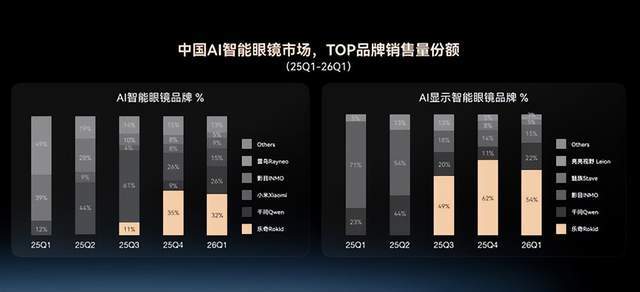
The AI glasses industry has experienced a period of rapid growth. Industry data shows that global AI glasses sales will increase from 240,000 units in 2023 to 1.53 million units in 2024, and reach 7.66 million units in 2025. Nielsen report data shows that in Q1 of 2026, Rokid’s sales accounted for 32% in the industry, ranking first. In the subcategory of AI glasses with displays, it accounted for 54%, leaving other players behind.
Zhu Mingming’s goal is not just about share. He hopes to push the competition from hardware parameters to a comprehensive competition of product definition, execution and ecology.
He defined this conference as the “iPhone 1 moment” for AI glasses, and defined the product that is fully sensory, fully intelligent and weighs less than 45 grams as the “iPhone 4 moment.” This route points to two interrelated issues, how AI glasses can become a device that users are willing to use every day, and how to further compete for the entrance to the next generation of personal smart terminals.
01. Let AI glasses become a product that you are willing to wear every day.
The three pieces of hardware released by Rokid respectively correspond to the three questions it wants to answer: What capabilities should a useful AI hardware tool have? How should people interact with AI glasses? What should be the ultimate form of AI glasses in the future?
The first is Rokid Glasses 2, the main product for tool scenarios. Compared with the previous generation, the new Rokid Glasses does not have many functional innovations. It mainly carries out systematic engineering optimization around “ease of use”.
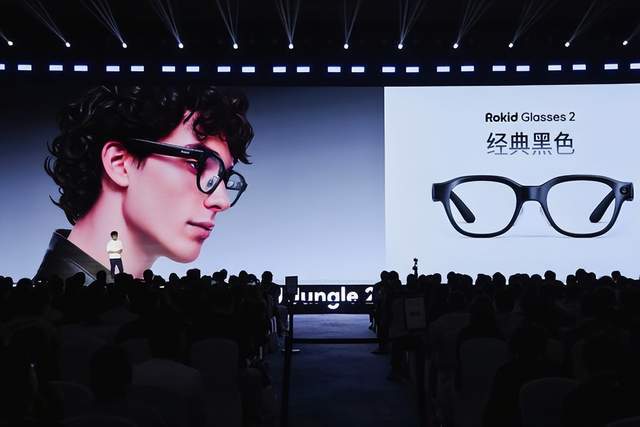
Common problems with AI glasses such as glasses clips, lens reflections, light leakage, low sound, poor sound quality, and discomfort when worn for a long time have all been targeted and improved in this generation.
The optical and mechanical volume of the new machine is reduced by 30% compared to the previous generation. The flexible temples, larger nose pad contact area and skin-friendly materials jointly improve the wearing experience. Magnetic custom-made glasses and sunglass clips cover different vision and usage environments. The display part reduces rainbow patterns and reflection interference, and the sound part adds new speaker units, Dolby certified sound effects, and a multi-microphone sound collection solution.
These upgrades serve a direct goal, allowing users to wear it longer. The battery capacity of Rokid Glasses 2 has been increased to 263mAh, an increase of 25% compared to the previous generation. The dual chips and dual systems allocate performance and power consumption according to task requirements. The overall battery life of the second generation is 50% higher than that of the first generation, which also includes optimization of the underlying system.
Rokid revealed the daily usage data of a group of users at the press conference. The average daily wearing time of purchased users is more than 6 hours, and the average usage time is about 3 hours. Teleprompt, translation and navigation are the most frequently used functions. For a class of devices that are still establishing usage habits, continued wear is often a better indicator of whether the product is entering real life than a single demonstration.
The AI function is the reason given by Lucky for “always wearing it”. Rokid Glasses 2 can combine sound and first-person perspective images to generate meeting minutes, summaries and to-do items, and supports AI call translation in 89 languages. Instant retrieval and all-day retrieval link conversations, events and photos. Users can ask “What did I just promise?” or let the glasses sort out the day’s experiences. Active reminders and personalized assistant configuration allow AI to gradually shift from waiting for questions to continuously understanding work and life scenarios.
Image upgrades also revolve around reducing operations. The pre-shooting preview allows users to confirm the viewing range before pressing the shutter. The 12-megapixel camera, HDR and RAW14 formats, and 4K 30fps and 2K 60fps video shooting expand the scope of first-person perspective recording. Users do not need to put down the activity they are participating in first and then look for their mobile phone to complete the recording. The shooting and experience itself can be synchronized.
It can be seen that the idea of Glasses 2 is to take away some high-frequency and lightweight scenes from mobile phones. For glasses to be worn for a long time, they must be more comfortable than taking out a mobile phone in these scenes.
This leads to two other needs. Can AI glasses display full color like mobile phones? Can AI glasses achieve a better interactive experience than smartphone taps? Lucky gave his own plan at the press conference.
The current mainstream AI glasses with displays all use monochromatic (green) optical waveguide display technology. There are glasses with full-color displays in the industry, but most of these glasses are reduced versions of previous AR glasses. The starting point is that AR is not AI.
Rokid Color is Rokid’s first full-color AI glasses, which will be delivered from April 2027. It is responsible for a product line that is more focused on content, social interaction and general experience. This full-color AI glasses weighs 55 grams, starts at 4,999 yuan, and uses a 0.16cc Micro LED full-color light engine. Color can distinguish navigation status, task progress and information priority, and also provide a more complete presentation of pictures, short videos, games and social content.
Zhu Mingming mentioned in the interview that after wearing them for the past two months, he has been able to consume more light content such as browsing Douyin, watching Bilibili and video accounts on the glasses, and the number of times his mobile phone has been taken out has been reduced.
The full-color display expands the content it can present, and the Rokid Ring complements how users respond. Micro-gestures such as left and right swiping, clicks, and double-clicks allow users to complete operations even when they are inconvenient to speak or need to browse continuously. Rokid product manager Zhang Tao said that the gesture recognition of the ring is completed inside the device, and the current accuracy rate has exceeded 95%, and the target is 97% to 98% when it is released. It also supports heart rate, body temperature, blood oxygen and sleep monitoring, priced at 1,699 yuan.
Zhu Mingming regards the ring as an important reason for the delay in the release of Rokid Color. The display solution had a clear path earlier, and the team spent more time looking for interactive methods with rich content. It took more than half a year to integrate the interaction between the ring and the product. The resulting product portfolio puts AI in charge of understanding intentions, glasses in charge of presenting information, and rings in charge of lightweight operations.
Glasses 2 continues to focus on tools and professional scenarios, while Color is aimed at more universal personal terminals. The two product lines jointly aim at a daily experience with less heads down, less switching, and less interruptions.
02. From product definition to the next generation entrance battle
There are two key time nodes in the history of smartphone development. The release of iPhone 1 and iPhone 4. The former completed the definition of smartphone products, and the latter promoted smartphones from a technology product for niche geeks to a wider range of users through ease of use.
In Zhu Mingming’s narrative, AI glasses will also have their own “iPhone moment.”
The core of what Zhu Mingming calls the “iPhone 1 moment” is that display and interaction begin to form a closed loop. The full-color technology roadmap is gradually becoming clearer, the ring is supplemented with continuous browsing and micro-gesture operations, and the smart body gives the glasses the ability to understand tasks and call services. Industry competition has shifted more towards product definition, mass production execution and ecological construction.
The next stage goal he gave is equally specific, which is to reduce the weight of the product to less than 45 grams while retaining the camera, display, AI and battery life. Weight is related to battery, power consumption and computing power, and is also the key to bringing AI glasses closer to the wearing experience of ordinary glasses. “Today I say it is the iPhone 1 moment, and I define an iPhone 4 moment. My definition is that the Rokid Color product is reduced to less than 45 grams. If it is reduced by 10 grams, it can basically kill most smart terminals.” Zhu Mingming said.
The success of smartphones relies not only on innovation at the hardware level, but also on the software ecosystem. Rokid also puts more chips on the open ecosystem. According to data released by the company, there are more than 45,000 registered developers on its platform, more than 12,000 intelligent agents have been developed, and more than 700 intelligent agents have been put on the shelves.
At the press conference, Rokid also demonstrated its cooperation with partners such as Xiaohongshu, Meituan, Tencent Travel Services, What’s Worth Buying, Qianwen Office, etc., covering local life search, scanning QR codes to open cabinets, calling a taxi with one sentence, product identification and office tasks. Glasses thus gain access to real services, and developers can supplement applications around fragmented and personalized needs.
Picture source / Rokid official website
This open approach also explains the relationship between Rokid and major manufacturers. Today, in addition to startups making products such as AI glasses, major technology and Internet companies are also important participants. Xiaomi, Huawei, and Alibaba all have their own product systems, and they are also very popular in the market.
Zhu Mingming divides the actions of large companies into protecting existing businesses and exploring new areas, and Rokid is more involved in the latter. For the Internet platform, glasses provide a new service entrance. For Rokid, partners with existing user scale and service capabilities can speed up the implementation of the scene. The two parties have cooperated around new terminals, allowing a startup to connect the core businesses of multiple large Internet companies at the same time.
When talking about the next development plan of Rokid, Zhu Mingming mentioned that Rokid will focus on exploring device-side AI and Small Language Model, so that more personalized capabilities can be run on the device side, and the cloud will undertake long and heavy tasks. Glasses continue to be close to the user’s audio-visual environment. Device-side capabilities are related to response speed, personal habits and naturalness of interaction, and will also become an important source of product differentiation.
Regarding the competition window, Zhu Mingming gave a rather optimistic judgment. He believes that it will be difficult for Rokid Color to meet direct competitors within next year. If measured in terms of mass production, the lead window may be longer. He also described a win-win phenomenon in the early stages of the industry. When other manufacturers held press conferences, Rokid’s sales also increased. New players jointly educate the market, which can expand the entire category more than simply competing for existing users. Rokid’s current choice is to continue to gain territory through product definition and ecological construction.
These layouts ultimately point to changes in how mobile phones are used. Zhu Mingming used his own usage data as an example. Before wearing glasses, he used his mobile phone for about 11 and a half hours a day, and now he uses his mobile phone for about 6 and a half hours. A large number of notifications, light content, translation, navigation and recording needs can already be completed on glasses. He predicts that glasses may be used longer than mobile phones by the end of next year or the year after that, and the relationship between glasses and mobile phones will gradually approach the relationship between mobile phones and computers today. Mobile phones continue to undertake complex and heavy tasks, and glasses take over higher-frequency and more immediate daily interactions.
With the development of AI today, on the software side Personal Agent is gathering functions scattered in different software under the user’s intention. On the hardware side, AI glasses also have the opportunity to transfer the operations scattered in the mobile phone to sight, voice and micro gestures. The release of Rokid is to dismantle this migration into products that can be worn, viewed, operated and connected to services. As for how quickly the change in user habits will occur, the market has yet to give an answer.
Related Reading
- The newly crowned richest woman in China has cut her company’s net profit in half!2026-10-29
- Humanoid robots are about to produce big results!2026-10-29
- Touchscreen MacBook Pro hands-on experience: It will shine as it becomes lighter and stronger. Why is it worth 110,000?2026-10-29
- So weird! The drone carrying a coffin up the mountain shocked the entire Internet. How will AI change the funeral industry?2026-10-29
- Hongguo shakes Tencent Games? True stories of 5 players2026-10-28