Text | Treasurer Finance, author | Vincent, editor | Jiajia
The Apple conference in September this year has an iconic symbolic meaning – its new CEO Ternus publicly hosted the entire event for the first time and released Apple’s new products. This also means that Cook has officially retired.
For most Apple fans, this is good news. Although Apple has soared in terms of market value, revenue, and brand image in the past few decades, many geeks are fed up with Cook’s pragmatism and small steps in product innovation. Apple’s products no longer have the amazing feeling of the Steve Jobs era.
This time Ternus, who has a background as a hardware engineer, becomes the new CEO. In the eyes of many people, Apple seems to be returning to the “innovation is king” product logic of the Steve Jobs era.
But for Apple, is it really a good idea to downplay Cook’s supply chain operations logic? Can Ternus, who comes from a hardware product background, really take Apple to new heights?
01 Performance reaches its peak
There are two extremes in outside comments about Cook. One side believes that Cook is the most successful CEO in Apple’s history because he allowed Apple to get rid of the personal influence of Jobs and transform it into a consumer company with sustainable development in a secular sense.
This can be seen from many data indicators.
In terms of market value, when Cook left office, Apple’s market value exceeded US$4.6 trillion. In the Steve Jobs era, Apple’s market value was only US$350 billion. In fifteen years, its market value increased 13.2 times.
In terms of market influence, in the Steve Jobs era, the iPhone was more of a symbol of geeks, and its market share once dropped to 10%. However, in the Cook era, the iPhone has transformed from a geek electronic item to a global fashion category. Its market share is stable at 16%, and it has captured more than 65% of the high-end mobile phone market share.
In terms of revenue, Cook directly increased Apple’s revenue from US$108 billion (fiscal year 2011) to US$416 billion (fiscal year 2025), a full 3.9 times increase. Moreover, Cook also changed Apple’s pure hardware revenue structure. In fiscal year 2025, service industry revenue surpassed hardware products and became Apple’s largest revenue pillar.
On the other hand, many people believe that behind Apple’s rapid performance is catering to the market and lack of innovation. At the annual press conference, iPhone innovation is like squeezing toothpaste.
From a product level, Apple in the Cook era was lackluster. Apple Watch was launched in 2015, AirPods in 2016, and Apple Vision Pro in 2024.
The market response of Apple Watch and AirPods has been very good, and the sales volume is also very good. However, in the eyes of many consumers, these are more micro-innovations, unlike the Macbook that was poured out of the brown paper bag during the Steve Jobs era, nor the iPhone that pioneered touch-screen mobile phones.
Apple Vision Pro, the only product with imagination and innovation, had limited market response and did not stir up much splash.
It can be said that in the past fifteen years, Cook has helped Apple reach the peak of a company’s performance, but for consumers, what they see is that Cook keeps squeezing out toothpaste in order to make money, and none of them can be called epoch-making hardware products.
02 Can innovation be reignited?
Cook’s focus on the direction and logic of operating light product innovation stems from Cook’s professional background.
When he joined Apple in 1998, Cook served as senior vice president of global operations, responsible for supply chain integration. After 2005, Cook became Apple’s chief operating officer, focusing on back-end supply chain, inventory, and sales.
It can be said that before becoming Apple CEO, Cook worked in operations and supply chain. Therefore, some people commented that Cook is an operations master who can implement Jobs’ ideas.
It can be said that the professional background of the company’s top leader determines the strategic direction of a company. If you look at it from this point of view, many Apple fans are immediately excited, because unlike Cooke’s operation supply chain, Ternus is a hardware product background.
Ternus graduated from the University of Pennsylvania in 1997 with a major in mechanical engineering. He joined Apple’s design team in 2001 and served as Apple’s vice president of hardware engineering in 2013. In 2021, he was promoted to senior vice president of hardware engineering and entered the top management.
Judging from his resume, both in terms of educational background and position at Apple, Ternus majored in technology research and development. According to the above rules, after serving as Apple CEO, Apple’s strategic focus will shift from operations and supply chain to product innovation and research and development.
It is worth noting that at this autumn conference, Apple released its first foldable screen phone, iPhone Duo, which uses a Samsung panel and a liquid metal hinge to achieve a crease-free screen.
“Back then, Apple didn’t want the iPad to be just ‘an enlarged iPhone’; now, it also doesn’t want the Duo to just mechanically stretch mobile phone applications after unfolding.” In response to Apple’s move into folding screen phones, Ternus said that the release of the iPhone Duo is the joint result of Apple’s rethinking of hardware structure, software interface, operation methods and industrial design.
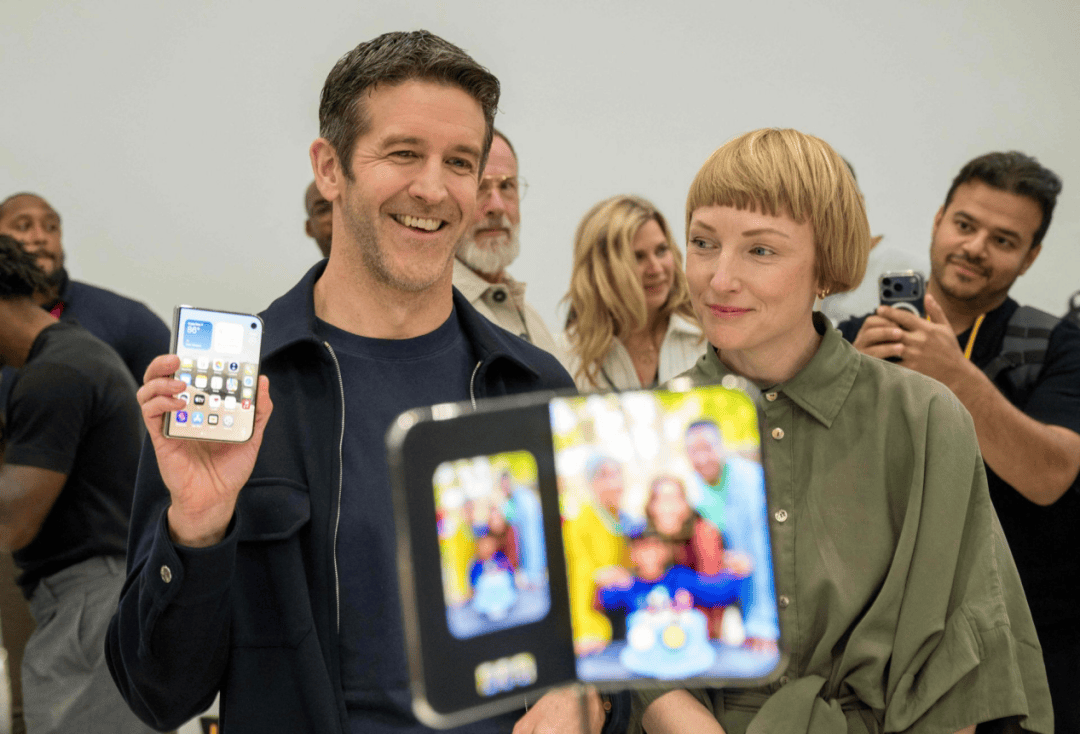
Whether it is the release of the iPhone Duo or Ternus’s statement after the press conference, this seems to indicate to the outside world that unlike Cook’s conservative product innovation, Apple in the Ternus era will make strides in innovation and return to the amazing era of Jobs’ era when product innovation was king.
But can this new CEO, who has been responsible for product hardware research and development at Apple, really bring Apple back to a new era of product strength?
03 The resurgence of innovation is a fantasy
Whether Apple’s inertia strategy of focusing on operations over products can be reversed depends on the ability of Ternus on the one hand, and the will of Apple on the other.
Let’s talk about ability first. Unlike what everyone thinks of as a skilled person, Ternus doesn’t have many amazing performances in Apple hardware products although he is the person in charge of hardware products.
The most direct manifestation is the “three-piece set” of Apple’s innovations in the Cook era – Apple Watch, AirPods and Apple Vision Pro. As mentioned above, Apple Watch and AirPods are micro-innovations and have won the market, but they have no epoch-making performance. Apple Vision Pro has lost both reputation and sales.
The important thing is that these three relatively mediocre products were all developed by Ternus. From this point of view, compared to the Steve Jobs era, when Apple was full of unbridled creativity and extremely serious about its product capabilities, Ternus is more like a technical director who has completed R&D upgrades.
The second is Apple’s willingness at the company level.
For most Apple fans, they expect Apple to launch an epoch-making product again. This is only the expectation of our C-end fans. But for Apple management, the most important thing is not that Apple products can stay in history, but to maintain performance growth.
During the Cook era, Apple’s growth points came from service businesses such as App Store commissions, iCloud+ subscriptions, Apple Music/Apple TV+, Apple Pay and AppleCare.
In the current era of AI explosion, whether it is Ternus or Apple’s management, for them, the way to maintain Apple’s performance growth is not hardware products, but AI business.
“AI has opened the door to new categories, and we are extremely excited about the roadmap.” In a recent media interview, Ternus made it clear that AI is Apple’s future direction, and the new opportunities brought by AI are the biggest driving force at the moment.
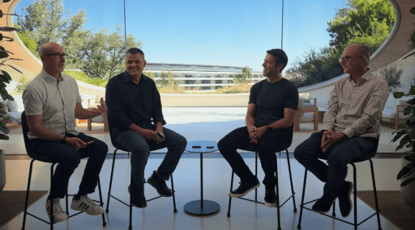
But the problem is that although the growth direction of the Ternus era has been set, for Ternus, he has a not so good card:
In January 2026, Apple and Google jointly announced a multi-year AI cooperation agreement, with Gemini driving the next generation of Apple Foundation Models and paying Google about $1 billion in license fees every year. This means that Apple has officially abandoned the self-developed large model route and adopted the Google Gemini model on the AI infrastructure.
In June, Apple released Siri AI, which has been improved in aspects such as personal context understanding, screen perception and visual intelligence, and cross-App operation. However, Bloomberg stated after testing that the overall capabilities of the current new version of Siri are roughly equivalent to the level of the head AI chatbot about six months ago.
You must know that large global models are already doing multi-step Agent tasks, such as collaborative office and deep reasoning, and Siri AI is more like a qualified conversational assistant.
What’s more important is the loss of talent in Apple’s AI team. According to media reports, from June 2025 to January 2026, more than a dozen AI researchers from Apple’s AI team have resigned and switched to giants such as Meta and Google DeepMind, including Stuart Bowers, one of the highest-level directors of the Siri team.
It can be said that Ternus inherited not only the giant left by Cook, but also an Apple that fell behind in AI.