It turns out that theater chains represent high aesthetics and high quality. How come AI movies are now able to get the Dragon Award and be on the screen?
文|榮婧
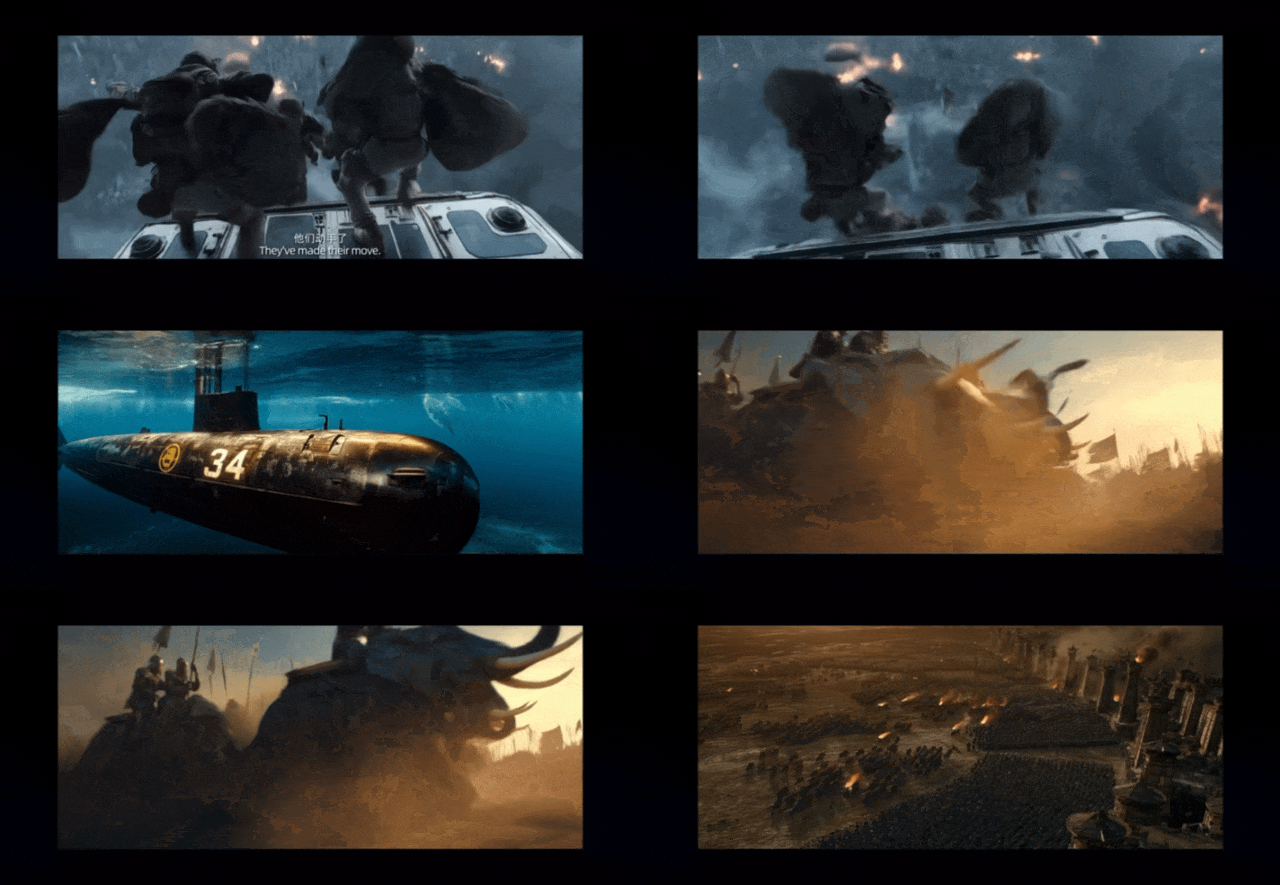
The high-tech spaceship pierced the smoke-filled sky, and the flames of the heavy machine guns burst out one after another. “Wu Lei” was seen doing a neat rollover to avoid the bullets, and hugged an astronaut with his backhand, covering his evacuation from the scene. When the camera turned, the scene was suddenly transported to ancient times. Not only were primitive tribes beating coconuts, but there were also scenes of living people being sacrificed to the sky.
An audience member next to him had the look of a “grandpa on the subway looking at his cell phone” and couldn’t help complaining: “It feels like several different group assignments have been put together. Why do you take pictures wherever you dream?”

However, netizens followed the video clips to the film introduction and discovered that this was not a new film by Lei Wu at all, but a completely pure AI movie.
Since the advent of AI, new things have emerged one after another, and the “first xxx” has been released one after another.
In August this year, the first all-AI talent show variety show “Starlight 108” was launched on Douyin, and then the first all-AI production long drama “Journey to the West” was launched on Hunan Satellite TV’s prime time slot. While the audience is still marveling at the speed at which AI has conquered the city and debating “whether AI can replace real people and produce high-quality film and television content,” the enterprising AI has already trotted along and passed a higher industry threshold – AI movies are really here.
On October 23, “Sanxingdui: Days of Future Past”, China’s first fully AI-produced theater movie to win the Dragon Award, was officially released.
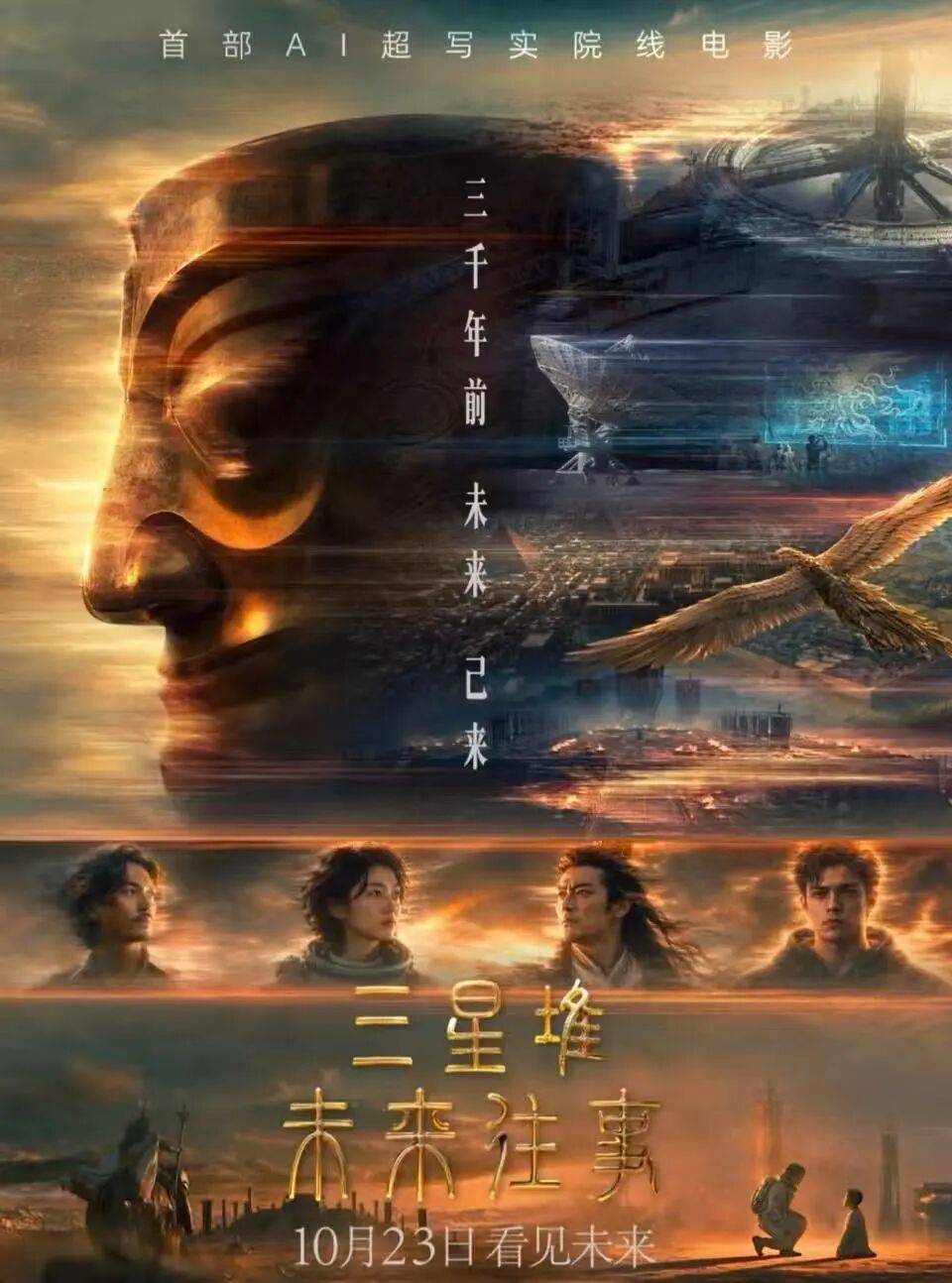
This AI movie is 100 minutes long and has no real actors or live shooting. Maoyan Professional Edition shows that as of press time, a total of 13,310 screenings have been scheduled. The cumulative number of people wanting to watch it on the platform is less than 6,000, and the box office on the first day was only 100,000 yuan.
Then I lowered my head and looked at the ticket price on my phone. It was 67.9 yuan, and the cheaper one was 41.9 yuan. It’s no wonder that netizens complained: “It’s okay if a movie made by AI is cheaper. Why should we pay the same price as a real movie to go to the theater?”
At present, the market’s acceptance of AI cinema movies is generally low, and there are very few people who are willing to pay real money to be the “first batch of people to eat crabs.”
“Who on earth would buy a ticket to watch a movie like this? They won’t all be stock investors, right?” Although this statement is more of a joke, the film’s producer, Bona Pictures Group, did have its stock price take off before the film was released. On October 12, the stock price of Bona Pictures reached the daily limit, achieving two consecutive daily limit and three daily limit in six trading days.
When it was released these two days, the audience who bought tickets also began to discuss it intensely on various platforms.
“Watching an AI movie is like eating a pre-prepared dish. It’s all delicious and delicious, but it doesn’t have the spirit and soul of freshly cooked food.”
“Some pictures can’t even be seen to be made by AI. The production is pretty good. The integration of AI into all aspects of life is definitely a future trend. Come and witness it in advance.”
But the most commented ones still tied this AI movie to the hit “Niu Lai” two months ago. Many netizens lamented: It used to be that theaters represented high aesthetics and high quality, but now how come all movies can get the dragon label and be on the screen?
01
The most “facially paralyzed” acting skills in all domestic entertainment,
都在這了
I have to admit that when the movie first started, I was really surprised by the texture of some of the pictures. The majestic bronze sacred tree rising from the ground, the clearly visible graininess on the surface of the bronze giant, the mysterious and treacherous lines on the Zongmu mask… broke our inherent perception of rough and cheap AI pictures.
Even the characters’ faces look very real at first glance.
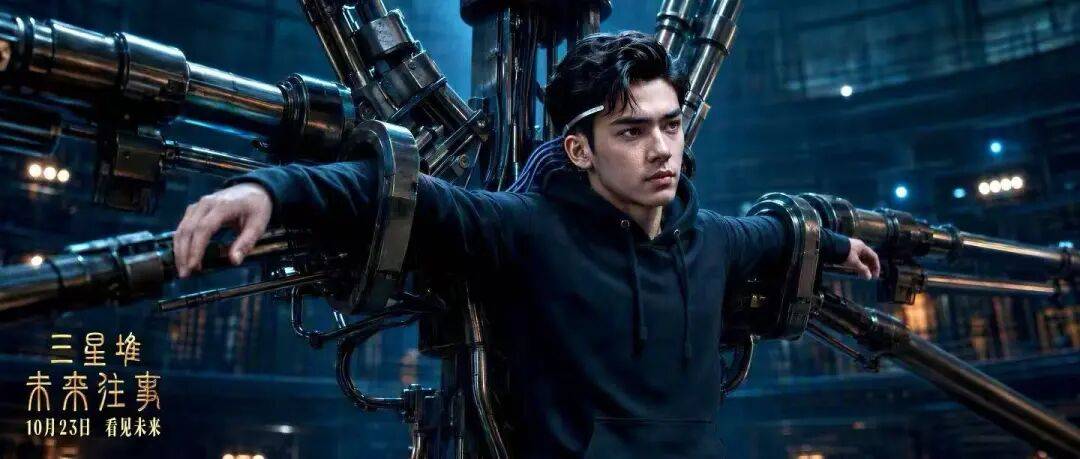
But if you watch it later, you will notice something is wrong. All the characters in the movie have a sense of facial paralysis that is as calm as water and calm. The leader only frowned slightly when faced with the dilemma of making a decision when faced with the space warning; the archaeologist was shocked when he discovered seven mysterious talismans and just opened his eyes wider; the most impressive thing is the teenage version of Silkworm Cong, with a large cut on his neck, not a drop of blood, and no reaction, as if “a light touch will make things smooth”… After seeing this, I finally understand why most of the trailer is full of close-ups of scenes and characters, and I seriously suspect that it is for fear of revealing the truth.
Coupled with the standard pronunciation of all the news anchors and the heart-burning lines of “It’s not…but…”, the more people watch, the more the drama becomes, and these emotional dramas are often the key to supporting the tension of the plot.
圖源:Screenshot from the trailer of “The Future of Sanxingdui”
Some viewers said bluntly: “Even if this movie is shot in real life, it won’t be good. The key lies in the plot.”
And how creative is the plot of the first AI movie? It used AI to film a story about AI crisis, which has a sense of absurdity like “Peach Blossom Man vs. Chrysanthemum Monster”, which can be called the AI version of “I scold myself.”
The story is set 3000 years later, when super AI sweeps the world. Human beings take the initiative to implant AI into their brains and hand over all decisions to algorithms, but instead drag themselves into crisis. Xiling, the only female astronaut in the world who is not controlled by AI, was sent on a spaceship to travel back in time in an attempt to rewrite history. As a result, she accidentally fell into the ancient Shu era while traveling through a wormhole. Then there were many “intellectual” scenes, including but not limited to: the past Human bronze casting technology and sericulture technology were taught by future people who “traveled” to the past; future people had “ships” made with super-powerful technology, but they were conquered by ancient kings without even a single soldier; there was even an outrageous episode in which the ancients went to Egypt on foot to overthrow the Pharaoh.
To make matters worse, the movie uses a multi-line narrative technique throughout, with at least five parallel timelines. If you look down at your phone midway, you will think you are watching a new movie when you look at the screen again. After the movie ended, I had a 10-minute discussion with the two audience members before we pieced together the whole story. The threshold for watching the movie was extremely high. After watching it, I just want to apologize to the masterpiece “Dwelling in the Fuchun Mountains” that year. This drama is truly “filmed wherever I dreamed.”
However, the theme of the film is quite special, combining the two major fantasy and science fiction themes of ancient Shu civilization and future AI crisis. Friends who often watch short dramas will probably find that these two themes appear most frequently in AI short dramas. Why is AI particularly passionate about this?
Because it is good at special effects rather than touching plots.
Some netizens commented: “What’s the use of big special effects? In traditional movies, special effects can’t save the movie. Can it be done in the AI era?”
This truth has long been verified by the AI short drama market. Pure AI short dramas have been popular for more than half a year. The ones with the widest audience and the best reputation are idol dramas and realistic themes such as “Laid Off Girl” and “Beautiful Malice”. They rely on striking the emotional resonance of contemporary people, cleverly reversed plot rhythms, and a sense of connection that is fast enough, and have little to do with visual novelty and impact.
Moreover, the reason why audiences were willing to pay for big special effects movies before was mainly due to the real cost of funds, manpower and time behind the special effects, and the sense of scarcity created by spending real money. But when AI makes special effects production affordable, affordable, and efficient, the audience’s aesthetic threshold will only rise with the tide. Everything you do is taken for granted, and no matter how exquisite the picture is, you can only get the sentence “the prompts are well written.”
No matter in which era, the core of the story is the fundamental thing that impresses the audience. No matter how advanced the tools are, they are still just means.
02
AI makes movies,
Far more difficult than imagined
In public perception, AI movies are a business where you can make money by inputting a few prompt words and generating a movie with just one click. However, the process of producing and obtaining the Dragon Award for “Sanxingdui: Days of Future Past” was far more difficult than we imagined.
From the perspective of the film crew, the team’s starting point for making AI movies was actually the frustration of “not being able to make a film”. According to Bona CEO Jiang Defu, the team initially wanted to make a live-action movie in Sanxingdui. However, the initial design was too grand and the cost was as high as 800 to 900 million yuan. “Now the market cannot achieve such a high return, and the risk is very high.”
At that time, they decisively chose to suspend the project until the development of AI technology later gave them a new way out. In July 2024, the team produced the AI short drama “Sanxingdui·Future Apocalypse”, which received more than 200 million views and discussions on the entire network. This successful test gave confidence for the subsequent production of AI movies.
But the success of short plays does not mean that feature films can be easily copied. The giant screen in a movie theater will magnify every detail. The “AI flavor” that can be tolerated in a short play will become a fatal highlight in a theatrical feature film. In order to withstand the scrutiny of the audience, producer Qu Ji Xiaojiang said frankly that the production cost of the film was 20 million yuan, and “the crew totaled nearly a hundred people.”
This figure is considered a very expensive movie in the field of AI, but it does save a lot of money compared to real-life movies. When Shen Teng was filming “Hello, Li Huanying”, his seven-day fixed salary was as high as 30 million yuan. The entire production cost of “Sanxingdui: Days of Future Past” was not even enough to support the four-day filming salary of A-list stars of the same level.
However, on the other hand, saving money does not mean saving trouble. On the contrary, the production of AI movies has encountered two major hurdles.
The first difficulty is to solve the problem of inconsistent pictures.
In a feature film, the details of each character’s face and the folds of a suit of clothing need to remain stable between different shots. But the images generated by AI are random. Maybe one second your protagonist is still a European and American face with deep outlines, but the next second his race may have changed and he has become an Asian face with soft features. It is very difficult to ensure that the faces of the 7 or 8 main characters in the movie remain stable for 100 minutes, while taking into account the unity of the scene, light and shadow. For this reason, the team had to look at the details frame by frame. After one group of people finished watching, another group of people had to look at it, find different problems, add frames, and make adjustments again and again. The whole process was boring and painful.
The second difficulty is to adapt to the continuously upgraded AI model.
The production cycle of the film lasted for 2 years, and the generative AI model was updated almost every month. Whenever the underlying model is upgraded, the prompt word skills, parameter settings, and standardized workflow that the team spent several months polishing may immediately become invalid, requiring multiple debuggings, and the production cycle will also be extended.
Faced with these difficulties, the core solution given by the team is “people lead decision-making and AI is responsible for execution.” From the story script, scene structure, shot scheduling to performance logic and overall art style, all core links were designed and finalized in advance by the creative team; the basic image of the characters and the restoration standards of Sanxingdui cultural relics were all finalized by professional artists to provide a clear reference for AI to ensure the quality of the film.
Even after completing the production stage, there is still a longer review process waiting for the team.
The film was first submitted for review in September 2025. It has completed hundreds of adjustments and modifications to the plot and content details. It was not until 4 months ago that it officially received the animation dragon mark. After the dragon mark, an exclusive line of AI logo was added, stating that “all the images and some sounds of this film are generated by artificial intelligence.”
However, the film received the title of “Electronic Review”. Since China has not yet established a dedicated AI film review channel, many AI film and television projects that have tried to hit theaters have only obtained online broadcast qualifications due to unclear regulatory rules. In this context, it is a pragmatic path for “Sanxingdui: Past Events” to choose “electronic review and dynamic characters”. “It is equivalent to classifying itself into a mature animated film review system and taking an access path with clear rules. If it wants to directly benchmark the standards of live-action feature films, I am afraid there is still a long way to go,” said an AI film and television creator.
At the same time, according to the explanation of the relevant animated film producer: “The technical review of the film only focuses on the safety and stability of the screening. As long as the content does not violate red lines and the procedures are in compliance, you can get a public screening permit.” This means that what Longbiao guarantees is “can be placed” rather than “good-looking”. This misalignment between censorship standards and public aesthetic expectations is the core reason why many viewers are confused about “why AI movies can also go to theaters.”
03
The golden brand of cinema chains is depreciating
After watching “Sanxingdui: Days of Future Past”, many viewers will subconsciously think of “Niu Lai”, a theatrical blockbuster that made its debut in August this year. Both started with small-scale films, broke into the public eye by relying on topicality, and opened the door to theaters at low cost.
The popularity of “Niu Lai” is accidental. The audience may go to the theater once out of curiosity, but it is difficult to pay for similar content again. But it has really set a precedent: whether it looks good or not is secondary. As long as you go through the compliance process, get the dragon label, and create topics, you can make money at a low cost.
The release of “Sanxingdui: Days of Future Past” this time seems to indicate that the film industry is increasingly embarking on the path of “betting on box office rather than reducing investment”. Even large companies that were once known for their large productions and high costs no longer simply pin their revenue hopes on the box office success of their films, but have begun to try to control cost investment with the help of tools such as AI.
Theater movies, which once represented high investment, high production, and high-quality endorsement, are losing their authority.
Behind this chaos is actually the structural dilemma of the theater market. In the first half of 2026, the national movie box office performance was mediocre. According to data from Maoyan, Tuopu and other institutions, the total box office was only 17.356 billion yuan, down 40.6% year-on-year. There is also a serious “winner takes all” phenomenon: top hits ate up nearly one-third of the box office, leaving small and medium-cost films with a narrow living space. The daily attendance rate continues to be sluggish, with the average attendance rate being only 5.7%, and a large number of screens are idle during non-prime hours.
If theaters want to survive, they can’t just rely on a few blockbusters every year. Filling the venues, tapping audience segments, and undertaking various novel contents have become inevitable choices. As a result, we have seen that odd and bad movies can be released, AI movies can be released, and even various re-releases of old movies, concert broadcasts, and live sports events have all been squeezed into the cinema’s schedule. As long as there’s a topic, an audience, and people willing to pay, it’s worth putting out a show to test the waters. Therefore, this orientation has also been transmitted upstream. Film production pays more attention to topicality and gimmicks. As for the content itself, it has become unimportant.
Regarding the lowering of the threshold for theater chains, some people think this is a bad thing, a compromise by theater chains, and the end of the era of good movies; others think this is a good thing, as it breaks the monopoly and allows more diverse creations to have the opportunity to appear on the big screen. But it is undeniable that when the audience walks into the theater with expectations again and again and returns disappointed due to the quality of the content, it consumes the trust of the entire theater chain.
今日互動
Are you willing to pay to go to the cinema to watch an AI-generated movie?
你覺得How about the AI movie “Sanxingdui: Days of Future Past”??
Leave your thoughts in the comment area
Related Reading
- Original overseas “red fruits”, harvesting the world?2026-10-27
- Original iPhone Duo, aren’t you giving Ternus eye drops?2026-10-26
- Arrested! A generation of chip giants fell into gambling2026-10-26
- The mother-in-law also started snatching AI people2026-10-26
- Five million Chinese doctors are being competed for by major Internet companies2026-10-25