問AI· What wealth expectations are hidden in the matchmaking AI company?

Recently, OpenAI has even worried about the luck of its employees.
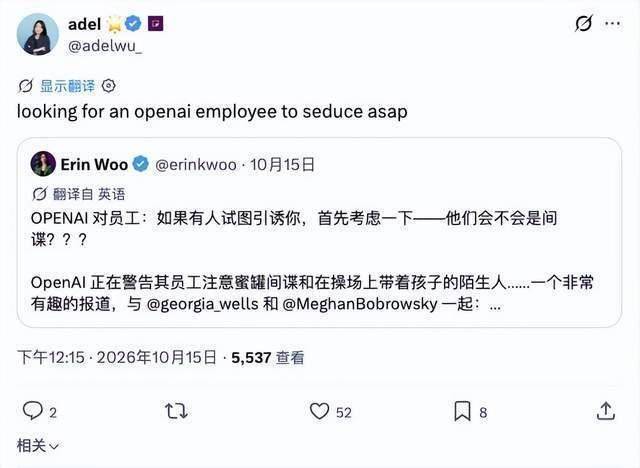
According to reports, OpenAI reminds employees in its counterintelligence training that outsiders may use romantic or sexual relationships as bait to approach them and obtain company secrets. Also known as ” 美人計”。
You think the other party is interested in you, but the other party may be more interested in your company’s secrets. Someone summarized this matter as “OpenAI reminds employees not to forget that they are ugly and boring.”
This information is a bit subtle in today’s Silicon Valley.
In fact, when someone hears that you work at OpenAI, they want to get to know you. In today’s dating market, this is really not surprising. This may also be why using a “honey trap” to approach OpenAI employees can work – it is indeed very common.
In the eyes of Bay Area matchmaking agencies, employees of OpenAI and Anthropic have been ranked among the ” 第一梯隊”。 When a client is looking for a partner, he or she must specify which company the partner works for. Some people’s plans for choosing a spouse go far beyond “finding a partner with a high salary.” While I was still in China, I began to consider settling in Silicon Valley.
The technical nerd who was always ridiculed for his incomprehensible style has now become someone’s target. Some people find people cute if they are smart, have a high income, have a promising career, or are not very social.
AI companies are grabbing people, and so is the blind date market.
A
“To me, marriage now is an asset restructuring.”
The person who said this was a Chinese female entrepreneur in her 40s.
She is divorced and currently lives in China with her son, and is planning to settle in Silicon Valley. For her next husband, she is particularly interested in someone who works for an AI company that is preparing to go public and has stocks that may appreciate in value.
She explained that ordinary salary income may not have much left after paying taxes. In contrast, she hopes to find someone who can make her see her future prospects clearly.
Among those looking for marriage across borders, the most popular ones nowadays are the AI people in Silicon Valley.
Qinghua Zhao, the founder of the Chinese dating platform 2RedBeans, has observed this change.
This platform mainly provides online dating, offline activities and matchmaking services for overseas Chinese men and women. However, it has also extended its business to China. The official website introduces cross-border marriage and love consulting services for women over 35 years old in Greater China.
In Zhao Qinghua’s recollection, customer requirements have become more and more specific in recent years.
Earlier, the Chinese customer said that he hoped to find a destined person on the east coast or west coast of the United States. Later, the location gradually narrowed to Silicon Valley, and the career was focused on engineers.
Later, it was no longer clear enough to be an engineer, it was best to be an AI engineer.
Nowadays, this mate selection list can even be accurate to the company. The “first echelon” listed by Zhao Qinghua is Anthropic and OpenAI.
The reason is not difficult to understand. To her, the prospect of these companies going public, and the wealth their employees might gain as a result, is part of the appeal.
Moreover, some people in Silicon Valley have turned this imagination into real money.
In October 2025, current and former employees of OpenAI sold a total of $6.6 billion in shares, of which about 75 people cashed out about $30 million each.
The company hasn’t even gone public yet, but a group of employees have already made a wealth transition. No wonder even the name of the employer becomes particularly important when a matchmaking agency introduces a partner.
There are still several doors between seeing the wealth news of this group of people and getting to know them in reality, so matchmaking companies and platforms come into play.
Amy Yang, a Bay Area matchmaking agency, used to work as a tax analyst at Oracle and now matches people. She mentioned that many technology practitioners enter the company directly from school, and their colleagues and friends also have similar backgrounds. Work already takes up a lot of time, and their social circles are relatively fixed, so they may not be used to approaching strangers.
Therefore, matchmaking agencies find partners for clients, which is a bit like headhunting.
Zhao Qinghua will first check the platform’s member database, and then ask friends in large factories for recommendations. Amy Yang also uses friends, past clients, industry contacts, and even other matchmaking agencies for help.
The other party also has its own filtering conditions.
According to Amy Yang’s observation, even if the man is already an AI scientist, he will hope that the woman has at least a college degree and a stable job in the Bay Area. Zhao Qinghua said that these men who have received long-term technical and logical training often hope that their partners will be warm and understand them.
On the one hand, we are looking at the company’s growth prospects, and on the other hand, we are also looking at academic qualifications, work and the way we get along. In the story of cross-border mate selection, both parties bring their own lists.
The change in preferences in cross-border marriages is just a signal. In fact, AI people are really popular regardless of whether they are cross-border or not.
B
Kinjal Nandy, a 21-year-old AI entrepreneur, prepared a “Girlfriend Needs Document” for himself.
Yes, he imitated the requirements documents written by technology companies when developing products, but this time, he filled in the requirements into the mobile phone memo: high emotional intelligence, independence, and willingness to establish boundaries.
Nandy is the co-founder and CEO of San Francisco AI startup Sonatic. When chatting, he would occasionally talk about “potential space” and “scalability”.
When you are looking for a partner, you still have to create a document. It seems a bit self-respecting. From this move, it is not difficult to see that Nandi is at a high position in the marriage and love market.
At least in the eyes of some Bay Area dating agencies, there is quite a market for this kind of technical geek temperament.
Amy Andersen, the founder of high-end dating agency Linx Dating, found that whenever she told a potential date that a certain male client rarely appeared online, the response was often: When can I meet him?
Even the lack of aesthetics in life photos may be understood as an advantage – this person seems not so keen on showing himself off and not so narcissistic.
A bit introverted, but can be down to earth. He is not very good at observing words and expressions, and may be considered cutely clumsy. In the past, introverted, smart, slightly nerdy engineers might have been overlooked, but now these types of people are getting more and more attention.
Female practitioners are equally welcome. After Annie Liao, a 25-year-old AI entrepreneur, moved from Sydney to San Francisco to develop her project Build Club, her dating profile received a large number of messages from men. The attention was so overwhelming that she began avoiding dating apps altogether.
For most AI people in Silicon Valley, the benefits of being popular in the dating market are obvious. After all, I am usually too busy with work and 996 is the norm, and I have no time or opportunity to meet the opposite sex. A popular saying in Silicon Valley: Stay single before Series B financing。
Domestically, trends in dating corners have also changed.
The Yangtze River Daily reported that in May, open umbrellas and A4 marriage papers crowded the path at the dating corner in Zhongshan Park, Wuhan. The matchmaker took the registration book and introduced the young man who was doing microchips in Optics Valley.
Local reports gave the group a title: “ 光電郎”。
This scope is broader than AI engineers, including technical practitioners in chip, artificial intelligence, storage and other fields.
According to the information displayed by the matchmaker, the man was born in 1992, has a PhD from the University of Nottingham in the UK, and works as a senior chip engineer in Optics Valley. She described that when information with similar conditions is posted, it is often “snatched” within a week or so.
What’s even more interesting is that parents who are looking for a partner for their children will also talk about Wuhan’s plans to develop storage and optoelectronics industries, and take the city’s industrial prospects into their judgment.
Matchmaking agencies in Silicon Valley discuss the listing prospects of AI companies, and parents in Wuhan Dating Corner discuss the direction of the local industry. Across the ocean, everyone is using their own judgment on the industry to imagine a person’s future.
To be grounded, it means living with this person and whether you will succeed in the future.
However, the industry outlook is constantly changing.
C
There is nothing new under the sun.
Nowadays, AI talents are in high demand in the marriage and love market. It reminds people of the time when major Internet companies were running wild ten years ago. Zhongguancun’s “plaid shirt” programmers were also ridiculed and became the king of the marriage market. Nowadays, if you have nothing to do with AI, it is no longer easy to just rely on the halo of a big company. Your date will only think that you are busy at work and may be optimized at any time.
Further back, in the Internet bubble at the turn of the century, technology practitioners in Silicon Valley encountered ice and fire.
Looking through old reports, in 1999, a bachelor party in Silicon Valley dared to make a promise to women: if they failed to meet at least one good man, they would get a refund. When the organizers promoted local men, the selling points they used were the same as the traits that are popular today, which are nothing more than good academic qualifications, stable jobs, and money.
According to an organizer at the time, 1,000 men and women had signed up, and applicants even came from Canada and London.
As for how useful the signs of technology companies are, a bartender in San Francisco recalled that when the Internet was booming, men could attract women’s attention by directly telling them their company, income and car they drove.
The name of the company is almost the opening statement.
But once the Internet bubble burst, stock prices fell, companies closed down, and the company names and positions that were originally used to support the situation were no longer so effective. There were reports in 2002 documenting this change.
Andrew Stern, who was in his 20s at the time, worked as a business development director at Bang Networks. He found that titles such as Internet company CEO and business development director were no longer as popular as before. People are no longer keen to talk about how their companies will conquer the world.
He himself carries a title that is losing its appeal.
The topic of the meeting also changed. From asking what the other person does for a job, to asking if they have a job first. In Stern’s view, there is nothing to be ashamed of even if you are unemployed.
Changes can be seen even on the bachelor party table. Caviar and sushi gave way to mashed potatoes and bread, and the pomp of famous bands was replaced by local bands or DJs.
If the excitement eventually fades away, then the past experience is not entirely full of disappointment. An interesting phenomenon is that after the Internet bubble, relationships between women and men are not necessarily more difficult to develop.
Another interviewee, Ravi Bellur’s startup company collapsed in August 2000. Over the next year, four of the six men from the original company got married and one proposed marriage.
Julie Paiva, who runs the matchmaking service Table for Six, has found that clients don’t give up on finding a match, they just adjust. Men value character and the ability to raise children more. Women are more concerned about each other’s values and whether they value family. Even at that time, more and more customers asked to suspend their membership because they had found someone they wanted to have a serious relationship with and no longer needed to participate in singles activities for the time being.
It turns out that losing the blessing of a technology company title and losing the prospect of marriage are not the same thing. It’s just that the situation of being easy, being surrounded, and being held high has changed.
Related Reading
- Original overseas “red fruits”, harvesting the world?2026-10-27
- Original iPhone Duo, aren’t you giving Ternus eye drops?2026-10-26
- Audiences who spent money to go to the cinema to watch “China’s first AI blockbuster” are eager to slap themselves twice.2026-10-26
- Arrested! A generation of chip giants fell into gambling2026-10-26
- Five million Chinese doctors are being competed for by major Internet companies2026-10-25