Replicating red fruits overseas is more difficult than imagined.
Fixed focus One (dingjiaoone) original
Author | Chen Dan
Editor | Wei Jia
While filming short dramas in Los Angeles over the past few years, producer Fancy spent a lot of time appeasing the crew.
At that time, she and her colleagues often rented a mansion in Beverly Hills and filmed a short play in 5 to 8 days. Many people in the crew have participated in the production of Hollywood movies and TV series, and are accustomed to fine division of labor and repeated polishing. The shooting period was compressed to one week, and the images on the monitor were quite rough in their eyes, making it difficult for many people to accept that such a work was made by themselves. Fancy often has to communicate repeatedly before the other party is willing to compromise.
Now, these communications are eliminated. In Fancy’s team, except for the investors and screenwriters in the United States, all other production links have moved back to China. There is no need for a set in Los Angeles, the images are generated by AI.
She remembered that 2024 and 2025 were the busiest years for live-action short drama shooting in Los Angeles, with at least thirty or forty crews starting work at the same time every month. Nowadays, it is quite good to shoot 8 movies in a month. Multiple sources told “Focus One” that domestic short drama companies such as GoodShort, Jiuzhou, Kunlun Wanwei, and Malt have successively reduced their local production teams in the United States, retaining only a small number of management personnel.
But the deserted studio scene does not mean that the overseas short drama business is declining.
Sensor Tower data shows that in the first quarter of 2026, global short drama App downloads exceeded 850 million times, a year-on-year increase of 140%; during the same period, in-app purchase revenue was approximately US$750 million, a year-on-year increase of 20%. Users are still pouring in, but the growth in paid revenue has lagged far behind downloads.
AI has reduced the cost of a drama to a few tenths of what it was in the past, and it has also emboldened another model: not charging the audience, exchanging massive amounts of free content for traffic, and then relying on advertising to make money. The fastest player is ByteDance.
At the end of 2025, Byte began testing the free short drama app PineDrama overseas, and it was officially launched in January this year. According to Sensor Tower, as of October 12, PineDrama has been downloaded more than 100 million times and has approximately 7 million daily active users. Among the seven independent short drama apps with over 100 million downloads globally, it is the only one that has been online for less than a year.
This style of play is no stranger to Chinese audiences. In 2023, Byte launched the Hongguo short drama, which rewrote the competition rules of the domestic short drama industry with a model of free viewing and advertising monetization. QuestMobile data shows that as of July 2026, Hongguo’s daily active users have reached 168 million, exceeding the sum of the four parent video platforms of Tencent Video, iQiyi, Youku, and Mango TV.
Hongguo also changed the survival rules of production companies. At the beginning of the launch, Hongguo used a guaranteed fee of 200,000 to 350,000 yuan per film to attract production companies. The platform controls the scripts and copyrights, and the producers will share the accounts proportionally after filming. As the platform grows bigger, production companies begin to compete around popularity, completion rates and account sharing rules, gradually becoming a link in the platform’s content supply chain. After the Spring Festival in 2026, Hongguo adjusted the guarantee mechanism and canceled the guarantees for live-action short dramas of some production companies. Many companies’ real-life projects were suspended and turned to lower-cost AI comics.
Now, this model has been brought overseas. Will Hong Guo’s script be performed again overseas?
01. The studio is getting colder, but the platform is stronger
Since June this year, Fancy has received messages from some short play directors: “I have a schedule now, do you have any projects?”
Half a year ago, the situation was exactly the opposite. At that time, if you wanted to make an appointment with a director, you had to wait two or three months. An actor’s daily salary was US$1,000, which might rise to US$1,200 to US$1,500 next month.
Overseas short dramas will rise around 2022, and competition will be fiercest in 2024 and 2025. Leo, a Hollywood producer who is engaged in traditional film and television development, has experienced this heat wave. He said that in the hottest years, vertical screen short plays almost “supported most of the young people in Hollywood,” many of whom were Chinese students. They graduated from film school and were “recruited” by short drama companies because they couldn’t get into traditional major film and television studios. Several interns that Leo led later became the content production leaders of the head short drama platform and earned more than him.
Picture source/PineDrama APP
But the twist came quickly.
On March 28, NetShort, a short drama platform owned by Malt Media, launched an AI drama “One Move God Mode”. The 46-episode drama is based on Greek mythology and tells the story of the son of Poseidon, the god of the sea, who rose from a despised farmer to become a god. The drama quickly became a hit. In April, it topped the overseas AI drama list and has been launched in multiple languages. According to media reports, the show’s global revenue exceeded $8 million.
It also made NetShort, a short drama app owned by Malya, popular. In April, NetShort’s monthly downloads ranked second among overseas short drama apps. According to Sensor Tower, its single-day downloads once reached 1 million, and its single-day revenue reached US$750,000.
NetShort was not originally a strong player in this market. Fancy said that after the show exploded, almost all leading platforms panicked. At that time, she also talked with the management of a leading short drama platform, and the other party said that they had been planning AI dramas for a long time, “but it was always just a layout.” It wasn’t until the AI short drama came out that everyone became anxious and began to fully invest in it, for fear that they would not get a share of the pie if it was too late.
The choice of platform was quickly transferred to the set.
AI dramas broke out in April, and by June, real-life filming in the United States had shrunk significantly. According to Fancy’s observation, only a few companies such as ReelShort, owned by Maple Leaf Interactive, and DramaBox, owned by Dianzhong Technology, are still insisting on real-life shooting in the United States; among peers who can still receive short drama projects, “maybe less than 10% of the previous ones.”
Fancy also switched to AI short dramas. She only leaves partners in the United States, mainly investors and local screenwriters, while directors and production engineers are all in China. Firstly, there is no time difference, which makes it easier to communicate with the director and production team; secondly, the cost is lower. When doing it in the United States, the cost of renting an office and buying equipment is much higher.
Her business has changed as well. In the era of real-life shooting, most of the production teams of overseas short dramas are producers: the platform provides the script and pays, and the producer is responsible for assembling the crew, filming and post-production, and receives production fees according to the project. A decent overseas live-action short drama costs at least US$200,000 to produce, and Fancy can earn about US$10,000 after completing one. She works on at most two and a half movies a month at the same time – two are filming and one is in preparation. This is already her upper limit because she has to follow the group in person. There are also producers who take on several films a month, and then leave them to their assistants to monitor.
Most of the AI short dramas are self-made. You have to raise investment and buy the scripts yourself, and then sell them to the platform after they are completed. According to Fancy’s estimation, the cost of an AI drama today is only about 30,000-50,000 yuan, which is less than 1/20 of the cost of live-action short dramas in the past. AI dramas mainly make money by distributing them to various short drama platforms. In an ideal world, a drama costing 50,000 yuan would be sold to five platforms for a “joint premiere” at a cost of 20,000 yuan each, with an income of 100,000 yuan, and a net profit of 50,000 yuan. But for each drama, she had to buy the script first, and then do manual review and translation. The early stage took a long time, and she could only produce two or three dramas a month.
Prices for selling dramas continue to fall. The price for platforms to receive dramas has dropped from 30,000 to 50,000 yuan per drama to 10,000 to 20,000 yuan. “Some platforms simply say they won’t accept them.”
An employee of a short drama company told “Focus One” that many platforms now rarely seek outsourcing because “the cost is lower to do it yourself” and “whenever a drama becomes popular, it will be roughly modified, and there is almost no originality.” In her opinion, there is no future for contract manufacturers. Even if they can receive orders, they will only make a small profit, not to mention that most contractors on the market have been unable to receive orders.
In the short drama industry, which is full of life and death, going overseas has always been regarded as a blue ocean. Nowadays, this door is closing for small and medium-sized producers, but it is opening wider to platforms with traffic.
This scene is no stranger to domestic short drama practitioners. After the rise of Hongguo, production companies have increasingly relied on the platform’s accounting and distribution rules, and their bargaining space has continued to narrow. Although the changes in domestic and foreign markets have different reasons, they point to similar trends: when content production costs continue to decline and supply becomes more abundant, platforms that control users and distribution channels are gaining greater initiative.
Byte is trying to take advantage of this trend and copy the Hongguo model overseas.
02. A set of red fruit tactics that stirred up overseas short dramas
Fancy has a dozen short drama apps installed on her phone. Now every time she completes a drama, she has to carefully arrange the release sequence.
For the first round of distribution, she usually chooses paid platforms such as DramaBox and ReelShort. If you gather enough joint starters, you can basically recoup the cost. It was only in the second round that the drama was put on free channels such as TikTok and PineDrama. “How much pocket money is left depends on the traffic of this movie.”
Tinghuadao, the leading domestic short drama label, has also shifted its strategic focus overseas in 2026 and jointly created the short drama platform FlickReels with Zhangwan. Tinghuadao told “Focus One” that new dramas will be given priority on their own platforms, and TikTok is more of a channel for simultaneous distribution or second-round distribution.
This is completely different from the distribution pattern that has been formed in China. After the rise of Hongguo, free platforms have gradually become the main place for the launch of short dramas, and the living space of paid mini programs has continued to narrow. But overseas, the payment model still dominates.
以美国市场为例,ReelShort的周卡会员通常在15至20美元,DramaBox约6至20美元。 If unlocked by episode, watching a short drama of about 80 episodes on ReelShort may cost US$30 to US$45, equivalent to two to three hundred yuan.尽管价格不菲,海外观众仍愿意为内容付费。
In this market, PineDrama is regarded as the biggest variable.
At the end of 2025, Byte began testing PineDrama in markets such as the United States and Brazil, and it was officially launched in January this year.
PineDrama had a rocky start. According to Diandian data, in the early days of its launch, its average daily downloads on both ends in Brazil were only about 50 times in a certain week. Since then, the platform has gradually increased its buying volume. According to the monitoring of DataEye’s ADX overseas version, in early March, PineDrama delivered more than 2,000 sets of advertising materials every day. By late March, it had exceeded 4,000 sets, with the highest number reaching 5,662 sets in a single day. In April, it was downloaded more than 18 million times, a month-on-month increase of 180%.
In July, PineDrama ranked first in the download list of the Brazilian App Store, with approximately 5.5 million downloads in Brazil that month, more than twice that of ReelShort in the same period. As of September 2026, its cumulative downloads exceeded 100 million times, with approximately 7 million daily active users.

Picture source/PineDrama APP
Those who are familiar with Hongguo can easily see a similar style of play from PineDrama.
The first is to watch dramas for free and make money from advertising. In September this year, TikTok opened PineDrama’s performance bidding advertising, and advertisers can place ads between recommended streams, short drama channels and episodes. The second is to improve user retention by using tasks such as checking in and receiving gold coins for watching dramas. In China, Hongguo has also used red envelopes for new users and receiving cash for watching dramas continuously to allow users to keep the app on their phones. Once again, use split accounts and rewards to attract copyright owners. From January to July this year, TikTok’s short drama business has paid more than 110 million U.S. dollars to copyright owners, but this figure includes short dramas on the TikTok site and is not a separate account for PineDrama.
This is not Byte’s first attempt at overseas short dramas.
Melolo, launched in 2024, focuses on Southeast Asia. Although the free model is popular, the content is highly dependent on domestically produced dramas, localization is insufficient, and advertising is relatively conservative, failing to quickly open the market. PikoShow, which will be launched for Japan in 2025, is trying a paid model, but the main content is still translated dramas, and the supply of new dramas is insufficient. As the number of purchases shrank, its downloads also declined rapidly.
In contrast, PineDrama did not come up with a brand new play style. Free, translated, and purchased, these are all strategies that Byte has tried before. The difference is that this time, Byte has pushed them to a larger market and invested more resources.
The first is content supply. PineDrama is not in a hurry to establish local production teams in each market. Instead, it allows the same short drama to enter different countries through multi-language translation. According to SocialPeta statistics, of the approximately 1,178 short dramas promoted by PineDrama in April this year, more than 90% involved translated content. Fancy discovered that as long as the movie is given to PineDrama, it can be translated into several languages, and it can be released locally by registering accounts in different countries. In contrast, other short drama platforms have to invest in translation, dubbing, proofreading and local operations to enter new markets.
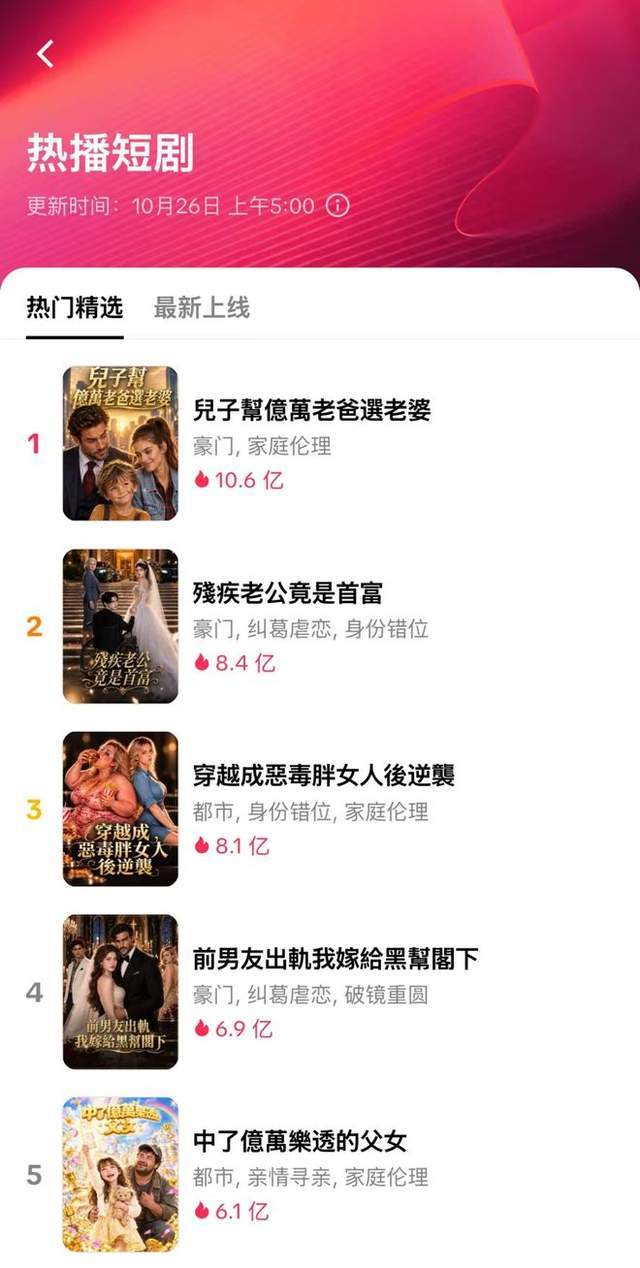
The second is to use AI to reduce localized production costs. In the past, to produce a short play starring European and American actors, it was often necessary to form a local crew and bear the costs of actors, locations, and filming. Nowadays, AI can generate pictures with European and American characters and local scene characteristics, so that the platform does not have to rely entirely on local real-life shots and can quickly expand its content supply. When you open PineDrama, you can see that most of the top 100 works in the United States have AI simulation features.
Byte does not need to determine which type of content is most popular from the beginning. Instead, it can supply it at a low cost and then filter the content through delivery and playback data. This is exactly Hongguo’s path in China: thousands of new dramas are released every month, traffic is distributed according to user preferences, and data such as popularity and completion rate determine what to film next.
What makes peers even more fearful is that Byte also controls production tools, traffic portals and advertising systems.
To acquire customers for independent platforms such as ReelShort, DramaBox, and FreeReels, they need to buy volume from Meta, Google, and TikTok. PineDrama also needs to invest in traffic, but it can borrow TikTok’s existing traffic and commercialization system. On this software, users can log in directly with their TikTok account and jump to the short drama section of the main website to watch the full episode. At the same time, the production side has video generation tools such as Seedance, and the monetization side is connected to the TikTok advertising system.
The rise of Hongguo in China has proven the power of this platform model: first gathering users for free, and then attracting production companies through guarantees, account sharing and traffic support. When audiences shift to free platforms, producers will also adjust their distribution strategies, and the bargaining power of paid platforms will decrease.
However, PineDrama has not yet shaken the basic base of overseas paid short dramas.
According to DataEye estimates, in September this year, overseas short drama App in-app purchase revenue was approximately US$285 million, a decrease of only 1.3% month-on-month; DramaBox still topped the revenue list, and ReelShort ranked first in the download list with more than 28 million downloads.
PineDrama attracted another group of users. According to Sensor Tower, about 82% of its downloads come from Indonesia and Brazil, rather than the more affordable US market. Rather than directly taking away paid users of ReelShort and DramaBox, it is currently more like opening up the free market while competing with FreeReels for users.
Changes on the content side are not that fast either.
Fancy said that currently most producers still use paid platforms as their main distribution channel. Those who take the initiative to hand over new dramas to free channels such as PineDrama for first release are often producers who lack other distribution channels and can only rely on traffic sharing.
In the early days, TikTok offered a considerable share of revenue in order to attract content, but this dropped significantly after July and August this year. She has contacted several companies that mainly rely on TikTok for distribution, and most of them have not made any money. In the eyes of many producers, it is too risky to spend a high cost to produce a drama and then pin all hopes of repaying the money on uncertain traffic.
But some teams have also changed their algorithm: since whether a single drama can recover its cost depends on luck, then the cost should be lowered and the quantity should be increased. According to Fancy, some teams have reduced the cost of an AI drama to about 30,000 yuan, and make a dozen of them at a time and invest them on TikTok. “It’s a bet.” As long as one hits, the entire investment can be repaid. A team she worked with once made a hit TV show on TikTok relying on pure natural traffic, earning US$180,000.
This style of play is currently only being attempted by a few teams. But if it can run through, the low-cost, high-volume content that free platforms need most will come to their doorstep.
The domestic short drama industry has gone through a similar path. When Hongguo first launched, paid mini-programs were still the mainstream of short dramas, and production companies had to guarantee a minimum before they were willing to enter. Three years later, the free platform has become the main place for the launch of short dramas, and Hongguo’s daily activity has exceeded the total of the four Aiyu Tengmang companies. It’s too early to tell whether Pine Drama will re-write Hong Guo’s script overseas.
03. Copying red fruits is harder than imagined
Hongguo has rewritten the distribution rules of short dramas in the country, but this may not be a result that all production companies are happy to see.
A short drama practitioner told “Focus One” that as Hongguo becomes bigger, more and more producers need to accept the platform’s exclusive cooperation requirements. When traffic and distribution channels are highly concentrated, platforms adjust accounts and modify rules, and producers have less and less room for bargaining. In February this year, Hongguo canceled the guarantees for some live-action short dramas, which caused many production companies to suspend almost all live-action projects.
This is one of the reasons why some short drama companies are looking overseas. They don’t necessarily want to encounter another red fruit overseas.
Another practitioner said that the current general consensus in the industry is that it is difficult for one company to become the dominant player in the overseas short drama market, “otherwise no one would be able to develop their efforts overseas.”
The most fundamental reason is that Byte cannot monopolize traffic entrance overseas.
in the country, Douyin is an important condition for the rapid rise of Hongguo. Hundreds of millions of people use Douyin every day, and almost any App launch cannot avoid it; Hongguo’s team has previously completed the “free content + advertising monetization” model on Tomato Novels. It is different overseas. Meta controls Facebook and Instagram, Google owns YouTube and search advertising, and TikTok is just one of several major traffic channels.
Platforms such as ReelShort and DramaBox can allocate delivery budgets among different channels based on customer acquisition costs. Even if TikTok holds an important traffic entrance for short dramas, it will be difficult to have such a strong influence on the traffic distribution of the entire industry as it does in China.
PineDrama also faces stronger opponents.
Paid platforms such as ReelShort and DramaBox have accumulated a large number of users and content, and have also established relatively mature purchase, production and distribution systems. After the rise of AI short dramas, these old players are also reducing costs and increasing efficiency. At the same time, new platforms that rely on the rapid expansion of AI content, such as NetShort and Kunlun Wanwei’s DramaWave, are also competing for users.
The free skit market also has no shortage of competitors. FreeReels, a free short drama application owned by Kunlun, has accumulated a considerable number of downloads in emerging markets such as Southeast Asia and Latin America. PineDrama is not the only player to make money from free content and advertising.
The list of overseas short drama apps in September also reflects this pattern. According to Insightrackr’s estimation, DramaBox and ReelShort still occupy the top two in the revenue list, NetShort ranks third, and PineDrama ranks sixth; the top three in the download list are ReelShort, DramaWave, and PineDrama.
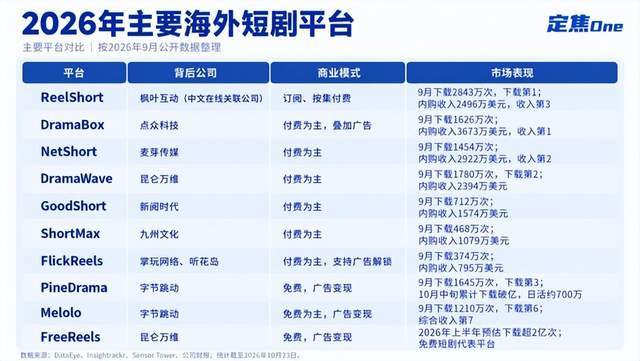
Fancy believes that PineDrama may have more opportunities in some emerging markets. Local entertainment content is relatively scarce and audiences have limited ability to pay, so free viewing is naturally attractive. But the U.S. market is different. Audiences have more entertainment choices and have long been accustomed to paying for film and television content. For users who really want to catch up on a show, a dozen dollars a week is not unacceptable.
In her view, top paid platforms such as ReelShort and DramaBox have accumulated a group of users who are willing to recharge their membership, and their aesthetics have also been cultivated. “Let them watch those free dramas produced for 30,000 yuan on free platforms, and there will be a strong contrast.” But TikTok’s advantage is that it is a global social platform with large traffic. As long as the story is attractive, even if the picture is rough, if passers-by click on it and take a look, it will bring benefits. “The two teams are actually facing different audiences.”
Just because the audience is different doesn’t mean that paid platforms can sit back and relax.
A screenwriter who works on a leading overseas platform believes that PineDrama’s free model will change the business of overseas short dramas sooner or later.
In her opinion, a short play that lasts only one or two hours will cost two to three hundred yuan to watch. At such a price, it is difficult to compete with free in the long term. Short dramas are essentially a business that constantly creates emotional stimulation and attracts users to follow the next episode. As long as the platform has enough content, coupled with algorithm recommendations, there will be opportunities to continuously extend users’ viewing time.
According to this logic, even if free short dramas cannot replace all paid short dramas, they may force the latter to reduce prices or turn to advertising for monetization.
However, whether paid or free, short dramas are still only a small part of the film and television entertainment market in North America.
In Leo’s view, vertical screen short dramas do not create new content demand, but are taking over the soap operas, low-cost thrillers, Christmas movies and other content that American audiences are already consuming. This type of work is not expensive to produce, but has a stable audience. Now it just has a different presentation form.
He believes that Hollywood is a mature industrial system with the ability to adjust itself. New technologies and new players are constantly emerging, but there are always different voices surrounding content. “Even for the most popular companies at the moment, if the content has not been produced well, the industry will discuss it and the creators will gradually stay away.” From Netflix to short dramas to today’s AI short dramas, some people stay and some quit. What ultimately determines who can stay is not just technology and traffic, but also whether the audience is willing to keep watching.
But for short drama producers like Fancy, the more pressing question than who can win the market is how long they can stay in this business. She said that the short drama industry can only take one step at a time. If one day, the platform no longer accepts dramas from outside, she will have to reconsider whether to continue doing short dramas or look for the next opportunity.
Whether Hongguo’s script can be repeated overseas may take a long time to determine the outcome between platforms. But the scene in the script that belongs to the producer may have ended early.
Related Reading
- Original iPhone Duo, aren’t you giving Ternus eye drops?2026-10-26
- Audiences who spent money to go to the cinema to watch “China’s first AI blockbuster” are eager to slap themselves twice.2026-10-26
- Arrested! A generation of chip giants fell into gambling2026-10-26
- The mother-in-law also started snatching AI people2026-10-26
- Five million Chinese doctors are being competed for by major Internet companies2026-10-25