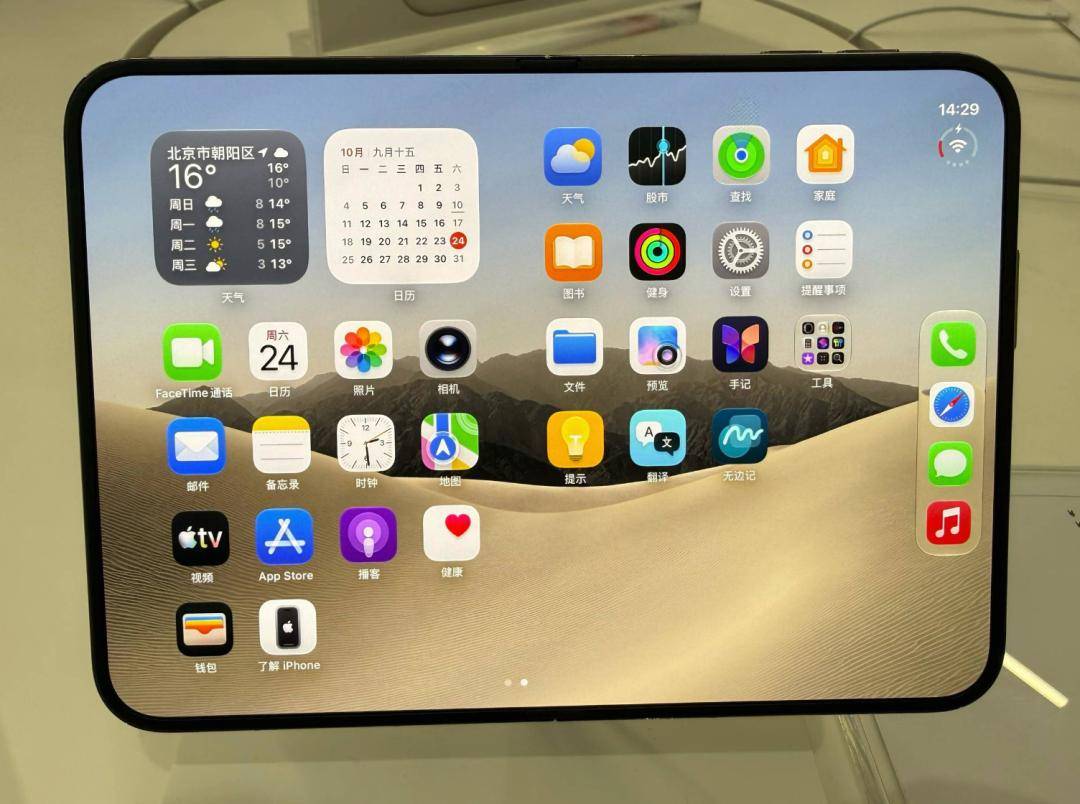
Text | Tang Chen iPhone Duo front view Source: Photographed by Tang Chen
iPhone Duo “stomped” Ternus hard.
On October 23, iPhone Duo was officially released, but it soon became controversial in the form of multiple hot searches. Among them, software adaptation is the biggest problem. For example, He tested 25 common applications before going on sale and found that about 80% had not yet completed the folding screen adaptation, and some applications left large black borders after opening.
There is also a large number of user reports that the new phone has problems such as screen scaling, not supporting columns, and crashes when switching between internal and external screens.
Quality control is also a stretch. Many users at home and abroad reported on social channels that the iPhone Duo has problems such as bright lines and cracks on the screen right out of the box, and related faults are mostly concentrated just above the hinge. Film and television hurricane Tim has undergone 10,000 folding tests at room temperature and 1,000 folding tests at minus 20 degrees Celsius. The hinge is still smooth, but the creases on the screen are getting deeper and deeper.
In terms of hardware configuration, Apple is also making subtractions: no telephoto, no Face ID, only supports eSIM, and weighs 254 grams. Teardown blogger Yang Changshun mentioned a theory that Apple claims to have polished the matte screen for several years as a “black technology”, but it may just put on a matte film that costs two to three hundred yuan.
Its price also broke directly within just a few days, catching many scalpers off guard.
As Apple’s first new form of folding screen phone, it is also its flagship hardware with the longest delivery cycle in its history. I noticed that in the past five years, its autumn flagships have taken an average of 3 days from release to pre-sale and about 10 days to launch. iPhone Duo has stretched the two intervals to 36 days and 43 days respectively. iPhone Duo is more like a semi-finished product that was rushed to market before it was completed.
Apple has also experienced “overturns” in the past, but most of them were at the product level such as communications, technology, and keyboards. But this time the problem lies in the application ecosystem that Apple is proud of. This “Duo” is at least a little funny, and it is also a serious eye medicine for Ternus, who has just taken over the responsibility of Apple’s CEO.
At the critical juncture of the handover between Cook and Ternus, why does Apple still forcefully promote this machine?
On the one hand, Apple is grabbing the time window for folding screens. The competition of AI mobile phones continues to squeeze growth expectations, and foldable large screens are one of the few hardware categories that can open up a new growth curve.
Moreover, there is no need to prove whether this form is a “pseudo demand”. Prior to this, Huawei and Samsung have been iterating on the horizontal folding track for many years. The hinge solution, large screen adaptation, and split-screen interaction have been verified for several rounds. The sales volume of various folding screen mobile phones has exceeded 100 million units.
At the same time, IDC predicts that global foldable screen shipments will reach 22.9 million units in 2026, a year-on-year increase of 12.6%. In the same year, global mobile phone shipments are expected to decline by 16.7%. This is one of the very few subcategories that is still growing.
Apple is a latecomer, but latecomers do not always have opportunities. The market and its friends leave the space for Apple to slowly polish its products and improve its application ecosystem, which is smaller than before.
On the other hand is growth pressure. The iPhone contributes nearly half of Apple’s revenue. Taking the third quarter of fiscal year 2026 as an example, Apple’s total revenue was US$109.4 billion, of which iPhone revenue was US$54.25 billion, accounting for 49.6%.
However, the iPhone replacement cycle is lengthening, and the cost side is also rising due to the increase in storage prices. Apple’s response is to raise the price. The iPhone Duo starts at $1,999, which is the same idea.
The Bank of China’s Apple Intelligence (hereinafter referred to as “Apple AI”) is still on the way, and AI’s influence on machine replacement has not been realized. Apple needs a new hardware form that is heavy enough to support the next growth curve.
Right now, Apple is mainly promoting two things: one is the implementation of Apple AI on a larger scale, and the other is the advancement of iPhone Duo production capacity.
Apple’s AI line has always been troubled. After more than two years of delays, the Bank of China version is finally confirmed to be implemented, but it is still in limited supply, with a small batch of functions released at a time and a small area at a time.
This is Apple’s old routine: limited manufacturing makes products scarce, and scarcity leads to willingness to pay. Only then can AI become a commodity and put on the shelves, prompting users to pay.
The iPhone Duo is running at a fast pace, and the delivery time of the new phone is scheduled to January 2027. Apple said the demand for pre-orders was “extraordinary” and it would get the product into consumers’ hands as soon as possible.
At the same time, it also issued “mandatory requirements” to developers, and the adaptation deadline for third-party apps is April 2027. This means that Apple chooses to give priority to delivering hardware to the market, and it will take a long time for existing apps to be adapted.
This logic is exactly the same as Apple AI and Vision Pro: tell the story first, and then deliver the product. However, foldable screen mobile phones are also mobile phones and are mass consumer products with different levels of users. Product defects will be directly displayed on the table, making it difficult for Apple to cover them up.
The reason why Apple dares to set such a delivery pace is that buying stocks and buying machines are two completely different groups.
On the day the iPhone Duo went on sale, Apple’s market value reached US$5.1 trillion, briefly surpassing Nvidia. Apple depends on iPhone to eat iPhone, and the imagination brought by folding screen is enough for investors to pay the price willingly.
Of course, Apple’s current round of stock price rise cannot be entirely attributed to the new folding machine. The greater push comes from the change in the direction of funding. Two or three years after the rapid development of AI infrastructure, the market and investors began to worry that some technology companies had taken on too much debt for AI infrastructure.
According to some data, Apple’s annual AI-related expenditures only remain in the range of 11 billion to 13 billion US dollars, while the annual capital expenditures of competitors can easily reach the level of 100 billion US dollars.
Many analysts have concluded that low AI capital expenditures have allowed Apple to be regarded as a safe-haven asset by funds amid the collective sell-off of technology stocks. Coupled with the high popularity of orders for the first folding screen, market confidence has been further boosted.
But for consumers, what they value is the actual experience of getting a real machine. No one is willing to pay a high price to buy a “brick” with incomplete experience. The misalignment of the expectations of these two groups will explode into a crisis of public opinion.
In my opinion, this series of problems with iPhone Duo are the product sequelae of Apple’s strategic choices.
Apple claims to have been “ambiguous” about folding screen mobile phones for many years, and this track has been cultivated by friends for seven years and is basically mature.
Taking the two leading brands on the folding screen track as an example, Huawei will capture 71.8% of the domestic folding screen share in 2025. The wide-folding Pura
Interestingly, in the days after Duo was released, data showed that sales of Huawei Pura X Max bucked the trend and increased by about 76%.
Apple’s first foldable screen phone set a precedent for its rivals.
You know, in the past, every time Apple entered a category, such as Pod, iPhone, iPad, Watch, AirPods, etc., it ripened and even redefined the market. Folding screens are the other way around. Apple watched its competitors spend seven years and multiple rounds of iterations getting through this before it jumped in to pick the peaches.
When Apple no longer “redefines” its products, its brand premium will have to be “weighed” again. With iPhone Duo’s “most expensive price in history”, no one can tell what percentage of the product is the product, what percentage is the brand power, and what percentage is the bubble blown by scalpers.
Perhaps, as Li Nan, the founder of Numiao Technology, analyzed, the iPhone Duo quality control problem is essentially due to the unfamiliarity between Apple and the Chinese supply chain. It is more likely that the risks have been anticipated in advance but simply ignored by senior management.

Ternus took over the plate left by Cook. The cash flow and supply chain infrastructure are very stable, but the product development is conservative. If the past judgment logic is followed, iPhone Duo will most likely be released until the collaboration between the software, hardware ecosystem and AI is ready.
But he doesn’t have that much time. Ternus urgently needs a sure win to start a standing battle, and iPhone Duo is the only bargaining chip at the moment.
As I said before, “The crazy hype of scalpers has become Apple’s cheapest marketing.” This is not a joke, but more likely a strategic choice for the first financial report of the Ternus era.
The price of doing things quickly is that after the delivery of iPhone Duo, ecological adaptation, quality control disputes, channel premium collapse, and public opinion narratives are simultaneously under pressure. All the above contradictions are transmitted layer by layer, and finally fall on Ternus, which is the “eye medicine”.
In my opinion, the essence of the contradiction of iPhone Duo is that after Ternus came to power, Apple adopted a completely different delivery strategy in the hardware line and AI business in order to compete for admission to the new track, which gave rise to a series of abnormal phenomena in the market.
But what needs to be affirmed is that Ternus’s choice of the direction of the folding screen track is not wrong in itself, and being the first to enter the market is not without gain: engineering data on the adaptation of hinges and large screens, developer docking experience, and first-release slots on the folding track, all of which will be accumulated into subsequent iterations.
What’s more, the stock price has actually risen to an all-time high. But after the premium of iPhone Duo subsided, Ternus faced the embarrassment that the capital narrative ran too fast, and the physical products failed to keep up with its expectations.
Is this start a surprise that Cook laid for Ternus?
References:
Classmate Tang Chen, “The “lagging behind” Apple begins to supply AI in limited quantities”, “Apple needs scalpers more than ever”
Huxiu, “Apple’s first foldable screen failed to fatten scalpers”
I am Tang Chen, a student who focuses on Internet technology and AI new economy. Original content, no reproduction without permission.
“Classmate Tang Chen”
TMTpost Media, 36Kr, Tiger Finance Hot List
The Paper The Paper’s Most Popular Creators in 2024
Tiger Finance 2024 Outstanding Column
Henan Daily·Top News 2024 Influential Author
Interface News Quality List
Tiger Finance 2024 Outstanding Column
Tencent News annual high-quality hot Q&A host
2023 Sohu News Annual Quality Creator
Everyone is a Product Manager Outstanding Author of 2023
2023 NetEase News Content Partner of the Year
Related Reading
- Original overseas “red fruits”, harvesting the world?2026-10-27
- Audiences who spent money to go to the cinema to watch “China’s first AI blockbuster” are eager to slap themselves twice.2026-10-26
- Arrested! A generation of chip giants fell into gambling2026-10-26
- The mother-in-law also started snatching AI people2026-10-26
- Five million Chinese doctors are being competed for by major Internet companies2026-10-25