01. Earned 600 million in the first half of the year
While other AI applications still need to prove that they will not be swallowed up by AI, one AI application company has already begun to make a fortune quietly.
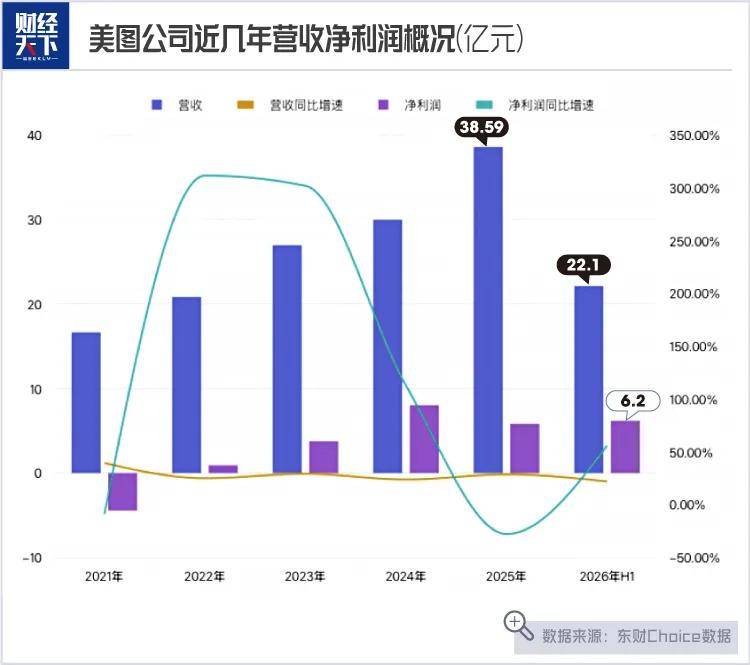
In the first half of 2026, Meitu delivered an enviable financial report. In the first half of the year, Meitu’s total revenue was 2.21 billion yuan, a year-on-year increase of 22.1%; net profit attributable to the parent company was 620 million yuan, a year-on-year increase of 56%.
Looking at 2025, Meitu’s revenue has reached a historical high of 3.859 billion yuan, and the adjusted net profit attributable to the parent company is 965 million yuan, achieving positive growth for the seventh consecutive year. In the past three years (2023~2025), Meitu has earned a total of 1.766 billion yuan.
The byte system is the opponent that Meitu needs to be wary of most. Byte’s wake-up pictures, cut-outs, and beanbags are all rapidly iterating on their image retouching capabilities. In addition, a number of general-purpose AI tools, including Qianwen, are also continuing to evolve their image processing capabilities and pose a substantial threat to beauty.
In the field of professional tools, Meitu cannot compete with the image design software company Adobe; in terms of traffic + tools, its volume and size are far inferior to Byte products.
In addition, mobile phone manufacturers have always regarded imaging capabilities as their core selling point, and beautiful pictures are caught in the middle, and their living space is constantly being compressed.
Even so, Meitu is still alive and well.
Looking back on the past, 2022 is a critical year for Meitu’s transformation.
That year was Meitu’s darkest moment. The company’s market value once fell to HK$2.7 billion, with net profit of less than 100 million yuan, and it was almost collapsed by diversified businesses. Fortunately, when ChatGPT came out that year, Meitu Xiu Xiu’s AI drawing function unexpectedly became popular in many overseas countries, and it reached the top of the App Store free list in many countries. This signal made Meitu founder Wu Xinhong realize that imaging tools are the most direct and natural implementation scenario for generative AI. Meitu had no room for trial and error. He quickly convened a meeting with the management and in less than 30 minutes, he made the decision to fully deploy generative AI.
From 2023 to 2025, during the AI transformation period, Meitu’s cumulative R&D expenditures will be approximately 2.5 billion yuan, and R&D expenditures in the first half of 2026 will be approximately 470 million yuan. But this amount is still insignificant in the current large-model racing circuit. To this end, Meitu has established the technical route of “model container”. On the one hand, Meitu insists on self-developed large-scale visual model MiracleVision (Qixiang Intelligence), which has been iterated to the V6 version, supporting multi-modal input such as text, images, videos, audio, etc.; on the other hand, in the track of “heavy investment and competition for scale” such as basic video models, Meitu chooses to cooperate with external giants.
Regarding this trade-off, Wu Xinhong’s explanation is very straightforward: “The giants will continue to increase investment in models and create scale effects, and it will be difficult for Meitu itself to invest in underlying models.” Therefore, Meitu needs a basic model strategic partner to ensure that it does not fall behind in competition.
As an asset-light software and AI service provider, Meitu naturally has room for higher gross profit margins. In 2025, the company’s gross profit margin will be 73.57%; in the first half of 2026, the gross profit margin will be 71.47%. This level is much higher than that of most industries. Even in the hardware field, Apple’s sales gross profit margin is only 49%. Xiaomi Group’s comprehensive gross profit margin in the first half of the year was 21%, which is also lower than Meitu. Among Internet companies, in the first half of 2026, Alibaba (combined gross profit margin is 38.24%), Baidu (38.98%), and Meituan (31.21%) are also unable to compare with Meitu.
Although Meitu has not been involved in the upstream computing industry, it has not been absent from the investment layout. In 2023, Meitu participated in the D round of financing of Suiyuan Technology with an investment amount of 150 million yuan and held 1.31% of its equity. Suiyuan Technology is a hard technology company focusing on cloud AI chips. It was listed on the Science and Technology Innovation Board on September 11 this year. Its market value once exceeded 170 billion yuan on the first day of listing. The book value of Meitu’s shares exceeded 2 billion yuan.
Although Meitu’s fundamental performance is good, the capital market does not buy it, and its stock price continues to fall. Compared with its peak market value of nearly HK$54 billion in August last year, it has fallen to less than half. As of the close of trading on September 28 this year, its market value was only HK$16.6 billion.
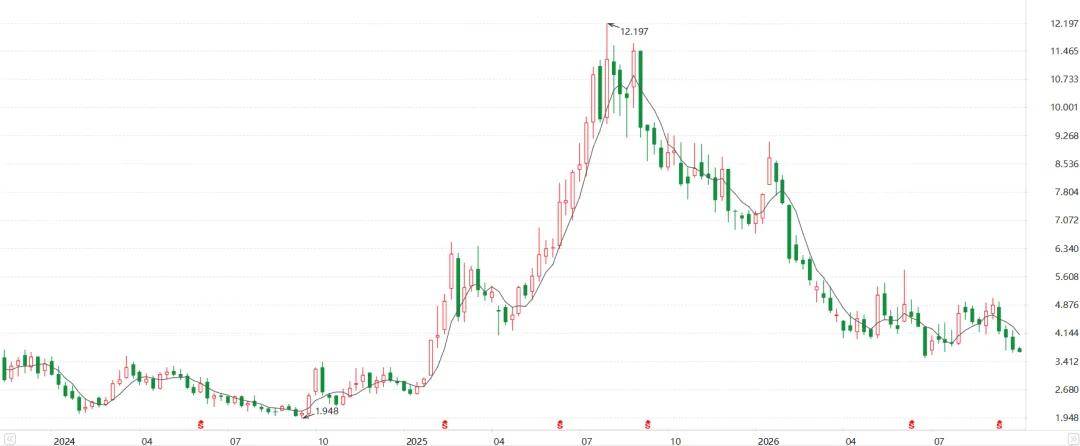
▲Meitu’s stock price chart in the past three years, weekly K-line
At a time when the stock price is under pressure, news has spread in the market that Wu Xinhong has sold or plans to sell the company’s shares. Meitu stated that Wu Xinhong has never sold any shares of Meitu Company. Since May 2018, Wu Xinhong has continued to increase his holdings of Meitu Company shares. He has purchased a total of 6.58 million shares of Meitu Company. After increasing his holdings in September this year, Wu Xinhong’s shares account for approximately 12.99% of Meitu’s issued share capital.
02. Meitu’s AI “alchemy”
Under the siege of giants, why is Meitu so profitable?
This starts with a detour that Meitu has taken. Meitu, founded in 2008, went smoothly. Under the leadership of founder Wu Xinhong, it was listed on the Hong Kong stock market in 2016. Its market value reached a peak of hundreds of billions of Hong Kong dollars. It once became the Internet giant with the market value of the Hong Kong Stock Exchange second only to Tencent. When the young Wu Xinhong saw that giants such as Alibaba and Tencent began to develop ecological layouts, he was not willing to allow Meitu to be just a “tools” company. He began to lead Meitu to expand diversified businesses such as e-commerce, short videos, and mobile phones.
Unexpectedly, every trend was pursued but failed to do well. Meitu suffered a cumulative loss of nearly 8.2 billion yuan from 2016 to 2021.
After realizing the problem, Wu Xinhong quickly laid off employees, closed non-core businesses, and refocused on imaging tools. He later admitted: “I began to realize in 2019 that I might be a bottleneck of the company.” After Meitu was forced to cut off non-core businesses, it returned to what it was best at.
The transformation of AI has given Meitu a rebirth.
Meitu’s main sources of income include imaging and design products, advertising and others. Before 2021, advertising had always been the bulk of Meitu’s revenue, accounting for more than 50%. It was not until the first half of 2021 that its revenue proportion fell below 50% for the first time. By the first half of 2026, Meitu’s advertising revenue will be 415 million yuan, a year-on-year decrease of 4.4%, accounting for less than 20%.
Part of the imaging and design product business comes from life-scenario applications such as Meitu Xiuxiu and Beauty Camera, targeting C-end consumers; the other part comes from the “productivity tool” business of e-commerce owners, video bloggers, small and medium-sized business owners, etc., such as Meitu Design Studio, Kaifai, Vmake, etc. If the daily life application business is Meitu’s fundamentals, then productivity tools have become the new engine driving Meitu’s growth.
At present, Meitu Design Studio has thousands of high-value users, and their annual consumption has reached 10 times that of ordinary users (the ARPPU of ordinary users is about 200 yuan). For the newly launched AI music video product MVLAND, the average monthly consumption of users has reached 13 times the comprehensive ARPPU. In terms of growth rate, AI computing power point consumption increased by more than 46% month-on-month in both the first and second quarters of this year. These consumptions mainly come from paid users of AI-driven productivity applications.
Meitu is not only a C-side tool that allows users to become more beautiful, it has also become a productivity platform that helps merchants make money. Meitu optimistically predicts that productivity applications will become an important driver of growth in the next phase. In June this year, at the 2026 Meitu Image Festival, Meitu released 8 AI products in one go, covering 8 creative scenarios including portrait retouching, commercial design, oral videos, concept images, designer community, and AI short plays.
It should be noted that Meitu’s user base is entering a bottleneck period, and the number of users of life-scenario applications that it relies on for survival has begun to peak. As of June this year, Meitu’s overall MAU was 282 million, a slight increase of 0.7% year-on-year. Among them, MAU of life scene applications, which is the basic market, fell by 3.1% year-on-year. Looking back to the whole year of 2025, the overall MAU was 276 million, a slight increase of 3.8% year-on-year; the MAU of life scene applications was 252 million, a slight increase of 3.3% year-on-year. Comparatively, it can be seen that the growth momentum has slowed down significantly, and even negative growth has occurred.
What cannot be ignored is that the image processing capabilities of general AI tools such as ByteDance’s Doubao and Alibaba’s Tongyi Qianwen are rapidly iterating, which has caused a substantial diversion and squeeze on beautiful images. At the same time, AI creation platforms such as Kuaishou Keling and Bytedance Dream continue to carve up some of Meitu’s B-end user groups in specific niche scenarios such as video generation and e-commerce design.
It took Meitu 7 years to complete its turnaround, using “productivity tools” to prove the moat of the vertical scene. However, in the face of the all-encompassing large models such as Doubao and Qianwen, how this moat can withstand the impact of dimensionality reduction will be the ultimate test question of whether it can overcome the cycle.
Related Reading
- Short plays have been hard to make money for a long time2026-09-30
- Magic9 invites Alai, Honor will not be a substitute this time2026-09-30
- McDonald’s AI pricing push is widening the divide with some franchisees2026-09-30
- Yu Minhong doesn’t take Luo Yonghao as a stumbling block+2026-09-30
- Original Dong Mingzhu is “handing over” Gree2026-09-30