The direction of public opinion about the “second generation factory” changed overnight.
In September, a large number of netizens flooded the comment section of the “Factory Second Generation” blogger asking: Are workers paid five insurances and one housing fund? Weekend? Has the 8-hour work system been implemented? Many of the “second generation factory workers” who were previously active on social media chose to remain silent, delete comments, or even close the comment area.
Some “second-generation factory” bloggers responded, “You can get a salary based on your academic qualifications and abilities.” “If you don’t have double days off, go to a company where you get five days’ salary if you want two days off.” This further aroused the dissatisfaction of netizens.

▲Some “second-generation factory” bloggers responded, “If you don’t have double holidays, if you want double holidays, go to a company where you get five days’ salary.”
Before this, the reputation of “Factory Second Generation” was very positive. They are the children of the founders of manufacturing factories. Most of them were born between 1985 and 2000. They have good educational backgrounds and are “taking over” the family business. Doing self-media is one of the attempts of this group of young people to lead the manufacturing industry to “break the situation”. They filmed factory tour vlogs, danced in the workshop, and performed the plot of “Succession”, which was loved by the public.
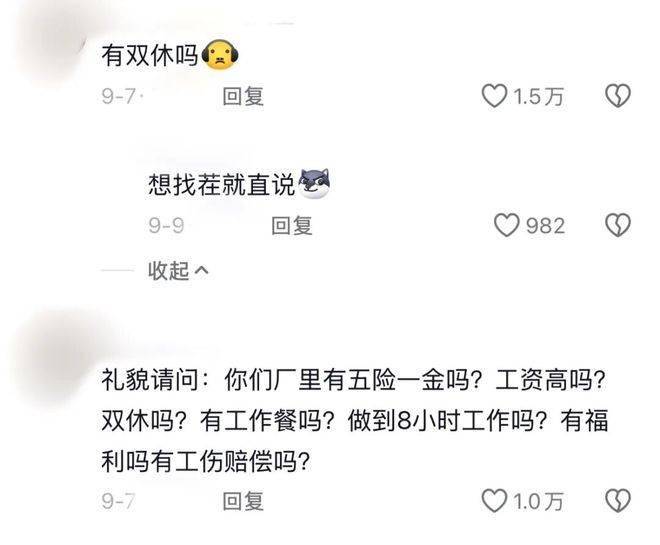
▲When asked about topics such as weekend breaks, some second-generation factory workers chose to remain silent, delete comments, or even close the comment area.
Compared with other “second generations”, “factory second generations” have been quite tolerantly welcomed on the Internet.
But now, people look at the story of the “second generation” from a different perspective. The workshop workers who once served as background material have become the protagonists of the camera: What are their daily lives and working conditions like? Are you eating well? Have you paid social security?
The halo of “second generation factory” is subtly removed in this change of perspective. Using current buzzwords, the public has completed a collective “disenchantment” of the “second generation factory workers.”
01
Create a “factory second generation” IP
Traffic is one of the most expensive assets today, even for manufacturing.
The “second generation of factories” has entered the public eye, and behind it is the wave of succession that China’s manufacturing industry is experiencing. According to data from the All-China Federation of Industry and Commerce, family businesses account for more than 80% of the more than 58 million private enterprises in the country. In these family businesses, the “founding generation” reaches retirement age and gradually passes the baton to their children and subsequent generations.
The “second-generation factory” who wanted to find a new path chose to create self-media IP and “exploit” the Internet with their own factories in order to break the situation.
Among the first batch of representatives to receive dividends is Zhao Zelong, the “young master” of Qumei Home Furnishings. He became popular on the Internet through his alternative persona of “the company has a debt of 4.8 billion, and the father’s debt is repaid by the son.” There is also Shi Zhancheng, the “eldest grandson” of Jie Liya, who quickly attracted millions of fans by filming a “rich family short drama” in which “the villain’s second uncle and his nephew compete for the family property”.
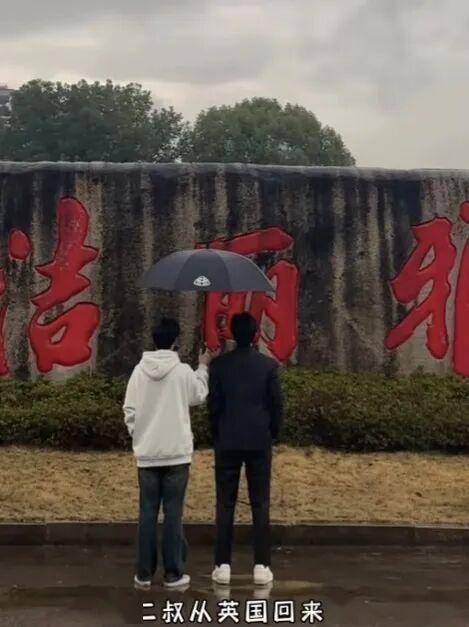
▲The “rich family short drama” filmed by Jie Liya’s “eldest grandson” Shi Zhancheng, “The villain’s second uncle and his nephew compete for the family property”
Qumei Home Furnishing’s 2025 annual report specifically highlights the value of Zhao Zelong’s IP assets: the cumulative exposure of IP exceeds 1 billion times, which has improved the brand awareness of young consumer groups, reduced traditional marketing expenses with natural traffic, and driven the growth of offline customer flow.
With the traffic dividend, more “second-generation factories” from small and medium-sized factories have entered the industry. For a time, “Boiler Princess”, “Luggage Girl” and “Liquor Master” appeared on the Internet.
The “Succession Diary” of the “Second Generation Factory” focuses on down-to-earth contrasting characters. After they returned from studying abroad, they had to put on work clothes, pack things in the computer room, and go to the stalls to guard the stalls. They joked to themselves, “It doesn’t matter if you get angry, the shares are the most important thing.”
Some exquisite-looking “second-generation factory workers” danced hand gestures in the workshop to highlight the contrast between their looks and the factory environment. The barrage said, “Young master and young lady are risking their lives for the sake of the factory.”
The effect of traffic is significant. A “second-generation factory worker” said in an interview that the factory’s traditional ways of acquiring customers include participating in industry exhibitions and offline customer visits, which are costly and have limited effects; through short videos, half of some factories’ business volume comes from self-media channels.
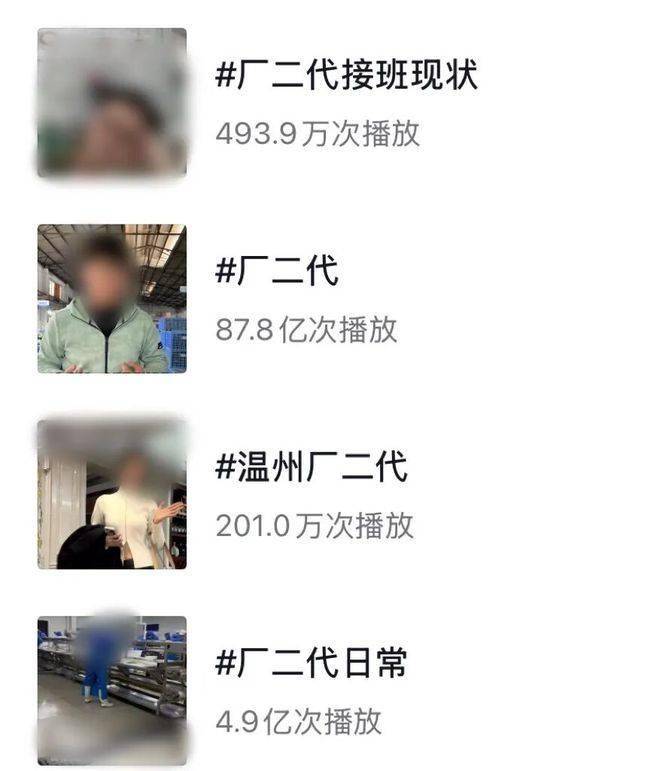
▲The topic of “second generation factory” is popular on social platforms
Compared with ordinary “rich second generation”, the manufacturing industry provides a credible scenario for the “second generation of factory” to interpret their identities. The daily vlogs of “Factory Second Generation” take place in factories and workshops, showing the internal links of factory production, sales and circulation, and therefore have “industrial weight” – at least in terms of visual narrative. Their short video creations are also “all for the purpose of starting a factory,” and they have the legitimacy to make the audience empathize.
So traffic and manufacturing are needed here in both directions. Traditional factories need to attract customers, and “second-generation factories” need to prove their ability to innovate; the manufacturing industry also provides freshness to the short video content pool.
But like other “personalities”, once it enters the commercial inertia of self-media, the “factory second generation” track has undergone a subtle deviation.
For example, there is a large amount of homogeneous content in the “Master” and “Princess” accounts. The copying of BGM and gesture dance makes factories and products become mere visual backgrounds and lose their meaning. This makes some of the “Factory Second Generation” content look like the dancing scenes were just moved to the factory. Some people criticize that these contents are just a different kind of “showing off wealth and appearance.”
Then, an even more ridiculous situation emerged. According to media reports, some of the “second-generation factory workers” who are active on social platforms are not the children of entrepreneurs, but are just personalities operated by the MCN team. The “second generation” IP has stripped away its real identity and become a content type created arbitrarily by self-media and a shortcut to “starting a business”.
It is not difficult to explain why some “second-generation factory” bloggers have difficulty answering the “five insurances and one housing fund” questions in the comment area.
02
“The Era of Great Enlightenment”
Like a codeword, questions such as “Have you paid five social insurances and one housing fund, are you on weekends, and are you compensated for work-related injuries?” quickly spread in the comment areas of various “second-generation factory” bloggers.
Someone cut out a scene of a worker working from a video of the “Second Generation Factory” and pointed out, “They don’t even have basic labor protection supplies!” The lens of the short video underwent an important zoom, and the focus changed from the “Second Generation Factory” to ordinary workers.
In the past, the wealth and strength behind the factory was the traffic code of the “second generation of the factory”. Rich business heirs, and even “creator generations” who are over fifty years old, dance fashionable dot dances in front of the camera, which undoubtedly creates a viewing pleasure of contrasting identities. In short videos, through watching and being watched, the power relationship is inverted in reality.
In the comment area, messages like this often appear: Putting aside your status as the heir of XX Group, you are the most beautiful girl I have ever seen. Or sigh: Excellent studies, wonderful life, most afraid of being richer than you and working harder than you.
▲The “second generation factory workers” dancing on social platforms
In “Status Anxiety”, de Botton sorted out the formation of a modern concept: in pre-modern society, wealth was not naturally equivalent to a person’s moral value. But since the 18th century, with the development of commercial society, rich people are considered more “useful” to society, and success is increasingly seen as proof of ability and hard work.
In other words, people tend to actively attribute personality charm to wealth, and automatically complete a set of personalities around wealth: beautiful, hard-working, excellent, wonderful in life, and worthy of liking.
After the success of the “factory second generation” account, it is often accompanied by the monetization of the content. As someone joked, “Money flows to those who are not short of money.” One of the consequences of self-media communication is the re-centralization of wealth.
Starting from the “question of five insurances and one housing fund”, people’s framework for viewing the “second generation of factories” has been reversed.
In the past, the audience mainly followed the narrative framework established by the “second generation of the factory” and watched their wealth and life inheriting the family business. But now, the audience begins to examine the production and distribution structure of this wealth itself, and begins to ask: the number of company insured persons, employee meal conditions, wages and benefits, holiday arrangements…
These questions no longer revolve around the personal narratives of the “second generation factory workers”, but require verifiable reality. In the eyes of netizens, they can better explain the operating conditions of a factory than the protagonist story of “Factory Second Generation”.
▲Stills from “My Mountain and the Sea”
Some people commented that this year’s netizens have entered the “era of great enlightenment.” “Kai Zhi” is a popular Internet term recently, which means that people suddenly “understand” certain social rules that they were accustomed to before, and even actively participated in them, and refuse to act according to the original rules.
The “disenchantment” of self-media stories about wealth owners is one of them. People realize that in the distribution pattern of self-media, attention is an expensive resource, and they no longer provide unnecessary emotional value to the “second generation”, and they no longer participate in the re-centering of wealth.
Similar disenchantment has occurred in public discussions of entertainment stars in recent years. A “melon-eating” incident exposed a female star’s daily salary equivalent to “2.08 million” per day, and the distance between celebrities and ordinary workers was crystallized. People’s mentality towards celebrities has shifted from content consumption to thinking about resource allocation: Why does the camera only let me see this person? Who else is outside the camera?
On and off the screen, the viewing positions of the “protagonist” and the “audience” have fundamentally changed – the latter begins to re-decide to whom to allocate attention.
03
It is inevitable to come to the stage
In May of this year, Jie Liya encountered a dramatic public relations crisis. The “Towel Empire” series of fictional shorts filmed by “Young Master” Shi Zhancheng were mapped by netizens to real family relationships, giving rise to various speculations about “illegitimate children” and “family power seizures.” Some consumers announced a boycott of Jie Liya and even flocked to competing product live broadcast rooms.
The IP mechanism that once brought huge attention to Jie Liya has backfired on the company in terms of public opinion. When the “second generation factory workers” take the initiative to expose the relationship between the factory and their family, it in turn shows that they have opened the corresponding space to the public.
To a certain extent, this is inevitable for the manufacturing industry to interact intensively with traffic and come to the forefront.
After being asked about “five insurances and one housing fund”, some “second-generation workers” answered calmly about the situation in the factory. “To be honest, there is no weekend off. But the protection, benefits, and respect will not be lacking. All five insurances are paid, lunch and accommodation are all included, and there is a high temperature subsidy.”
Such a statement was recognized by the comment section.
▲Responses from some “second-generation factory” bloggers
In fact, the manufacturing industry is in its own transformation cycle. Over the years, the industry itself has developed a labor-intensive operational inertia. Some older workers value immediate income. Some small factories are also facing cost and operating pressures, posing practical obstacles to the implementation of social security.
At the legal level, the Social Insurance Law clearly stipulates that for employees who have established a labor relationship, the employer must register for social insurance in accordance with the law and pay in full and on time. This is not an enterprise benefit that can be freely negotiated and waived. In reality, this involves a more complex and huge industry transformation.
Related Reading
- Revelations of AI breaches add to safety fears as Trump meets with Anthropic’s CEO2026-09-28
- Original: What Luo Yonghao misses most is Yu Minhong2026-09-28
- Medical waste made into mobile phone cases? The poison exceeds the standard by 1,500 times and even causes cancer. Netizen: I still use it2026-09-28
- China is digging an “inexhaustible mine”2026-09-27
- Nubia wants to turn around by relying on bean bags2026-09-27