New energy vehicles are still there, but “father” is gone
1.4萬
The Chengdu Auto Show has just ended, and the new cars on the booth are still competing with each other to see whose screen is bigger, whose smart driving is better, and whose car model is more beautiful. At the same time, 850,000 new energy vehicles across the country are becoming “orphans.”
These cars are not broken and are fully functional, but the trouble is that the factory that made them is gone. After-sales outlets are closed, original parts are discontinued, insurance companies refuse to insure cars against damage, and second-hand car dealers lower prices to 20% or 30% off.
What the car owner spent more than a dozen dollars to buy has turned into a burden that he cannot afford to repair or sell within a few months, so he can only drive it carefully.
As of May this year, a total of 23 new energy vehicle companies have been liquidated and effectively suspended, involving 850,000 existing vehicles.
The cars are still there, but the “father” is gone.
01
The first unattended tram appeared around 2020. After that, Weimar, AIWAYS, Tianji, Byton, Ranger, Reading, Bojun, Sailin and Qiantu disappeared one by one.
WM Motor entered judicial reorganization in October 2023. Authorized 4S stores across the country closed collectively, and 110,000 car owners lost their parents’ homes overnight.
A car owner in Shenzhen had a problem with his battery. He went to auto repair shops all over the city and no one took the order. Finally, he spent 30,000 yuan to buy an accident car, removed the battery and installed it in his car. There is neither testing nor warranty, so there are hidden dangers.
There are also car owners whose bumpers were damaged. Searching for original parts on the e-commerce platform showed “no results”, so they could only go to the car enthusiast group to dismantle the car parts. It is common to wait for half a year, and the price is three times more expensive than the original one before the discontinuation of production.
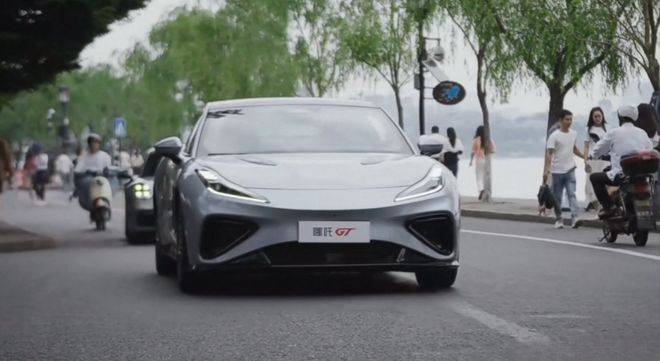
Nezha is even more famous. In 2022, Nezha sold 152,100 vehicles and won the new sales championship. In June 2025, the parent company Hezhong New Energy entered bankruptcy and reorganization. In March 2026, the court ruled that it would be transferred to bankruptcy liquidation.
▲Picture/video screenshots
Beijing Business Daily interviewed a car owner. When he bought the car in 2023, the sales promised Sanden’s lifetime warranty. He had driven it for more than 30,000 kilometers and received a 40% discount on the nominal 400-kilometer range. The 4S store said that the battery was still within the warranty period and the manufacturer could not be contacted, so he would have to pay for the repair himself. In the end, she spent more than 20,000 yuan to repair it, and then turned around and wanted to sell the car. The second-hand residual value of the 140,000 yuan car was less than 50,000 yuan.
Another car owner received a text message that the Internet of Vehicles service provider had stopped its service. If he wanted to continue using remote control of the car and online navigation, he had to buy a data package for 299 yuan a year.
極越It is another face. Logically speaking, Baidu and Geely are standing behind it, so someone should know the truth. When the thunderstorm hit at the end of 2024, there were only 15,000 car owners in the country. As a result, the new cars just delivered became out of print in an instant.
Car owners originally placed orders with the endorsement of major manufacturers, but later discovered that shareholders’ commitments and the life and death of the company are two different things.
AIWAYS, Tianji, Hengchi, Hechuang, Reading, Sailin, the list can go on. According to statistics from the China Automobile Dealers Association a few years ago, new energy car companies that filed for bankruptcy or suspended production for a long time involved more than 160,000 existing car owners. In the past two years, this number has increased several times.
02
It’s not like oil car manufacturers have disappeared. Fiat, Acura, and Mitsubishi have all withdrawn from the Chinese market. The cars are still running without brands. The masters at the roadside repair shop can open the hood to work. Accessories are everywhere in the auto parts city.
Santana has been out of production for more than ten years, but you can still see it on the street. This has nothing to do with the luck of the car owner. It is supported by the common parts system accumulated from more than a hundred years of fuel vehicles.
Electric vehicles really don’t work. Batteries, motors, and electronic controls are all different and highly customized. What’s even more difficult is that diagnostic permissions, fault codes and detection programs are encrypted by the manufacturer and locked in the cloud server.
When the car company collapsed, the third-party repair shop couldn’t even read the fault code and couldn’t open the battery pack.. How can I repair this car?
There are about 400,000 fuel vehicle maintenance companies in the country and 20,000 to 30,000 new energy maintenance companies. Only 2% to 3% can perform in-depth repairs on electricity, electricity, and electricity. The owner of a Gaohe car was quoted a price of RMB 38,000 to replace a set of headlight assemblies, which was higher than the residual value of the entire vehicle.

▲Picture/picture insect creativity
The car is the second hurdle, including remote unlocking, air conditioning preheating, navigation updates, and OTA upgrades. The more advanced the thing, the more dependent it is on the system behind it.
After Nezha was shut down, 400,000 car owners received notifications of the termination of Internet of Vehicles services. Some people were unable to even open their car doors after disconnecting from the Internet, and finally drove their cars away with electricity. The smart tram bought for hundreds of thousands has become a big old man’s delight.
Article 21 of the “Automobile Sales Management Measures” stipulates that suppliers should ensure the supply of spare parts and after-sales services for discontinued models for at least ten years. However, when a company enters bankruptcy liquidation, the property must be divided in the legal order. Secured claims are paid first against the collateral, and the rest is divided in the order of employee claims, taxes, and ordinary claims. The car owner’s claims based on warranty and after-sales have become ordinary claims in judicial practice, trailing behind.
Weimar disclosed during its pre-reorganization that it had liabilities of approximately 25 billion yuan and assets of 9.6 billion yuan. If the first few grades are not enough, the car owner’s claim will definitely not be settled.
In November last year, the Supreme People’s Court recognized WM Motor’s Internet service fee as a mutual debt, which was an opening. However, there is no public precedent that the warranty debt in the hands of individual car owners has been actually paid off. To this day, there is no public precedent.
03
Zooming out further, the “orphan car” is only a small loss in the big story of new energy vehicle manufacturing.
In 2009, the country launched the demonstration and promotion of energy-saving and new energy vehicles, with thousands of vehicles in ten cities, and the industry was officially launched. Subsidies and licenses will be given first, followed by rights of way and government procurement.
At the local level, the need to attract investment is even greater. When car companies want to set up shop, the local government will provide land for factories, rents will also be reduced, and the money will come from the government and state-owned assets platforms.
CCTV’s “Focus Interview” did a program in April this year. The camera showed an automobile factory in Yichun, Jiangxi Province that was only put into operation in 2021. On more than 600 acres of land, only empty factory buildings and dusty production lines were left.
▲”Focus Interview” (picture/video screenshot)
The program said that the contract signed between Yichun Economic Development Zone and Hezhong New Energy has a total project investment of 5 billion yuan, most of which will be raised by the management committee. A platform company under the Yichun State-owned Assets Supervision and Administration Commission and the Finance Bureau invested nearly 2 billion yuan in acquiring equity; local state-owned enterprises funded the construction of land and factories, which cost another nearly 300 million yuan. In order to get the project off the ground quickly, it also offered a ten-year rent exemption and promised a reward of 20,000 yuan for every car sold in Yichun. A state-owned company in Yichun has invested a total of 1.42 billion yuan, and at least 800 million yuan is difficult to recover.
New energy is the direction encouraged by policies, and everyone wants a piece of the pie. If you can give discounts, I can give more. Yichun has no foundation for car manufacturing and has no advantage in terms of location, so it still has to get it because other places have it. Since everyone is doing the same thing, the only difference between them is the intensity of preferential treatment. Local competition has become a matter of who can pay more.
Various places played to the end, and more than 300 brands rushed to participate.
Where does the money come from? Local state-owned assets are the first layer, social capital and equity investment are the second layer, and consumers are the last layer.
Among the more than 20 billion in financing Nezha burned, there were state-owned assets from Nanning and Yichun, as well as equity funds chasing higher prices. It lost 18.3 billion in three years, with an average loss of more than 80,000 for every car sold. Early investors have already withdrawn one after another, but investors and car buyers are in dire straits.
This was still built. As for Byton’s financing of 8.4 billion yuan and Singularity’s financing of 17 billion yuan, the PPT was very beautiful. Only a few cars were built, and the deposits could not be recovered, which made the local government even more embarrassed.
04
The sales data of the national passenger car market in August looked quite divided.
The retail sales of new energy passenger vehicles were 1.005 million units, a year-on-year decrease of 10.1%. In the first eight months, a total of 6.674 million units were sold, a year-on-year decrease of 12.1%. The overall situation of passenger cars is even worse. In the first eight months, the cumulative retail sales fell by 20.8% year-on-year. In August, the retail sales of fuel vehicles fell by 40% year-on-year, and the retail sales of pure fuel vehicles fell by 45%.
However, tram penetration reached a new high of 65.2%. Cui Dongshu, secretary-general of the Passenger Car Association branch, said that this number is rising passively. Fuel vehicles collapse faster, which makes the denominator smaller. The total domestic market is shrinking, and goods can only go overseas.
Therefore, the only bright spot is export. In August, passenger car exports reached 888,000 units, a year-on-year increase of 77.8%, accounting for 38% of manufacturers’ sales, of which new energy sources accounted for 58.4% of total exports. Exports are afraid of trade wars. Whenever there is any disturbance, the hearts of new energy vehicle companies will jump.
▲Picture/picture insect creativity
This is the complete form of this strategy. In the first stage, policies are used to promote industries, and in the later stage, the knife of the market is used to make enterprises go through elimination. The costs are shared by local finance and consumers. It is a typical semi-planned and semi-market system.
The consulting agency AlixPartners has issued a report that of the 129 new energy brands on sale in 2024, at most 15 will survive in good health by 2030. He Xiaopeng, founder of Xpeng Motors, said that no more than seven companies survived in the end. Great Wall Wei Jianjun’s words are even more cruel. Evergrande in the automobile industry has emerged!
By the end of June this year, there were 48.97 million new energy vehicles in the country, and 23 brands had fallen, involving 850,000 vehicles, accounting for less than 2%, which is actually not a lot. But in the next few years, every time a brand falls, there will be a group of car owners who still have the car but the factory is gone.
People who buy cars used to compare configurations and prices, but in the future they have to first see whether the manufacturer can outlast their own car.
Return to the homepage to see more car information
Related Reading
- “Sky-high divorce” raids Shennong Group2026-09-28
- The courier boy made a lot of money in Africa2026-09-28
- Trump says he’s ‘very seriously’ looking at a diesel export ban2026-09-28
- Two accounts of Chinese and foreign car companies2026-09-27
- Can you get “luxury goods” for 8.5 yuan? LV and Valentino began to gather together to sell snacks and coffee2026-09-27