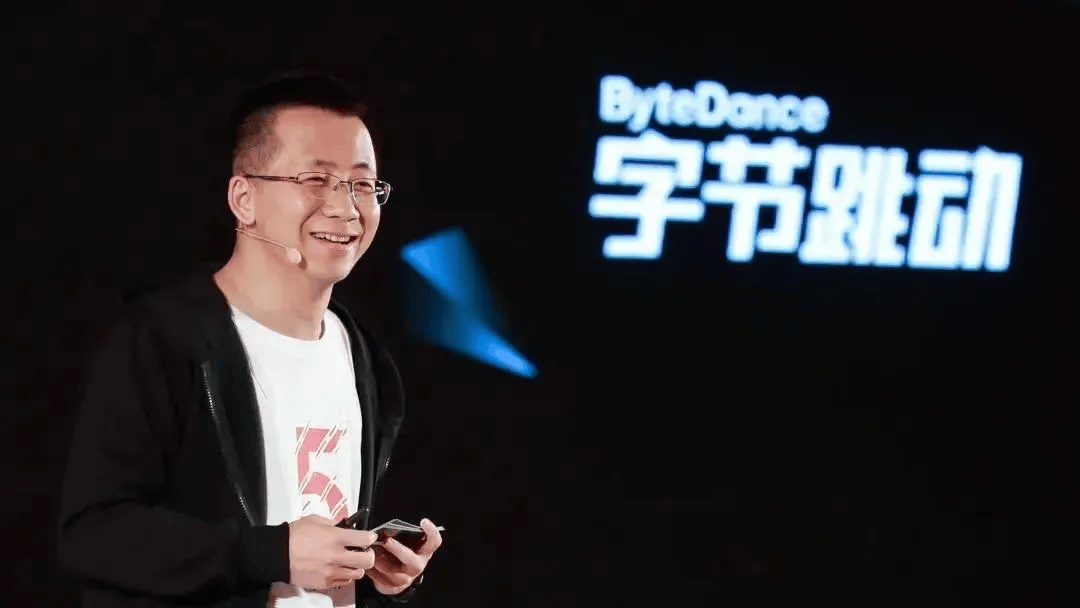
The AI war is in full swing, and Zhang Yiming, the newly crowned richest man in Asia, has quietly begun buying real estate at the bottom.
On September 21, the official website of the Beijing Municipal Commission of Planning and Regulation posted a transaction announcement: the OS-15 plot in the south area of the Olympic Park in Chaoyang District was acquired by a company called Beijing Yunrui Feldspar Technology at a reserve price of 2.613 billion yuan.
When the equity is penetrated, the actual controller of this new company established in June is Douyin Group, and the person behind it is Zhang Yiming, who just a few days ago became the richest man in Asia with a net worth of US$105 billion.
This is not the first time Zhang Yiming has made a move this year. In February, he acquired the Lanjinglijia plot in Haidian for RMB 2.8 billion, and in April he acquired the Shuangquanbao R&D plot on Xueyuan Road for RMB 3.305 billion. In just seven months, ByteDance has launched in three cities in the core urban area of Beijing, spending a total of 8.718 billion yuan.
Are technology giants starting to buy real estate at the bottom?
1. Byte buys land
In the Internet circle, ByteDance was once one of the most famous renters.
At the beginning of the business in 2012, the team rented a residential office in Jinqiu Homes on Zhichun Road. Later, they moved to Yingdu Building, Zhongweitong Building, and later Fangheng Fashion Center, moving seven or eight times in a few years.
The turning point occurred in 2019. That year, Byte purchased Dazhong Temple Zhongkun Plaza for a sky-high price of 9 billion yuan, which shocked the entire Internet circle. You must know that before this, few pure Internet companies would spend nearly 10 billion to buy an office building.
In 2020, Fangheng Fashion Center, which Byte purchased for about 5 billion yuan, was officially opened. This is Byte’s first self-owned office building, ending the company’s history of not having self-owned office properties since its establishment.
At that time, many people couldn’t understand that Internet companies focused on asset-light and fast turnover, and property purchases were asset-heavy. Didn’t they go against the rules of the industry?
But everyone has seen the story going forward. Douyin’s daily active users exceeded 700 million, TikTok’s global monthly active users exceeded 2 billion, Feishu, Volcano Engine, and large model businesses took turns to gain momentum, and the number of employees continued to expand. The rent of office buildings in Beijing has been rising year after year, and it is difficult to find a location in the core area. The “not doing business” at that time has become the most cost-effective investment.
This year’s three land acquisitions have pushed this logic to the extreme.
All three land parcels are located in Beijing’s industrial core area: two land parcels in Haidian, one is planned as a digital economy industrial park, and the other is located in the Science and Technology Innovation Zone on Xueyuan Road, within the radiation circle of Tsinghua University, Peking University, Chinese Academy of Sciences and other universities and colleges, aiming at AI research and development; the Chaoyang Aoyuan land parcel is adjacent to the Asia-Olympic business district and is positioned as a high-end business facade.
All three plots of land are self-owned, and none of them are used for commercial housing development.
This means that what Zhang Yiming spent 8.7 billion was not real estate, but Byte’s office infrastructure for the next ten years.
2. Business multiple choice questions
The reason why Zhang Yiming started to buy real estate at low prices is actually a simple business multiple-choice question if you calculate it thoroughly.
The first account is the cost account.
At present, Beijing’s commercial office market is in a once-in-a-decade adjustment cycle.
Data from DTZ shows that the vacancy rate of Grade A office buildings in Beijing’s core business districts will remain high in the first half of 2026.
Taking the Aoyuan plot as an example, the floor price is about 28,400 yuan/square meter, while the surrounding office buildings of the same quality generally sell for more than 50,000 yuan, and the rental level remains at 6.8-9 yuan/square meter/day.
A simple calculation, based on 7 yuan/square meter/day, the annual rent for a 90,000 square meter building is 230 million, which is 6.9 billion in 30 years, not counting the increase in rent.
But now the total cost of buying land and building a building is only more than 4 billion, and the property rights are still 40 to 50 years away. For a company with hundreds of billions of cash on its books and employees that continue to expand, buying is a much more cost-effective option than renting.
The second account is the talent account.
These three parcels of land have a common feature: they are all located in areas with the highest talent density in China.
The Xueyuan Road plot in Haidian is close to 39 universities such as Tsinghua University, Peking University, and the Chinese Academy of Sciences and hundreds of scientific research institutes. The Lanjinglijia plot is connected with Byte’s existing Zhongkun Plaza and Fangheng Plaza. The Aoyuan plot hosts front-end teams such as AI and commercialization.
In the end, Internet competition is all about talent, and the competition for talent has already extended from salary to office experience, commuting costs, and industrial atmosphere. The contiguous deployment of self-owned properties in Beijing’s core industrial areas is essentially building a nest for the competition for talent in the next ten years.
The third account is the periodic account.
This is the most critical big account. The Internet industry has been running wild for two decades, and everyone believes in “light assets, high turnover, and traffic is king.” The house is rented, the server is cloud-based, and the employees are flexible. Everything is aimed at maximizing growth.
However, as the industry enters the stock era from the incremental era, when the traffic dividend peaks and the AI cycle is still far away, the strategic focus of the giants will naturally shift from “expansion” to “bottom building.”
Exchanging cash flow for hard assets in core cities has three benefits: first, it locks in long-term office costs and hedges against inflation; second, the fixed assets themselves are credit collateral, which can provide stronger risk resistance during economic downturns; third, when industry growth slows down, heavy assets themselves serve as moats.
So you will see that it is not just Zhang Yiming who is buying, Chen Tianqiao bought the entire hotel in Shanghai for 200 million, JD.com continues to acquire land in Yizhuang, Beijing to expand its headquarters, and Pinduoduo continues to expand buildings in Shanghai and Xiongan.
Statistics from Cushman & Wakefield show that among Shanghai’s large property transactions in the first half of 2026, the proportion of transaction value for owner-occupied buyers will increase from 26% in 2025 to 50%. Among the group of self-use buyers, technology giants with abundant cash flow are the most eye-catching group.
3. Big shake-up of real estate players
Of course, controversy ensued.
Some people say that as a technology company, ByteDance does not engage in AI research and development, but instead uses money to buy land. Is it not doing its job properly? Some people are also worried that the giants are stepping down to acquire land, will it push up housing prices, and will it turn into a new real estate boom?
In my opinion, these concerns are overblown.
What Zhang Yiming is looking for is not the bottom of the entire real estate market, but the bottom of industrial and commercial real estate in the core areas of Beijing. This is a completely different logic from the residential market. No residences can be built on these plots of land, and they have nothing to do with the housing prices that ordinary people care about.
The real significance of this incident is that the takeovers of China’s commercial real estate are switching from traditional developers to industrial capital.
In the past, those who acquired land and built buildings in Beijing were Vanke, Wanda, and SOHO China; now, those who frequently acquire land and build buildings in Beijing are Byte, Huawei, Xiaomi, and Meituan. The former makes money by selling houses and collecting rents, while the latter takes land for their own use and treats the land as infrastructure for company operations. It is essentially a fixed asset investment for the company, no different from buying servers or building data centers.
This is not the spring of real estate, but the necessity of industrial differentiation.
Cities without industrial support and land without core competitiveness will only become more and more deserted; while high-quality assets in core cities and core locations will always be targeted by the most profitable companies.
When the tide recedes, some people swim naked, while others quietly bend down to pick up the most valuable shells.
4. Write at the end
Finally I want to make a few deeper observations.
In the past two decades, China’s Internet industry has been “light”. Light assets, light operations, light employment, everything revolves around efficiency and speed. We laugh at traditional industries as heavy, slow, and stupid. We believe that code changes the world and traffic defeats everything.
But today, the top Internet companies have begun to take the initiative to become “heavy”.
They began to buy land and build buildings, began to build their own data centers, began to penetrate into the supply chain, began to make hardware, and began to hire more and more full-time employees. They are no longer satisfied with being a castle-in-the-air traffic platform, and are beginning to put their roots into real soil.
This is like a person who can wander around, rent a house, travel light, and try things out when he is young. But when you start a family, have tens of thousands of employees, and are responsible for the next few decades, you will eventually need to buy a house of your own and a stable base.
The same goes for businesses. ByteDance is 14 years old this year, and it is no longer the small company that started a business in a residential building. It has hundreds of thousands of employees, a global business, and hundreds of billions in revenue. It needs a matching physical chassis.
Therefore, Zhang Yiming is not here to save the property market.
Related Reading
- Revelations of AI breaches add to safety fears as Trump meets with Anthropic’s CEO2026-09-28
- Original: What Luo Yonghao misses most is Yu Minhong2026-09-28
- The “young master and young lady” in the factory are being counterattacked by traffic2026-09-28
- Medical waste made into mobile phone cases? The poison exceeds the standard by 1,500 times and even causes cancer. Netizen: I still use it2026-09-28
- China is digging an “inexhaustible mine”2026-09-27