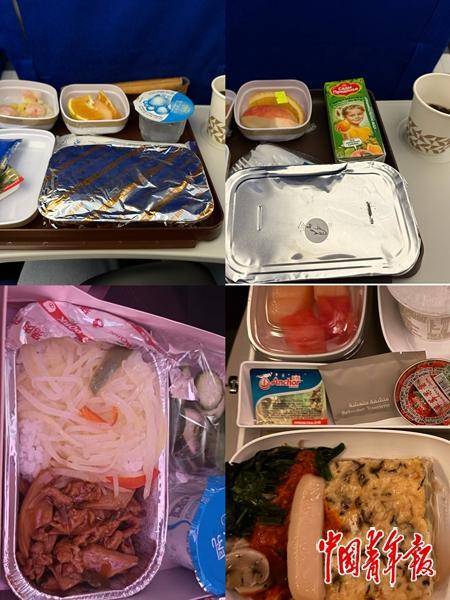
Different airplane meals. China Youth Daily·China Youth Daily reporter Yu Bingyue/photo
“In the past, when flying, I didn’t care whether I was hungry or not when the meal was served. I took two bites and put it down. Now I click on ‘discard meal’ on my phone and the miles are directly accumulated into my account. It is environmentally friendly and affordable.” Chen Li (pseudonym), a post-95s passenger who often travels between Beijing and Shanghai, showed reporters the operation records of his latest flight. On the app, Chen Li chose “travel green and be courteous when giving up meals” and received non-qualified mileage rewards. “I’m not hungry after a short trip anyway. Wouldn’t it be nice to save points to buy a plane ticket?”
Chen Li’s choice is not unique. When free flight meals change from “standard” to “optional”, when “giving up meals for points” becomes an active choice for more and more young people, when paid meals quietly become popular on major airline apps… civil aviation meal services are undergoing a market-oriented change.
Rather than “being fed”, we need “the right to choose”
“I used to think that airplane meals were a service included in the ticket, and if you didn’t eat them, you’d lose money. But sometimes the food tastes average and you can’t eat too much, so it’s better to exchange the meals for other benefits.” Wang Quanshu (pseudonym), a graduate student in Beijing, told reporters that now after booking a ticket, he habitually opens the “Meal Reservation” page to see if there are suitable paid meals. If not, he just chooses “abandoning the meal.”
During the interview, the reporter found that the attitude of young passengers towards airline meals is dividing: some people, like Chen Li, regard “giving up meals for points” as a rational choice – they avoid waste and gain practical rights; others, like Wang Quanshu, are willing to pay for quality and try to pay to upgrade meals on long-distance routes. There are also some travelers who are waiting and watching – worried about whether the quality of the paid meals can truly match the price.
“This differentiation itself is a true reflection of the stratification of consumer demand.” Guo Jia, a civil aviation expert and professor at the Nanguo Business School of Guangdong University of Foreign Studies, said, “Young people are not unwilling to spend money, but they are unwilling to spend money in vain.”
Guo Jia believes that the underlying logic of airline meal reform is “on-demand consumption”. “The poor taste of airline meals is a long-term pain point. Optimizing services by taking advantage of the situation and allowing passengers to decide what to eat and whether to eat based on their own needs is a service upgrade in itself.”
In Guo Jia’s view, giving up meals in exchange for points is not simply to save costs. On the contrary, the handling and confirmation process of special meals also increases the airline’s operating costs. “If a passenger chooses not to have a meal, the airline needs to make separate statistics through the system and provide points and other rights as compensation. Only by adding service links and processes can the precise matching of meal needs be finally achieved.”
From the perspective of consumer psychology, the younger generation attaches much greater importance to the “right to choose” than the older generation. They are more likely to pay for the services they really need, rather than paying for bundled services that “seem to be free.” This change in consumption concepts is forcing airlines to re-examine the positioning of meal services: from “you eat what I provide” to “I provide what you need.”
From “one size fits all” to “layered protection”
Green travel, giving up meals in exchange for points, paying for meal selections… these services that once only appeared in the pilot projects of a few airlines are now quite common in the domestic civil aviation industry. Travel industry analyst Xu Hong believes that behind this diversified choice is the airline’s rethinking of the positioning of meal services. It is not just a “standard” cost, but a service product that can be operated in layers.
Judging from industry data, this trend is spreading faster than expected. The relevant person in charge of China Southern Airlines revealed that the service of “paid meals and green flight on-demand meals” reaches millions of people every year, and the number of personalized meal reservations continues to grow. This year’s booking volume increased by nearly 80% year-on-year; Air China has extended the meal abandonment service to all domestic departure routes, and passengers can receive ticket coupons or non-qualified miles for abandoning meals; China Eastern Airlines has launched meal reservations on some routes; Xiamen Airlines has introduced local specialties into the cabin. Each airline has different paths, but the direction is the same, which is to “give the choice back to passengers.”
At the same time, in terms of protection for special passengers, China Southern clearly provides free special meal services for children, the elderly and passengers with special dietary needs. There are currently about 20 types of special meals available, covering children’s meals, vegetarian meals, low-sugar meals, low-salt meals, fruit meals, seafood meals, etc.
The dining experience when flights are delayed is also improving. The electronic delayed meal coupon service recently launched by China Eastern Airlines allows passengers to receive meal coupons with one click on their mobile phones and freely choose meals at partner restaurants in the airport, bidding farewell to the single option of receiving box lunches in the past. The service is currently available at Wuhan, Qingdao, Nanchang, Jinan and other airports, and the coverage will be expanded within the year.
Guo Jia summarizes these models as “basic guarantee + paid optional”. “This is not only a cost control method, but also a reflection of refined service.” He pointed out, “Passengers on international long-distance routes rarely give up meals, and the majority of people are still dining. On domestic short-distance routes, many high-card (gold and silver card) passengers of airlines have already eaten in the lounge, resulting in a reduction in the demand for in-flight dining among this group of people, which also creates a broader space for ‘tiered services’.”
It is worth noting that changes in meal services are also forcing airlines to re-examine supply chain management. When selecting paid meal suppliers, it is necessary to comprehensively evaluate food safety standards, supply chain stability, and cost price. China Southern Airlines stated that all catering suppliers are cooperative units with aviation flight guarantee qualifications. Paid meals and regular free meals follow unified food safety management and control system standards. The differences are mainly reflected in the type of ingredients, flavor mix and meal presentation. This means that while services are layered, the security bottom line is not reduced.
Where is the next stop for airline meals?
In fact, the transformation of airline meals is also restricted by objective conditions. Guo Jia pointed out that the taste of airline meals is not only limited by the production level, but also by the high-altitude flight environment. “Changes in humidity and pressure in the high-altitude environment will change people’s taste. Food that is delicious on the ground may not taste good on board. At the same time, to ensure flight safety, there are restrictions on the ingredients used, and most meals are pre-made and then heated.”
Studies have shown that in the low-pressure and dry environment of the cabin, people’s perception of sweet and salty tastes will decrease by about 30%. This is why airline meals often require more seasoning. However, adding more seasoning may cause health concerns, and it is not easy for airlines to balance taste and health.
Looking into the future, Guo Jia believes that “specialization” may become a new stage for domestic airline meals. “Some airlines launch simple meals with local characteristics, such as roujiamo, donkey meat barbecue, etc., to enhance brand recognition. However, even special meals need to be changed regularly to maintain freshness and appeal.”
The transformation of airline meals also resonates with the overall transformation of the civil aviation industry. As China’s civil aviation shifts from a stage of rapid growth to a stage of high-quality development, refined operations and differentiated services have become industry consensus. In Xu Hong’s view, although the meal is small, it is a window for observing the airline’s service philosophy and market strategy. Behind the seemingly small changes such as giving up meals in exchange for points, paying for meal selections, and special simple meals are the airlines’ re-understanding of passenger needs and a proactive response to the concept of green and low-carbon development.
China Youth Daily·China Youth Daily reporter Zhang Zhenqi Source: China Youth Daily
Related Reading
- In chaotic L.A. skies, news helicopter pilots juggle competition, camaraderie, risk2026-09-20
- Trump says he will form an “artificial intelligence army”2026-09-20
- 13-year-old Yu Zidi broke the Asian Games record and won the gold medal!2026-09-20
- The State Administration for Market Regulation is clear! This type of infant formula food must not continue to be sold2026-09-20