CCTV Dalian News on September 18 (Reporter Ding Yi) In early September, Dalian ended the four-month fishing moratorium during the summer season. On the day of the Fishing Festival, hundreds of steel fishing boats from Dalian Liao Fishing Wharf lined up to leave the port, and more than 320 fishing boats unmoored and anchored at Xingshu National Central Fishing Port. Zhuanghe set up a long table for the “Fishermen’s Banquet for Thousands” in the park, and drums and drums blared for the sea sacrifice ceremony on Ocean Island in Changhai County. More than 100 fishing ports and nearly 5,000 fishing boats in Dalian started moving at the same minute.
Year after year, the “unblocking” of this fishing moratorium has been celebrated as a holiday. But if you want to calculate the accounts of the fishing festival, you will find that these 12 hours are not just one day’s activities – it is four months of net closure and eight months of fishing in a year, which is a vivid epitome of a system that has gone through thirty-two years. The real importance of the Fishing Festival lies not only in the opening of fishing, but also in people’s understanding of how to use scientific methods to obtain from the sea without overdrafting.
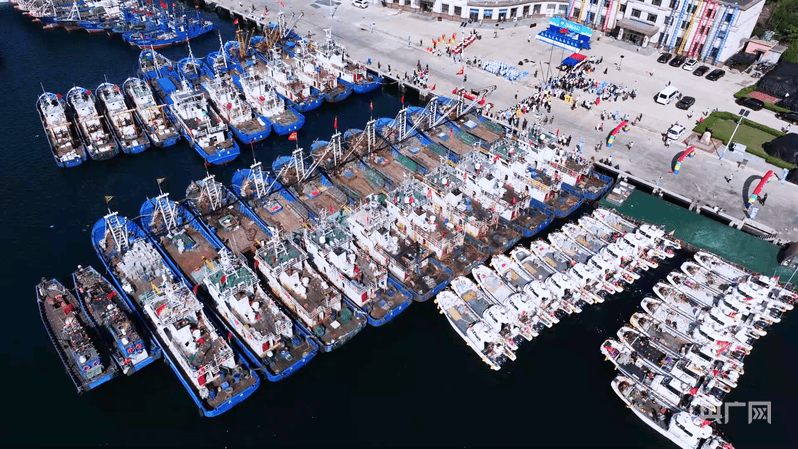
Fishing boats ready to go on Haiyang Island (photo by CCTV reporter Ding Yi)
Put the net away first, then there will be fish to catch
The logic of holding a fishing festival is ultimately the way fishermen get along with the sea.
“The sea is opening. This is the most exciting thing for fishermen. After all, we have been waiting for four months.” On the morning of September 1, at the Haiyang Island Pier, Meng Qinggui, an old fisherman in his 50s, squatted on the stern of his fishing boat to organize the cages. The people of Haiyang Island have lived with the North Yellow Sea for several lifetimes, and everyone knows that after May 1 every year, when ships enter the port, nets are put into the warehouse, and people come ashore, they are not idle, but to make time for the sea. Small fish grow meat under the reef, and crabs lay eggs on the seabed. These are invisible, but the old fishermen know it.
After the sea opened, fishermen were looking forward to it. What they were looking forward to was not “something”, but “fat”. “The quantity is large and the size is large, so we can sell it at a good price.” Meng Qinggui made calculations for reporters: After the market opened, there were more products from Shanghai. The prices of Dalian’s signature seafood such as flying crabs, shrimps and sea urchins will go down. Sea products are put on the market in a centralized manner, and the prices are more affordable to the people. Fishermen can also sell them at a good price. Once in and out, both accounts look good. This is the reason why the summer fishing moratorium system has been able to persist for thirty-two years – it is not supported by propaganda, but by the yield in the sea, the size of fish and shrimp, and the pockets of fishermen.
Behind the excitement, there is a group of people who dare not relax.
At the Ocean Island Pier, the last people to board the ship were law enforcement officer Tan Kui of Dalian Coast Guard Changhai No. 1 Work Station and his colleagues. In the past four months, they have carried out maritime control and off-peak cruising, focusing on poaching; before setting sail, they walked to the docks and boarded fishing boats to ensure safety. “At 12 noon today, fishing in the Yellow and Bohai Sea officially opened, and this year’s summer fishing moratorium came to a successful conclusion.” Tan Kui told reporters, “The opening of fishing does not mean loosening the restrictions. There are hundreds of boats out there, wind, fog, and fishing areas intersect, so risks still exist. When fishermen go into the sea to catch fish, we are in the back pocket.”
Seal the net, throw seedlings, and raise the sea
Many people only focus on “no fishing”. In fact, during the fishing moratorium, neither the sea nor the people are idle.
In mid-May, Pikou sea area, Pulandian District. With the sound of “release”, individual Chinese shrimp seedlings slowly slid into the sea along the diversion trough. At the same time, the same action was also carried out in Jiangjun Shihaiyu, West Yangxiang, Wafangdian. This is proliferation and release – releasing artificially cultivated seedlings into the natural sea to allow the wild population to recover and grow. Dalian has been breeding and releasing fish for more than ten years. The window period is from May to August every year, which coincides with the fishing moratorium: nets are sealed here and seedlings are thrown there. The species are also carefully selected – Chinese prawns, brown flounder, swimming crabs, and Xu’s flat worms. They are all local species in Dalian. The catch rate is high, and the fishermen can see real benefits. Some fishermen put it seriously: “It’s like depositing money into the sea, and getting it back with interest in the fall.”
On the evening of August 20, 2026, hundreds of fishing boats loaded with squid returned to the Dalian Bay Fishing Port of Liaoyu Group. Fresh squid are continuously unloaded ashore through automated conveyor belts, workers sort and transfer them, and the catch flows to the market through the Liaoyu Group Aquatic Products Trading Center. This is Dalian City’s special squid fishing during the 2026 summer fishing moratorium, and this year is the second year it has been carried out.
Many people will wonder: Can we still catch fish during the fishing moratorium? This is precisely proof that the fishing moratorium system is becoming more sophisticated. Squid are mostly annual marine organisms, and their offspring will naturally die after spawning. If this window period is missed, these resources will be wasted in the sea. Special fishing does not allow them to escape, nor does it touch the breeding fish and shrimps – the balance between opening and resting is as fine as the species.
Resting without replenishing is passive waiting; resting and replenishing at the same time is active nourishing.
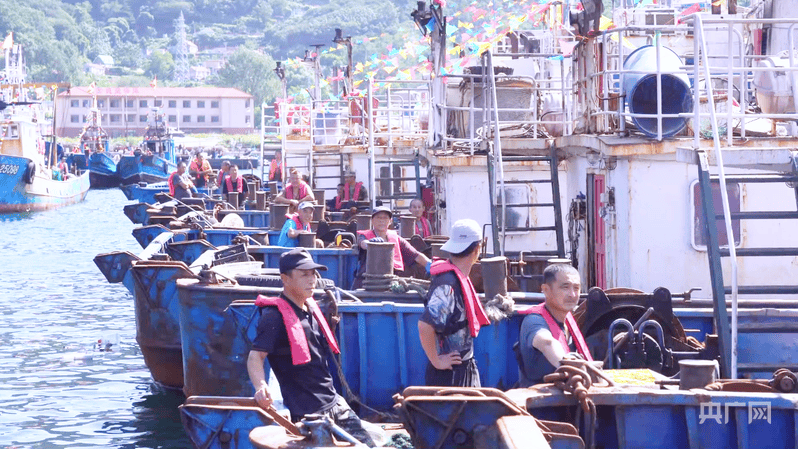
Fishermen waiting to go out to sea (photo by CCTV reporter Yi Bowen)
Thirty-two years later, Hai gave the answer
There is another account that is not related to fishing.
Data shows that as of May 2025, Dalian has created a total of 32 national-level modern marine ranch demonstration areas, with a total sea area of more than 300,000 acres. Relevant data from the Dalian Municipal Bureau of Statistics show that in 2025, local aquatic product output will be 2.873 million tons, an increase of 5.1%. Among them, marine aquaculture was 2.446 million tons, an increase of 4.8%. From artificial reefs to fish breeding and release, to national-level modern marine ranch demonstration areas, this path is essentially a turning point: from asking for the sea to “operating” with the sea.
Protecting and using the sea has gone so far. Looking back at the whistles that resounded in various ports in Dalian on September 1st, what exactly are we celebrating during the Fishing Festival? On the surface, it celebrates the upcoming full catch, the price reduction of seafood, and the bulging pockets of fishermen; looking deeper, it celebrates a set of sea-use logic that has been verified for thirty-two years—restoring the sea and leaving time for resources to breed; replenishing the sea with seedlings, turning solicitation into release; managing the sea with systems, and accurately determining “opening and closing” to species and window periods. The combination of these aspects is the scientific use of the sea: it is not that we don’t ask for help from the sea, but we ask for it according to the laws of the sea; it is not that we catch more, but we catch longer.