【Editor’s note】
The Long March was a great feat in human history and created a miracle on earth that swallowed up mountains and rivers. The imprint of the Long March is contained in the daily lives of countless ordinary soldiers and people along the way. A fishhook, a lantern, half a leather belt… each precious token is imbued with the spirit of the great Long March, embodying the comradeship that depends on life and death, the military-civilian sentiment that sticks together through thick and thin, and the time-honored sentiments of family and country.
On the occasion of the 90th anniversary of the victory of the Red Army’s Long March, the Litchi News Center launched the “Indelible Marks” series of integrated media reports, using “objects” from the Long March period as emotional ties to look back on the arduous and arduous years and relive the everlasting red memories, leading the youth to draw spiritual strength across time and space and walk the Long March in the new era.
On the ancient street of Jianguo Road in Yudu, Ganzhou, there is a Hakka house standing quietly. The person who lives here is named Liu. This century-old Liu family’s house retains many unusual traces: only half of a double-leaf wooden door remains; the wooden walls of some houses are empty, with only wooden columns remaining; two of the six wooden beams in a certain house are missing, and the sawn holes are clearly visible…
Liu Zhiming is a descendant of the owner of the old house. He grew up in the old house. He is particularly familiar with these special “vacancies”. Whenever you walk into the old house, an indelible red memory slowly unfolds, and the prosperous years of more than 90 years ago seem to be right in front of you.
People demolished their homes and donated wood to support the erection of the pontoon bridge
Whenever he is asked why the wooden door is only half-way, Liu Zhiming’s thoughts are taken far away. “There used to be two doors here, but now only half of them remain. In order to support the Red Army in building the pontoon bridge, these door panels were donated. When they came back later, half of the doors were missing…”
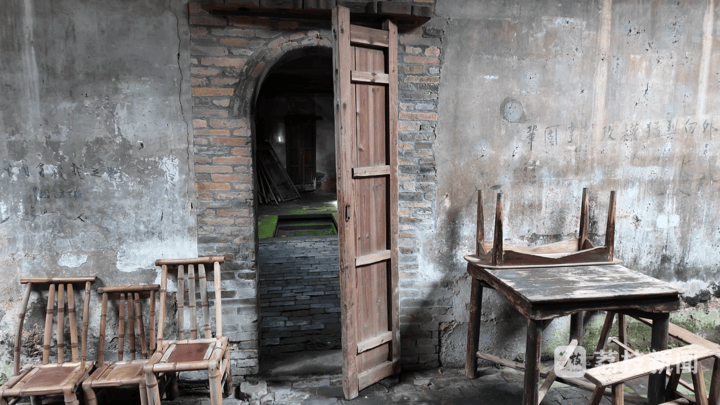
Only half of the wooden door remains in the Liu family’s old house
Due to the failure of the fifth anti-“encirclement and suppression” campaign, the Central Soviet Area was shrinking day by day, and the Central Red Army was forced to implement strategic shifts. Yudu is located in the southwest corner of the Central Soviet Area. The territory is mostly hilly, which is both hidden and open, which is conducive to the movement of large troops. In addition, the war here has not yet occurred, it is relatively safe, has a good mass base and material conditions, and has outstanding military advantages, making it the first choice place for the Red Army to gather and set off. In October 1934, the central organs, the Central Revolutionary Military Commission and the main force of the Central Red Army gathered in the capital. The Yudu River was the first large river that the Red Army had to cross when it embarked on the Long March. At that time, the river was more than 600 meters wide and 1-3 meters deep. The water flow was very fast. If the large troops wanted to cross the river, they had to build pontoon bridges.
When the Red Army needed a lot of wood to build bridges, Liu Zhiming’s grandfather Liu Zhisan did not hesitate to remove the door panels, wall panels and other wood from his home. “As long as the Red Army needs it, he donates everything for free.” Liu Zhiming said that his grandfather signed up to join the Red Army in 1929 and became an instructor of the Red Army guerrillas. When the wall panels were being demolished, grandma stopped her and said, “If it’s demolished, where will we live?” Grandpa just said a few words, “The Red Army can’t cross the river, and we don’t even have a place to cry!”
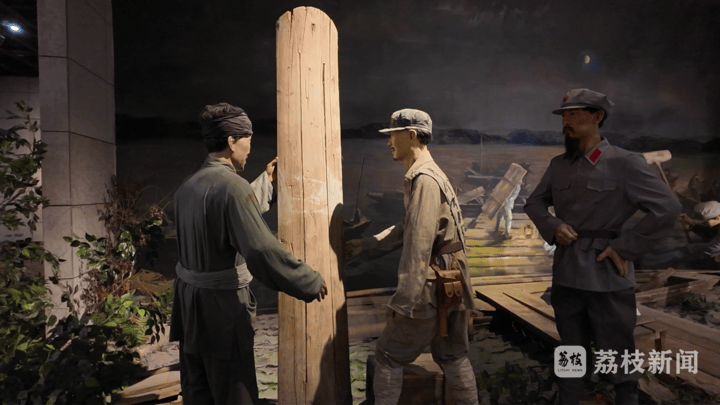
Restore the scene where Uncle Zeng donated materials for his birthday in the Central Red Army Long March Departure Memorial Hall in the capital
Led by Liu Zhisan, the Liu clan also took action. In fact, in order to support the Red Army, people in Yudu donated various types of wood from their homes. There was an uncle Zeng who donated all the available wood in his home and also donated the longevity wood boards. After learning about it, Zhou Enlai, then vice chairman of the Central Revolutionary Military Commission, said: “The people in Yudu are so kind, and the people in the Soviet area are so close.”
Crossing the river in the dark night, 300,000 people keep a secret
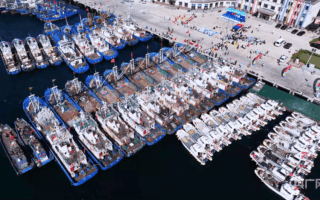
In addition to the wood from their homes, people along the river also donated all their fishing boats. More than 800 large and small boats have been collected, some used for ferries, and some used to build pontoons.
“The pontoon bridge uses fishing boats as the bridge base, and uses wooden beams to connect the boats. The top is covered with shop planks, door planks, bed planks and other wood.” Zhang Xiaoping, former deputy director of the Yudu Central Red Army Long March Departure Memorial Hall, said that at that time, there were eight major ferries on the Yudu River, five of which required pontoon bridges. In order to avoid reconnaissance by Kuomintang aircraft and conceal strategic intentions, crossing the river could only be carried out at night. The people of Yudu assisted the engineers and started building the bridge at five o’clock in the evening. The Red Army worked all night to cross the bridge. The pontoon bridge was completely dismantled before six-thirty the next morning, leaving no trace.
A restored pontoon bridge on the Yudu River
Because the Liu family’s old residence was close to the river, many Red Army soldiers lived here before crossing the river. Liu Zhiming clearly remembers what his grandma once said. “One group left and another group came, staying during the day and leaving again in the evening. They spread propaganda wherever they went, and they also left their mark here.” On the wall of the old house, you can still see the slogans left by the Red Army: “Break the feudal power” “Guarantee the victory of the land distribution and join the Red Army”…
The Red Army slogans preserved on the wall of the Liu family’s old house
From October 17th to October 20th, 1934, more than 86,000 Red Army soldiers crossed the Duhe River in four nights, and the pontoon bridge was disassembled and reassembled a total of 15 times. With the close cooperation of the people of Yudu, the enemy did not know that the Red Army had broken through to the southwest until the Red Army broke through the first blockade. “300,000 people keep a secret because everyone believes that the Red Army is the people’s team and the one that truly serves the people.” Liu Zhiming said.
The fire continues forever, and the old appearance of Yudu River is renewed
After the main force of the Red Army embarked on the Long March, white terror enveloped the capital, and the Kuomintang reactionaries launched frantic revenge. Liu Zhisan stayed and persisted in the guerrilla struggle. In December 1934, he was unfortunately arrested and sacrificed at the age of 37. Liu Zhiming always kept his two wishes in mind during his lifetime.
The restored scene of the Red Army crossing the river in the Red Army Long March Departure Memorial Hall in the Central Government of Yudu
When the Red Army crossed the river and left Yudu, Liu Zhisan took his children to bid farewell at the South Gate Ferry. He was filled with emotion and hoped that some of his descendants would serve the country as soldiers and that some of them could join in building bridges and paving roads. “My uncle once told me a story about how he followed my grandfather and his father to see off the Red Army. After he told me, I have always kept my grandfather’s wish in mind.” In 1972, Liu Zhiming joined the army. Today, his son Liu Feng is a bridge engineer. Liu Zhiming recalled that his son took the college entrance examination in 1997. On May 1 of that year, the Yudu Changzheng Bridge was completed and opened to traffic. He was shocked and inspired by the grand occasion at that time, so he chose transportation and civil engineering when filling out his application form. After graduation, he continued to work in the field of bridges.
Liu Zhiming by the Dudu River
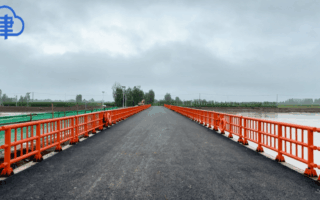
Liu Zhiming often thought that if his grandfather knew this in heaven, he would be very happy. “Although grandpa died so early and we have never met, we have inherited his spirit and we have fulfilled his wish.” Liu Zhiming said that Yudu has also undergone earth-shaking changes in these years. At that time, modern bridges were built next to the ferry. In addition to the Long March Bridge, there were also the Red Army Bridge, the Assembly Bridge, the Dujiang Bridge, and the Victory Bridge. “It’s very convenient to go anywhere now, and the natural chasm has become a thoroughfare.”
The old appearance on the banks of the Yudu River has been given a new look, but the Liu family’s old house still retains its original appearance. The slogans on the walls are vaguely visible, and the door panels that cannot be found are still blank. “Why are they all preserved? If they are all renovated, people behind may not know this history.” Here, the echoes of history are still stirring, inspiring generations of people to forge ahead and keep the fire burning.