At 9 o’clock in the morning, in the ancient books reading room of the Peking University Library, Xie Mengen, a 2024 doctoral student in the Department of Chinese Language and Literature, was leaning over a volume of “Collected Works of Mr. Gong Wei” inscribed in the Southern Song Dynasty. “This is the Siming Lou family’s block book. The fonts are stretched and smooth. It is a model of calligraphy in eastern Zhejiang in the late Southern Song Dynasty.” He said that opening the ancient book was like having a conversation with the engraver from 800 years ago.
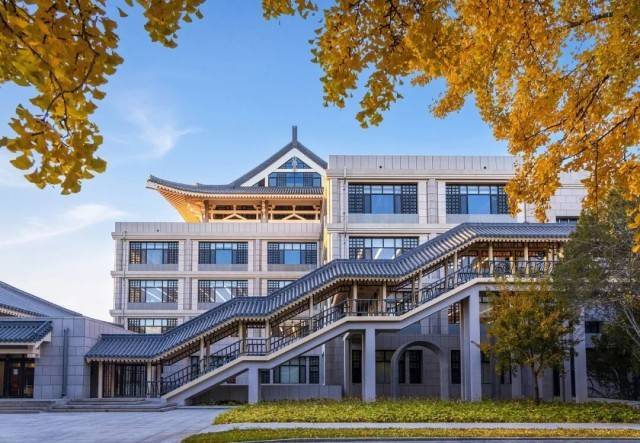
Exterior view of Peking University Library.
This library has gone through 128 years, from the Red Building on the beach to the Yanyuan Garden, from the library of the Imperial University to the modern library with tens of millions of volumes today. The space is changing, the people are changing, but the fragrance of books has never gone far.
紅樓燈火
Faith is ignited here
In 1918, Li Dazhao walked into the Beach Red Building and took over as director of the Peking University Library. He introduced Marxist books and periodicals, making the library an important place for spreading new culture. In 1920, he guided the establishment of the “Marx Theory Research Society of Peking University”, and the library was named “Kang Mu Yizhai”. “Kangmuyi” is the transliteration of the German “Kommunismus”, which means communism. In the display cabinet, 8 books stamped with the “Kang Mu Yizhai” collection seal are the treasures of the library.
It was also in the Red Mansion that the young Mao Zedong worked as a library assistant and began to come into contact with Marxism under the influence of Li Dazhao. “While I was working as a library assistant, I moved very quickly in a Marxist direction,” he later said in a conversation with Snow.
Today, the Dazhao Reading Room on the 4th floor of Yanyuan Library has restored the scene of Li Dazhao’s Red Building Office. Qian Weinan, a 2025 doctoral student in the School of Computer Science, said that touching red history in yellowed books and periodicals has continuously enhanced the sense of responsibility and mission.
The Dazhao Reading Room integrates reading, exhibition, and collection. There are more than a thousand books in the “Books Telling Party History” study area in the open-shelf area, and more than 10,000 original revolutionary documents are properly preserved in the closed-shelf area. “More than 50,000 readers study here every year, and we have received more than a thousand group visits.” Xu Qingbai, a librarian at Peking University, said that the library cooperates with the School of Marxism at Peking University and other schools to carry out ideological and political courses in the Dazhao Reading Room, allowing the Dazhao spirit and revolutionary culture to be deeply rooted in the hearts of the people.
燕園書香
The context continues here
In 1952, Peking University moved to Yanyuan, and more than 400,000 volumes of the Yenching University Library were incorporated. The merger of the collections of the two universities, coupled with the continuous accumulation of more than 70 years since then, has resulted in the collection of ancient documents in the Peking University Library reaching 1.6 million volumes (items), including more than 200,000 volumes of more than 20,000 rare books.
Zhong Di, director of the Ancient Books Resource Service Center of Peking University Library, said that the collection brings together the old collections of famous writers such as Fang Gonghui’s “Bilinlang Library”, Ma Lian’s “Budeng Elegant Hall”, and Li Shengduo’s “Muxixuan”. In 2013, the “Okura Bunko” was repurchased as a whole – this was the first large-scale repurchase of lost classics from overseas by a state-owned collection institution after the founding of New China.
“Ancient books are not only cultural relics, but also ‘living teaching materials’ for teaching.” Zhong Di said that the library has cooperated with the Department of Chinese and History of Peking University to move classes into the ancient books library. Since 2018, it has supported more than 100 teaching sessions, with more than 1,500 teachers and students participating.
Xie Mengen often comes to the ancient book library to read. He said: “After reading ancient books for a long time, the atmosphere of the ancients will penetrate into the speech and mentality, and it will also inspire me to move forward.”
In the ancient book restoration room, Zhang Yanxia, deputy director of the Ancient Books Resource Service Center of the Peking University Library, is leading a team to restore an ancient book that is heavily infested with insects. In 2021, the Peking University Library’s ancient book restoration team expanded from 1 to 7 people, and established a hierarchical and classified restoration system. On-site emergency restoration averages 3,000 volumes per year, and regular disassembly and restoration averages 40 to 50 volumes per year. In recent years, the restoration team has also entered the “History of Chinese Books” class at the Department of Information Management of Peking University to guide students in learning and mastering the binding of thread-bound books. “International students participate every year, and this is also an attempt to spread traditional culture to the outside world,” Zhang Yanxia said.
書聲不輟
Youth grows here
In the sunshine hall of the library, the general reference hall is often “hard to find”. The circular “Water Wave Bookshelf” means the waves of the unnamed lake. The Boya Book Tower echoes the Boya Tower, and the large floor-to-ceiling windows echo the shadow of the Lake Tower. Zhang Naishui, director of the Knowledge Resource Service Center of Peking University Library, said that the design draws on the concept of “Ming Tang Pi Yong” to allow “people to be in books and books at hand.” It integrates teaching reference books, general education books and “Reading Peking University” characteristic literature to form a multi-level resource system from course learning to knowledge expansion.
Zhang Yuanyuan, a 2023 undergraduate student from Yuanpei College, is the 2025 “Unknown Reading Star” and has read more than 400 books in a year. “When I first entered school, I liked to go to the new book reading hall to read novels and historical works. Later, due to professional study needs, I began to read a lot of law and political science classics.” She said that each of their classes is equipped with a “class librarian” in the library. The “class librarian” recommends activities and answers questions in the class group, just like a reading guide who is always around.
“Teaching Librarian” is the library’s integrated and accompanying information service for undergraduate students. Starting from the freshman year, each class is assigned a dedicated librarian, who joins the class WeChat group to provide personalized information consultation and scientific research assistance. Liu Yaqiong, deputy director of the Peking University Library Collaborative Service Center, said that currently, “class librarians” cover more than 110 freshmen undergraduate classes every year and serve more than 10,000 students. “From resource introduction at the time of admission, to database retrieval and academic standards for sophomores, to thesis writing guidance for juniors and seniors, they accompany students throughout their undergraduate stages.”
In the Data Reading Hall, Gu Shuazhi, a 2024 undergraduate student in the Department of Information Management, is experiencing the library’s self-built intelligent platform. “I previously participated in a series of artificial intelligence literacy activities and learned to use artificial intelligence to assist reading and writing. The library is not only a place to borrow books, but also a platform to learn new technologies and improve comprehensive literacy.” Gu Shuaizhi said.
“Libraries have three basic functions: document protection, information services, and cultural education.” Chen Jianlong, director of Peking University Library, said that the borrowing volume of paper books at Peking University Library has continued to grow in the past 10 years, reaching 1.2 million volumes in 2025. In recent years, the library has paid special attention to cultural education, exploring immersive, scenario-based, and all-round educational practices around China’s excellent traditional culture, revolutionary culture, and advanced socialist culture. “We hope that through ancient books, red documents and other carriers, students can enhance their cultural identity and strengthen their cultural confidence through dialogue with classics and civilizations,” said Chen Jianlong.