“Comrade Lu Qi, a member of the Communist Party of China, a famous performing artist and retired cadre of the Beijing People’s Art Theater, died in Beijing on November 1, 2026 at the age of 101 due to illness.” The obituary issued by the theater also read: “According to Comrade Lu Qi’s last wishes and the wishes of his family, the funeral will be kept simple.”
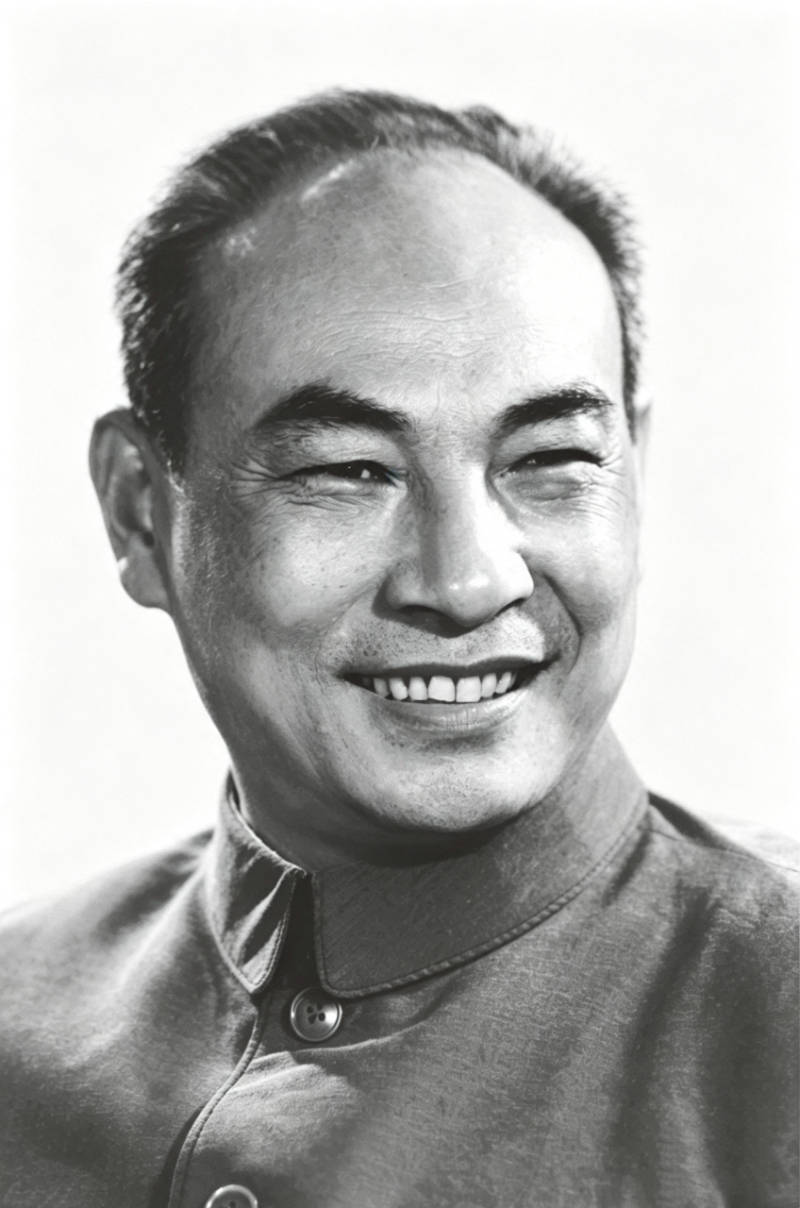
Lu Qi (August 29, 1925 – November 1, 2026)
A centenarian, looking forward to a long life. Sadly, Lu Qi’s death also marked the end of the last well-known actor born in the 1920s in Beijing People’s Art Theatre. This old artist, who has left classic roles on both the stage and the screen, has been obsessed with performing arts throughout his life. He once said: “Acting is about being obsessed. Acting is an endless battle of resilience.”
Creating a character is “like digging a well”
Lu Qi’s original name was Lu Changqi. He was born in Huang County, Shandong Province on August 29, 1925. He graduated from the Nanjing National Drama College in 1949 with a major in acting. In May of the same year, he joined the 35th Army Art Troupe of the Chinese People’s Liberation Army. From 1950 to 1953, he served as the captain of the Maritime and Art Troupe of the East China Military Commission. During this period, he created many artistic images with distinctive personalities and unique charm. He was awarded the title of third-class meritorious actor for his role as Zhukhlai in the drama “Paul Korchagin”.
In 1954, Lu Qi was transferred to the Beijing People’s Art Theater and began a decades-long artistic career on the drama stage. He has appeared in more than 70 plays such as “Aesop”, “A wise man must make a mistake”, “Wang Zhaojun”, “Spring Dawn in the Old Capital”, “Who is the Strong”, “The Lady Returns to the Hometown”, “The Trouble Begins”, “The King of Wu’s King’s Sword”, “The Time of Labor Pain”, “The Savage”, “The Beloved of God” and “Li Bai”. The characters he created are all delicate and vivid, with rich levels of emotional transmission, and have won praise from the industry and the audience.
Liang Bingkun, an actor and screenwriter at Beijing People’s Art Theatre, once recalled that Lu Qi’s creation of characters was “like digging a deep well.” “Everyone who is familiar with Lu Qi knows that in the process of creating characters, he is very stubborn like a Shandong native. This is mainly reflected in the fact that he always tries his best to make the character’s thought line and action line clear, and clearly reflects them in the whole process of performance.” In Lu Qi’s words: “The thoughts of the characters must be constantly explored and reflected. Every step forward in this regard is difficult, but also endless fun.”
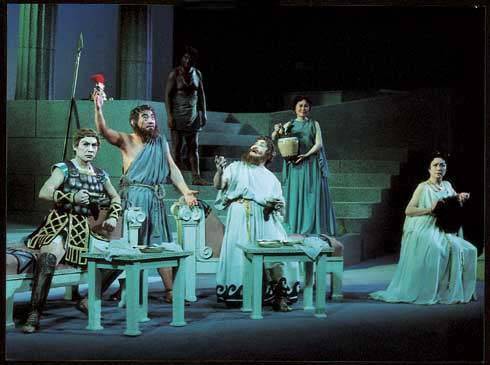
Stills from the drama “Aesop” Lu Qi (second from left) plays Aesop
The drama “Aesop” (1959) was Lu Qi’s early masterpiece on the Beijing People’s Art Stage. In the play, the performance of the slave Aesop when he is freed is very different. When he first performed, he only thought of Aesop’s strong desire for freedom and the ecstasy after regaining freedom: when Klea let him escape while the male protagonist Gesang was not around, he suddenly turned around in excitement and rushed to the top of the tall platform without wanting to stay for a moment.
As the number of performances and life experiences increased, Lu Qi felt that only expressing desire and joy was superficial – Aesop had gone through many vicissitudes, he was a slave, a poet, and a philosopher. He had obtained short-term freedom many times in his life, but he never broke out of the trap of slavery. “The lessons he learned with tears and blood made him have to wake up and calm down immediately.” So the subsequent performance was changed to: Excitement first. He turned around and rushed to two or three steps, suddenly stopped, there was a big pause behind the stage, then turned around slowly, and said in a cold tone, “I can’t. Look, I am always worried about being caught by others. Is this freedom?” The pause behind the stage was like a window, allowing the audience to see the bloody scars on his soul, and even his decades and even lifetime experiences.
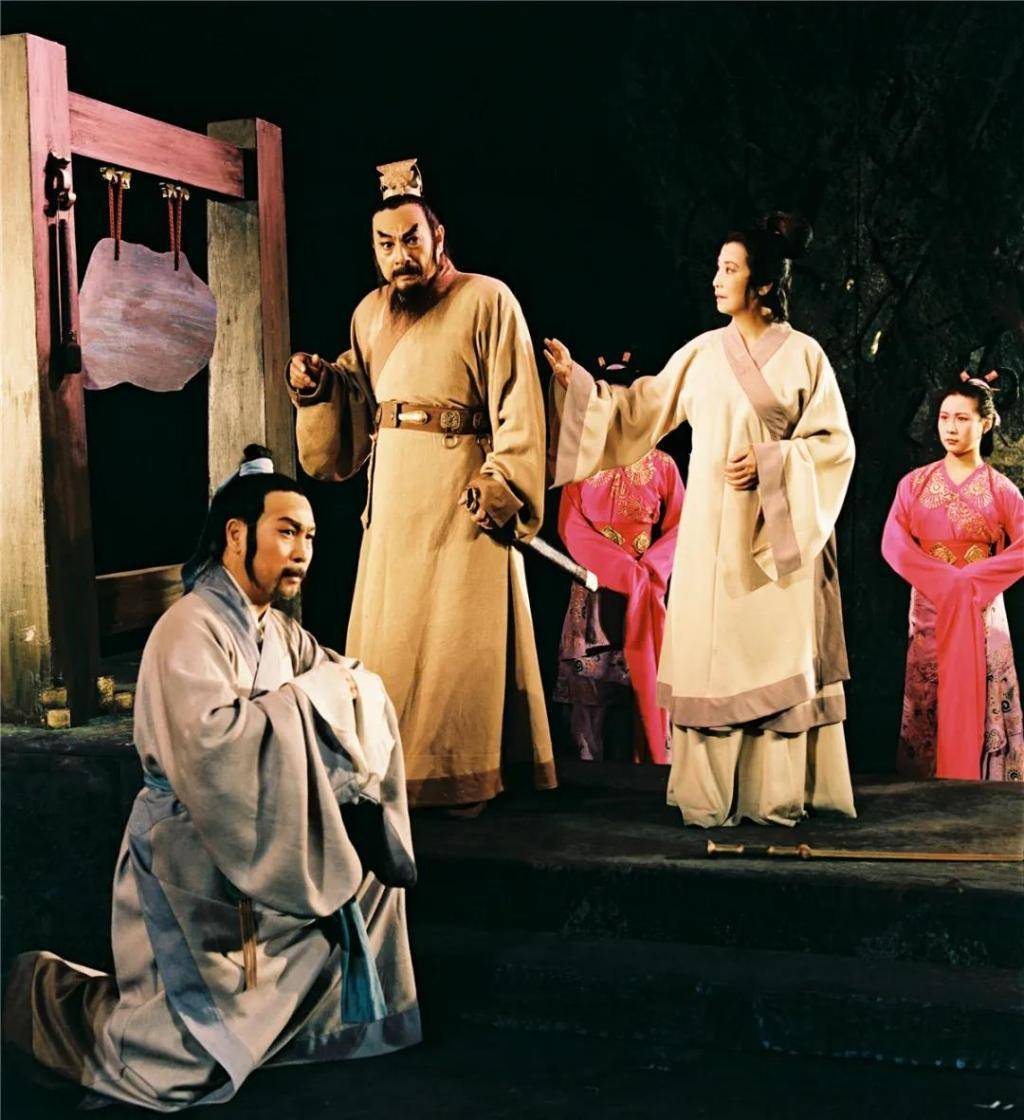
Stills from the drama “The King of Wu, Jin Ge, Yue Wang Sword” Lu Qi (middle) plays Gou Jian
Lu Qi has this opinion: “Actors’ performances often rely on changes in rhythm to refresh themselves. It is difficult to catch the audience with a dull rhythm.” In “The King of Wu, Jin Ge, Yue Wang Sword” (1983), the scene in which Lu Qi’s Gou Jian first meets Xi Shi is another example of him using changes in rhythm to achieve the extraordinary. In the script, when Gou Jian meets Xi Shi, the former faces the audience and the latter faces away from the audience. During the rehearsal, director Lan Tianye changed the schedule so that Xi Shi was facing the audience and Gou Jian had his back to the audience. This posed a moderate problem for Lu Qi – how to convey the complex and changeable inner world of the character at this moment only through his own back.
Let’s take a look at how the old opera performer performed it: First, he walked quickly on the stage and ignored Fan Li’s admonitions. He thought: “What can a dancer do to me?” She seemed to be full of confidence in her own self-control. And when he suddenly looked up and saw Xi Shi, he was so shocked that he didn’t move. After staring for a long time, he was gradually attracted to Xi Shi and gently took her hand… “This is how Lu Qi makes ordinary things strange through the ups and downs in rhythm, and the opening and closing, and strongly attracts the audience’s attention.”
The jealous court musician Salieri in the play “The Beloved of God” (1986) was another Western character played by Lu Qi who won great acclaim. In order to accurately interpret the character’s temperament, he not only carefully studied “History of European Literature and Art”, “The Biography of Mozart”, “History of Western Music” and other books, but also repeatedly studied audio and video materials to fully understand the charm of Mozart’s works. In order to more fully grasp the rhythm of the performance and show the characteristics of the characters, he also memorized the lines of other characters in the play. In the uninterrupted stage performance, the status of the old and mature characters can be switched freely, and the dialogue and narration are seamlessly connected.
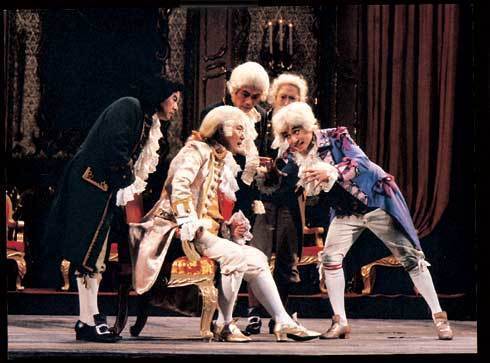
Stills from “God’s Beloved”
Screenwriter and theater critic Li Longyin still remembers that Salieri, played by Lu Qi, had three wonderful monologue scenes in the play, and he always nailed it. “He looked at Mozart’s manuscripts one by one and cried heartbreakingly, which left a deep impression on me, ‘My plays were performed constantly, the king liked it, the audience cheered, and became famous all over the world. I suppressed all Mozart’s plays. Mozart is dead! He left behind Now one after another of my plays has been staged, causing a huge sensation! But one by one my plays have been forgotten… God, I know how you punished me! “I have brought to life a complex character who is completely swallowed up by jealousy and inferiority.”
His acting style is unique, and after his retirement, film and television ushered in a second spring
In the 1980s and 1990s, “life flow” performances that were close to nature became very popular in the theater world. Lu Qi’s unique performance style amazed the younger generations such as Pu Cunxin and He Bing who were new to the theater. Pu Cunxin told The Paper that in the drama “Li Bai” (1991), Lu Qi played the role of Taoist Priest Wu Yun, and his aura on the stage was unparalleled, and his aura was enough to fill the entire theater. “Teacher Lu Qi dared to take action on the stage. His seemingly unobstructed movements made people feel that they were reasonable and reasonable. This kind of poetic exaggeration is both impromptu and beautiful.”
“With the words ‘Brother Taibai,’ Taoist Wu Yun’s appearance was unforgettable, and he vividly expressed the character’s idea of being a gentleman, but Yun Hu is not happy.” He Bing also imitated Lu Qi’s performance in a variety show. “It was really a dance of hands and feet, so exaggerated that it seems impossible to imitate it and cannot be imitated. He is always an amplified performance, passionate, but very convincing.”
After retiring from Beijing People’s Art Theater in March 1988, Lu Qi gained a second spring in the film and television industry. What really made him well-known to a generation of viewers was “Editor Chen” in the 1992 TV series “The Story of the Editorial Department”. In the play, he plays the leader of a magazine who is on the defensive. He is well versed in the ways of the world and is very open-minded and tolerant in his dealings with others. It is said that this role was “picked up” – the original actor was not qualified for the role, director Zhao Baocong changed the role, and Lu Qi was appointed at the critical moment, and he went to the studio to shoot in just one night after reading the script.
Stills of “The Story of the Editorial Department” Lu Qi (middle) plays Editor Chen
Some commentators believe that Editor-in-Chief Chen is the “solver” of all contradictions and problems in the editorial department: he not only invigorates and corrects the openness of young people in a timely manner, but also moderately criticizes the rigid thinking of older comrades. In the face of the “trendsetters” who appear from time to time in the early stage of the market economy, he rarely finds himself in a dilemma. It stands to reason that playing a veteran cadre in a drama that is known for ridicule and satire would be very easy and thankless. Lu Qi’s performance style is light and easy, “like the only understanding person with a God’s perspective in the whole drama, acting as a lubricant to connect the three generations together.”
“Farewell My Concubine” stills Lu Qi plays Master Guan
The year after “The Story of the Editorial Department” was broadcast, Lu Qi appeared in the movie “Farewell My Concubine”, playing the role of Guan Jinfa, the leader of the “happy Luck Cheng” theater troupe. Master Guan has fewer scenes than Chief Editor Chen. In just a few appearances, Lu Qi vividly portrays an old street performer on the flyover in the old society: when faced with the prostitute played by Jiang Wenli, who is flattering, his sentence “They are all low-class, who dislikes whom?” is completely invisible; He is full of piety when it comes to singing and acting skills, “If you want to be distinguished in front of others, you must suffer behind others.” “You have to fulfill yourself.” From his mouth, he perfectly interprets the sternness, persistence and love of his disciples, and has become one of the classic screen images in the history of Chinese films.
Related Reading
- The first in the country! How to learn “unpopular secret skills”? Who will teach? Dean’s interpretation2026-11-12
- The price of refined oil may drop for the sixth time this year. Filling up a tank will cost about 15 yuan less2026-11-12
- “Token hoarding” became a hot word in the “Double 11” circle, and after Li Jiaqi, Luo Yonghao also came to sell2026-11-12
- Does the United States really not want to fight Iran anymore?2026-11-11
- Fireballs are scattered around Shijiazhuang. How much is the value of “visitors from outside”?2026-11-11