As soon as the tricycle coming out of the stall appeared, crowds surrounded it from all directions, and live broadcast cameras were set up layer by layer…
This autumn, a young man from Xinjiang’s noodle stall has become the most popular check-in spot in Xi’an.
The young man’s name is Neseldin Rexiti, and he is called “Adaxi” by netizens, which means brother or friend in Uyghur. Nesirdin has been selling baked rice noodles in Xi’an for three years. Three freshly made baked rice noodles cost 10 yuan each. Netizens call him a “model in the food industry” and jokingly say, “You can eat these noodles without burning your heart.”
As the roasted glutinous rice short video attracted attention, the online popularity also extended to his offline mobile stalls, and many diners came here. Two hours before the stall was set to go out, the queue to buy noodles had already turned a corner.
In recent days, as soon as he leaves the stall, he will be quickly surrounded by an army of live broadcast mobile phones. Once when there were too many people, he was even squeezed out of his noodle stall by the crowd.
After becoming popular for many days, on October 24, Neseldin opened a personal account and released his first video. In online narratives about “Adasi”, when people discuss “why he is popular”, they often mention that he is simple, down-to-earth, and heart-warming. Some people also believe that this is another time that platforms and algorithms are “creating gods.”
Recently, reporters from The Paper (www.thepaper.cn) came to the place where “Adasi” set up a stall, trying to see a more realistic look at this traffic carnival.
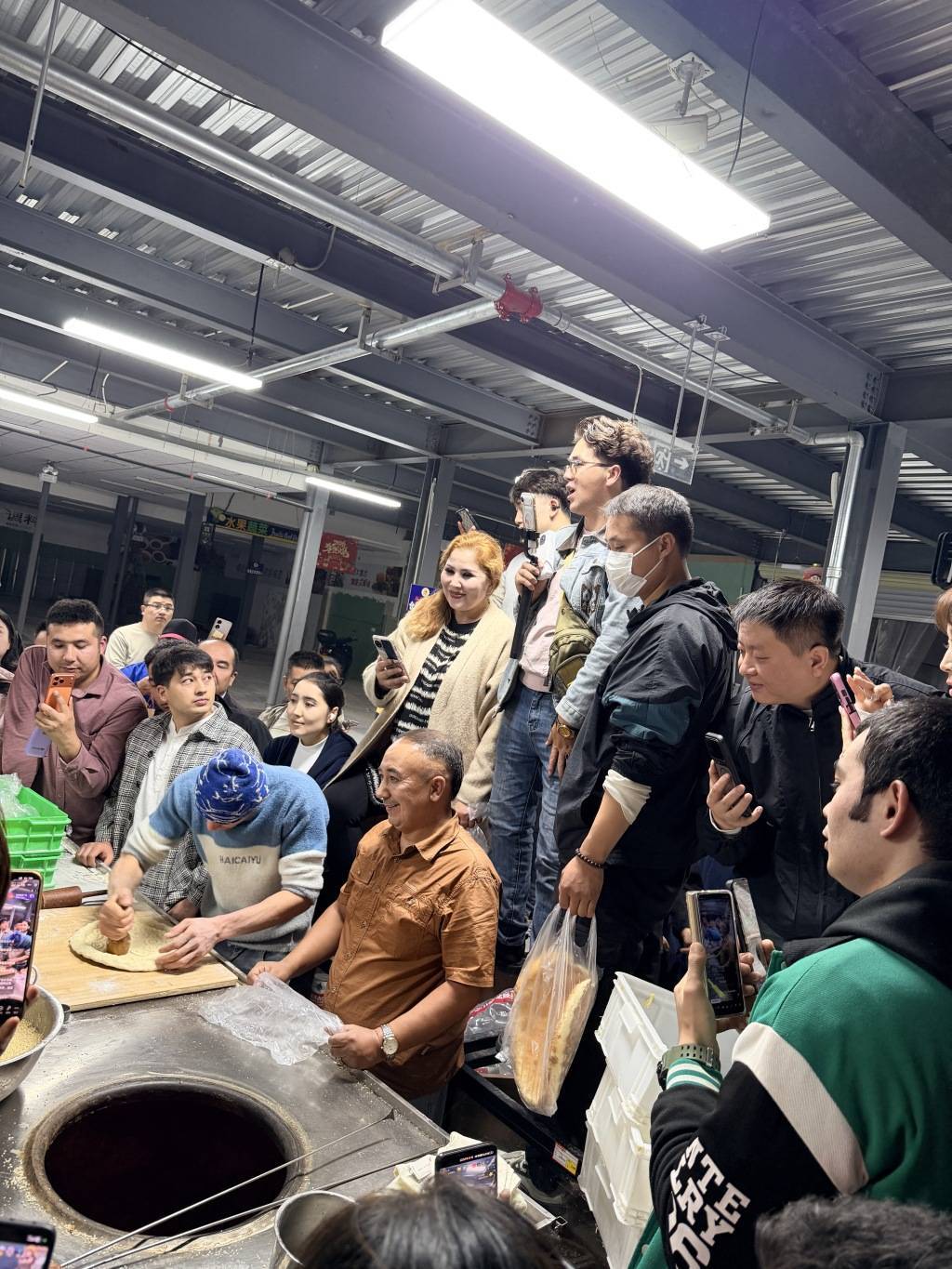
In front of the “Adasi” booth on October 19
In front of the stall: Customers who queued for 5 hours to buy noodle, live footage of three floors inside and three outside
On October 19th and 20th, multiple merchants near Neseldin’s stall introduced that his popularity only happened a week ago. “We used to queue up, but usually there were three to five people. Sometimes there were more than a dozen people, not as many as now.”
At around 5 p.m., there were still 2 hours before the stall opened, and more than 60 customers were already waiting in line near the stall. In the team, there were elderly people over 70 years old, mothers holding children, college students riding bicycles, and people pulling suitcases. Xiao Chen, a customer who was queuing up, said, “I didn’t expect that selling rice would be so popular.” Xiao Chen said that when he arrived at Nesirdin’s stall on Wannian Road at 11 a.m., the first pot of glutinous rice had just been served, and by that time there was no longer a queue. At 1 o’clock in the afternoon, he came to the stall location on Hansen East Road again and continued to wait in the evening queue.
The sky is getting darker and more people are queuing up. Near 7 p.m., Nesirdin and his tricycle appeared in everyone’s sight, and the scene fell into chaos. “People come from all over,” said a nearby merchant whose tables were squeezed.
The chaos didn’t last long. Some citizens voluntarily became volunteers to maintain order. Someone provided a pen, someone brought paper, and even reporters present at the interview were temporarily brought in to help write numbers.
At around 7:10 pm on the 19th, Ms. Xin, who had queued for 5 hours, bought the first noodle of the night. Ms. Xin felt that the trip was worthwhile, “It’s a little hot, it’s really big, it’s very thick, and it’s very fragrant.”
Another nearby resident said that she and her daughter had to wait in line for 4 hours to finally eat rice that could be bought at any time in the past. “It’s not easy for him, please support him.” Many customers had similar thoughts. Ms. Gao, who was waiting in line, said she was “touched by Neseldin’s sincerity and realism” and wanted to support her.
At the scene, some people came for the people, some came for the taste, and even more people came for the traffic.
“Master, Master” “Like” “Look at the king” “Here comes another sports car”… The live broadcast anchors near the booth stared at the screen for fear of missing something, while the anchors on the periphery raised their selfie sticks high. One anchor lamented that “his hands are tired.” They are not very interested in buying food, and most of them are more concerned about their “family members” in the live broadcast room.
“How many people are really here to buy food now? They are all here to shoot videos.” Brother Li, the owner of a nearby fruit shop, said that he used to buy Nesirdin’s glutinous rice cakes, and Nesirdin also bought his fruits, but recently he couldn’t buy glutinous rice cakes and he didn’t have time to queue up. After Nesirdin became popular, Brother Li also changed the name of his social platform, started a live broadcast of the noodle stall, and updated the queue situation in real time.
Ayisha and her family, who sell Xinjiang fried rice noodles, moved their stall near the rice stall. Ayixia said that they came here on the 18th and there are more people here. Compared with the original location, the sales here can be more than 100 yuan more.
On the 20th, an urban management officer near the stall said that the popularity of “Adasi” has had a great impact. “There are also shoe vendors running over, and they all follow the traffic.” They received complaints from citizens. There were so many people that they blocked all nearby courtyards and fronts, and cars in the garage couldn’t get in or out.
The urban management official said that they could not drive away all the people queuing up, and these people were not occupying the road, they were just queuing up.
On October 20, a traffic-generating banner advertisement was posted behind Nesreddine’s stall, and the banner was also marked with “Nasreddine Resiti Assistant Account.” When Nesirdin noticed it, he tore down the banner.
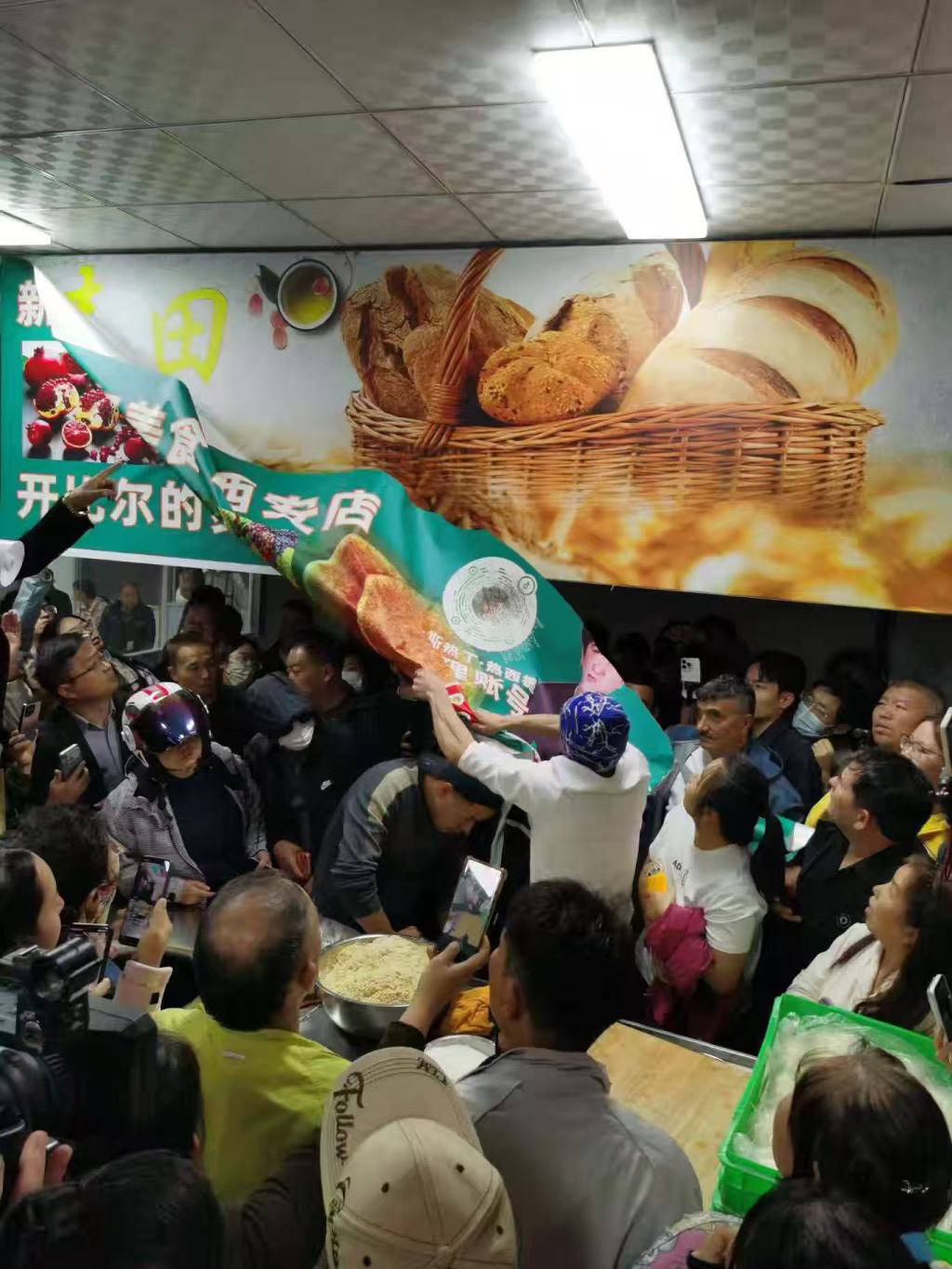
Nesirdin tears down the advertising banner. The picture is provided by a resident near the stall.
Outside the booth: The changed life, from “not wanting to open an account” to opening an account
At around 11 o’clock in the evening on the 19th, Nesirdin and his master Maimati Tursun Maimati finished their work for the day and drove their tricycle home. Because he is not fluent in Chinese and is introverted and not good at speaking, Nesrddin did not accept an interview directly. His master and fellow villagers helped relay some of his thoughts.
Maimeti Tursun relayed, “The apprentice doesn’t want to open a store or open an account. He just wants to earn money by playing games.” A fellow villager next to him said that Nesseldin felt that “it would be okay if the food is bigger. You can make less money, just so that customers can eat better.”
In Xi’an, the price of sesame noodles varies. In many stores, the price is around 5 yuan, and the weight ranges from 0.5 kilograms to 1 kilogram. Nesirdin’s noodles are priced at 4 yuan each and 3 pieces at 10 yuan. According to actual measurements by the media, one of his noodles weighs 2 kilograms.
Teacher Tang, who works as an education and training teacher, lives near the noodle stall. He said he hoped that more people would see the simplicity of Nesirdin. He also noticed that some fellow noodle sellers said that Nesirdin had messed up the prices. Many netizens posted that they felt sorry for Nesirdin and felt that the noodle he made was too cheap. They hoped that he would increase the price because they were afraid that he would not make money.
Neseldin’s cousin Sherkang told The Paper that in the past, Neseldin’s idea of doing business was “small profits but quick turnover.”
“The reason why he hits harder and harder is to live up to the onlookers, but it is not good for him, and if he keeps hitting, he will be very tired at the end of the day.” An online ride-hailing driver in Xi’an also came across the story of Nesreddin. He said that he had been to Xinjiang and there were some noodle dishes there for 3 yuan each, but the weight did not seem to be as big as Nesreddin’s. “For 10 yuan and 3 min, he may not have much profit.”
On the evening of the 19th, Nasirdin’s brother Abdulmijiti Rexiti came to Xi’an with pomegranates, grapes and other things his brother loved to eat from his hometown. Abdulmijiti said that the brothers lost their father when they were young, and “the younger brother has not been home for three years.” Before leaving, his mother told him, “Help my brother. He is tired and I am worried about him, so go and help him.”
Abdulmijiti said that the two brothers have a good relationship. The younger brother usually calls to care about the situation at home and reports that he is safe. He often says, “Work is good and I am not tired.” But when I came to Xi’an and saw my younger brother constantly yelling at me in the crowd, I felt very distressed and felt that “he is very tired.”
Maimeti Tursun arrived in Xi’an one day earlier, “He was working too hard to help his apprentice.” He said that Nesirdin studied under him from 2014 to 2016 and had a “down-to-earth personality and a relatively introverted character.”
Many fellow residents of Nesirdin also came to Xi’an from other places. Abu, who is also from Kashgar, said that he is also a caterer, and recently he helps Nesirdin mix noodles and do other chores. In Abu’s eyes, Nasirdin has a full day schedule: he gets up at 9:30, takes two hours to prepare the things needed for the stall, finishes around 12:00, starts making bread at noon, and is busy until about 4:00 pm; after having lunch, he seizes the time to prepare things for the evening meal, which lasts 4 to 5 hours. Basically, two bags of flour will be consumed at noon, and three bags of flour will be consumed in the evening. After a busy day, it was already past 2 o’clock in the morning.
When Nasir al-Din goes out to eat bread, Abu will start the live broadcast. He said that “people in his hometown in Kashgar can see it.” Master Maimeti Tursun also briefly hosted a live broadcast.
On the evening of October 23, Nesirdin’s mobile stall moved to a new address outdoors. With the help of a citizen in Xi’an, his elder brother Abdulmijiti started a long live broadcast in front of his younger brother’s stall. The platform interface showed that 215,000 people had watched it.
On October 24, Neseldin posted his first video on his social account, saying that he would share his daily life with everyone in the future. As of press time, his account shows that he has over 30,000 fans. Some netizens said in the comment area, “I hope you can catch this wave of traffic generously and get better and better.” Some netizens also reminded, “I hope everyone will just consume my brother’s cakes instead of consuming him as a person.”

Screenshot of Neseldin’s account
Regarding why he opened the account, a fellow villager who followed Nesirdin said that a relative persuaded him to open it. However, Nesirdin and his relatives have yet to respond.
At the same time, as Nesreddin’s attention has increased, some anchors have broadcast live in more places, starting from Nesreddine’s stall to where he eats and near his home. Some netizens shouted in the live broadcast room, “Don’t disturb others,” while others accused them of “following the broadcast without knowing the bottom line.”
Several accounts impersonating Neseldin and his family have appeared online. On the 24th, The Paper found that some counterfeit accounts had turned gray, but there were still many counterfeit accounts that had not been processed.
Expert: Algorithms act as invisible curators, but traffic explosions are somewhat accidental
The Paper combed through the traffic hot spots in recent years and found that stories like “Adasi” are not uncommon, and “Xiaohua Haircut” and “Chicken Pai Brother” have also attracted attention.
Xu Peixi, a professor at the School of Television at Communication University of China and director of the Cyberspace Global Governance Research Center, said that the reason why people like “Adasi”, “Xiaohua Barber” and “Chicken Pai Brother” have repeatedly appeared in the circle and are easy to impress people is that people like stories with human touch, and they like these real and down-to-earth stories.
Cui Di, an associate professor at the School of Journalism at Fudan University, believes that in the modern public opinion environment, public attention is relatively fragmented, and the short video platform’s huge user base and algorithm are one of the few media mechanisms that can still gather huge attention.
Cui Di believes that the peak of traffic is definitely not determined by one or two factors. Among them are the cultural authorization of ordinary people, and also involves “algorithmic curation” – algorithms act as invisible curators, deciding which people and content are easily visible. In recent years, everyone is more willing to grant this kind of authorization to those who shine in these ordinary positions; secondly, from the perspective of the platform, once the algorithm identifies this traffic trend, it will be further amplified, because creating traffic hot spots one after another is the business model of platform operation; thirdly, the platform economy has been developing for so many years, MCN organizations, small Internet celebrities and other people who rely on the traffic economy to make a living, once such hot spots appear, they will instinctively rush to them.
Cui Di said that our country has a vast territory and there are many people with personality potential. A certain video or piece of content of theirs happened to be coupled with some random factors on the platform, resulting in explosions. There is a certain degree of chance in this. “Is it true that people with colorful personalities will be popular? Not necessarily; even if they have the same personality, they may not be popular.”
With the attention being paid to it, some netizens also talked about the “privacy issues” of traffic figures. Cui Di said that in the past, celebrities benefited from public attention, so they were bound to let their private boundaries drift a little. Some celebrities have to wear masks and glasses when going out. If they don’t want to be seen, they can only cover up their schedule. In the era of traffic, airport pick-ups and drop-offs for some celebrities have turned into shows, turning the original private itinerary space into an adjustable space. In a sense, “Adasi” are also celebrities, sometimes called “micro-celebrities” in academic terms. They gain attention like celebrities, but without the corresponding social rights that celebrities do. He may be more vulnerable than us ordinary people at the level of protecting himself. “Many people don’t want to get involved in traffic, but their mentality is easy to change when faced with the temptation of income. There is no need for simple moral judgment. This is the real dilemma of ordinary people under the opportunity of traffic.”
Regarding the counterfeit accounts of “Adasi” and his family on the platform, Xu Peixi suggested that “Adasi” and his family take various measures to protect their own interests. They can report to the 12377 Illegal and Bad Information Reporting Center. The platform also has the responsibility to cooperate in handling these accounts.
Related Reading
- The first AI movie to win the “Dragon Label” has a box office of over 500,000 yuan. Can it retain the audience for 100 minutes?2026-10-25
- Typhoon warning continues! “Qiangpi” turned around and weakened to tropical storm level. There are still strong winds along the coast of Jiangsu and Zhejiang.2026-10-25
- Tibet Baqing earthquake rescue progress: Power supply has been fully restored, 36 people were injured in the hospital, and the remaining injured have been discharged from the hospital after treatment2026-10-25
- U.S. intelligence warns Iranian plots to kill Americans are in ‘advanced stages’2026-10-25
- Autumn is deep and the leaves are red! The most beautiful autumn colors in these places are online2026-10-24